

More news on this day
European air travel has been hit by another wave of disruption, with publicly available data indicating 1,445 flight delays and at least 20 cancellations in a single day, and major Italian gateways in Rome and Milan bearing the brunt of the turmoil.
Get the latest news straight to your inbox!
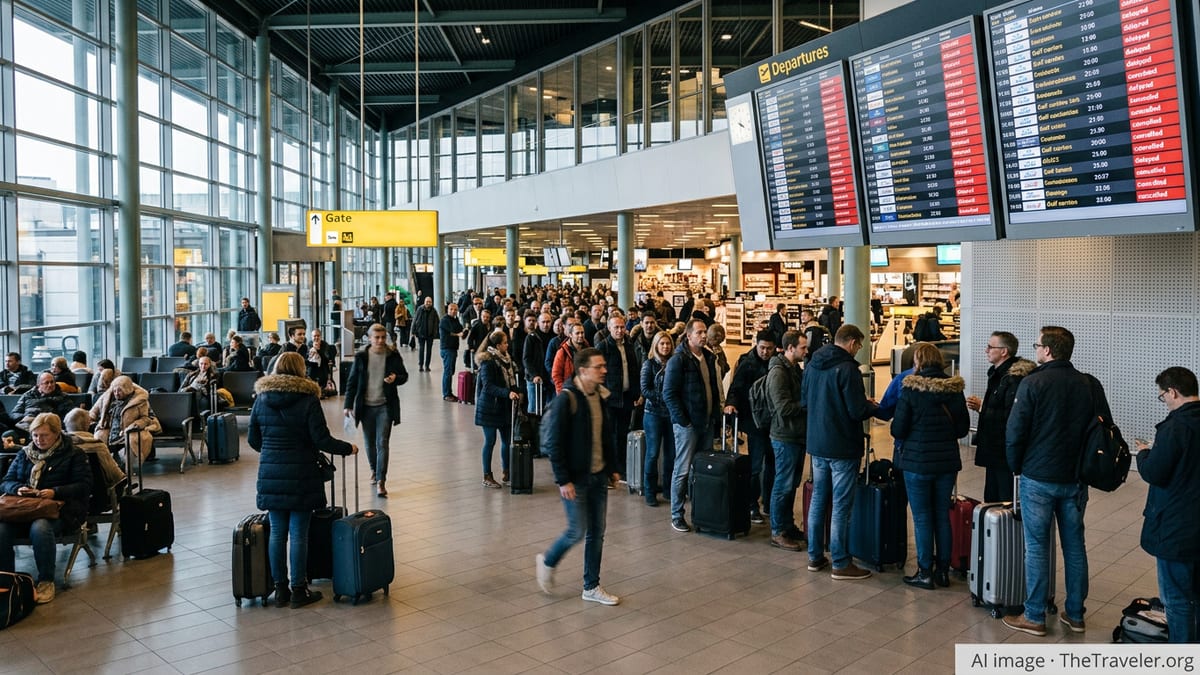
Rome and Milan at the Center of Fresh Turbulence
Operational data compiled from flight‑tracking and aviation‑industry reports show that the latest spike in delays has been felt most acutely in Italy, where Rome Fiumicino and Milan’s two city airports together account for a significant share of the 1,445 affected flights across Europe. One recent snapshot published by industry media highlights 223 delayed departures and arrivals at Rome’s Leonardo da Vinci Fiumicino alone, alongside 67 delays at Milan Malpensa and 36 at Milan Linate on the same day.
While no single cause has been identified, the disruption in Italy coincides with a broader pattern of strain in European aviation this spring, where even moderate weather systems or local staffing challenges have quickly cascaded into network‑wide knock‑on effects. Italy’s main hubs are heavily integrated into pan‑European and intercontinental schedules, which means delays at key northern airports can quickly ripple into congestion on routes connecting through Rome and Milan.
Recent punctuality benchmarks for 2025 already show Rome and Milan operating with relatively slim margins. Airport performance comparisons released by European industry bodies indicate that both cities have seen average delay minutes per flight creep higher year on year, leaving less resilience when traffic peaks or storms move across the continent. In that context, a day with more than 1,400 delayed flights across Europe has proved enough to push Italian hubs into visible congestion.
Knock‑On Disruption Across Europe’s Major Hubs
The 1,445 delays recorded in the latest event did not stop at Italy’s borders. Monitoring of Europe‑wide traffic indicates that airports in England, France, Ireland, Portugal, the Netherlands, Denmark and Switzerland also reported elevated levels of disruption on the same day, with Amsterdam, London Heathrow, London Gatwick, Dublin, Lisbon, Porto, Zurich, Copenhagen, Lyon and Marseille all featuring prominently in the statistics.
Travel‑industry coverage of the disruption points to a familiar pattern. When a busy hub such as Amsterdam Schiphol posts close to 200 delays in a single session, those late departures reverberate through the network, affecting aircraft and crew rotations scheduled to operate onward services to southern Europe. Aircraft that should be operating afternoon or evening flights out of Rome or Milan can arrive hours late from northern bases, compressing ground‑handling windows and pushing back subsequent departure slots.
Industry analyses published in recent months underline that European air traffic control capacity and staffing remain under pressure in several key sectors, increasing the likelihood that weather fronts or localized operational issues will translate into restrictions on airspace or airport movements. On the day of the 1,445 delays, reports from passenger‑rights and data‑analytics platforms indicate that this combination of factors again converged across multiple countries, overwhelming the usual buffers built into airline schedules.
Weather, Staffing and Structural Strain Behind the Numbers
Although individual airlines and airports may highlight different local triggers, publicly available information from passenger‑rights organizations, aviation data firms and regional media points to three recurring drivers behind the latest wave of disruptions: unstable spring weather, airspace bottlenecks and staffing constraints.
Weather has been a consistent theme throughout late March and early April 2026, with storms, heavy rain and strong winds tracking across northern and western Europe on several days. Even when conditions in central and southern Europe have appeared relatively benign, restrictions further north have imposed holding patterns, reroutings and temporary reductions in arrivals and departures that ultimately reduce the number of flights the system can handle per hour.
At the same time, reports drawing on European air traffic management statistics note that en‑route and airport‑related delays have more than doubled over the past decade. Air traffic control centers and ground operations teams in busy hubs are still rebuilding resilience after the pandemic period, and several industry briefings in 2025 and 2026 have highlighted the challenge of recruiting and training sufficient qualified staff. This structural strain means that when storms or technical issues do arise, schedules deteriorate more quickly than they might have a decade ago.
In Italy, local industrial actions and staffing pressures have periodically intersected with these broader European patterns. Travel‑advisory bulletins for the current week flag the potential for further disruption linked to industrial action in the Italian air traffic control and airport sectors, prompting some airlines to introduce flexible rebooking options for customers traveling via Rome and Milan.
What the Chaos Means for Travelers
For passengers holding tickets through Rome, Milan or other affected European hubs, the immediate impact of a day with 1,445 delays can range from missed connections to improvised overnight stays. Travel‑rights organizations emphasize that even relatively short delays early in the day can turn into missed long‑haul departures later, particularly for itineraries that rely on tight connections or involve separate tickets.
Consumer‑advice platforms recommend that travelers transiting heavily affected airports take a proactive approach. That typically includes monitoring flight status regularly, downloading airline apps, and enabling notifications that signal gate changes or revised departure times. Where possible, picking routing options that allow more generous connection windows through congested hubs such as Rome Fiumicino, Milan Malpensa, Amsterdam, London Heathrow or Paris Charles de Gaulle can provide an extra buffer when operations are unstable.
Under European air passenger legislation, some customers on delayed or canceled flights may be entitled to care such as meals and accommodation, and in specific circumstances to financial compensation. Passenger‑rights specialists caution that eligibility depends on factors including the length of the delay, flight distance and whether the root cause was within the airline’s control. Disruptions attributed to severe weather or air traffic control restrictions are often treated differently from those linked to crew or aircraft resourcing.
Outlook for the Spring Travel Season
The latest figures add to a growing list of high‑impact disruption days across Europe in early 2026, reinforcing concerns about the resilience of the continent’s aviation network ahead of the busy late spring and summer travel period. March and early April have already seen multiple days with more than 1,000 delays, and in some cases significantly higher, according to compilations from aviation analytics providers and airport performance reports.
Rome and Milan, both central nodes for Italy’s domestic and international connectivity, are likely to remain under close scrutiny from airlines, tourism bodies and passengers as the season progresses. Historical punctuality data for 2025 shows that both cities can perform strongly in stable conditions but are vulnerable to spikes in average delay minutes when wider European traffic becomes congested. The concentration of connecting traffic through their terminals amplifies both the economic and reputational stakes when schedules falter.
For now, industry observers expect that episodes similar to the 1,445‑delay day will continue to occur whenever adverse weather, airspace constraints and staffing gaps coincide. Travelers planning trips through Rome, Milan or other major hubs over the coming weeks are being advised in public guidance to build flexibility into itineraries, allow additional time for connections and remain prepared for short‑notice changes as Europe’s aviation system navigates another volatile spring.