

The Keweenaw Peninsula juts like a crooked finger into the cold expanse of Lake Superior, a place where dense forest meets volcanic rock and copper mining history clings to every hillside. From the harbor town at its northern tip to tiny coastal villages scattered along M-26 and US 41, this stretch of Upper Peninsula shoreline rewards travelers with big-lake drama, dark skies, waterfalls and miles of empty road. Whether you are here for a long weekend or a full week, these 10 standout experiences will help you make the most of your time in the Keweenaw Peninsula, from Copper Harbor to its rugged, scenic coastlines.
Take in the View from Brockway Mountain Drive
No visit to the Keweenaw Peninsula feels complete without following the narrow ribbon of pavement that climbs Brockway Mountain Drive above Copper Harbor. The road rises to roughly 720 feet above Lake Superior, high enough that you can look north across miles of open water and south over a vast canopy of hardwood forest. On clear days, visibility often stretches all the way to the Huron Mountains and out toward Isle Royale, giving a remarkable sense of just how remote this section of Michigan truly is.
The drive itself is short but slow, with tight curves and frequent pullouts that invite you to step out and let the wind and silence sink in. In late September and early October, hillsides erupt in waves of red, orange and gold, and Brockway Mountain is regularly cited by regional tourism organizations and magazines as one of the premier fall color viewpoints in the Upper Peninsula. Even in summer, when leaves are deep green and wildflowers line the ditches, the contrast between forest, rocky outcrops and blue water feels dramatic.
If you have time, linger at the main summit area instead of snapping a quick photo and leaving. Walk along the rocky spine to find quieter vantage points, study the way M 26 snakes along the shoreline far below, and watch for hawks and other raptors riding the thermals. Sunset and the hour before it can be spectacular, but daylight views reveal more of the terrain. Plan your visit around weather, since low clouds or heavy fog can completely erase the panorama.
Because the road is steep and narrow in places, drive cautiously and be prepared for slow moving vehicles and cyclists, especially in peak foliage season. Basic amenities are limited at the top, so bring water, an extra layer for the wind off the lake, and enough time to simply stand and take in the scene without rushing back down to Copper Harbor.
Explore Copper Harbor’s Trails, Waterfalls and Quiet Streets
At the northern tip of the Keweenaw, Copper Harbor serves as both a base camp and a destination in its own right. The small harbor town is framed by forested ridges and basalt shoreline, with a compact main street of lodges, motels, restaurants and a handful of shops. Despite its modest size, Copper Harbor feels surprisingly busy in summer and early fall thanks to a growing reputation for hiking, mountain biking and paddling.
Just outside town, short trails lead to local waterfalls and scenic overlooks. Manganese Falls, tucked in a deep gorge near Lake Fanny Hooe, is one of the easiest to reach and is often highlighted in regional waterfall guides. A short walk delivers you to a viewpoint where water plunges roughly 45 feet into a narrow chasm lined with moss and ferns, especially impressive in spring or after heavy rains. Nearby paths loop along Lake Fanny Hooe and into surrounding forest, offering quick escapes from the harbor’s modest bustle.
Within Copper Harbor itself, you can easily spend an afternoon wandering the waterfront, watching fishing boats and tour vessels come and go, and pausing at small public access points where lava rock meets cold, clear lake water. When Lake Superior is calm, reflections of clouds and pine trees turn the harbor surface into a mirror. When winds pick up, waves crash against the breakwall and outer points, reminding you that this inland sea is anything but gentle in rough weather.
The town also serves as the gateway to Isle Royale National Park ferry service during the main season, which further underscores how far north you have traveled. Even if you are not catching a boat, the schedule and chatter at the dock lend a sense of adventure. After a day on the trails or shoreline, Copper Harbor’s cafes, pubs and seasonal eateries provide hot meals, local beer and a chance to trade stories with other travelers who have come to the end of the road.
Drive the Lake Superior Coastline on M 26 and US 41
One of the purest pleasures in the Keweenaw Peninsula is simply driving its shoreline roads. Between Copper Harbor and Eagle River, M 26 hugs the north coast, weaving around rocky points, pocket beaches and tiny communities. Scenic pullouts and small roadside parks appear frequently, with places like Esrey Park offering direct access to wave washed conglomerate rock and sweeping views of Lake Superior. Even on busy fall weekends, it is easy to find a quiet spot where the only sounds are wind, water and gulls.
Travel writers and regional tourism boards alike point to this stretch as one of Michigan’s great lake drives, especially during peak color. The combination of dark volcanic rock, silver blue water and maple and birch forests creates a vivid, textured landscape. At times the road rises above the shore, revealing long perspectives down the coastline. At others it dips nearly to water level, where spray drifts across the pavement on stormy days. Pull into roadside turnouts rather than stopping on the shoulder so you can safely admire the scenery and take photos.
South of Copper Harbor, US 41 provides a different but equally memorable experience. An approximately 18 mile segment between Central and Copper Harbor is designated as a Scenic Heritage Route, and is widely known for its tunnel like canopy of trees. In summer and early fall, branches from both sides arch overhead, casting a mottled pattern of light and shadow across the narrow pavement. In late September and early October, that canopy glows in shades of amber and scarlet, creating a natural corridor that feels almost enclosed.
Driving these roads is as much about slowing down as it is about covering distance. Plan extra time for unplanned stops at small coves, wayside parks and inland lakes. Weather on Lake Superior can change quickly, with fog or sudden squalls rolling in, so treat travel times as estimates rather than fixed schedules. With patience and flexibility, the journey itself becomes one of the signature experiences of the peninsula.
Step Back in Time at Fort Wilkins and Copper Harbor Lighthouse
On the east side of Copper Harbor, Fort Wilkins Historic State Park preserves a mid nineteenth century frontier army post built in the 1840s to keep order in the booming copper region. Today, visitors find one of Michigan’s best preserved examples of an isolated Great Lakes military outpost, with white painted buildings arranged around a parade ground near the lakeshore. Exhibits and interpretive signs explain the daily routine of soldiers stationed here, far from major cities and supply centers.
Walking through the fort’s barracks, officer’s quarters and guardhouse offers a tangible sense of how challenging life must have been during long Upper Peninsula winters. Many rooms are furnished with period appropriate bunks, stoves and equipment, and in peak season there are often staff or interpreters available to answer questions about the site’s history. The calm setting today, with waves breaking gently on the rocky shore, contrasts sharply with the fort’s original role as a symbol of federal authority in a fast growing mining frontier.
The park also includes the historic Copper Harbor Lighthouse complex across the water on a point that guards the harbor entrance. The light station, which dates back to the mid nineteenth century, includes a keeper’s dwelling and later lighthouse structures that illustrate the evolution of navigation aids on Lake Superior. Access is typically by guided boat tours in season, giving visitors a chance to approach the peninsula from the water and appreciate why reliable lights were so vital to shipping on this rugged coast.
Even if you opt not to cross to the lighthouse, the grounds and shoreline at Fort Wilkins provide rich rewards. Lakeside trails offer views across the harbor and out toward Manitou Island and other light stations that continue to warn mariners today. Picnic areas, a modern campground and easy access to both forest and water make the park a natural base for families who want history, scenery and simple outdoor time in a single stop.
Descend Underground at the Delaware Copper Mine
Farther south along US 41, the Delaware Copper Mine invites visitors to step below the surface into one of the Keweenaw’s older underground mine workings. Located roughly a dozen miles south of Copper Harbor, the mine began operations in the 1840s and eventually extended multiple shafts more than a thousand feet deep. Today, a portion of those historic tunnels is open for self guided or guided tours in the main visitor season, typically from early summer into fall.
Inside, you follow lit passages carved through solid rock, seeing remnants of drill marks, support structures and rusting equipment left from the mine’s productive years. Interpretive displays explain how miners chased native copper deposits through narrow stopes, how ore was hoisted to the surface, and what daily life was like for workers in an isolated northern camp. Temperatures underground remain cool even on hot days, so a light jacket and sturdy shoes are recommended for comfort and safety.
Above ground, remnants of hoist houses and other surface buildings hint at the once busy industrial landscape that stretched across much of the Keweenaw Peninsula. The Delaware site is part of the larger network of Keweenaw Heritage Sites coordinated through Keweenaw National Historical Park, which collectively tell the story of more than a century of copper mining on the peninsula. Pairing a mine visit with stops in Calumet or other former company towns helps connect the dots between geology, industry and the communities that grew up around them.
For many travelers, a trip below ground becomes a highlight of their time in the Keweenaw because it reveals the human effort behind the region’s ruins and place names. Walking through black rock corridors lit by modern fixtures, it is easy to imagine faint flame lamps and the sound of drills that once echoed here. The experience adds a layer of depth to every later glimpse of abandoned shafts, rock piles and stamp mill foundations along the coast.
Visit Eagle Harbor, Eagle River and the Keweenaw’s Lighthouses
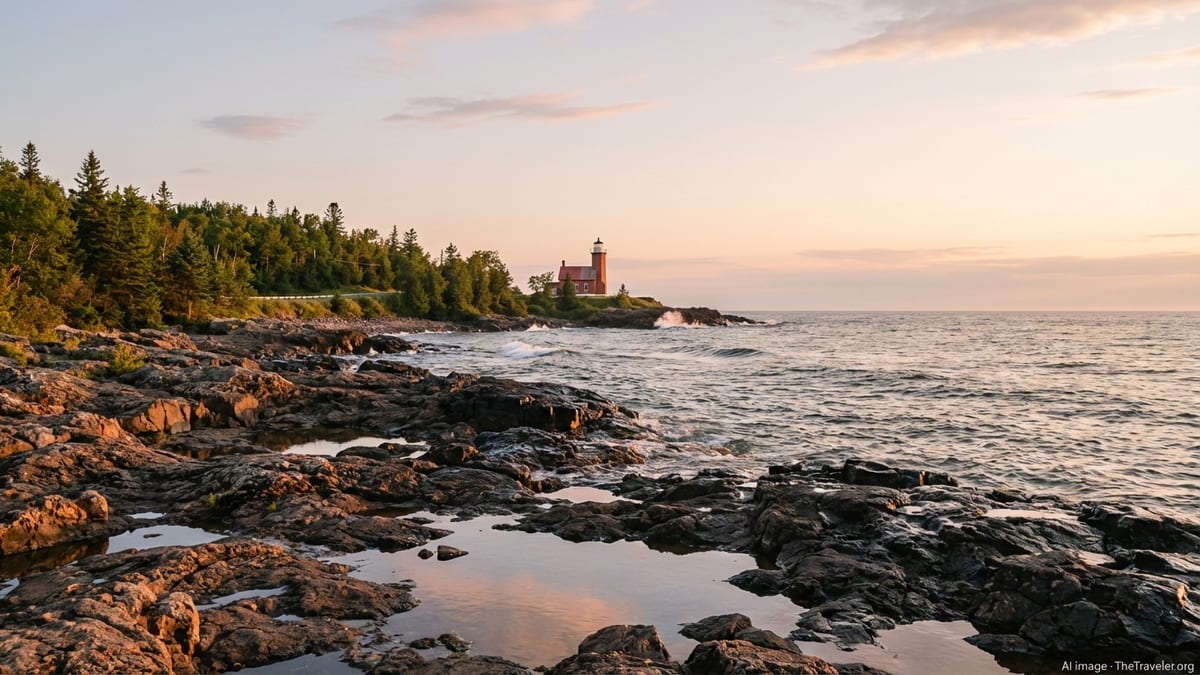
West of the peninsula’s spine, the small harbor towns of Eagle Harbor and Eagle River offer a quieter counterpoint to Copper Harbor. Eagle Harbor curls around a protected bay guarded by rocky points, with cottages, a modest marina and one of the Keweenaw’s most picturesque lighthouses. The red brick Eagle Harbor Light, an operational aid to navigation built in the nineteenth century, rises above a rugged shoreline of wave smoothed basalt and conglomerate. It is widely recognized as a historic site and is part of a complex of museums maintained by the local historical society.
On the same grounds, visitors can explore a maritime museum, a Keweenaw history museum and exhibits dedicated to commercial fishing and local industries. Artifacts range from shipwreck relics and navigation equipment to mineral specimens and mining tools, offering insight into how closely life here has always been tied to both the lake and the copper rich bedrock. Short walks around the light station grounds reveal multiple vantage points where Lake Superior stretches to the horizon, sometimes calm and glassy, other times pounding the rocks with white spray.
A short drive away, Eagle River sits near the mouth of its namesake stream, with a decommissioned historic light station and a small cluster of buildings that hint at its past as a bustling copper era port. The shoreline here is more gently sloping, with a mix of cobble and sand beaches that make it a favorite for sunset watchers. Inland, roads climb toward the Cliff Range, where former mining sites and forest trails invite further exploration.
Beyond these towns, the Keweenaw’s broader lighthouse landscape can be glimpsed from shore and water. Offshore stations at Manitou Island and Gull Rock, both historically significant light facilities guarding the approach to Copper Harbor, are visible from certain points on clear days, though access is more limited and often arranged through specialized tours. Together with the more accessible lights at Eagle Harbor and Copper Harbor, they form a chain of beacons that have guided Great Lakes shipping for well over a century.
Chase Waterfalls and Forest Trails Across the Peninsula
Thanks to its hilly topography and frequent rainfall, the Keweenaw Peninsula is laced with streams that form an array of waterfalls. Many visitors focus their waterfall chasing around Copper Harbor, Eagle River and nearby inland routes, where short hikes lead to scenic cascades in shaded ravines. Manganese Falls near Copper Harbor, Silver River Falls close to the Lake Superior shoreline and Haven Falls near Lac La Belle are commonly recommended in local visitor guides as accessible stops that pair well with scenic drives.
Each waterfall has its own character. Manganese Falls drops through a deep, narrow gorge lined with moss and ferns, with viewpoints positioned near the rim. Silver River Falls, reached via a short trail from a roadside preserve, spills over layered basalt that creates attractive ledges. Haven Falls, tucked in a small community near the south side of the peninsula, drops in a curtainlike sheet next to a roadside park with benches and picnic tables. Flow levels change throughout the year, generally highest in spring and after sustained rain.
Beyond named waterfalls, the broader trail network around Copper Harbor, Eagle Harbor and Calumet offers countless chances to walk through mixed forests of maple, birch and spruce. Some routes follow old mining roads, while others cross bedrock ridges that reveal the peninsula’s volcanic origins. Trails can be muddy after storms and buggy in early summer, but the reward is a sense of immersion in one of the Upper Peninsula’s least developed corners. It is common to hike for an hour or more without seeing another party, especially on weekdays outside peak color season.
Given the region’s variable weather and occasionally rugged footing, visitors should prepare with appropriate footwear, layers, and basic navigation tools, whether printed maps or downloaded route information. Cell coverage can be patchy in ravines and remote stretches. By approaching the landscape with a bit of respect and planning, waterfall and forest walks become some of the most quietly memorable experiences of a Keweenaw trip.
Experience Lake Superior’s Beaches, Parks and Dark Skies
Even in a region defined by mining history and forested hills, Lake Superior remains the Keweenaw’s central character. Public access points along M 26, US 41, and within state parks invite travelers to wander rocky points, skip stones on cobble beaches and sit on driftwood logs watching the horizon. McLain State Park, located between Calumet and Hancock closer to the base of the peninsula, is a popular stop thanks to its long sweep of sand, gentle shallows in calm weather and broad views westward toward the setting sun.
Farther north, small roadside parks such as those near Great Sand Bay, Eagle River and Eagle Harbor offer more intimate encounters with the lake. Wave action constantly rearranges stones into ridges and bars, and beachcombers often spend hours searching for interesting rocks, bits of copper bearing conglomerate and the occasional agate. Water temperatures remain cold even in midsummer, so most visitors limit their contact to wading, but on rare hot days you will see brave swimmers taking short plunges.
As daylight fades, the peninsula’s low population density and relative absence of major cities make it an excellent place for stargazing. Portions of the Keweenaw are promoted as dark sky viewing areas, and on clear nights the Milky Way can be obvious to the naked eye. The combination of early sunsets in fall, crisp air and open horizons over Lake Superior creates ideal conditions for night photography and quiet sky watching. On some nights, particularly around periods of heightened solar activity, visitors are treated to aurora displays that ripple and glow above the water.
Even without northern lights, simply listening to waves in the dark while stars appear overhead is one of the peninsula’s essential experiences. Pack a headlamp with a red light setting, extra layers and a thermos of something warm, then find a safe, open area away from high cliffs or steep drop offs. Give your eyes time to adjust, turn off your devices and let the slow rhythm of lake and sky work its way into your memory of the Keweenaw.
The Takeaway
The Keweenaw Peninsula rewards travelers who appreciate wild edges and subtle details rather than crowded attractions. From the sweeping views atop Brockway Mountain to the intimate hush of underground mine tunnels, from the tree tunnel of US 41 to the spray drenched rocks beneath Eagle Harbor Light, this narrow finger of land offers a concentrated taste of Lake Superior country. Distances are short, but the landscape feels expansive, shaped by ancient lava flows, dense forests and relentless waves.
Planning a trip here is less about checking boxes and more about leaving space for weather, light and mood. A foggy morning might send you into museums and mines, while a clear evening draws you to a west facing beach for sunset or a dark turnout for stargazing. Shoulder seasons, particularly late September into early October, provide a powerful combination of fall color, cool temperatures and fewer crowds, though summer offers warmer lake breezes and long daylight for exploration.
Whatever time of year you choose, travel with flexibility, warm layers and a willingness to slow down on steep, winding roads. Respect the power of Lake Superior, tread lightly on fragile shorelines and historic sites, and pause often to listen to the mix of wind in the trees and waves on rock. Do that, and the Keweenaw Peninsula from Copper Harbor to its scenic coastlines is likely to leave you with the feeling that you have reached not just the end of the road, but a quieter corner of the world.
FAQ
Q1. When is the best time of year to visit the Keweenaw Peninsula?
The most popular times are midsummer for warm weather and late September to early October for fall colors, though each season offers distinct experiences.
Q2. How many days should I plan for a trip from Copper Harbor down the coast?
A long weekend of three to four days works for key highlights, while five to seven days allows time for hikes, mine tours and slower coastal drives.
Q3. Is Brockway Mountain Drive suitable for all vehicles?
The road is paved but steep and narrow in places. Most standard vehicles can manage it in good weather if driven slowly and cautiously.
Q4. Are the waterfalls near Copper Harbor and along the coast easy to access?
Many popular falls are reached by short walks on uneven trails or from roadside pullouts. Sturdy footwear is recommended, especially after rain.
Q5. Can I swim in Lake Superior during summer?
Some visitors do swim on warm days, but the lake remains very cold. Many people prefer brief wades, beach walks and paddling close to shore.
Q6. Do I need special gear to tour the Delaware Copper Mine?
You mainly need sturdy shoes and a light jacket, as temperatures underground stay cool. Helmets or other safety gear are typically provided on site.
Q7. Is cell phone coverage reliable across the Keweenaw Peninsula?
Coverage is generally good near towns and main highways but can be spotty on remote roads, trails and shoreline areas, so plan accordingly.
Q8. Are the lighthouses open year round?
Most lighthouse tours and associated museums operate seasonally, typically from late spring through fall. Hours vary, so check current schedules in advance.
Q9. Where can I see the best sunsets along the Keweenaw coast?
West facing spots such as Eagle River, Eagle Harbor, Great Sand Bay and McLain State Park are all known for wide open views of Lake Superior sunsets.
Q10. Is the Keweenaw Peninsula family friendly for young children?
Yes. Short hikes, beach play, waterfall stops, historic forts and mine tours provide a range of low distance, high interest activities suitable for families.