

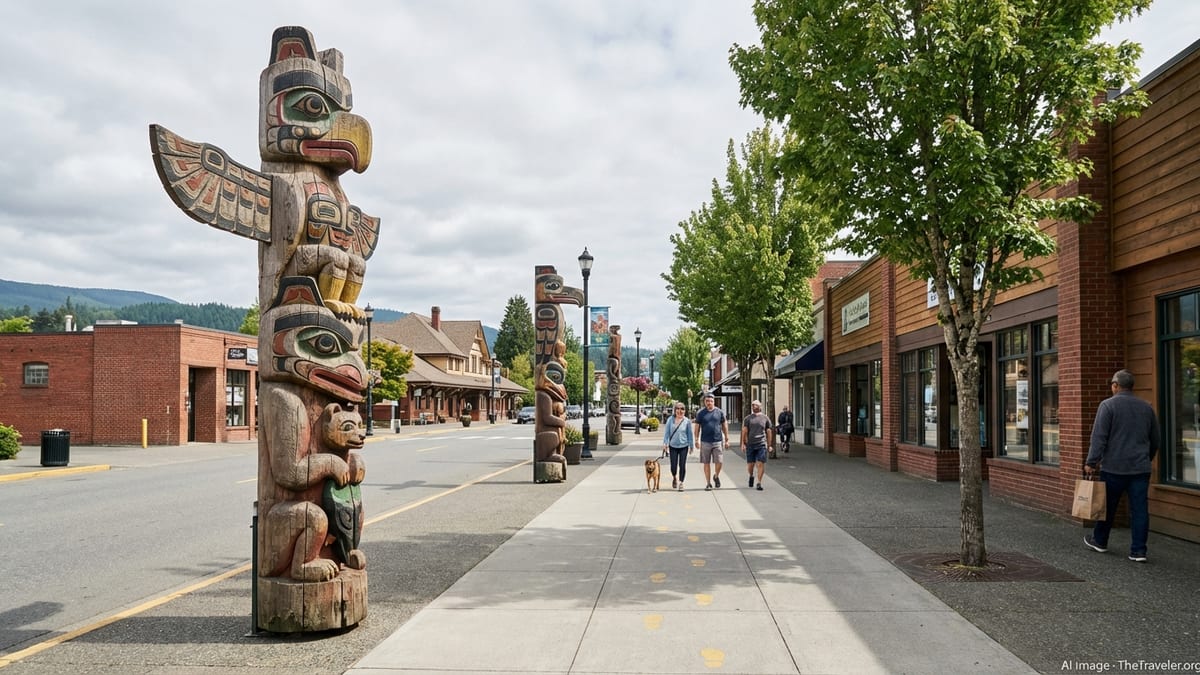
Duncan, on Vancouver Island in British Columbia, proudly calls itself the City of Totems, and a self guided walk among its carved poles is one of the most rewarding cultural experiences in the Cowichan Valley. More than 40 poles stand throughout the compact downtown, many carved by renowned Coast Salish and other Indigenous artists, each with its own story, family connection and purpose.
With fresh interpretive signage, yellow footprints on the sidewalks, and a new digital tour, it has never been easier to explore these works at your own pace. This guide highlights 10 essential stops to help you shape a meaningful, respectful totem walking route through Duncan.
How to Explore Duncan’s Totem Walk on Your Own
Duncan’s self guided Totem Tour Walk is designed to be easy to follow, even on a first visit. Yellow footprints painted on the sidewalks mark a looping path through downtown, and most poles are clustered within a few compact blocks. The city and Cowichan Tribes also support a new digital totem tour accessed via QR codes on decals installed at totem stands, which link to videos, photos and artist stories on your phone. Together, the physical trail and digital content let you build a route that suits your interests and timing, whether you have an hour or a full day.
The 10 stops below are organized in a logical walking sequence starting near the Cowichan Valley Museum and train station, circling through the core, then returning via Station Street and City Hall. They mix some of the most photographed poles with quieter carvings that reward closer attention. Take your time at each one, read the interpretive signs, and remember that you are moving through the traditional and unceded territory of the Quw’utsun people. Whenever possible, acknowledge carvers by name if you share your photos or stories afterward.
Start of the Route: Cowichan Valley Museum & Station Street
The historic train station, now home to the Cowichan Valley Museum, is the natural gateway to Duncan’s totem walk. Several important poles stand in and around Charles Hoey Park and along Station Street, and the museum staff can often provide current maps or printed brochures. This first cluster allows you to get oriented, understand the visual language of the poles and ease into the rhythm of the walk before heading deeper into downtown.
1. Cedar Man Walking out of the Log
One of Duncan’s defining carvings, Cedar Man Walking out of the Log is widely described as the world’s widest totem pole, with a diameter of nearly six feet. Carved from a massive red cedar that was already several centuries old when felled and donated to the city, the pole is an immediate demonstration of both the scale and the patience involved in traditional carving. The back of the log is partially hollowed, a reminder that planks from similar trees once became the walls of coastal longhouses.
The pole’s design has roots in earlier Kwakwaka'wakw carving that honored master carver Mungo Martin, and the figure holds a talking stick bearing key family crests: Kulus or baby Thunderbird at the top, a Killer Whale in the middle, and a human figure at the base. On the chest, a stylized copper shield symbolizes wealth and status. Pausing here at the start of your walk offers a kind of visual glossary of elements you will see echoed, reinterpreted and localized across other poles throughout the city.
2. Raven’s Gift
Just a short stroll from the train station, Raven’s Gift stands as a story of exchange, generosity and the responsibilities that come with artistic ability. The pole centers on a human carver figure holding an adze, the traditional carving tool, flanked by animal helpers. In the narrative shared on the city’s interpretive signage, a chief commissions a pole and the Raven helps deliver it to another community, while Beaver provides the log itself. The story blends mythic beings with the very real labor of shaping a cedar trunk into art.
This stop is a good place to focus on the surface of the carving. Look for adze marks, curves and subtle asymmetries in the wood that reveal the hand of the carver and assistants. Depending on the light and time of day, the play of shadow in the deeply cut lines becomes especially striking in photographs. Reading the sign and reflecting on the idea of a gift pole also adds depth to the rest of your walk, where many carvings commemorate events, people or relationships between communities.
Honoring Quw’utsun Knowledge and Elders
Several of Duncan’s most powerful poles explicitly honor Quw’utsun knowledge keepers and elders, as well as the cultural practices that have sustained Coast Salish communities for generations. These carvings are not simply decorative; they represent teachings, protocols and responsibilities. Spending time at these stops invites you to move beyond a casual glance and consider how stories, skills and laws are carried forward through the figures on each pole.
3. Cedar Woman and Man
Often visited together as a pair, Cedar Woman and Cedar Man depict human figures wrapped in woven Salish blankets, standing on bases that carry important cultural symbols. The pairing is frequently described as representing balance between female and male aspects of life, an idea that extends beyond gender to encompass reciprocal responsibilities within families and communities. For many visitors, these poles are a tangible entry point into the worldview embedded in Coast Salish design.
The story shared locally emphasizes Cedar Woman as a teacher and originator of weaving knowledge. In Quw’utsun oral history, she brings techniques for harvesting roots and bark, splitting and preparing materials, and weaving them into clothing, baskets and blankets. As you stand in front of the poles, you can imagine this knowledge passing down through generations, embodied in both the carved figures and the blankets people continue to create and wear at ceremonies today.
4. Mortuary Pole
Another profound stop on your self guided route is the Mortuary Pole, carved as a memorial that references earlier coastal practices surrounding death and remembrance. At the top, a carved frame suggests the shape of a burial box, evoking how the remains of important individuals were once placed in boxes mounted above the ground on poles. Below, a bear figure holds a scroll-like element that symbolizes treaties or agreements made between Indigenous people and colonial authorities.
The surrounding figures of eagles, ravens and the sun are often described as spiritual helpers or guides for the soul, underscoring the pole’s role as both a commemoration and a teaching tool. This is a good place to pause and reflect quietly. While photography is usually permitted in public space, consider the memorial nature of the carving, approach respectfully and give others room to connect with the site in their own way.
Animal Guides and Coastal Mythology
Many of Duncan’s totems feature animal figures drawn from the rich cosmology of the Northwest Coast: bears, ravens, killer whales, thunderbirds, frogs and more. These are not simply mascots or mascots; each carries stories, clan identities and teachings that vary between communities and families. As you continue your walk into the downtown core, look for how carvers stack, merge and abstract these animal forms to convey layered meaning.
5. Kwagu’ł Bear Holding a Seal
Kwagu’ł Bear Holding a Seal is a striking example of narrative condensed into a single vertical composition. At a glance, you see a powerful bear, jaws open, grasping a seal. In coastal storytelling, Bear can stand for strength, family protection, and the intensity of life on the edge of land and sea, while Seal hints at the ocean’s abundance and vulnerability. Together, the two animals recall traditional hunting and fishing economies and the obligations that come with harvesting from the environment.
Spend a few minutes walking around the base and looking at this pole from multiple angles. The curve of the bear’s paws, the shape of the seal’s body and the flowing negative spaces between them all reveal the carver’s skill in transforming a solid cylinder of cedar into a dynamic, almost moving scene. If you have been tracking the yellow footprints, you will notice how the path encourages you to arrive at this pole from a specific direction, then continue onward into the commercial heart of Duncan.
6. Thunderbird and Killer Whale
Another notable stop along the route is a pole that features Thunderbird high above a Killer Whale, a composition that appears in several coastal traditions. Thunderbird is often associated with storms, transformation and spiritual power, its great wings and beak commanding attention from far away. Killer Whale is a powerful ocean being, representing strong families, deep memory and travel between worlds. Stacked together, they suggest a relationship between sky and sea and between human communities and the forces of nature they depend on.
This is a particularly rewarding pole to revisit at different times of day. In early morning or late afternoon, when the sun sits lower, shadows bring out the bevels and deep relief carving that define feathers, fins and beaks. The interpretive panel near the base provides specific information about the carver and the pole’s commission. Reading or listening to the story in the digital tour app will help you understand how this specific Thunderbird and Killer Whale belong to the family and territory represented here, rather than being generic symbols.
Community, Water and Public Space Around City Hall
From the Station Street and Charles Hoey Park area, the walking route naturally curves toward Duncan’s City Hall and surrounding streets, where several artworks, including a contemporary fountain, connect water, community life and Indigenous narratives. This portion of the walk brings you into the everyday rhythm of downtown, with locals running errands, children playing and visitors pausing on benches beneath the gaze of the poles.
7. Quench Fountain
Quench Fountain, located near City Hall, is not a traditional pole but an important stop on any self guided totem route because it weaves Indigenous motifs into a piece of interactive public infrastructure. The fountain was designed to celebrate Duncan’s national recognition for its high quality tap water, and its sculptural components feature Raven perched at the top, a Shaman figure, an Eagle Bowl and a Magical Frog below. People and pets alike can drink from basins incorporated into the design.
Raven, often called bringer of light, here connects the vital element of water to stories of transformation and renewal, while Frog traditionally signals that salmon are returning and a new season is beginning. As you watch people fill reusable bottles or let their dogs drink, the fountain underscores how Indigenous imagery can be part of everyday urban life in a way that encourages both reflection and practical use. It also highlights the collaborative nature of contemporary public art in Duncan, where carvers, designers, engineers and community partners work together.
8. Protest Pole in City Hall
Inside City Hall, on an upper floor, stands a carving often referred to as the Protest Pole, a reminder that totem poles can be powerful tools for political expression and not only ceremonial or commemorative pieces. While access hours and viewing conditions change periodically, this pole has typically been included in the broader totem collection and is referenced in city materials. It addresses concerns and conflicts between Indigenous communities and various levels of government, using familiar forms like human figures and crest animals to convey its message.
If your timing allows, inquire at City Hall reception about current access to this pole. Even if you cannot see it in person, its presence within the municipal building is worth noting as you walk by, because it signals a recognition that Indigenous voices and critiques belong within civic spaces. On a self guided route, you might choose to reflect here on how public art can mark both pride and protest, and how those two currents run together in Duncan’s identity as the City of Totems.
Art Across Cultures and Sister City Connections
Not every sculpture on Duncan’s totem walk is a traditional coastal pole. The city has also invited artists from its sister city in Quebec and other regions to contribute large carvings that share space with the totems. Including at least one of these in your route helps broaden your experience, showing how Duncan’s public art program links local Indigenous expression with national and international relationships.
9. La Fille des Dunes
La Fille des Dunes, or The Dune Girl, was carved by Quebec sculptor Claude Tardif as part of a cultural exchange with Duncan’s sister city of Montmagny. The piece depicts a woman standing on a shoreline rock, gazing out to sea while waiting for a fishing boat to return. Although not a totem pole in the strict Northwest Coast sense, it resonates strongly with Duncan’s other carvings through its themes of watchfulness, family ties and life lived in close relationship with the water.
Stopping here adds a different texture to your walk. The carving style reflects Tardif’s background and influences, with smoother surfaces and a quieter, introspective mood compared to some of the more animated poles nearby. At the same time, the sculpture speaks to shared experiences between coastal communities across Canada: uncertainty at sea, reliance on fisheries, and the emotional labor of those who wait on shore. It is a reminder that Duncan’s public art also gestures outward, connecting the City of Totems to other places and stories.
10. Centre Court Totems at Duncan Mall
A short detour from the core walking route brings you into an everyday commercial space where several totems stand at the center court of Duncan Mall. Some of these carvings are by acclaimed Quw’utsun master Simon Charlie, whose work has been widely recognized and displayed across Canada. Encountering poles in this setting can feel surprising at first, but it underlines how Indigenous art in Duncan is not confined to museums or ceremonial grounds.
If you choose to extend your walk here, take the time to move slowly around each pole, noting how shoppers and staff weave them into their routines almost unconsciously. The mall setting also offers shelter on rainy days, making this a good fallback if weather turns during your walk. As always, read any available signage and look for mentions of the carvers and their families, whose contributions have made Duncan’s identity as a totem city possible.
The Takeaway
Planning a self guided totem walk in Duncan is less about ticking off every pole and more about choosing a handful of meaningful stops that help you understand the stories this City of Totems is telling. Following the yellow footprints, using the digital tour and focusing on highlights such as Cedar Man Walking out of the Log, Cedar Woman and Man, the Mortuary Pole, Quench Fountain and La Fille des Dunes, you can trace a route that weaves together Quw’utsun teachings, regional mythology, contemporary collaborations and cross country connections.
As you move between these ten suggested stops, remember that each carving is tied to real families, histories and responsibilities. Approach with curiosity and respect, give yourself time to read and listen, and consider supporting local Indigenous owned businesses or cultural centers during your visit. By the time you return to the train station or City Hall at the end of your walk, you will have glimpsed how deeply the art of the pole is woven into Duncan’s streetscapes and sense of place.
FAQ
Q1. How long does a self guided totem walk in Duncan usually take?
Most visitors spend between one and two hours following the yellow footprint route through downtown, though you can easily extend it to half a day if you stop frequently to read interpretive panels, use the digital tour, visit the museum or detour to the mall to see additional poles.
Q2. Where should I start my self guided totem route in Duncan?
A convenient starting point is the Cowichan Valley Museum at the historic train station and Charles Hoey Park, where several significant poles stand and where you can often pick up current maps or information before following the yellow footprints into downtown.
Q3. Is there a digital guide or app for the Duncan totem walk?
Yes, the city and partners have launched a digital totem tour that uses decals with QR codes on totem stands so you can scan with your phone to access stories, photos and videos about each pole and its carvers as you walk.
Q4. Do I need to join a guided tour, or can I explore the totems independently?
You can comfortably explore the totems on your own using the marked sidewalks, interpretive signs and digital content; seasonal guided tours may be available, but they are optional rather than required for a meaningful visit.
Q5. Are the totem poles in Duncan all Coast Salish in style?
Many are carved by Quw’utsun and other Coast Salish artists, but the collection also includes works by carvers from other Northwest Coast nations and a few non totem sculptures, such as La Fille des Dunes, created through sister city exchanges.
Q6. Is it respectful to take photographs of the totem poles?
Photography for personal use is generally welcomed, especially in public streets and parks, but it is considered respectful to acknowledge the pole’s name and carver when sharing images and to seek permission from the city if you plan commercial use.
Q7. Can I touch the totem poles during my walk?
While there are no fences around most poles, it is best to avoid touching carved surfaces both out of respect and to help preserve the wood and paint from oils and wear; admire details visually instead.
Q8. Is the Duncan totem walk accessible for strollers and wheelchairs?
The core route follows downtown sidewalks that are mostly level and paved, making it relatively accessible for strollers and many mobility devices, though individual curbs, weather and construction can affect conditions, so check locally if accessibility is a key concern.
Q9. What is the best time of day or year to do the totem walk?
Mornings and late afternoons often provide softer light for viewing and photography, while late spring through early fall usually offers comfortable temperatures; the walk can be done year round with appropriate rain gear in the wetter months.
Q10. How can I learn more about Quw’utsun culture while visiting Duncan?
In addition to the totem walk, consider visiting local cultural centers, galleries and the Cowichan Valley Museum, and look for programming or exhibits developed in collaboration with Cowichan Tribes, which provide deeper context about language, history and ongoing cultural practices.