

More news on this day
About 12.5 million people in Britain are planning a holiday trip within the UK over the Easter bank holiday weekend, pointing to a major boost for domestic tourism but also a challenging few days for the country’s already busy transport network.
Get the latest news straight to your inbox!
Domestic Tourism Set for a Major Easter Surge
Survey data from national tourism trackers indicates that close to one in five adults in Britain “definitely” plan to take a UK holiday over the Easter period, equating to around 12.5 million people. That figure covers overnight leisure trips within England, Scotland and Wales, and underscores how strongly domestic breaks continue to appeal amid lingering cost-of-living pressures and fluctuating air fares.
The latest Easter outlook from domestic tourism analysts for 2025 points to a similar volume of trips as last year, when VisitEngland reported around 10.6 million adults planning a UK break over the long weekend. More recent tracking shows that intention levels have risen, suggesting that late-bookers and families waiting for clearer weather forecasts have now committed to travelling within the country.
Industry briefings highlight that Easter, the August bank holiday and Christmas remain the three pivotal periods for UK domestic tourism. With Easter falling relatively late in the calendar this year, tour operators and accommodation providers are reporting stronger interest in coastal stays and countryside retreats, as travellers bet on milder weather and longer daylight hours.
Publicly available figures from travel associations also show that millions of Britons are heading overseas across the same dates. Even so, the share of residents choosing to stay within the UK remains substantial, giving local destinations a vital early-season injection of visitor spending.
Seaside, Countryside and City Breaks Lead Demand
Bookings data cited in recent travel coverage suggests that traditional seaside hotspots in the South West, Wales and parts of northern England are attracting strong demand from families and multi-generational groups. Cornwall, Devon, the North Yorkshire coast and North Wales are among the areas expected to see heavy traffic on key approach routes as visitors arrive for three- and four-night breaks.
Countryside locations, including the Lake District, the Peak District, the Cotswolds and parts of rural Scotland, are also benefiting from the trend toward shorter domestic stays. Many operators report that Easter is increasingly treated as the unofficial start of the walking and outdoor-activity season, with travellers combining hiking and cycling with pub stays and self-catering cottages.
City breaks remain an important part of the Easter picture. Recent tourism updates point to solid demand for London, Edinburgh, Bath, York and Manchester, where cultural attractions, major museums and family-friendly events provide a draw regardless of the weather. Theatre performances, special exhibitions and Easter-themed programming at heritage sites are expected to help fill hotels and short-term rentals across the long weekend.
Analysts note that the mix of destinations reflects how Britons are balancing budgets and convenience. Domestic trips typically involve lower transport costs than flying abroad, and travellers can more easily adjust plans in response to weather, industrial action or personal circumstances, making UK breaks a comparatively flexible option.
Roads Braced for Heavy Traffic Across Key Corridors
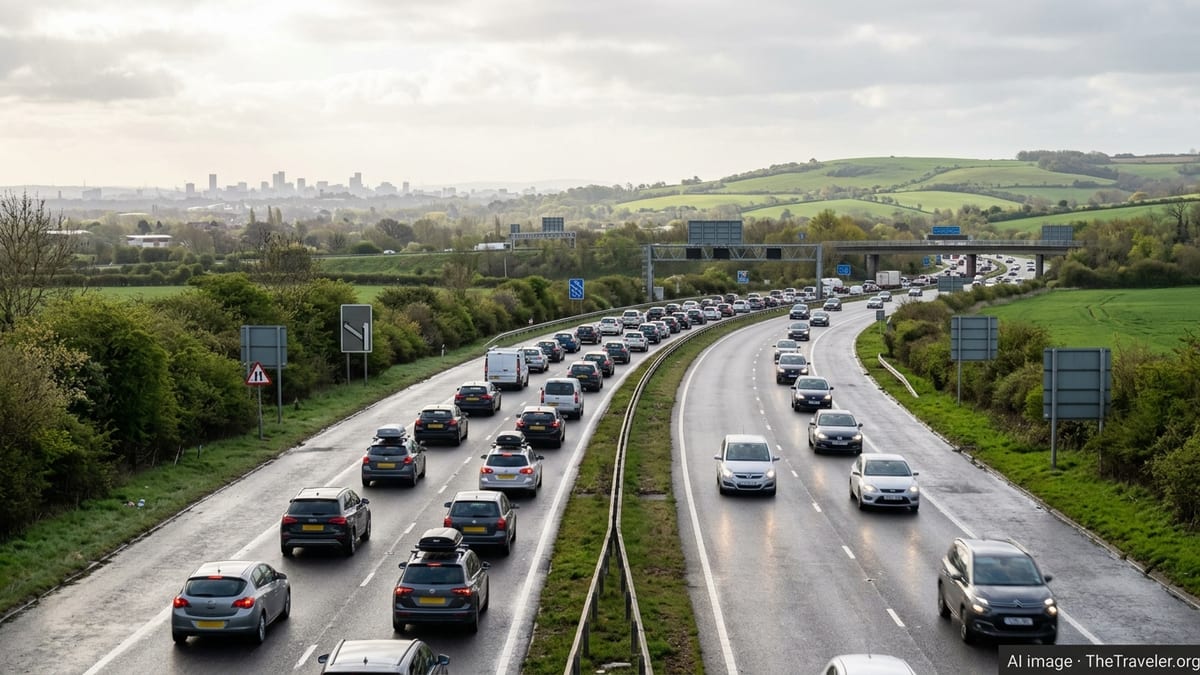
Motoring organisations are warning that major routes will be under intense pressure as millions of residents set off for Easter holidays, day trips and visits to friends and relatives. Recent forecasts for the 2025 Easter weekend point to tens of millions of leisure journeys by car between Good Friday and Easter Monday, with Friday often singled out as the busiest getaway day.
Previous bank holiday patterns suggest that bottlenecks are likely around the M6 near Birmingham and towards Blackpool, the M5 around Bristol, the western sections of the M25, and the A303 towards the South West. Traffic analytics firms cited in national media expect journey times on some stretches to be significantly longer than usual at peak times, particularly late morning and mid-afternoon.
National Highways has announced that it will remove or suspend a large proportion of planned roadworks over the period, leaving the overwhelming majority of motorways and key A-roads free of cones and lane closures. Nonetheless, any collisions, breakdowns or adverse weather could rapidly lead to queues on arterial routes serving popular coastal and countryside destinations.
Travel advisers are encouraging drivers to check conditions before setting off, avoid the busiest departure windows where possible and build extra time into schedules. Early-morning or later-evening departures are consistently highlighted in public guidance as the best options for those looking to minimise time spent in traffic.
Rail Engineering Works and Crowded Trains Add to Pressure
While the road network is expected to carry the bulk of Easter leisure travel, the rail system is also facing a demanding weekend. Network Rail has scheduled hundreds of engineering projects over the Easter period in recent years, and public timetables for 2025 again show partial closures and reduced services on several main lines.
Information published by train operators points to temporary bus replacement services on some intercity and regional routes, particularly in western England, South Wales and parts of northern England and Scotland. On other lines, extended journey times and earlier last trains are in place so that overnight engineering work can proceed.
At the same time, leisure demand for rail travel is peaking as households take advantage of the four-day weekend. Industry updates ahead of the break indicate strong advance bookings on popular flows between London and resort areas, as well as on cross-country services linking major cities with national parks and coastal towns.
Passengers are being urged in public-facing travel advice to check timetables carefully, reserve seats where possible and familiarise themselves with any bus connections before they arrive at the station. Rail industry briefings also recommend allowing additional time for connections and being prepared for busy trains, especially on Good Friday and Easter Monday when many people are departing and returning.
Mixed Weather and Cost Pressures Shape Traveller Behaviour
Early forecasts from meteorological services for the Easter period suggest a mixed picture, with spells of rain and wind likely at times, especially in western areas, but brighter interludes expected for at least part of the long weekend. Similar conditions during Easter 2025 brought heavy showers to parts of the South West on Good Friday before more settled weather developed for Easter Sunday, allowing many outdoor events and coastal trips to proceed.
Weather patterns remain a key factor in late decision-making, with tourism researchers noting that a significant share of domestic travellers now wait until closer to departure to commit to trips. This is particularly true for camping, caravan and glamping stays, where demand tends to spike if a window of drier, sunnier conditions appears in short-range forecasts.
Cost-of-living pressures also continue to influence how and where Britons travel. Recent government and industry data show that while the overall number of overnight domestic trips dipped in 2024 compared with pre-pandemic levels, total spending rose, reflecting higher prices for fuel, food, accommodation and attractions. As a result, many households are shortening the length of stays, choosing self-catering options or travelling off-peak to manage budgets.
Despite these constraints, the volume of residents planning a UK break this Easter underlines the enduring appeal of domestic tourism and the importance of the holiday weekend to local economies. From seaside towns to rural villages and major cities, destinations across the country are preparing for a surge in visitors that could set the tone for the wider spring and summer travel season.