

Winnipeg is often introduced with a weather joke, yet the city’s real story plays out in its riverside meeting places, galleries, festivals and neighbourhoods. At the junction of the Red and Assiniboine rivers, this prairie capital has been a gathering place for thousands of years, shaped by Indigenous nations, fur traders, railroads, waves of newcomers and bold experiments in social justice and the arts. These 12 cultural and historical experiences offer one of the clearest ways to understand how Winnipeg became the city it is today.
The Forks: Six Millennia at the Meeting of Rivers
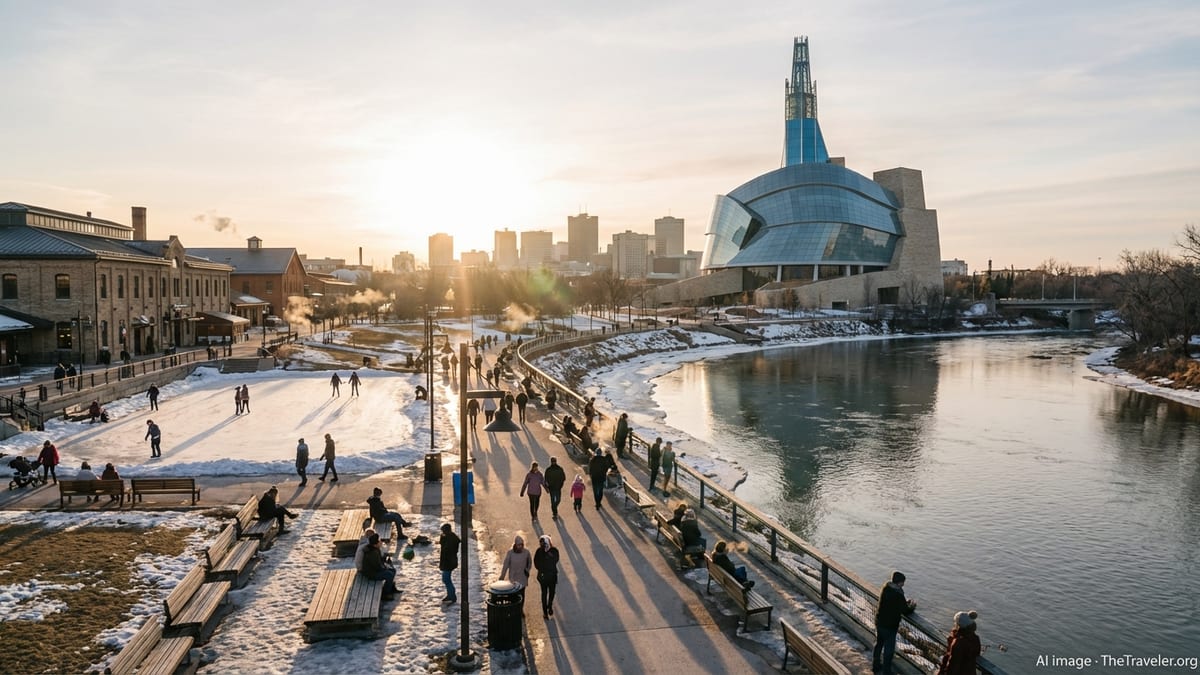
To understand Winnipeg, start where everything began. Long before there was a city, The Forks was a vital gathering place where peoples, trade routes and ideas converged. Today it functions as Winnipeg’s social heart, but just beneath the surface you can still trace thousands of years of human history along the riverbanks.
1. Walking the Ancient Gathering Place at The Forks
The Forks sits at the confluence of the Red and Assiniboine rivers, on land used by Indigenous peoples for more than 6,000 years. Archaeological digs in the late twentieth century uncovered hearths, tools and animal bones that confirm this was a seasonal campsite and trading hub long before European arrival. Interpretive signs and public art installations help visitors imagine the canoes, campfires and trading circles that once filled this riverside plain.
As you stroll the riverwalk or climb the Forks Market Tower for a panoramic view, it becomes clear why this patch of land has always mattered. The waterways formed a natural crossroads linking prairie grasslands, northern forests and distant Hudson Bay. Because of that geography, The Forks is the single best place to grasp why a major city developed here rather than on some other stretch of prairie.
2. From Rail Yards to Public Common
By the late nineteenth century, the same strategic location that drew Indigenous traders attracted railway companies and new immigrants. For decades, the area that is now The Forks was crowded with warehouses, stables and tracks. When rail operations moved elsewhere, the land sat derelict until a long-term redevelopment project in the 1980s and 1990s transformed the brownfield into one of Canada’s most successful urban renewal stories.
Today, former railway buildings house the Forks Market food hall and artisan stalls, while the grounds host concerts, public art and seasonal skating trails. The reuse of industrial heritage has given Winnipeg an outdoor living room where residents share space in a way that mirrors the site’s older role as a place of meeting, negotiation and cultural exchange.
Human Rights and Social Justice in the Prairie City
Winnipeg’s history is full of moments when ordinary people challenged injustice, from early labour movements to contemporary campaigns for Indigenous rights. Nowhere is this legacy more tangible than at the Canadian Museum for Human Rights and in the stories of protest and reform rooted in the city’s streets.
3. Exploring the Canadian Museum for Human Rights
Rising beside The Forks, the Canadian Museum for Human Rights is the first national museum in Canada built outside the capital region. Its purpose is to explore human rights issues in Canada and around the world, encouraging visitors to reflect, question and engage. Exhibits blend personal testimonies, archival materials and interactive media to examine topics such as Indigenous rights, the Holocaust, language rights and contemporary struggles against discrimination.
The architecture itself is symbolic. Inside, ramps of pale stone guide visitors upward through dim galleries toward brighter spaces and an illuminated tower. The journey is designed to feel like a movement from darkness toward light, mirroring the often difficult path from abuse to accountability. Spending a few hours here offers insight into how Winnipeg sees its role as a city that both remembers injustice and actively debates how to prevent it.
4. Tracing the Legacy of the 1919 General Strike
Long before the museum opened, Winnipeg was already known as a crucible of labour history. In the spring of 1919, more than 30,000 workers walked off the job during what became one of the most significant strikes in Canadian history. The confrontation began over wages and bargaining rights, but quickly grew into a wider clash over political and economic power in a rapidly industrializing country.
At sites around downtown, interpretive plaques and public art installations describe those tense weeks, culminating in a violent clash known as Bloody Saturday. While modern Winnipeg feels far removed from that turmoil, the strike’s legacy lives on in local political culture and in national labour law. Visitors who seek out these markers, particularly around City Hall and Main Street, gain a deeper appreciation of how collective action helped shape the civic identity of this prairie capital.
Indigenous Presence and Reconciliation in Everyday Winnipeg
Winnipeg is home to one of the largest Indigenous urban populations in Canada, and their presence is woven into the city’s language, art and public life. Learning from Indigenous perspectives in Winnipeg is not simply an add-on experience but one of the most meaningful ways to understand where the city has come from and where it is heading.
5. Learning Treaty History at The Forks and Beyond
Throughout The Forks and other public spaces, visitors encounter land acknowledgements and educational panels that reference Treaty 1 Territory and the homeland of the Métis Nation. These statements are not ceremonial extras. They invite people to understand the city as part of a longer story of agreements between Indigenous nations and the Crown, and to consider how those agreements have been honoured or violated over time.
Guided walks, seasonal programs and special events frequently highlight Indigenous languages, protocols and oral histories. By listening to knowledge keepers or joining a workshop, travellers can gain a more nuanced sense of how Indigenous law and worldview continue to shape conversations about land use, education and social services in Winnipeg today.
6. Indigenous Art and Stories in Public Spaces
Beyond formal learning programs, Indigenous creativity is visible in murals, sculpture and performance across the city. At The Forks alone, visitors might encounter stone carvings, contemporary installations referencing traditional teachings, or murals honouring prominent Indigenous artists. Elsewhere in Winnipeg, major galleries and smaller artist-run centres showcase work by First Nations, Inuit and Métis creators who are reinterpreting everything from beadwork to political poster design.
Taking time to look closely at these works, reading the accompanying panels and noting whose stories are being centred, reveals a city in the midst of a cultural shift. Rather than treating Indigenous culture as something from the distant past, Winnipeg is increasingly foregrounding Indigenous artists and curators as central voices in defining what the city means in the present.
Gateway to the West: Railways, Immigration and Exchange
Winnipeg’s rapid growth in the late nineteenth and early twentieth centuries hinged on its role as the principal gateway to the Canadian West. Rail lines converged here, and newcomers from Europe, Asia and other parts of North America passed through city depots on their way to farms and towns across the Prairies. That history of movement and settlement still shapes Winnipeg’s neighbourhoods and cultural life.
7. Union Station and the Story of Newcomers
Facing The Forks, the imposing limestone arches of Union Station testify to an era when thousands of immigrants arrived by train. Many stayed in temporary housing near the rail yards while they waited for land or work. Others chose to remain in Winnipeg, helping build the commercial and cultural institutions that would sustain the growing city.
Today, the station functions on a smaller scale for passenger rail, yet it also serves as an architectural reminder of the optimism and hardship that accompanied western settlement. Nearby, information panels and heritage displays recall the mixture of opportunity and prejudice that newcomers experienced, from language barriers to discriminatory policies. Understanding this chapter sheds light on why Winnipeg remains one of the most diverse cities on the Prairies and why questions of inclusion and equity continue to resonate.
8. St. Boniface and Francophone Heritage
Across the Red River from downtown, the neighbourhood of St. Boniface anchors Manitoba’s largest Francophone community. Its streets mix cozy bakeries and cultural centres with landmarks such as the ruins of the old St. Boniface Cathedral and the cemetery where Louis Riel, political leader of the Métis, is buried. Visiting this area reveals the deep French and Métis roots that predate the creation of Manitoba as a province.
Local museums and institutions trace the story of early missions, the Red River Settlement and political struggles over language and land. Even a simple walk along Provencher Boulevard, listening to conversations switch between French, English and Michif, offers a sense of how multilingualism is part of everyday life. The district’s festivals, from winter celebrations to summer street fairs, further underscore how Francophone culture remains a vibrant and evolving force in contemporary Winnipeg.
Festivals That Showcase a Multicultural Prairie Capital
If you want to see Winnipeg’s diversity in motion, align your visit with one of the city’s major festivals. From winter celebrations that defy the cold to summer events that fill parks and neighbourhoods with music and food, these gatherings reveal the depth of local cultural pride.
9. Folklorama: A City of Pavilions
Each August, Winnipeg hosts Folklorama, regarded as the world’s largest and longest-running multicultural festival. Over roughly two weeks, cultural organizations across the city open themed pavilions showcasing food, dance, music and storytelling from dozens of communities. Visitors might eat Caribbean patties in one hall, listen to Ukrainian folk music in another, then finish the night with South Asian sweets and drumming.
The festival grew from a 1970 centennial project into a cornerstone of the city’s identity. For many residents, volunteering at a pavilion is a multigenerational tradition, while for newcomers it can be a way to connect with both their heritage and other communities. Experiencing Folklorama offers a vivid, sensory introduction to how immigration has transformed Winnipeg into a mosaic of cultures that coexist, collaborate and sometimes debate what multiculturalism should look like in practice.
10. Festival du Voyageur and Winter Storytelling
In February, as temperatures drop and river ice thickens, Winnipeg leans into winter with Festival du Voyageur. Centred in St. Boniface, this ten-day event is billed as western Canada’s largest winter festival. It celebrates the history of the French Canadian voyageurs and the fur trade era through costumed interpreters, traditional music, snow sculptures and hearty food.
Stepping into the festival grounds, visitors encounter log structures, crackling bonfires and performers speaking French and English, often punctuated with a jubilant “Hé ho.” The atmosphere is festive, yet beneath the fun lies a chance to reflect on how trade networks, alliances and conflicts between European traders and Indigenous nations shaped the region. The festival’s focus on storytelling, craft and song makes those histories feel immediate rather than distant.
Art, Architecture and the Winnipeg Imagination
Winnipeg’s creative scene punches above its weight, shaped by long winters that encourage indoor pursuits and a tradition of artist-run initiatives and experimental thinking. From striking public buildings to galleries that champion local voices, the city’s cultural institutions offer another lens on what it means to live at the heart of the continent.
11. The Exchange District and a Living Urban Museum
North of downtown’s modern towers, the Exchange District preserves one of North America’s most intact collections of early twentieth-century warehouses and commercial buildings. Once the financial engine of the Prairies, this compact grid of streets now houses galleries, design studios, theatres and independent shops. Cobblestone lanes and brick facades provide a cinematic backdrop, but the real story lies in how the area has repeatedly reinvented itself.
Walking tours and heritage plaques outline how Winnipeg boomed during the grain trade expansion, then declined as trade routes shifted and economic power moved west. The subsequent revival, driven by heritage conservation and the arts, turned the Exchange into a creative hub and frequent film set. Exploring the district, whether on an official tour or an aimless wander, reveals how adaptive reuse of historic buildings has become a hallmark of Winnipeg’s approach to preserving its past while nurturing new ideas.
12. Winnipeg’s Galleries, Theatres and Music Halls
Beyond individual neighbourhoods, Winnipeg’s cultural infrastructure speaks volumes about the city’s priorities. Its major art gallery, theatres, symphony hall and independent venues host programming that ranges from classical ballet and orchestral performances to experimental theatre and contemporary visual art. Many institutions make a point of highlighting regional creators and stories tied to the Prairies, rather than simply importing touring shows.
Attending a performance or exhibition, even spontaneously, can be one of the most revealing experiences for visitors. The audience’s enthusiasm, the prominence of local artists and the ease with which people move between high culture and grassroots venues all underline Winnipeg’s self-image as a creative, slightly unconventional city. This thriving scene is not separate from the histories of labour, migration and Indigenous resurgence. Instead, it is one of the main ways those histories are reinterpreted and carried forward.
The Takeaway
Winnipeg defies easy summary. It is at once an ancient gathering place and a relatively young city, a former industrial powerhouse and a contemporary hub for human rights education and the arts. Walking its riverfronts, exploring its museums, joining its festivals and listening to its many languages reveal a community that has been negotiating difference and change for centuries.
The 12 experiences highlighted here are not a checklist so much as a starting map. Together they trace a line from pre-contact Indigenous camps to rail-era immigration halls, from historic strikes to present-day campaigns for equity, from fur trade camps to snow-carved festival grounds. Travellers who take the time to engage with these stories will come away with a more layered understanding of Winnipeg and, perhaps, a new appreciation for the resilience and creativity that flourish at this meeting of rivers.
FAQ
Q1. What makes The Forks such an important place in Winnipeg’s history?
Archaeological evidence shows that The Forks has been a meeting place and trading hub for more than 6,000 years, used by Indigenous peoples long before the modern city existed.
Q2. How much time should I plan for the Canadian Museum for Human Rights?
Most visitors spend at least three hours exploring the museum’s galleries, but those who read in depth or attend programs can easily fill most of a day.
Q3. Is Winnipeg a good destination for learning about Indigenous cultures?
Yes. Winnipeg has a large Indigenous population, visible public art, cultural programming and educational initiatives that make it a strong place to learn respectfully about Indigenous histories and present realities.
Q4. When is the best time to experience Winnipeg’s major festivals?
Folklorama usually takes place in August, while Festival du Voyageur is held over 10 days in February. Checking specific dates before travel is essential.
Q5. Do I need a car to explore Winnipeg’s cultural and historical sites?
Many key sites, including The Forks, downtown museums and the Exchange District, are walkable from each other, though transit or taxis help for farther neighbourhoods like St. Boniface.
Q6. Are tours available that focus on Winnipeg’s labour and social justice history?
Seasonal walking tours, talks and special programs are often offered by local organizations and museums, particularly around anniversaries and heritage weeks.
Q7. Can families with children enjoy these cultural experiences?
Yes. Many venues offer family-friendly exhibits, interactive elements and outdoor spaces, making it easy to combine learning with play and exploration.
Q8. How does winter affect visiting cultural sites in Winnipeg?
Cold temperatures mean bundling up for outdoor walks, but most museums and theatres operate year-round, and winter festivals turn the season into an attraction.
Q9. Is English widely spoken, or will I need French to visit St. Boniface?
English is widely spoken throughout Winnipeg. In St. Boniface, you will also hear French, but visitors can comfortably navigate using English alone.
Q10. What is the single best place to start if I have only one day in Winnipeg?
Begin at The Forks, where you can experience deep history, riverside views and nearby institutions like the Canadian Museum for Human Rights within easy walking distance.