

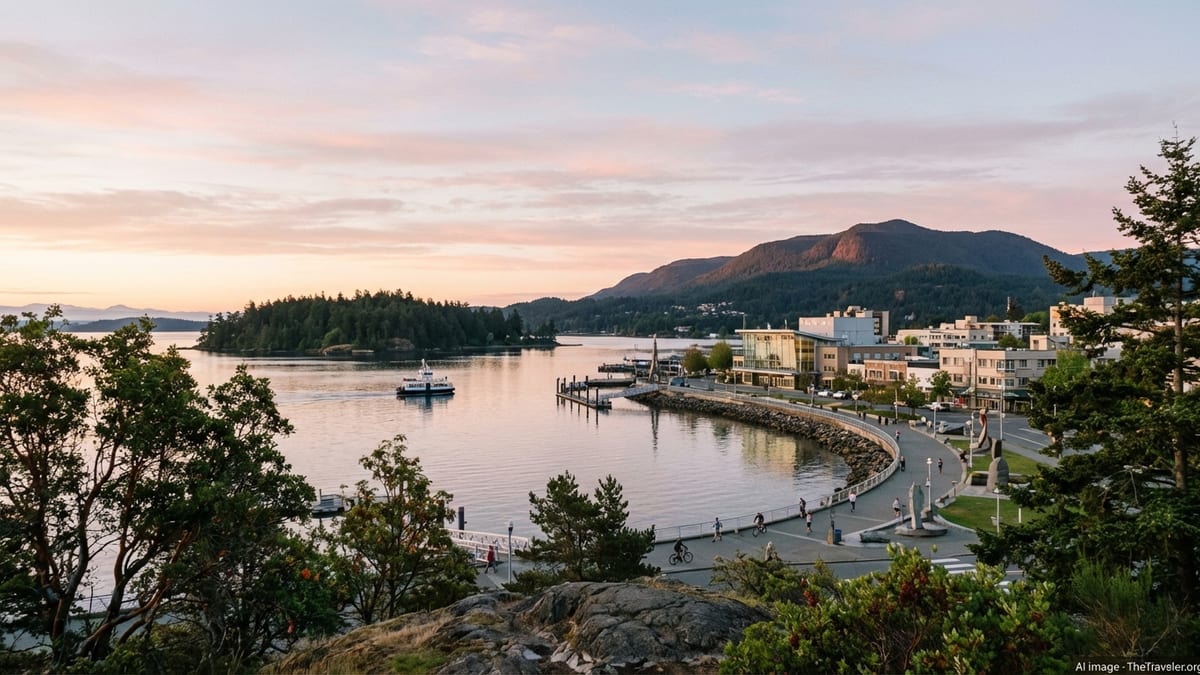
Nanaimo’s name is instantly associated with two things: its creamy layered dessert and its busy working harbor. Spend more than a day here, though, and an entirely different city emerges.
On this stretch of Vancouver Island’s east coast, Indigenous history meets island adventure, coal-mining heritage sits beside contemporary arts, and locals still cheer for bathtub racers as seriously as some towns back a hockey team.
These are 12 of the experiences and stories that define Nanaimo far beyond the famous bars and waterfront views.
Indigenous Roots and Living Coast Salish Culture
Before ferries, floatplanes and cruise ships, this shoreline was and remains the territory of the Snuneymuxw First Nation. Understanding that living presence is essential to understanding Nanaimo itself. Across parks, museums and the waterfront, visitors are starting to encounter more visible signs of Coast Salish art, language and stewardship, reflecting a gradual shift toward telling the city’s full story.
1. Snuneymuxw Territory and Waterfront Storytelling
Nanaimo sits on the traditional territory of the Snuneymuxw, a Coast Salish people whose villages and seasonal camps once ringed the harbour and nearby islands. Today, interpretive signs and public artworks along the waterfront begin to acknowledge those deep roots, highlighting traditional fishing techniques, trade routes and the importance of the protected bays that now hold marinas and seaplane docks.
Many of these installations focus on everyday relationships with the sea rather than grand monuments. Carved figures, spindle whorl motifs and bilingual inscriptions in English and Hul’q’umi’num’ gently shift the narrative from a purely colonial port to a place where Indigenous culture is current, not confined to the past. Visitors who pause to read these panels get a very different sense of how long people have called this place home.
2. Petroglyph Provincial Park’s Ancient Carvings
Just south of downtown, Petroglyph Provincial Park protects one of the most concentrated collections of Indigenous rock carvings on Vancouver Island. The images, some thought to be more than a thousand years old, depict sea creatures, human figures and supernatural beings carved into sandstone outcrops near the Nanaimo River estuary.
It is a compact park, closer in feel to a forest clearing than a big provincial campground. A short trail leads through mossy trees to the petroglyph site, where interpretive panels provide context about Coast Salish beliefs and the significance of “places of power” in the landscape. Visitors are encouraged to view the carvings with care, avoid touching them and consider them as part of a living spiritual tradition rather than outdoor curiosities.
3. Saysutshun / Newcastle Island’s Cultural Landscape
Across a narrow channel from downtown, Saysutshun (Newcastle Island Marine Provincial Park) has long been important to the Snuneymuxw as a food-gathering and village site, and more recently as a place to share culture with visitors. Reached by a short passenger-ferry ride from Maffeo Sutton Park, the island is entirely car-free, its walking trails looping through arbutus groves, old quarry sites and quiet coves.
Interpretive signs and programming highlight both Indigenous and industrial history, from shell middens and traditional use of native plants to the period when coal mining and sandstone quarrying reshaped the shoreline. In summer, cultural tours and events led by Snuneymuxw hosts are sometimes offered, adding stories, language and song to what might otherwise be just a scenic hike or bike ride around the island.
Coal, Timber and the Stories That Built the City
Beneath Nanaimo’s relaxed island surface lies a much more industrial past. Coal seams under the harbour, timber on the surrounding hills and the strategic location on coastal shipping routes all shaped how the city grew. Today, you can still trace those layers of history in carefully restored structures, specialized museums and even the contours of the waterfront itself.
4. Nanaimo Museum and the Recreated Coal Mine
Downtown’s Nanaimo Museum provides one of the clearest introductions to how the modern city emerged. Exhibits walk visitors through the coal era, including a walk-through recreation of a mine tunnel that hints at the conditions underground. Panels and artifacts explore the influence of the Hudson’s Bay Company, the arrival of miners from Britain and elsewhere, and the labour disputes that helped define local politics.
The museum also devotes space to First Nations history, early settlement and the region’s forestry story. Temporary exhibits regularly bring in works from major Canadian institutions or focus on local themes, making it a useful first stop for anyone who wants context before heading out to the Bastion, waterfront or former mining sites around the city.
5. The Bastion and Hudson’s Bay Company Legacy
On the inner harbour, the white, three-storey Bastion is one of Nanaimo’s most photogenic and prominent landmarks. Built by the Hudson’s Bay Company in the 1850s as a defensive blockhouse, it once overlooked a coal-exporting anchorage and acted as a symbol of corporate and colonial authority in a contested landscape.
Today it functions as a small seasonal museum, with exhibits on early settlement, trade and the transition from trading post to city. Standing on its wooden walkways above the waterfront, visitors can picture the bay crowded not with recreational boats and floatplanes but with sailing ships and barges loading coal and supplies. It is a reminder that Nanaimo’s port identity long predates its modern ferry and cruise operations.
6. Morden Colliery and Industrial Archaeology
South of the city, Morden Colliery Historic Provincial Park preserves the striking concrete headframe and tipple of a former coal mine. Recently stabilized and restored, the tall structure is one of the most complete above-ground remnants of a coal operation on Vancouver Island, standing almost alone beside a forested trail.
Walking the site, it is easy to imagine the complex of buildings and rail tracks that once surrounded it. Interpretive boards outline how coal moved from underground workings to the tipple, then into railcars bound for Nanaimo’s docks. Paired with a visit to the museum’s mine exhibit, Morden Colliery helps bring to life the era when underground tunnels criss-crossed beneath the harbour and surrounding communities.
Arts, Performance and a Growing Cultural Scene
Nanaimo’s creative side often surprises visitors who know the city mainly as a travel hub. Beyond its coffee shops and pubs, there is a year-round calendar of theatre, music and visual art shaped by a mix of grassroots organizations, professional companies and an increasingly visible Indigenous arts community.
7. The Port Theatre and Live Performance Network
The Port Theatre, an 804-seat performing arts centre on the downtown waterfront, has become one of Nanaimo’s cultural anchors since it opened in the late 1990s. The city-owned, not-for-profit venue hosts everything from touring musicians and dance companies to local productions by TheatreOne, Crimson Coast Dance and community groups.
Recognized with provincial and industry awards for its programming and presentation, the theatre is also home base for the Vancouver Island Symphony. Its Spotlight and festival series bring national and international artists to a city that, a generation ago, had far fewer chances to see such work without a trip to Victoria or Vancouver. On any given week, the marquee can showcase a classical concert, spoken-word performance or a contemporary Indigenous dance work.
8. Galleries, Public Art and Diana Krall Plaza
Scattered through downtown and the Old City Quarter are small galleries, studios and public-art installations that reflect Nanaimo’s evolving creative identity. The Nanaimo Art Gallery focuses on contemporary work with a strong regional and Indigenous presence, while smaller spaces and cooperative studios showcase ceramics, jewelry, textile arts and painting by Vancouver Island creators.
Public art lines key walking routes, from sculptures along the waterfront to murals and installations in side streets and alleys. Diana Krall Plaza, the open space between the Port Theatre and the library named for the internationally known jazz pianist who grew up in Nanaimo, often serves as a stage for street performances, markets and outdoor concerts. In summer especially, the district feels like a compact arts campus stitched into the downtown grid.
Wild Coast, Lakes and Year-Round Adventure
Look inland from the harbour and you see the wooded flanks of Mount Benson rising behind the city. Forest parks, lakes and craggy shorelines form Nanaimo’s unofficial second waterfront, underpinning a thriving outdoor culture for hikers, cyclists, paddlers and divers. It is this ready access to wild spaces that often turns a simple stopover into a longer stay.
9. Hiking, Biking and the Trails of Mount Benson
Mount Benson dominates the skyline to the west and acts as Nanaimo’s outdoor playground. A network of trails climbs through second-growth forest to rocky viewpoints that look out over the city, Gulf Islands and coastal mountains. The routes vary from steep, rooty ascents that challenge experienced hikers to more gradual tracks suitable for families.
For mountain bikers, areas like Doumont, Westwood and the Benson foothills offer everything from rolling cross-country loops to technical descents and jump lines. Closer to town, the paved Parkway Trail threads through neighbourhoods and greenbelts, providing an easier option for casual riders or those exploring by e-bike. Even within city limits, it does not take long to feel surrounded by moss, cedar and the sound of small creeks.
10. Lakes, River Canyons and Island Shorelines
Westwood Lake, with its looping shoreline trail and small beaches, blurs the line between city park and backcountry gateway. Swimmers, paddlers and runners share the water and packed-dirt paths in warm weather, while in cooler months the forested circuit remains a favourite for locals seeking a quick dose of nature.
South of the city, the Nanaimo River carves a canyon that has become a hub for freshwater swimming, paddling and adventure parks. Operators at WildPlay offer zipline courses, bungee jumping and swings over the river, capitalizing on the dramatic cliffs and pools below. Offshore, the islands around Nanaimo harbour, including Saysutshun and Protection Island, provide protected shorelines for kayakers who want to combine easy paddling with views of city lights and distant snow-capped peaks.
11. Underwater Worlds and Artificial Reefs
Below the surface of the surrounding straits lies one of Nanaimo’s less obvious attractions. The city is a launching point for cold-water divers who come to explore artificial reefs created by the intentional sinking of retired naval vessels. Over time, these hulks have transformed into complex habitats layered with anemones, sponges and kelp.
Charter boats ferry divers to sites just outside the harbour, where visibility and currents can vary but encounters with octopus, wolf eels and schooling fish are common. For visitors who never pull on a wetsuit, the existence of these underwater parks still says a lot about Nanaimo’s relationship to the sea: this is a place that makes use of its maritime setting in three dimensions, not just along the breakwater.
Neighbourhoods, Food and Everyday Island Life
Beyond visitor attractions, Nanaimo’s character emerges most clearly in the rhythms of its neighbourhoods and the way locals eat, shop and spend their weekends. The city stretches along the coast, but a handful of compact districts capture its mix of heritage, creativity and casual island pace.
12. Old City Quarter, Markets and Local Flavours
Uphill from the waterfront, the Old City Quarter is a small grid of streets lined with restored heritage buildings that once housed shops and services for a coal company town. Today, their brick and wood-fronted facades hold independent boutiques, cafes, wellness studios and specialty food stores. The pace is unhurried, and it is easy to spend a morning wandering between bakeries, bookstores and vintage shops.
Food in Nanaimo leans toward relaxed and locally focused. Cafes make a point of serving Vancouver Island roasters; restaurants build menus around seafood, seasonal produce and, often, gluten-free and plant-based options. Weekly markets and seasonal farm stands connect city residents with growers in the surrounding region, from berry farms and orchards to small-scale livestock operations. Even the best-known dessert here is being reinterpreted, with bakers and chocolatiers creating inventive variations that sit comfortably alongside sushi bars, taco trucks and modern bistros.
The Takeaway
Nanaimo’s reputation still leans heavily on its signature dessert and the ferries that shuttle people and vehicles across the Salish Sea. Yet when you look closer, a more complex portrait emerges: a harbour city layered over coal mines and Coast Salish villages, ringed by lakes and mountains, animated by arts organizations and backyard musicians, and proud of a festival that sends bathtub-shaped craft crashing through ocean chop.
For travelers willing to venture beyond the waterfront promenade, Nanaimo offers a textured experience that feels authentically Vancouver Island. Walk the petroglyph trails, sit in a downtown theatre as the lights go down, ride a forested switchback or watch the sun sink behind Mount Benson from a quiet cove on Saysutshun. In the end, those moments, more than any square of chocolate-topped dessert, are what truly define the city.
FAQ
Q1. What is the best time of year to experience Nanaimo beyond the harbor?
Late spring through early fall offers the broadest range of activities, from hiking and island camping to festivals and outdoor performances, while shoulder seasons are quieter but still mild.
Q2. How can visitors respectfully engage with Indigenous culture in Nanaimo?
Seek out experiences developed or led by Snuneymuxw partners, read interpretive signage, support Indigenous artists and businesses, and treat cultural sites like petroglyphs with care and quiet respect.
Q3. Is it possible to explore Nanaimo without a car?
Yes. Downtown, the waterfront, Saysutshun ferry dock, museums, galleries and many restaurants are walkable, and local buses or taxis can connect you to trailheads and river areas.
Q4. What outdoor activities are suitable for beginners or families?
Gentle options include the loop around Westwood Lake, easy sections of the Parkway Trail, short walks at Petroglyph Provincial Park and relaxed beach and trail rambles on Saysutshun.
Q5. Are there cultural events to look for besides the bathtub races?
The Port Theatre hosts year-round music, dance and theatre; downtown streets and plazas often feature jazz events, seasonal festivals, markets and community celebrations.
Q6. How many days should I plan to get a feel for Nanaimo beyond the waterfront?
Two to three full days allow time for a mix of museum visits, an island trip, some hiking or biking and evenings spent exploring neighbourhood food and arts scenes.
Q7. Is Nanaimo a good base for exploring the rest of Vancouver Island?
Yes. Its central east-coast location, ferry and highway connections, and range of accommodations make it a practical hub for day trips north, south or inland.
Q8. Do I need special gear to enjoy the outdoor activities mentioned?
For most hikes and lake walks, sturdy shoes and weather-appropriate layers are enough. More technical pursuits like diving or bungee jumping are done with local operators who provide equipment.
Q9. What should visitors know about the weather in Nanaimo?
The climate is relatively mild, with cool, wet winters and warm, usually dry summers. Conditions can change quickly, especially in higher-elevation areas like Mount Benson.
Q10. Is Nanaimo suitable for travelers who prefer quieter, cultural experiences over nightlife?
Very much so. Museums, galleries, live performance, historic sites and relaxed neighbourhoods provide plenty to do without relying on late-night bar scenes.