

More news on this day
A $135 million plan to transform the longtime Paradise Cove Lūʻau site at Ko Olina into a new waterfront complex is emerging as a high-profile test of how Hawaii reshapes its tourism economy for a slower-growth, higher-value era.
Get the latest news straight to your inbox!
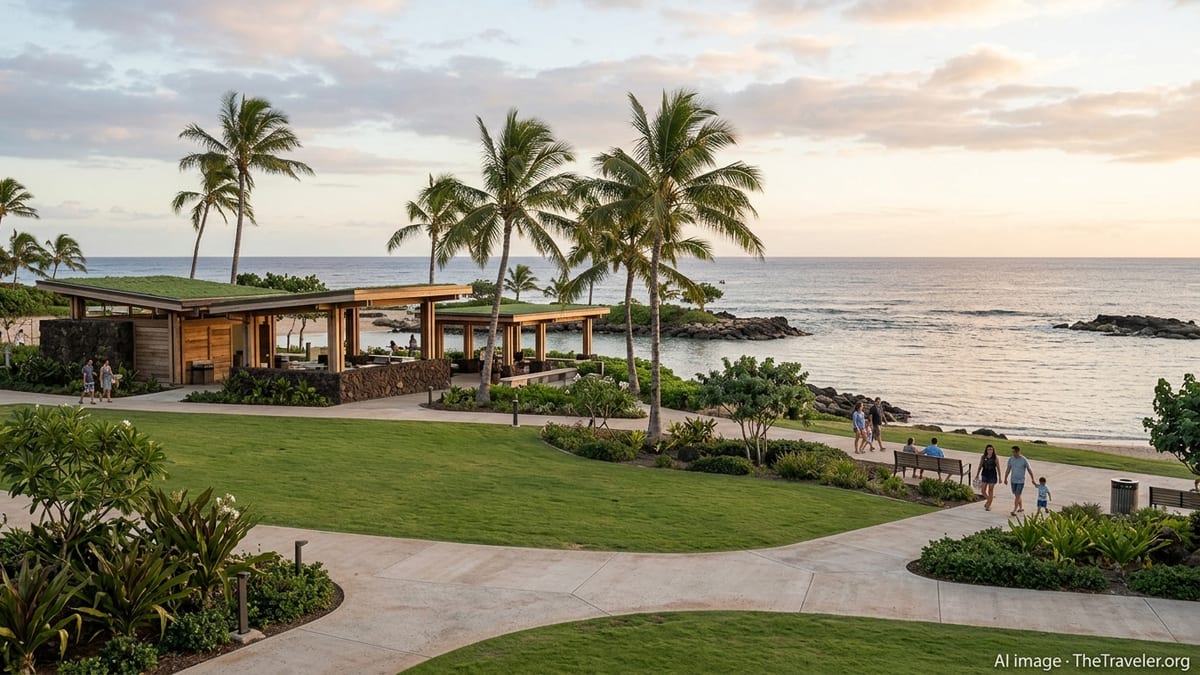
From Iconic Lūʻau to Multiuse Waterfront Hub
For nearly five decades, Paradise Cove Lūʻau has been one of Oʻahu’s most recognizable visitor experiences, drawing generations of travelers to its sunset shows on the leeward coast. Publicly available information shows that the venue hosted its final performance on December 31, 2025, clearing the way for demolition and site preparation in 2026.
State and city records describe the follow-on project, known simply as the Cove, as a roughly 10.8- to 11-acre redevelopment of the same shoreline parcel at Ko Olina in Kapolei. Environmental filings and local coverage indicate a construction budget in the range of 135 million dollars, with an opening targeted for early 2027, subject to permitting and build timelines.
According to planning documents, the new complex is expected to replace the single-purpose lūʻau format with a mix of restaurant, retail, cultural programming and outdoor recreation space. Conceptual material emphasizes an “authentic Hawaiian outdoor recreation facility and community gathering place” that is intended to appeal to both residents and visitors rather than tour groups alone.
The project’s ownership structure also reflects a broader shift in Hawaii’s resort landscape. Reports indicate that landowner James Campbell Company has teamed up with local development partners Kobayashi Group and BlackSand Capital, signaling long-term confidence in West Oʻahu’s role as a major tourism node even as statewide arrival numbers soften.
Regulators Focus on Shoreline, Culture and Climate Risk
The Cove’s path through Honolulu’s permitting process provides a snapshot of how coastal tourism projects in Hawaii are being reshaped by climate and cultural concerns. A final environmental impact statement for the redevelopment was published in early 2025, following a draft released the previous year that triggered extensive public comment on traffic, beach access and coastal erosion.
Special Management Area approvals reviewed at the Honolulu City Council level attach detailed conditions around shoreline protection and cultural monitoring. Meeting summaries indicate that about a quarter of the project area lies within a modeled 3.2-foot sea level rise exposure zone by 2100, affecting certain outdoor dining and building footprints and prompting design revisions intended to keep permanent structures landward of regulatory setback lines.
Archaeological survey work documented in the filings identified human remains and designated a burial preserve on-site, triggering the development of a data recovery and preservation plan under state historic preservation rules. Committee discussions recorded in public minutes highlight requirements for cultural monitors during ground disturbance and stop-work protocols if additional remains or significant cultural deposits are encountered.
These layers of review illustrate how large-scale coastal redevelopments in Hawaii are increasingly evaluated not only for economic return and job creation, but also for their resilience to sea level rise and their treatment of Native Hawaiian cultural landscapes.
A Tourism Industry Pivoting Beyond Volume Growth
The Paradise Cove redevelopment is unfolding as Hawaii’s tourism sector navigates a complex transition away from pre-pandemic growth patterns. State data for 2024 and 2025 show that total annual visitor counts have plateaued below the peak years when arrivals flirted with 10 million, even as per-visitor daily spending has in many months surpassed earlier levels.
Economic forecasts from local research institutions describe a “slow holiday season” pattern and consecutive months of modest year-over-year declines in arrivals, particularly from price-sensitive markets such as Canada. At the same time, spending has remained relatively robust, with visitors concentrating more dollars in dining, activities and higher-category accommodations.
This divergence between headcounts and revenue aligns with a policy shift toward destination management and quality-focused tourism, rather than simple volume. Hawaii’s move to implement a climate-linked “green tax” on visitors, including higher levies on lodging and cruise fares beginning in 2026, underscores a strategy that seeks to channel tourism revenue directly into environmental protection and community resilience.
In this context, the Cove project’s emphasis on locally grounded programming, open-air public spaces and cultural storytelling positions it as an example of how new investments are being framed as part of a more curated, less extractive visitor economy.
Balancing Community Access With Resort-Oriented Growth
Community reactions to the Paradise Cove transition capture the tensions that have defined Hawaii’s tourism debates in recent years. Reports on neighborhood board meetings near Ko Olina describe residents’ concerns about additional traffic on already congested roadways, limited public parking and the risk that new commercial construction might further constrain access to the shoreline fronting the resort area.
Ko Olina’s existing lagoon paths are technically open to the public, but in practice, parking caps and resort control points often limit spontaneous local use. Project descriptions for the Cove reference public walkways, gathering lawns and cultural spaces, but how these will function day to day for non-guests remains a closely watched issue for nearby communities.
At the same time, the closure of the lūʻau has raised questions about the fate of long-serving employees and small businesses tied to the attraction. Coverage from local outlets notes that job fairs and placement efforts have been organized to connect former Paradise Cove workers with openings at other visitor industry employers, as well as to flag future hiring linked to construction and eventual operations at the new complex.
The redevelopment’s backers position the site as a “community-oriented cultural and economic resource,” but local observers are likely to judge that claim by measures such as affordable access to events, opportunities for Native Hawaiian practitioners and artists, and the proportion of jobs that go to residents of West Oʻahu.
Symbol of a Broader Reimagining of Hawaii’s Visitor Experience
Beyond Ko Olina, planners and industry analysts often cite the Paradise Cove site as emblematic of Hawaii’s challenge: how to refresh aging visitor infrastructure without repeating the patterns of mass tourism that have fueled backlashes from residents concerned about housing costs, traffic and environmental degradation.
Across the islands, older hotels and attraction sites are being repositioned through nine-figure renovation budgets, often with branding that emphasizes cultural authenticity and sustainability. Projects from Waikīkī to the Kohala Coast have leaned into native flora, locally sourced dining, renewable energy systems and educational programming as differentiators in a competitive global market.
Publicly available strategy documents and audits of Hawaii’s tourism agencies describe a deliberate move toward “regenerative” models that aim to leave host communities better off, not merely compensated. That shift is being tested in real time as travelers weigh higher prices, new visitor taxes and stricter rules around popular sites against the enduring draw of Hawaii’s beaches, culture and climate.
If the Cove succeeds in blending resident use, cultural integrity, climate-aware design and profitable operations, it is likely to be cited as a model for similar redevelopments statewide. If it falls short on any of those fronts, the project could just as easily become a rallying point for critics who argue that Hawaii’s tourism industry has changed its marketing language more quickly than its fundamentals.