

More news on this day
A proposed 191-kilometre rail corridor linking Rewari in Haryana with Neemrana and Jaipur in Rajasthan is emerging as a key piece of infrastructure for northern India, with planning documents and railway budget allocations indicating a project designed to ease congestion, strengthen industrial corridors, and open up new employment opportunities along one of the country’s fastest-growing regional belts.
Get the latest news straight to your inbox!
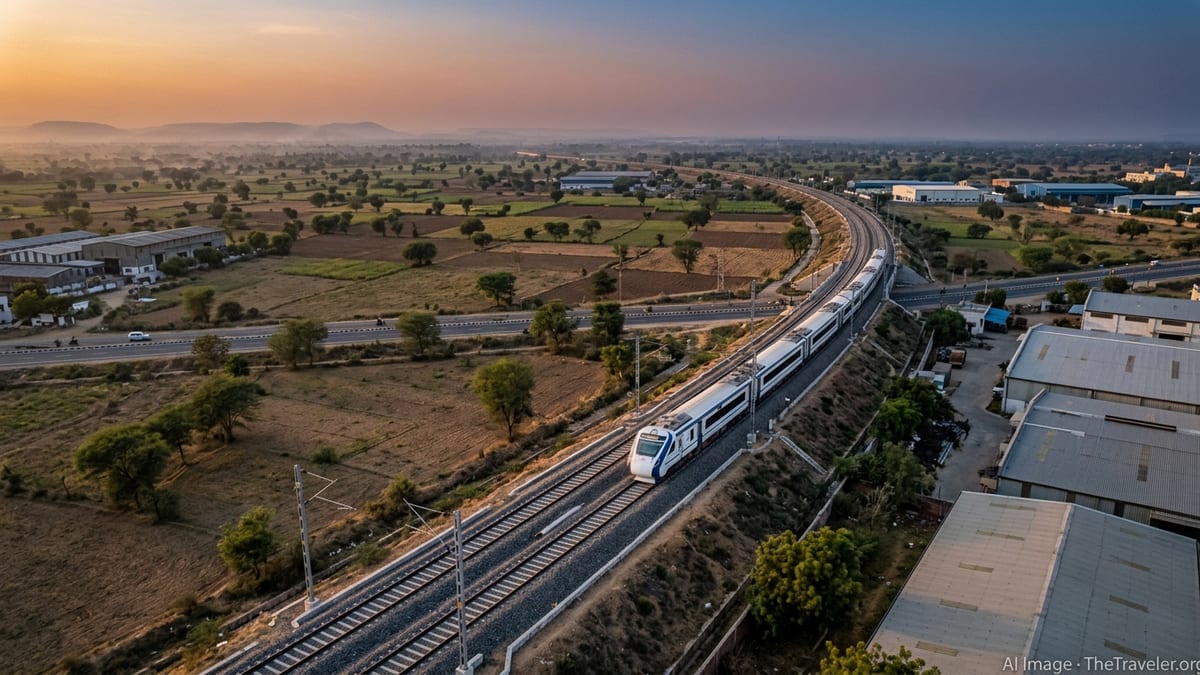
Strategic Rail Link in a Fast-Growing Industrial Belt
Recent planning and budget documents for the North Western Railway show a 191-kilometre set of works anchored on the Rewari–Jaipur axis, including sections between Garhi Harsaru and Rewari and between Jaipur and Phulera, signalling a broader effort to modernise and expand capacity on this heavily used route. While technical components are spread across segments, the emerging picture is of a continuous, higher-capacity rail spine that more closely integrates Rewari, Neemrana, and Jaipur within the wider national network.
The corridor would sit alongside a dense cluster of highways, industrial zones, and logistics assets already reshaping this part of the National Capital Region, including the Delhi–Jaipur highway, the Western Dedicated Freight Corridor, and the Delhi–Mumbai Industrial Corridor investment regions around Khushkhera, Bhiwadi, and Neemrana. Publicly available information from these projects highlights Rewari’s role as a key junction and Neemrana’s status as a major industrial and warehousing hub, indicating that an upgraded rail link is intended to complement rather than compete with road-based infrastructure.
By reinforcing the existing Delhi–Jaipur main line with targeted new capacity and connectivity, the 191-kilometre programme is expected to support both passenger mobility and freight flows, particularly where industrial clusters lack efficient rail access or where current tracks are constrained by older alignments and mixed traffic.
Boost to Industrial Corridors and Logistics Efficiency
The Rewari–Neemrana–Jaipur belt has been positioned for years as a critical node within the Delhi–Mumbai Industrial Corridor, with multiple planning reports identifying Khushkhera–Bhiwadi–Neemrana as an investment region and documenting strong demand from auto, engineering, logistics, and warehousing firms. A more robust rail corridor through this zone is therefore expected to strengthen supply chains by offering faster, more predictable connections to ports, dedicated freight lines, and inland markets.
Industry-focused studies on nearby expressways and freight projects already point to time and cost savings when high-speed corridors are introduced between Haryana’s industrial towns and Rajasthan’s manufacturing bases. Extending similar efficiencies to rail, especially where it can interface with the Dedicated Freight Corridor at Rewari and with industrial townships near Neemrana and Jaipur, would allow manufacturers to shift a greater share of bulk and containerised cargo from road to rail.
This shift is particularly significant for sectors that are sensitive to logistics costs, such as automotive components, textiles, and building materials, which have a substantial presence around Bhiwadi, Neemrana, and the Jaipur periphery. A better-integrated rail corridor could reduce truck traffic on the already congested Delhi–Jaipur highway, cut fuel consumption, and improve the reliability of deliveries across the region.
Improved Regional Accessibility for Workers and Travellers
The corridor’s travel implications extend beyond freight. Existing services between Jaipur, Rewari, and Delhi already carry substantial daily commuter and migrant worker traffic, and new trains introduced in recent years have demonstrated sustained demand for faster, more comfortable intercity options across Rajasthan and Haryana. As track capacity is expanded and modernised along the 191-kilometre stretch, planners expect an opening for additional passenger services and improved punctuality on existing ones.
Enhanced connectivity would be particularly meaningful for workers employed in industrial estates at Neemrana and Bhiwadi, many of whom commute from nearby towns or from Jaipur and Rewari. With more frequent and reliable rail options, businesses could draw from a wider labour catchment area while workers gain safer and more affordable alternatives to long bus or road journeys.
For leisure and business travellers, a smoother rail link between Jaipur’s tourism hubs, emerging conference venues, and Haryana’s logistics and healthcare centres could make multi-stop itineraries more attractive. This includes better access to Jaipur’s heritage districts, industrial townships near the capital region, and new institutional developments around Rewari that are drawing visitors and professionals from across northern India.
Employment, Urban Growth, and Real Estate Impacts
Experience from recent expressway and rail projects in Haryana indicates that new transport corridors tend to accelerate demand for land and services around junctions, interchanges, and industrial parks. As detailed in several state and industrial development reports, properties near major freight and expressway nodes in districts such as Rewari and Mahendragarh have seen rising interest from logistics firms, warehouse operators, and real estate developers following the announcement of new links.
A similar pattern is expected along the Rewari–Neemrana–Jaipur rail corridor, where construction activity itself is likely to generate short-term employment in civil works, signalling, electrification, and station upgrades. Over the longer term, improved access could encourage the growth of ancillary businesses such as transport services, hospitality, and small-scale manufacturing in towns that gain or upgrade railway facilities.
Urban planners have also indicated that better rail connectivity can support more balanced regional development, easing pressure on major metros by strengthening secondary cities and industrial towns. In this case, a stronger rail backbone may help distribute economic activity more evenly between the Delhi periphery, the Rewari–Neemrana industrial arc, and Jaipur’s expanding urban footprint.
Next Steps and Timelines Under Close Watch
While planning documents and budget references outline the technical scope of the 191-kilometre works, detailed timelines and specific commissioning dates for each section remain subject to further approvals, land acquisition processes, and construction progress. Observers of recent rail and expressway projects in the region note that such large-scale undertakings often advance in phases, with priority given to segments that unlock immediate capacity gains or connect to existing high-traffic nodes.
For businesses, workers, and travellers along the Rewari–Neemrana–Jaipur axis, the coming years will therefore be shaped not only by the final configuration of the corridor but also by the sequencing of partial openings, new train services, and integration with road and freight networks. As implementation advances, the 191-kilometre rail initiative is positioned to become a central element of northern India’s evolving transport map, with implications that reach well beyond its immediate alignment.