

More news on this day
Chippenham in Wiltshire is rapidly recasting itself from a commuter stop to a fully fledged visitor gateway, as a £2.3 million package of rail station and streetscape improvements begins to reshape how tourists arrive in and move through the historic market town.
A Strategic Rail Hub for Wiltshire’s Visitor Economy
Long known to many rail users simply as a convenient stop between London, Bath and Bristol, Chippenham is being repositioned as a prime landing point for visitors exploring Wiltshire’s heritage and countryside. The latest investment, worth £2.3 million, builds on recent accessibility schemes and public realm projects to create a more coherent, attractive arrival experience at the town’s Great Western Main Line station.
Great Western Railway services already put Chippenham within around 75 minutes of London Paddington and less than 15 minutes from Bath, while direct connections link the town to Swindon, Westbury and the wider TransWilts corridor. For tourism officials and local businesses, the station’s enhanced role as a regional gateway is critical to spreading visitor spending beyond traditional hotspots such as Bath, Lacock and the Cotswolds.
The funding dovetails with Wiltshire Council’s wider ambitions to encourage more sustainable travel into the county, reducing car dependency for visitors and residents alike. With the station as the main entry point, the town is being promoted as a launchpad for rail-and-walk itineraries that take in riverside paths, historic villages and nearby National Trust properties.
Local stakeholders say the shift is as much about perception as it is about infrastructure. By elevating the quality of the station environment and the streets that radiate from it, Chippenham is aiming to feel like a natural first stop rather than a place to simply pass through.
From Functional Stop to Welcoming Arrival Space
The £2.3 million station-focused investment concentrates on transforming the areas passengers encounter in the first few minutes after stepping off the train. Earlier schemes delivered lifts and step-free access on both sides of the railway, but the latest works focus on making the station forecourt, approaches and immediate streets safer, more legible and more inviting for visitors.
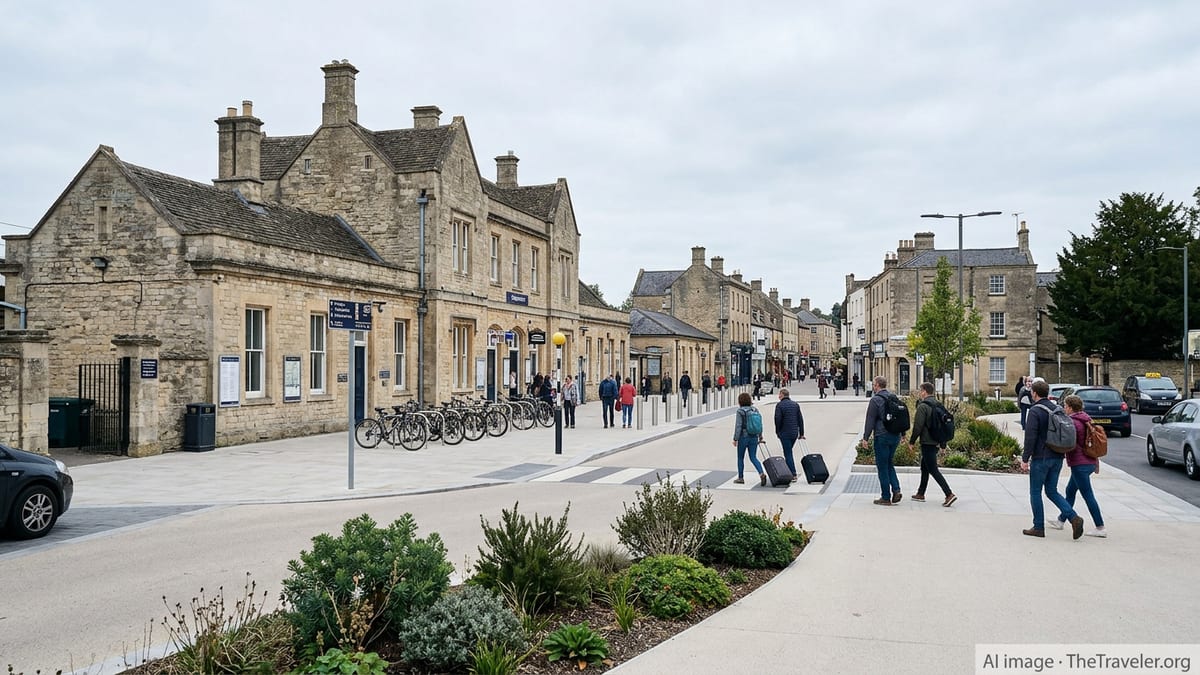
Plans include a reconfigured station square that prioritises pedestrians and cyclists, clearer sightlines from platforms to the town centre, and improved wayfinding to key attractions such as the riverside, the medieval core and local museums. A more intuitive layout for pick-up and drop-off points aims to reduce traffic conflicts, while upgraded lighting and planting are designed to soften what has historically been a car-dominated environment.
Transport planners say the emphasis is on creating a human-scale gateway that feels intuitive to first-time visitors. That means shorter, safer walking routes into the centre, fewer confusing road crossings and better integration with local bus services. Cycle parking and access to the National Cycle Network are being strengthened so that visitors can more easily continue their journeys on two wheels.
The measures reflect a wider shift in UK rail policy, which increasingly recognises that what happens outside the ticket barriers is just as important as on-platform facilities. In Chippenham’s case, officials believe that an improved sense of arrival will encourage day-trippers and weekend visitors to stay longer and explore further.
Linking the Station to Historic Streets and Riverside Walks
A crucial part of the programme is knitting the upgraded station into Chippenham’s historic fabric, so that visitors are drawn naturally toward its medieval streets, traditional markets and riverside spaces. The town centre, a short walk from the platforms, is being framed in promotion as an extension of the station experience rather than a separate destination.
Recent traffic management changes around the Market Place, including tighter controls on vehicle access, are intended to make the heart of Chippenham safer and more pleasant for pedestrians. For arriving tourists, this creates an almost continuous, low-traffic route from the station through the shopping streets to the riverside and parks, where trails connect onward toward villages such as Lacock and rural attractions across north Wiltshire.
Tourism businesses are responding by packaging rail travel with local experiences, from guided history walks to food-focused itineraries that showcase independent cafes, pubs and markets clustered within an easy stroll of the station. Hoteliers and guesthouse owners say the improved walking environment is already a selling point for visitors looking to avoid driving, particularly international tourists who are arriving in growing numbers via London and Heathrow.
The investment is also intended to support evening and shoulder-season tourism. Better lighting, clearer signage and a higher quality public realm between the station and town centre make it easier for theatre-goers, diners and event attendees to rely on late trains rather than cars, extending Chippenham’s appeal beyond the traditional daytime visit.
Accessibility and Sustainable Travel at the Core
Accessibility has been placed firmly at the centre of Chippenham’s station revolution. Recent upgrades have delivered three lifts and fully step-free routes to platforms from both sides of the railway, complementing the new emphasis on level, well-signed approaches and crossings outside the station. For visitors with mobility impairments, families with pushchairs and travellers with luggage, the town now offers a far smoother rail-based arrival than in the past.
Local leaders describe the £2.3 million package as a critical building block in Wiltshire’s shift toward low-carbon tourism. By making it significantly easier to arrive by train and to navigate the town on foot or by bike, they hope to encourage more visitors to leave their cars at home and to explore the surrounding countryside using public transport and active travel routes.
The project aligns with county-level climate and transport strategies that prioritise compact, walkable centres around key rail hubs. In Chippenham’s case, that means tightening the relationship between the station, nearby college campus, riverside employment sites and the retail core, so that visitors and residents can move easily between them without relying on private vehicles.
Rail operators, meanwhile, see an opportunity to grow leisure travel on existing services by marketing Chippenham as an easy, hassle-free weekend or short-break option. The message being pushed is that a single train ticket can unlock not just the town itself, but a wide sweep of Wiltshire’s landscapes and historic villages.
A Model for Smaller Town Gateways
As work progresses, Chippenham is attracting attention from planners and tourism specialists looking at how smaller towns on main lines can reposition themselves as visitor gateways. Unlike large city hubs, where major commercial development often dominates station projects, the Wiltshire scheme is focused on modest but carefully targeted interventions that collectively change how a place feels on arrival.
Local officials say the relative scale of the £2.3 million investment is a deliberate strength. Rather than a single, headline-grabbing structure, the project consists of coordinated changes to bridges, lifts, forecourts, crossings and public spaces that together create a more legible and welcoming journey from train door to town square.
If early reactions from residents and businesses are borne out by visitor numbers in coming seasons, Chippenham’s approach could provide a template for other market towns with strong rail connections but underdeveloped tourism identities. By focusing on accessibility, walkability and seamless links to local heritage, the town aims to prove that relatively modest sums can deliver outsized gains for both the visitor economy and everyday quality of life.
For now, as construction hoardings give way to new paving, planting and clearer routes into the centre, passengers stepping off at Chippenham are beginning to experience a station that feels less like a border and more like an open door to Wiltshire.