

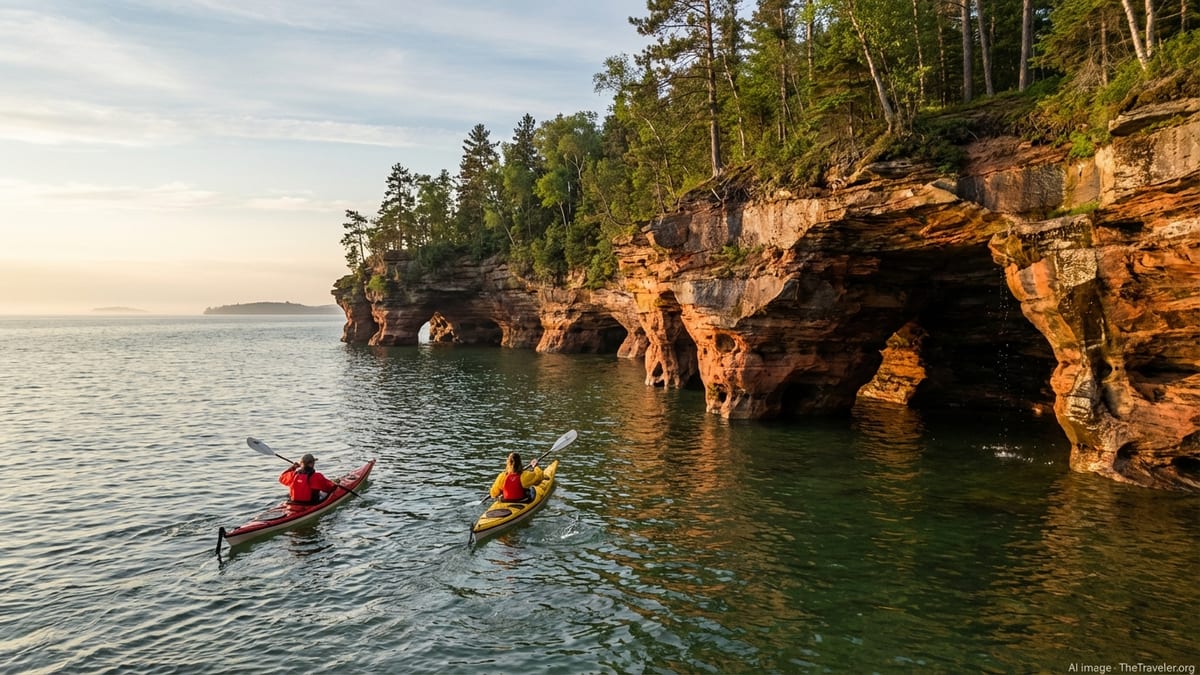
Few places in the Midwest feel as wild and elemental as the Apostle Islands, a scatter of forested sandstone islands off northern Wisconsin’s Bayfield Peninsula. Carved by Lake Superior into arches, tunnels and cathedral-like caverns, this national lakeshore offers an unforgettable short escape built around sea caves, island viewpoints and classic Great Lakes harbor towns. This 2 to 3 day Apostle Islands itinerary focuses on summer and early fall, when ferries and kayak outfitters are running and trails are snow free.
Planning Your 2 to 3 Day Apostle Islands Escape
The Apostle Islands National Lakeshore protects 21 islands and a stretch of mainland shoreline on Lake Superior. The area is compact enough for a weekend yet diverse enough that you can easily fill three or more days with paddling, hiking and boat trips. For a 2 day visit, base yourself in Bayfield or Washburn, focus on sea caves and one island cruise, and keep the schedule flexible for weather. With 3 days, you can slow down, add a hiking day on the mainland, or spend a night out on an island.
Summer conditions on Lake Superior can shift from glassy calm to steep waves and dense fog in a matter of hours. Park rangers strongly recommend treating any on-water time as a serious backcountry activity. Average water temperatures even in late summer tend to stay in the 50s, which means hypothermia is a risk in minutes without proper gear. Because of this, first time visitors often rely on authorized outfitters, guided kayak tours, or national park boat cruises instead of attempting long crossings on their own.
Bayfield is the main hub, with lodging, restaurants, marinas and the visitor center for Apostle Islands National Lakeshore. Washburn and Ashland, a bit farther south on Chequamegon Bay, offer more budget friendly motels and quieter evenings. Cornucopia, near Meyers Beach, puts you closer to the famous mainland sea caves but has limited services. Wherever you stay, advance lodging reservations are wise for July and August, as rooms can book out many weeks ahead.
This itinerary assumes you are visiting from roughly late June through September, when most commercial tours operate and island facilities are fully open. Winter access to the famed ice caves is a rare event that depends on weeks of subzero temperatures and stable lake ice, and should always be planned following the latest guidance from the National Park Service rather than any fixed itinerary.
Day 1: Bayfield Harbors, Orientation and Sunset Views
Start your Apostle Islands trip by grounding yourself in Bayfield and getting oriented to the park. Arrive by late morning if possible and visit the Apostle Islands National Lakeshore visitor center in downtown Bayfield. Exhibits here explain how Lake Superior carved the islands’ sandstone cliffs into the arches and caverns that draw so many paddlers today. Rangers can walk you through current marine forecasts, boating conditions, and any closures that may affect your plans.
After your stop at the visitor center, wander Bayfield’s compact harborfront. Fishing tugs, sailboats and tour vessels come and go throughout the day, with views across to Madeline Island and the more distant outer islands on a clear horizon. This is a good time to confirm or book a boat cruise, water taxi, or guided paddle for Day 2, because weather forecasts become more reliable within 24 hours. Many operators adjust routes based on lake conditions, so staying flexible maximizes your chances of safely reaching sea caves or remote island shorelines.
In the afternoon, consider stretching your legs on an inland hike before tomorrow’s time on the water. Local trails near Bayfield and Washburn lead through mixed hardwood and conifer forest, with modest elevation but frequent views toward Chequamegon Bay. If you would rather stay close to town, a leisurely walk along the waterfront and marina piers is enough to soak in the maritime feel of this small harbor community.
As evening approaches, seek out a sunset vantage point over Lake Superior. Weather permitting, twilight often washes the islands in pastel light and can give you a first glimpse of why paddlers time many cave tours for late day conditions. Some visitors opt for a short, calm water kayak outing in the protected reaches of Chequamegon Bay as a gentle introduction to paddling on Superior. Others simply watch the last ferries and fishing boats slip across the water before settling in for the night.
Day 2: Sea Caves and Island Perspectives
Day 2 is the heart of this Apostle Islands itinerary, when you focus on getting close to the sea caves that give the park its signature look. For many visitors, the safest and most memorable way to do this is on a guided kayak tour or small boat cruise that runs along the mainland cliffs near Meyers Beach or around islands such as Devils or Sand Island, where striking arches and tunnels puncture the shoreline. The National Park Service notes that the best summer views of sea caves are from the water, and that Devils Island, Sand Island, and the mainland near Meyers Beach are prime areas when wave and wind conditions are calm.
If you are an experienced cold water paddler with strong rescue skills and appropriate gear, you may choose to rent a true sea kayak from an authorized outfitter and launch from Meyers Beach or Little Sand Bay. The park recommends kayaks of about 16 feet or longer, equipped with bulkheads and spray skirts, and discourages small open boats, canoes, or sit on top kayaks for travel between islands. From Meyers Beach, the closest cluster of mainland sea caves lies roughly a mile and a half from the launch and then extends several miles along the shoreline, which makes for a full outing even in mild weather.
For those who prefer to leave the navigation and risk assessment to professionals, half day and full day cave tours are widely available in peak season. Many begin in sheltered waters, building confidence before approaching exposed cliffs. Guides monitor forecasts hour by hour and turn back when “confused water” from rebounding waves makes conditions unsafe near rock walls. Even with expert planning, it is common for trips to be rerouted to more protected sections of coastline when Lake Superior kicks up, so treat any itinerary that promises a specific cave or arch you will visit as provisional.
After time on the water, balance the day with an island perspective that does not depend on a paddle. Scheduled sightseeing cruises run from Bayfield and typically trace routes past several islands, lighthouses and historic fish camps. On calm days some boats may linger off sea cave lined shores to give passengers a closer look from a safe distance. If you opt instead for a water taxi to drop you at one island for hiking, budget time for shoreline walks and short interior trails that reveal how different each island feels, from wave battered cliffs to sheltered beaches and old growth hemlock groves.
Optional Day 3: Mainland Trails and Lake Superior Overlooks
With a third day, you can explore the Apostle Islands from above rather than from the water. The mainland Lakeshore Trail, which begins near Meyers Beach, is a standout choice. From the trailhead, a gradual route winds through forest for several miles before reaching overlooks where the forest abruptly falls away into vertical sandstone bluffs. Here you can peer down onto the same sea caves and arches you may have paddled the day before, watching waves roll through the openings and listening to the echo of water in the caverns below.
The full distance from the trailhead to the main viewpoints over the caves is roughly 2.5 miles one way, making this a moderate hike of about 5 miles round trip. Sections can be muddy after rain and the route has roots, rocks and short, steep pitches, so sturdy footwear is important. On hot summer days, this coastal forest walk still feels relatively cool thanks to Lake Superior’s influence, but bug spray and a head net can be helpful during peak mosquito and blackfly season.
If you prefer gentler walking, explore shorter shoreline paths near Little Sand Bay, or return to one of the islands via ferry or water taxi for a half day of relaxed wandering. Some islands have level sand spits and pocket beaches that are ideal for picnics and swimming on the rare days when surface water temperatures climb into a comfortable range. Inland, boardwalk style trails near the South Shore communities provide accessible options for those with limited mobility while still delivering glimpses of the lake and coastal wetlands.
However you spend Day 3, keep an eye on the weather and road conditions, especially in shoulder seasons. Fog can reduce visibility on the lake and on highways, while heavy rains in late summer sometimes swell streams that cross certain trailheads. Checking in with rangers or local outfitters each morning for updated trail and launch information helps avoid surprises and ensures that your final day in the Apostle Islands region ends on a relaxed note.
Seasonal Considerations and Safety Around the Sea Caves
While this itinerary focuses on the warmer months, it is impossible to talk about Apostle Islands sea caves without mentioning the rare winters when they transform into walkable ice caverns. National Park Service data shows that access to the mainland ice caves has historically been possible only during a very small fraction of days, and only when prolonged subzero temperatures, light winds and extensive ice cover line up perfectly. Even then, rangers emphasize that conditions can change quickly, and event style openings may last just days or weeks before warming temperatures or storm waves break the ice apart.
During summer and fall, sea caves pose an entirely different set of challenges. The park cautions that kayakers have suffered serious and sometimes fatal accidents at the caves, especially when waves bounce off the cliff walls and interact with incoming swells to form chaotic, multidirectional chop. It is common for skies to look calm from shore while conditions at the base of the cliffs are far more dynamic. Visiting the caves only in truly calm weather, wearing a personal flotation device and, in many cases, a wetsuit, and paddling with companions who know rescue techniques are all basic safety expectations.
For those with limited paddling experience, the simplest way to safely appreciate the sea caves is often to choose a fully guided trip in a true sea kayak, or to view the formations from a tour boat that keeps a prudent distance. Guides and captains can interpret radar, marine forecasts and local wind patterns, making real time decisions that most vacationers are not equipped to make. Even experienced paddlers often plan alternate inland lakes or more sheltered coastal routes as backups, recognizing that Lake Superior occasionally makes it clear that today is not a safe day to approach exposed cliffs.
Regardless of season, one universal safety principle in the Apostle Islands is to underestimate the help that will be available if something goes wrong. Cell service can be unreliable in pockets of the park, response times are long due to distances on land and water, and Lake Superior does not offer much margin for error. Building redundancy into your plans with extra clothing, food, water and communication devices, and leaving a detailed float or hiking plan with someone on shore, turns a beautiful itinerary into a responsibly managed adventure.
Where to Stay and How to Get Around
A successful short break in the Apostle Islands starts with choosing a base that matches your travel style. Bayfield, perched on a hillside above its harbor, is the most atmospheric choice if you want to be able to walk to restaurants, the ferry dock and the park visitor center. Lodging ranges from historic inns to modern motels and vacation rentals, with prices peaking in mid summer and during fall color season. Parking can be tight on busy weekends, so factor in a few minutes of walking between your accommodations and the waterfront.
Washburn and Ashland, located along the curve of Chequamegon Bay, offer a slightly more laid back feel with a mix of chain and independent motels, campgrounds and small cafes. These towns sit 15 to 30 minutes by car from Bayfield, which means a little more driving to reach ferries or Meyers Beach, but often with easier last minute availability. Cornucopia, closer to the mainland sea caves, has a handful of places to stay and a compact harbor area. It works well if your main goal is paddling or hiking near Meyers Beach and you do not mind a quiet evening scene.
Personal vehicles are by far the easiest way to travel between trailheads, outfitters and small harbors around the Bayfield Peninsula. Distances are modest, but many roads are two lane highways that wind through forest and small communities. Drive times can lengthen in fog, during road work, or when traffic builds heading to special events. Gas stations are clustered in the larger towns, so it is sensible to top off your tank when passing through Ashland or Washburn rather than counting on small rural stations to be open late.
On the water, you will rely on a mix of public ferries, scheduled cruise boats and private outfitters. The passenger and vehicle ferry to Madeline Island runs regularly in open water seasons and is a convenient way to add another island perspective without committing to a full backcountry trip. Park concession cruises typically depart from Bayfield, tracing set circuits past lighthouses and notable shorelines while narrating local history. Kayak and small boat tour companies launch from harbors around the peninsula, tailoring trips to match the day’s lake conditions and the skill levels of their clients.
Respecting Weather, Wildlife and Local Communities
Lake Superior dominates everything about the Apostle Islands experience, from travel logistics to local culture. Forecasts can change quickly, and fog, thunderstorms or high winds may rearrange your schedule with little warning. Building slack into your itinerary, such as keeping one morning or afternoon unscheduled, allows you to adapt. When conditions deteriorate and outfitters or rangers cancel trips, remember that such decisions are almost always made in the interest of safety and long term resource protection.
The islands and mainland forests provide habitat for black bears, nesting bald eagles, loons and a wide array of migratory songbirds. Following Leave No Trace principles is especially important in an island environment where ecosystems can be fragile. Pack out all trash, store food securely where camping is allowed, and stay on established trails to protect thin soils along cliff edges. On the water, give wildlife a wide berth, and avoid lingering directly under nesting sites or in narrow arches where your presence might disturb resting birds.
Finally, remember that the harbors and shorelines of the Apostles region are home to year round communities who make their living through a mix of tourism, commercial fishing and other industries. Respect private property signs, be mindful of parking rules at small marinas and trailheads, and support local businesses that operate with a light touch on the environment. By traveling thoughtfully, you help ensure that the same sea caves, island views and quiet harbor evenings remain unspoiled for future visitors.
FAQ
Q1. How many days do I need to see the Apostle Islands sea caves and main sights?
Most visitors are satisfied with 2 to 3 days, which allows one full day focused on sea caves and boat tours and another for hiking or extra island time.
Q2. Do I need previous kayaking experience to visit the sea caves?
No, but Lake Superior is demanding, so beginners are best served by joining a guided sea kayak tour in stable boats with professional instruction and safety support.
Q3. When is the best time of year for this 2 to 3 day itinerary?
Late June through September typically offers the most reliable combination of open visitor services, boat tours, and ice free conditions, though weather can still change quickly.
Q4. Can I count on the Apostle Islands ice caves being open in winter?
No. Access to the winter ice caves is rare and only happens in years with prolonged subzero temperatures and stable lake ice, so plans must remain flexible.
Q5. Are there safer alternatives if lake conditions are too rough for sea caves?
Yes. Protected paddling on inland lakes or in sheltered bays, lighthouse and sightseeing cruises, and mainland hikes all offer worthwhile experiences on rough days.
Q6. Is it possible to visit an island without camping overnight?
Yes. Sightseeing cruises and water taxis make it easy to spend a few hours hiking or exploring beaches on selected islands before returning to the mainland the same day.
Q7. Where should I base myself for a short Apostle Islands trip?
Bayfield is the most convenient base for ferries and cruises, while Washburn, Ashland and Cornucopia offer additional lodging choices with slightly quieter atmospheres.
Q8. How far are the mainland sea caves from the Meyers Beach launch?
The first cluster of mainland sea caves lies roughly a mile and a half from the Meyers Beach launch, with additional caves extending several miles farther along the shoreline.
Q9. What kind of kayak is recommended for Lake Superior conditions?
The National Park Service recommends true sea kayaks around 16 feet long with bulkheads and spray skirts, and does not encourage small open boats or sit on tops for long crossings.
Q10. Do I need permits or reservations for this itinerary?
Day hiking and sightseeing cruises do not usually require permits, but camping on park islands and many guided kayak tours need advance reservations, especially in peak season.