

More news on this day
From the glare of a once-in-a-century solar eclipse over North Africa to the shimmering northern lights above Iceland and the glaciers of Alaska’s Inside Passage, cruise lines are rolling out some of their most ambitious itineraries yet for 2027, betting that travelers want spectacle-filled voyages that go far beyond the standard sun-and-sea formula.
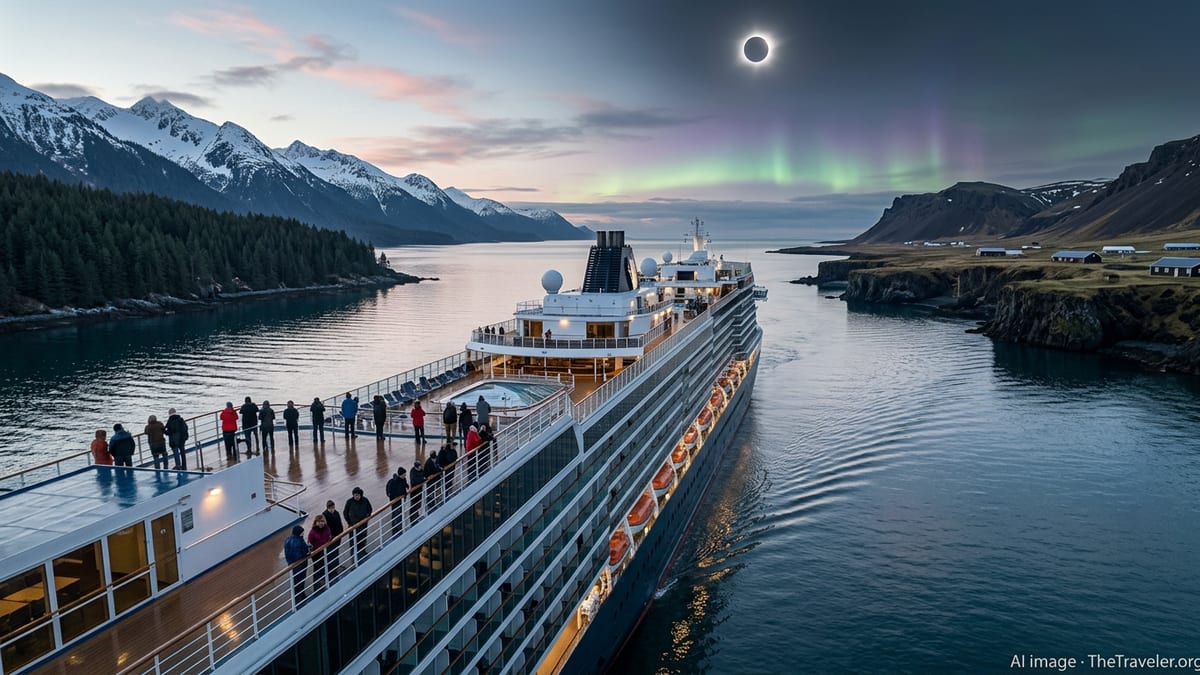
Eclipse Chasers Target Morocco and Tunisia at Sea
The total solar eclipse of August 2, 2027 is already being billed by astronomers as an “eclipse of the century,” and cruise operators are moving quickly to claim front-row positions along its path across North Africa. The narrow band of totality will cross the Strait of Gibraltar before sweeping over coastal Morocco and Tunisia, offering unusually reliable chances of clear skies compared with many previous land-based events.
Specialty and charter operators are building itineraries that combine classic Mediterranean ports with precision eclipse viewing at sea. Sailing off the coasts of Morocco and Tunisia allows ships to maneuver within the path of totality and adjust position on eclipse day to avoid cloud cover, a level of flexibility landlocked observers do not have. On board, travelers can expect guest astronomers, nightly sky briefings and safety gear such as filtered telescopes and eclipse glasses to turn the moment of totality into an immersive learning experience.
In Morocco, itineraries are pairing eclipse viewing with calls that showcase the country’s cultural contrasts, from whitewashed Tangier and the Atlantic fortress of Casablanca to inland excursions to imperial cities and desert fringes. In Tunisia, cruise lines are emphasizing Carthaginian and Roman heritage along the coast, framing the eclipse not only as a scientific event but as a rare celestial spectacle over landscapes that have witnessed millennia of astronomical observation.
Industry planners say interest is running especially high among repeat cruisers and dedicated eclipse chasers, many of whom are timing bucket-list trips to coincide with the 2027 event. As a result, eclipse-themed sailings in the western Mediterranean are among the earliest 2027 departures to attract strong advance inquiries, even before full deployment programs are publicly released.
Iceland Emerges as a Northern Lights Stage for 2027
Farther north, Iceland is consolidating its status as one of cruising’s most sought-after stages for aurora hunting. The island will already sit under the path of a total solar eclipse in August 2026, and that attention, combined with expectations of continued strong solar activity into 2027, is helping fuel a new wave of northern lights voyages built around Reykjavík as a turnaround port.
Expedition and premium lines are publishing 2027 sailings that weave Iceland into broader Arctic loops, combining remote Greenland fjords, Svalbard’s wildlife-rich coastlines and the volcanic landscapes of Iceland itself. These itineraries often sail in late summer and early autumn, when darkness returns to the high latitudes but seas can remain relatively manageable, giving guests realistic chances of seeing the aurora without the harshest winter conditions.
On board, operators are leaning into a more scientific and experiential approach to the northern lights. Many sailings now feature space-weather talks, photography workshops tailored to low-light shooting and late-night alerts that quietly sound in cabins when auroral activity spikes. Ashore, excursions highlight geothermal sites, black-sand beaches and glacier lagoons that feel otherworldly even in daylight, reinforcing Iceland’s image as a frontier destination wrapped around a modern, well-connected cruise hub.
With global demand for Iceland tourism still robust, port authorities in Reykjavík and smaller coastal towns are working with operators to stagger arrivals and promote smaller expedition-style visits alongside larger ship calls. For 2027, that is translating into more itineraries that circle the island or combine it with East Greenland and the Norwegian Arctic rather than treating it solely as a quick north Atlantic stopover.
Alaska’s Inside Passage Ups the Scenic Drama
On the opposite side of the Atlantic, Alaska’s Inside Passage is preparing for one of its most extensive cruise seasons yet in 2027, with major brands announcing expanded deployments, new ships and more varied itineraries along the glacier-carved route from Vancouver and Seattle into Southeast Alaska. Lines are betting that the combination of wildlife, Indigenous culture and close-up glacier viewing will continue to resonate with a new wave of post-pandemic travelers seeking remote nature without sacrificing comfort.
Seven to ten night Inside Passage voyages remain the backbone of most 2027 programs, but operators are adding twists that appeal to more adventurous guests. Some itineraries are lengthening calls in ports such as Juneau, Sitka and Ketchikan to accommodate flightseeing over icefields, small-boat forays into narrow fjords and guided hikes in temperate rainforest. Others are experimenting with shoulder-season departures that promise quieter ports and a higher chance of snow-dusted peaks framing the channels.
Newer and larger ships will share the waterway with smaller expedition vessels that can slip into lesser-visited inlets and anchorages. For travelers, that means a wider spectrum of experiences, from balcony-lined mega-ships offering classic scenic cruising past tidewater glaciers to intimate ships where Zodiac excursions and wildlife lectures are central to the day’s agenda. Across the board, Alaska itineraries in 2027 are placing more emphasis on environmental interpretation and partnerships with local communities, responding to rising traveler interest in conservation and cultural authenticity.
Cruise planners also note that Alaska’s Inside Passage serves as a logical counterpoint to the warmer-water eclipse and Mediterranean sailings that dominate midyear schedules. Many travelers are pairing an Alaska cruise with domestic travel in the Lower 48, viewing it as a high-impact yet logistically straightforward way to experience a pristine frontier within a single vacation window.
Bucket-List Voyages Blend Science, Culture and Spectacle
What unites these otherwise disparate routes through Morocco, Tunisia, Iceland and the Inside Passage is a growing focus on what cruise executives describe as “event-driven” travel. Rather than simply following classic loops, 2027 programs increasingly orbit around specific natural phenomena and cultural storylines, from the precise minutes of totality over North Africa to the glow of the aurora above Arctic seas and the thunder of calving glaciers in Alaska.
On board, that shift is reshaping the mix of activities that travelers encounter. There is more emphasis on expert-led programming, whether that means astronomers charting eclipse paths, geologists explaining Iceland’s restless tectonics or Indigenous storytellers in Alaska sharing perspectives on changing seas and wildlife. For many sailings, the draw is no longer only the destination list printed in the brochure, but the promise of understanding those destinations in a deeper, more connected way.
Cruise specialists say that these itineraries are also changing booking behavior. Because eclipses and peak aurora seasons are fixed in time, travelers are locking in cabins earlier, sometimes building entire gap years or milestone celebrations around a single departure. That in turn encourages lines to plan farther ahead, announcing 2027 voyages earlier and with more detail on scientific and cultural partnerships than in previous seasons.
For those willing to commit, the reward in 2027 looks set to be a new generation of bucket-list cruises that turn the ship itself into a mobile observatory and classroom. Whether anchored off the coast of Tunisia as day turns briefly to night, tracing Iceland’s volcanic shore under a curtain of northern lights or gliding through Alaska’s Inside Passage with glaciers on the horizon, passengers will find themselves at the intersection of science, scenery and seafaring tradition.
Planning Ahead for High-Demand 2027 Sailings
With the most coveted eclipse and aurora sailings already attracting outsized attention, industry advisers are urging travelers to approach 2027 cruise planning with more lead time than usual. Total solar eclipses that cross well-connected regions are rare, and cruise-capable ports along the path in Morocco and Tunisia have finite berths, which means only a limited number of ships can secure optimal positions for the August 2027 event.
Northern lights cruise capacity may appear broader, but cabins on itineraries timed to darker months and historically favorable weather windows are also expected to tighten. The same is true for premium Inside Passage voyages operated by newer ships and small expedition vessels, both of which are drawing strong loyalty followings in North America and Europe.
Observers say that the surge of interest in these itineraries underscores a broader trend toward travel that feels both spectacular and meaningful. For many potential guests, a 2027 eclipse sailing along the North African coast, a northern lights loop through Iceland and Greenland or a glacier-rich route through Alaska are not simply vacations but anchor experiences around which they are structuring several years of future travel.
However travelers choose to structure it, 2027 is shaping up as a watershed year for cruise itineraries that dare to link the movement of the seas with the rhythms of the sky. From Morocco and Tunisia to Iceland and Alaska’s Inside Passage, the most talked-about routes on the horizon promise a rare alignment of natural drama and maritime adventure.