

More news on this day
As the Maya Train continues to roll across southeastern Mexico, most travelers rush to book seats to Cancún, Mérida or Tulum, bypassing lesser-known stops that now offer rare access to riverside canyons, jungle-fringed ruins and small-town life unfolding far from the tourist corridors. Those overlooked stations are quietly reshaping how curious visitors can experience the Yucatán Peninsula and neighboring states, if they know where to get off.
A Mega Project Still Searching for Its Tourists
Since service began in late 2023, the Maya Train has been promoted by Mexican authorities as a transformational link between beach resorts, Maya archaeological sites and rural communities across roughly 1,500 kilometers of track in Tabasco, Chiapas, Campeche, Yucatán and Quintana Roo. Yet official figures show that the vast majority of riders still come from within Mexico, and overall passenger numbers remain well below early projections, particularly away from the Caribbean coast.
Government and industry data indicate that only a small share of passengers are foreign visitors, with most train journeys concentrated between Cancún and Mérida and to flagship destinations such as Chichén Itzá. Inland sections of the network, especially through Tabasco and Campeche, see a fraction of the traffic. Travel agents say many international tourists continue to rely on rental cars, long-distance buses and organized tours, often unaware that stations exist within striking distance of quieter ruins, biosphere reserves and artisan towns.
That uneven pattern of use has turned some remote platforms into the kind of under-the-radar stopovers that adventurous travelers usually need years to uncover. On a route designed to move thousands per day, trains still pull into certain stations to find only a handful of passengers stepping off, even in high season. For now, that lull is creating an unexpected window for visitors to explore parts of the Maya world with comparatively few tour buses and souvenir stalls.
Boca del Cerro: Gateway to the Usumacinta Canyon
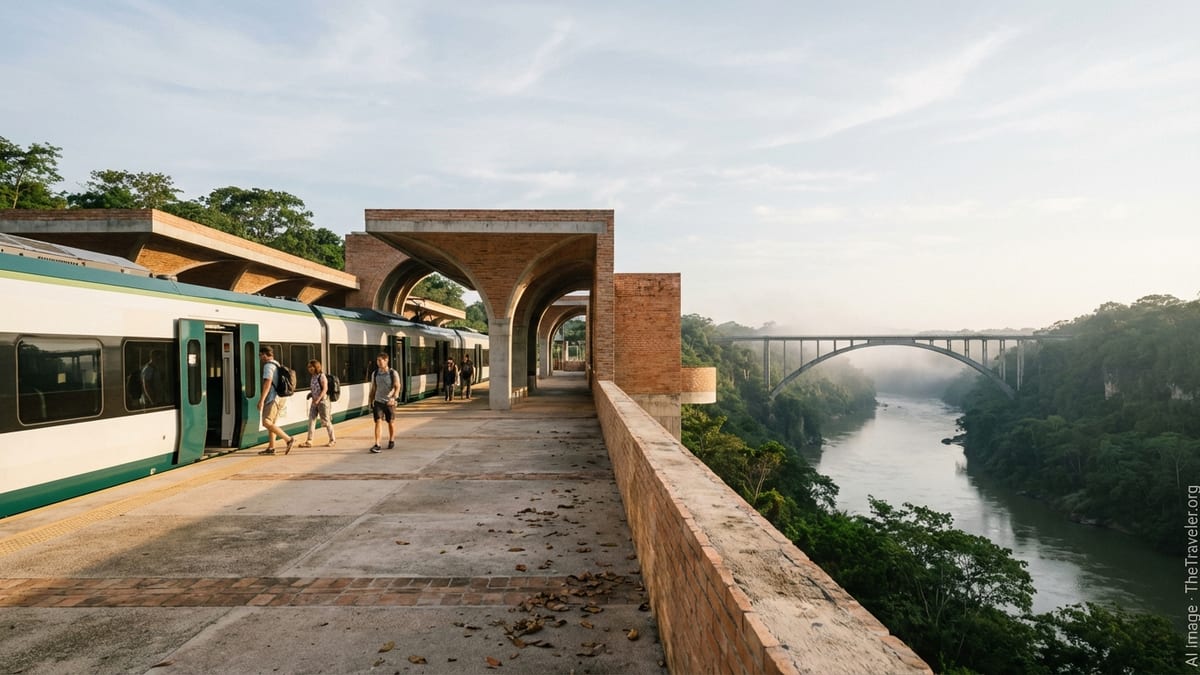
One of the most striking examples lies at Boca del Cerro, the second station on the line after Palenque and the first in the state of Tabasco. The low-slung brick and concrete building stands near the iconic arch bridge that crosses the Usumacinta River, its contemporary take on a Maya arch designed to channel air currents and shade passengers from the tropical heat. Yet despite the ambitious architecture and sweeping river views, staff and local guides say that trains routinely arrive with far more people staying on board than getting off.
From the station, a short drive leads to the Usumacinta Canyon, a little-known stretch of the river where steep, forested banks close in and small-boat operators wait to ferry visitors along rapids and eddies that form part of the natural border with Guatemala. The area is rich in birdlife, from herons skimming the waterline to scarlet macaws and toucans in the canopy, and remains largely undeveloped compared with Mexico’s better-known ecotourism hubs. On weekdays, it is not unusual for travelers to have entire river bends to themselves, shared only with local families on fishing outings.
The municipality of Tenosique, which administers Boca del Cerro, has been promoting the station as a springboard for regional experiences that barely register in mainstream guidebooks, including day trips to the Pomoná archaeological site and visits to rural communities along an emerging craft route. Municipal officials describe the train as a “new era” for the area, but acknowledge that the promised wave of visitors has yet to materialize. For those who do arrive, that gap between expectation and reality translates into short queues, unhurried conversations with guides and boatmen, and a chance to see how a major infrastructure project is intersecting with a riverside community at its own pace.
Practical obstacles still limit how many travelers can take advantage. Public transport links from the station to the town center remain sporadic, and services such as riverside restaurants and guesthouses are developing more slowly than the tracks themselves. Travel planners recommend that visitors book local operators and onward transfers in advance, or be prepared to negotiate informal taxis at the station. Even so, for passengers willing to step off early in their journey, Boca del Cerro offers a vivid reminder that the Maya Train is more than a shuttle between beach resorts.
Tenosique Stop: A Sleepy Platform with Big Ambitions
Just down the line from Boca del Cerro, the Tenosique stop functions as a smaller halt rather than a full-scale station, and it remains almost invisible in international tourism campaigns. The platform lies on the edge of a town that many Mexican travelers know as a commercial hub and borderland crossroads, but which rarely appears on foreign itineraries. On recent afternoons, ticket inspectors report entire cars disembarking at larger hubs while Tenosique sees only a scattering of students, traders and the occasional backpacker step onto the platform.
Local authorities nonetheless see the stop as a strategic link in a broader effort to reposition Tenosique as an ecotourism and culture gateway. The municipality highlights its proximity not only to the Usumacinta River but also to lesser-known nature reserves, waterfalls and caves that can be reached in a day trip by road. For visitors accustomed to the fully packaged experiences of Quintana Roo, the town offers a contrasting rhythm: shaded plazas where families gather in the evenings, simple eateries serving tamales and pozol, and markets where regional cheeses and smoked meats sit alongside everyday groceries.
Tenosique’s role as a staging point for cross-border migration has brought additional scrutiny to the area in recent years, but residents stress that the train is creating a separate, slower narrative focused on regional commerce and tourism. Hotel owners say that a modest but noticeable number of domestic visitors now arrive by rail to attend festivals, visit relatives or continue by road toward Palenque or Villahermosa, and they are preparing for a gradual uptick in international guests as word spreads. For now, room rates remain lower than in more famous destinations, and availability is easier to secure at short notice.
For travelers, that relatively low profile comes with trade-offs. English is far less widely spoken than in coastal resorts, and tourism infrastructure is still taking shape. Guides suggest that visitors with limited Spanish arrange tours in advance or travel with operators based in Palenque who are starting to bundle Tenosique and its surroundings into small-group itineraries. Those who make the effort often describe the experience as a glimpse of the Maya Train’s original promise: connecting everyday communities, not just headline attractions.
Maxcanú: Quiet Access to Ruins and Haciendas West of Mérida
Closer to the established tourist circuit, the Maxcanú stop in Yucatán has quietly opened a new rail gateway to the lesser-known western side of the peninsula. While service to Mérida’s Teya station and the colonial city itself dominates most advertising, the smaller platform at Maxcanú sees far fewer passengers, according to local tourism officials. Yet it sits within reach of significant archaeological and historical sites that, until now, have largely depended on car access from Mérida.
From Maxcanú, travelers can hire taxis or pre-arranged transfers to reach the Kabah and Uxmal archaeological zones along the so-called Puuc Route, a chain of Maya sites noted for their intricate stone mosaics and jungle surroundings. Uxmal remains better known than its neighbors, but still draws only a fraction of the visitors who crowd Chichén Itzá on a typical day. Further off the main tourist radar, smaller sites such as Xcoch and Oxkintok offer atmospheric plazas and pyramids with few other visitors in sight, especially during early morning and late afternoon light.
The surrounding countryside is dotted with former henequen haciendas, some restored as boutique lodges and others partially reclaimed by vegetation, their stone arches and chimneys rising above fields of scrub and agave. Local entrepreneurs in Maxcanú and nearby villages are beginning to offer guided cycling routes, cenote swims and culinary experiences built around traditional Yucatecan dishes such as cochinita pibil and relleno negro. Operators say that the arrival of the Maya Train has shortened travel times and reduced logistics costs, but they concede that most international travelers still opt to base themselves in Mérida and book road tours instead of using the smaller stop as a hub.
For visitors who do step off at Maxcanú, the advantages are tangible: shorter driving distances to key ruins, less congested access roads and a chance to overnight in rural guesthouses rather than returning to the city each evening. The town itself remains low-key, with modest hotels and family-run restaurants clustered around its main square. Travel planners recommend checking current timetables carefully, as some services run only once or twice daily, and building in extra time for local transfers, which may not yet be synchronized with train arrivals.
Why These Stations Stay Off Tourist Radars
The relative quiet at Boca del Cerro, Tenosique and Maxcanú reflects broader structural challenges that have tempered early expectations for the Maya Train. Many stations are located several kilometers from town centers, and in some cases, connecting buses are limited or priced beyond what local residents consider affordable. Travelers arriving on evening services sometimes report having to rely on taxis or informal rides when scheduled shuttles do not appear, adding uncertainty and cost to what was billed as a seamless journey.
Industry analysts note that the majority of international marketing still focuses on high-profile beach destinations and UNESCO-listed ruins, reinforcing familiar patterns of movement across the region. Package tours featuring smaller stations remain rare, and international travel advisories and guidebooks have been slow to integrate detailed information about schedules, ground transport and services at intermediate stops. As a result, many visitors simply do not realize that stepping off a train or two earlier could put them minutes from river canyons, artisan villages or less-visited archaeological zones.
Perception also plays a role. Safety incidents on the line have been minimal and non-fatal, but any derailment or disruption tends to generate headlines that eclipse quieter stories about communities building new tourism products around the tracks. Environmental debates over the project’s impact on forests and underground cave systems have likewise dominated coverage, leading some foreign travelers to view the train more as a controversy than a practical transport option. Local officials argue that increasing responsible, low-impact tourism at smaller stations could help demonstrate that the rail line can support community-led projects and nature-based experiences, rather than just mass tourism to resort areas.
A Different Kind of Maya Train Journey
For visitors willing to look beyond the main stations, these underused stops offer a different way of thinking about rail travel in southeastern Mexico. Instead of treating the train solely as a fast connection between beach and ruin, travelers can build itineraries that ride shorter segments, combining rail with local buses, taxis and community-based tours. That approach requires more planning, but it also allows for serendipitous encounters, from early-morning breakfasts in station cafeterias to conversations with artisans and guides who rarely see international guests.
Tour operators experimenting with new routes say that demand is starting from a low base but showing signs of growth, particularly among younger travelers and repeat visitors to Mexico who have already ticked off marquee attractions. Some are testing two- or three-night loops that begin in Mérida or Palenque, include overnights near Boca del Cerro or Maxcanú, and then reconnect with the main line toward Quintana Roo. As more accommodation and transport options align with the train’s schedule, they expect those pilot itineraries to become easier to scale.
For now, the window remains wide open. Trains still pull into riverside Boca del Cerro to find the Usumacinta glinting in the afternoon light with few outsiders in sight. Platforms at Tenosique and Maxcanú still feel more like community stations than tourist hubs. For travelers drawn to quieter corners of the Maya world, those gaps between expectation and reality may be precisely what makes these three stops worth discovering before the crowds catch up.