

More news on this day
A severe rain event forecast to deliver up to 320mm of rainfall over parts of northern New Zealand from Thursday is poised to disrupt flight schedules on key trans-Tasman and long-haul routes, with major airlines and hotels preparing for days of turbulence, cancellations and last-minute itinerary changes for visitors from Australia, the United States, China and the United Kingdom.
Get the latest news straight to your inbox!
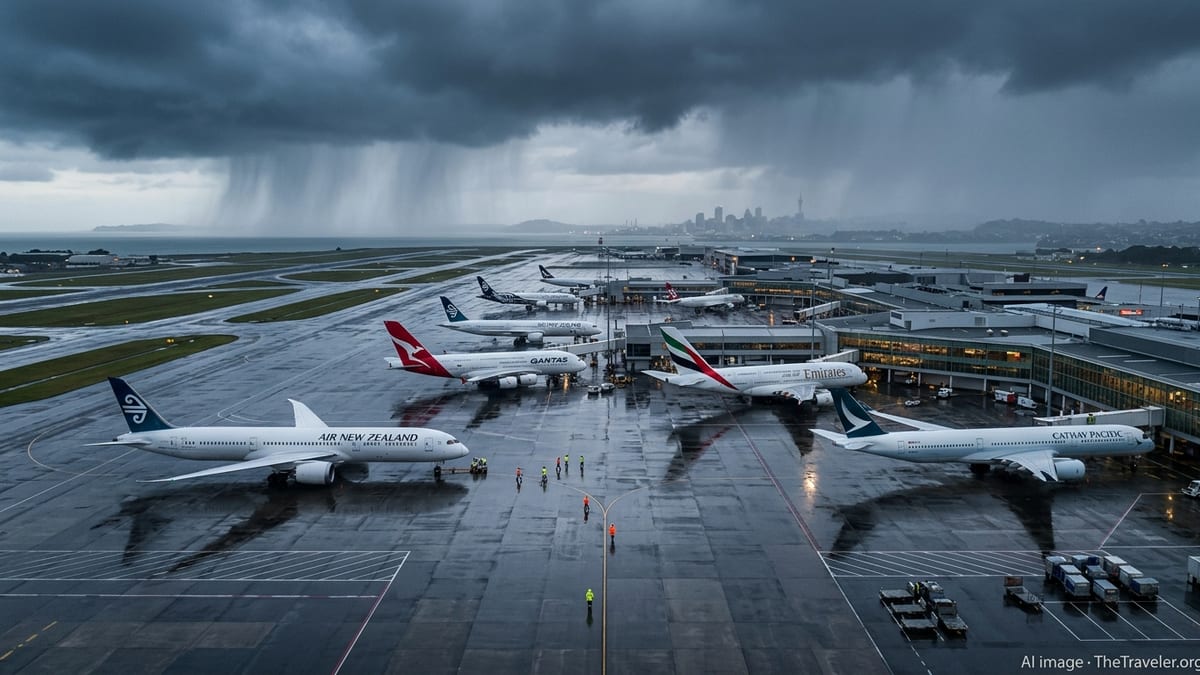
Multi-day deluge forecast for northern New Zealand
Publicly available forecasts from New Zealand’s national meteorological service indicate a high-impact rain system tracking toward the upper North Island, with some models pointing to 270 to 320mm of rain falling between Thursday afternoon and early Friday in the hardest-hit areas. The heaviest accumulation is expected in Northland and parts of Auckland and surrounding regions, where saturated ground and steep terrain raise the risk of flooding and landslides.
Weather updates describe the approaching system as a multi-hazard event, combining prolonged heavy rain with periods of gale-force winds and coastal swells. The timing, coinciding with a busy late-summer travel window, is raising concern across aviation and hospitality operators who are still managing residual disruption from earlier storms this year.
Recent climate summaries and historic flooding events in New Zealand highlight how similar rainfall totals have previously overwhelmed drainage networks, closed key highways and led to local states of emergency. With forecasters signaling the possibility that existing orange warnings may be escalated to the highest-tier red alerts in some districts, transport links in and out of Auckland, the country’s main international gateway, are under close scrutiny.
Major international airlines prepare for schedule disruption
Air New Zealand, Qantas, Emirates, Singapore Airlines, Cathay Pacific and American Airlines all operate into Auckland, with several also serving Christchurch and Wellington. Based on publicly available schedules, many of these carriers are exposed to potential knock-on effects if ground operations are slowed by flooding, low visibility, high crosswinds or temporary runway inspections.
In previous severe weather events, airlines have responded by trimming frequencies, consolidating services and imposing temporary pauses on check-in or boarding during peak wind or lightning periods. Industry commentary following recent New Zealand storms indicates that airlines now tend to move early to adjust rosters and crew positioning, in order to avoid aircraft and staff being stranded at outstations for days.
The latest rain projections are likely to trigger similar planning. Widebody flights linking Auckland with Sydney, Melbourne, Brisbane, Los Angeles, Dallas, Dubai, Singapore, Hong Kong and key Chinese hubs may see departure times shifted, minimum connection windows tightened and rebooking volumes increase. Public statements from airports and carriers during prior New Zealand weather disruptions have urged passengers to monitor their booking status closely and allow more time to navigate congested terminals when disruption peaks.
Domestic networks are also at risk, particularly short sectors into smaller regional airports prone to waterlogged runways and low cloud. Connecting passengers arriving from Australia, North America, China and the United Kingdom could face missed onward links to destinations such as Queenstown, Rotorua and Napier if the storm’s heaviest bands align with morning and evening banked departures.
Tourists from Australia, US, China and UK face itinerary turmoil
The upper North Island is one of New Zealand’s most popular regions for international visitors, with strong inbound flows from Australia, the United States, China and the United Kingdom. Tourism industry analysis shows that many first-time visitors build tight, multi-stop itineraries around Auckland, Northland and the central North Island, relying on punctual domestic flights and long-distance coach services.
Heavy rain of the magnitude currently forecast has the potential to derail those plans. Road authorities routinely warn that intense downpours can trigger surface flooding, slips and sudden closures on key intercity routes, particularly north of Auckland and across the central plateau. When combined with reduced flight capacity, that can leave travellers facing long queues at car-rental desks, sold-out coach services and limited same-day alternatives.
Travel forums and social media posts in recent days already reflect heightened anxiety among visitors driving between coastal towns as initial MetService warnings were issued. While many commentators describe these alerts as part of New Zealand’s weather reality, they also highlight the need for flexible planning, including keeping at least one buffer day in itineraries during the late-summer storm season.
For long-haul tourists who may have booked non-refundable excursions and prepaid experiences, even short delays can have a cascading cost. Missed day trips to popular islands, cancelled sightseeing cruises and rescheduled domestic flights can quickly absorb travel insurance deductibles, particularly when disruption extends over multiple days.
New Zealand hotels brace for cancellations and no-shows
Hotel operators across Auckland, Northland and key gateway cities are closely watching the evolving forecasts, with memories still fresh from earlier flooding events that led to abrupt waves of cancellations. Industry performance data for recent storm periods showed sharp swings in occupancy as guests either abandoned travel plans altogether or extended stays unexpectedly when roads and airports were closed.
Larger hotel groups and serviced apartment providers have, in past events, shifted to more flexible change and cancellation rules once severe weather became likely. Industry reports suggest that similar approaches are being discussed again, as properties weigh the short-term cost of relaxed policies against the reputational damage of enforcing strict penalties during a high-profile weather emergency.
Regional tourism organisations have previously encouraged visitors trapped by bad weather to remain in place until conditions improve rather than attempting risky overland detours, a stance that can help sustain local hotels and restaurants even as new arrivals fall away. If heavy rain forces the closure of scenic roads, coastal walking tracks and outdoor attractions, city hotels near indoor activities and shopping districts may see steadier demand than remote resorts.
For operators in smaller towns heavily dependent on seasonal international visitors, the immediate concern is a wave of pre-arrival cancellations from travellers who see dramatic rainfall figures and decide not to come at all. That risk is amplified for businesses still recovering from recent volcanic ash disruptions and fuel-related schedule cuts reported on some Air New Zealand services.
Travel advice focuses on flexibility and real-time information
Travel advisories from New Zealand transport and emergency management agencies during earlier storms have consistently promoted a cautious approach: avoid non-essential travel into areas under the highest rain warnings, follow detour instructions, and keep abreast of changing conditions. With models again pointing to intense localised rainfall and the possibility of upgraded alerts, similar guidance is expected to frame the public messaging around this event.
For international visitors already in the country, travel experts typically recommend several practical steps. These include enabling airline and airport notifications, checking flight status frequently in the 24 hours before departure, and confirming airport transfer times with extra buffer built in. Tourists planning long drives across the upper North Island are often urged to review official highway updates before setting off and to have backup accommodation options in case progress is slower than expected.
The looming storm is also reviving discussion in the tourism sector about climate resilience. A series of recent rain and flood events across New Zealand has highlighted the exposure of coastal towns, river valleys and transport corridors to extreme weather, just as international arrivals are rebuilding. Hotel investors and tour operators are beginning to factor more frequent weather interruptions into their financial forecasts, particularly for the peak shoulder seasons when many long-haul travellers visit.
While the final impact of the forecast 320mm deluge will depend on the storm’s exact track and intensity, the coming days are shaping up as another major test of how New Zealand’s aviation, tourism and accommodation sectors manage climate-driven volatility, and how quickly they can restore confidence for visitors once the skies finally clear.