

More news on this day
Ultra-wealthy travelers stuck in the Gulf are turning to eye-watering private jet charters costing up to $350,000 as airspace closures and missile strikes cripple commercial aviation across the Middle East, turning Saudi Arabia and the United Arab Emirates into focal points of an extraordinary, high-priced exodus.
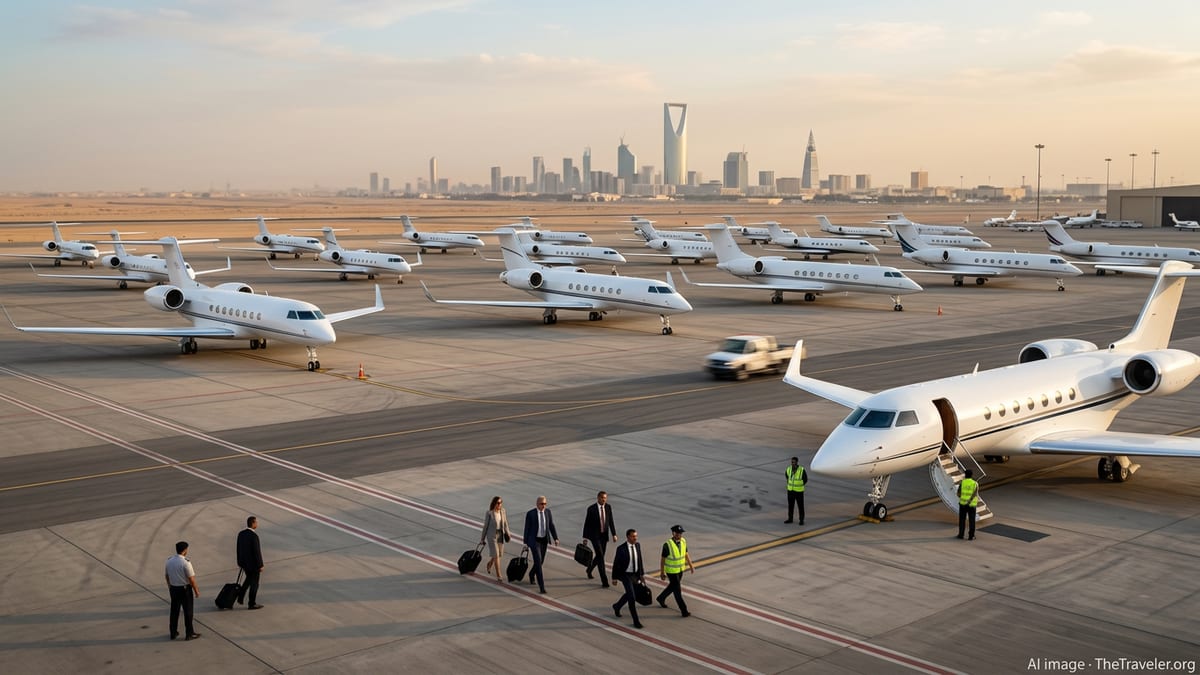
Riyadh Emerges as a $350,000 Escape Valve
As conflict-linked airspace restrictions ripple across the region, Riyadh has rapidly become the most reliable launchpad for private jet evacuations to Europe. Private aviation brokers report that a single charter from the Saudi capital to European cities such as London, Rome or Istanbul can now reach $350,000, several times the typical pre-crisis rate.
Normally, a heavy jet on this route might cost between $50,000 and $150,000, depending on aircraft size and availability. Today, the combination of closed airports elsewhere in the Gulf, aircraft stranded on the ground, and elevated insurance and security costs has pushed prices into unprecedented territory. Operators say these figures reflect genuine scarcity and risk rather than opportunistic price gouging.
Saudi Arabia’s open airspace, relatively unscathed infrastructure, and ability to handle larger business aircraft at Riyadh’s main airport have made the kingdom the default escape corridor for high-net-worth individuals and senior executives who can afford such charters.
Charter firms and security companies describe a constant stream of inquiries from corporate clients relocating key staff, as well as wealthy families cutting short holidays or business trips and seeking the fastest possible way out of the region.
UAE Closures Drive Overland Rush to Alternative Hubs
In the United Arab Emirates, the usual dominance of Dubai and Abu Dhabi as global aviation hubs has been upended. Repeated missile and drone threats, coupled with damage to infrastructure, have forced widespread flight cancellations and partial airspace closures, leaving tens of thousands of commercial passengers stranded while only limited repatriation services operate.
With direct departures from the UAE severely curtailed, a new evacuation pattern has emerged. Convoys of SUVs and coaches are ferrying affluent travelers overland from Dubai to airports in Saudi Arabia and Oman, often involving drives of four to ten hours through heavily monitored border crossings.
These road journeys, coordinated by private security firms, add thousands of dollars in additional cost on top of already inflated charter prices. Travelers are enduring multi-hour queues at border posts and strict security checks, all in a bid to reach functioning airports such as Riyadh or Muscat, where private jets and occasional commercial services still depart.
Industry analysts note that what were once routine regional connections now resemble complex multi-leg evacuation itineraries, stitched together at short notice and priced at levels that only a tiny fraction of travelers can contemplate paying.
Aircraft Scarcity and Risk Premiums Inflate Charter Costs
The spike in prices for private jet charters out of the Gulf is being driven as much by supply constraints as by surging demand. Many business jets that would typically serve clients in Dubai, Abu Dhabi, Doha and other Gulf cities are grounded at closed airports, unable to reposition. Brokers are therefore sourcing aircraft from Europe, Central Asia or Africa, adding costly empty legs and complex routing around restricted airspace.
Operators must also navigate rapidly changing risk assessments, with insurers, pilots and regulators scrutinizing every flight plan. Detours to avoid closed or contested skies lengthen flight times and fuel burn, while mandatory safety margins and crew duty limitations further constrain capacity.
Private jet executives say that, in some cases, the cost of simply positioning an aircraft into the region approaches what a full charter might have cost before the crisis. That repositioning burden, layered on top of hazard pay, higher insurance premiums and airport handling surcharges in a high-risk zone, is being passed directly on to end clients.
As a result, light-jet hops that previously cost less than six figures are now well into that range, while long-range heavy jets, especially those capable of nonstop links from Riyadh to Western Europe, have pushed toward the headline-grabbing $350,000 mark.
Stranded Masses Highlight a Two-Tier Travel Crisis
Behind the surge in seven-figure evacuation packages lies a stark contrast: for every traveler able to pay for a private jet, many thousands more remain stuck in hotels, cruise ships and airport terminals across the region, waiting for commercial schedules to restart. Travel industry data suggests that more than eleven thousand flights have been canceled in recent days, affecting around a million passengers.
Gulf cruise passengers and package tourists, in particular, have seen their plans thrown into disarray. Some governments are organizing limited charter flights to repatriate their citizens, but seats are scarce and departure dates uncertain. Travel agencies report that many itineraries that once connected seamlessly via Dubai or Doha must now be entirely rebooked or abandoned.
This divergence has sharpened debate about equity in crisis response, with images of luxury jets departing relatively quiet regional airports while economy passengers queue at packed hotel lobbies or wait out curfews on board cruise vessels anchored off the UAE coast.
Aviation consultants warn that even once airspace restrictions begin to ease, it could take days or weeks for major carriers to restore network connectivity, clear backlogs and re-position aircraft and crews. For stranded travelers without access to business aviation, the path home is likely to remain slow and uncertain.
Implications for Gulf Tourism and Business Travel
The current rush toward ultra-premium evacuation charters may be a short-term phenomenon, but industry observers say it could have longer-lasting consequences for how global travelers perceive safety and reliability in the Gulf’s key hubs. Dubai, Abu Dhabi and Doha have spent decades building reputations as secure, seamless transit points linking Europe, Asia and Africa.
That carefully cultivated image has been shaken by scenes of shuttered terminals, grounded fleets and emergency departures. Corporate travel managers are already reviewing contingency plans, including diversifying routings away from any single regional hub and establishing clear protocols for rapid staff extraction in the event of renewed tensions.
Private aviation companies, meanwhile, are recalibrating their own exposure to high-risk zones, weighing lucrative emergency demand against the operational and reputational risks of flying near active conflict areas. Some brokers expect that, even after prices normalize, a subset of wealthy clients will retain a heightened appetite for flexible, on-demand access to private aircraft as a form of security insurance.
For now, the Gulf’s skies tell a story of extremes: commercial passengers grounded by airspace closures, and a narrow elite willing to pay up to $350,000 to escape on private jets from Saudi Arabia and, where possible, the United Arab Emirates.