

More news on this day
Passengers at Kuwait International Airport are facing another day of disruption as 37 flights were cancelled with no delays officially recorded, highlighting how the ongoing closure of Kuwaiti airspace is now measured less in late departures than in services that never take off.
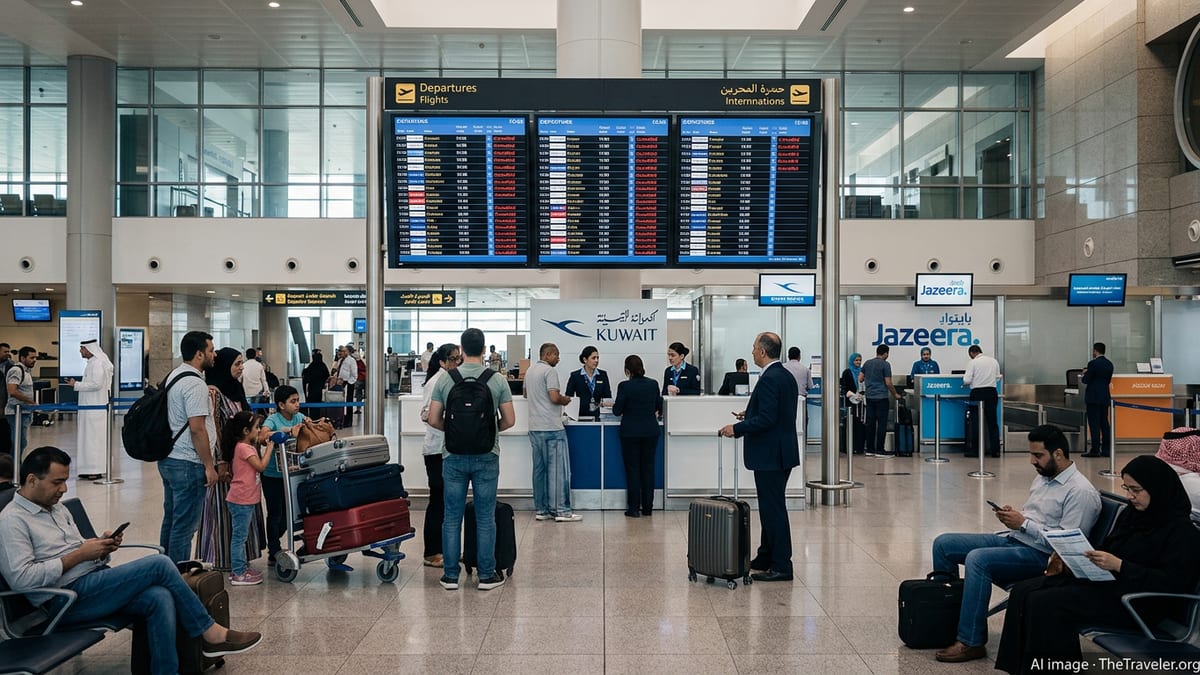
Silent departure boards as cancellations mount
At Kuwait International Airport on Tuesday, departure boards told a stark story. Rows of flights were marked as cancelled, yet the airport’s operational summaries showed no significant delays. For many travelers, the absence of delay statistics offered little comfort in the face of outright cancellations affecting 37 scheduled services.
The unusual pattern reflects the way airlines are adapting to the current regional security crisis. Instead of allowing departures to stack up with long waits, carriers are proactively scrubbing flights from the schedule. Kuwait Airways, Jazeera Airways and several foreign airlines serving the Gulf state have axed services in advance, cutting their losses and limiting on-the-day congestion inside the terminals.
Inside the airport, the atmosphere has swung between quiet resignation and tense uncertainty. Some passengers arrived to find their flights already removed from the boards, while others learned only at check-in that their journeys had been cancelled or rerouted through alternative hubs in Saudi Arabia or elsewhere in the Gulf.
Airport staff have been tasked with guiding stranded travelers toward airline desks, hotel counters and information booths. With no visible queues at security due to the reduced schedule, many of the longest lines are now at ticket offices and customer service points instead of boarding gates.
Airspace closure drives strategy at Kuwait Airways and Jazeera
The wave of cancellations is rooted in the broader shutdown of Kuwaiti airspace that began in late February, after regional tensions escalated and authorities moved swiftly to protect key infrastructure. Kuwait Airways, the national carrier, has maintained only a skeleton operation focused on repatriation and essential travel, consolidating routes and cancelling most of its regular commercial schedule.
Jazeera Airways, Kuwait’s main low cost airline, has pursued a different but equally disruptive strategy. With Kuwait International Airport largely shut to normal traffic, the carrier has shifted parts of its operation across the border to Qaisumah Airport in Saudi Arabia, a drive of several hours from Kuwait City. Limited charter and repatriation flights are being organized from there, but these services are not yet sufficient to absorb the full demand that would typically pass through Kuwait’s main airport.
Foreign airlines have also trimmed or suspended their Kuwait flights, either cancelling outright or rerouting passengers through alternative Gulf gateways such as Riyadh, Jeddah or Muscat. For Tuesday’s tally of 37 cancellations, that meant a mix of scrapped regional hops and longer haul services that would otherwise have connected Kuwait to key hubs in Europe and Asia.
By cancelling early and in blocks, airlines have managed to keep formal delay statistics low, since flights are removed from the schedule instead of operating hours behind. For travelers, however, the practical impact is more severe than a traditional delay, as many face complete itinerary rebuilds, overnight stays or lengthy ground transfers to reach functioning airports.
Travelers stranded between rebooking, refunds and reroutes
For passengers, the operational strategies of airlines and regulators translate into a complex web of options and uncertainty. Those booked on Kuwait Airways and Jazeera Airways are being offered rebooking on future services, travel vouchers or refunds, depending on fare class and route. Yet with the timeline for a full reopening of Kuwaiti airspace still unclear, some travelers worry that postponements may simply lead to further cancellations down the line.
Families attempting to return to Kuwait or depart for work assignments have reported juggling last minute changes, with some choosing to fly into neighboring countries and complete their journeys by road. Others, unable to secure suitable alternatives, are extending hotel stays or delaying trips altogether, waiting for more clarity before committing to new tickets.
Travel agents in Kuwait City say they have been fielding a surge in calls from customers looking to reroute via alternative hubs where flights are still operating, even if that means longer itineraries and higher fares. Agents report that some regional carriers are opening up additional capacity from Saudi and Omani airports to absorb displaced passengers from Kuwait and other affected Gulf states.
Despite the frustration, many passengers acknowledge that the cancellations stem from security and airspace considerations beyond the control of any single airline. The challenge lies in the uneven flow of information, with some customers receiving timely notifications and others discovering changes only when they attempt to check in online or arrive at the airport.
Operational calm masks deeper disruption for Kuwait’s hub
Operationally, Kuwait International Airport has remained orderly, helped by the sharply reduced schedule. With far fewer aircraft movements, there have been no significant runway queues, and ground handling teams are dealing with a lighter load than usual. That operational calm, however, masks a deeper disruption to Kuwait’s role as a regional aviation hub.
Before the current crisis, Kuwait International Airport functioned as an important connector between South Asia, the Gulf and parts of Europe, with Kuwait Airways and Jazeera Airways anchoring transfer traffic. The cancellation of dozens of daily flights has pushed much of that transit demand into neighboring states, at least temporarily shifting economic activity and passenger flows away from Kuwait.
Aviation analysts note that while airports and airlines can bounce back quickly once airspace reopens, the longer term impact will depend on how long passengers and corporate clients perceive Kuwait as a higher risk or less reliable transit point. Frequent cancellations, even if well managed, may prompt some travelers to favor alternative gateways when booking future itineraries.
For now, the priority remains restoring a basic level of connectivity for residents and citizens. Limited repatriation flights, ground transfers to Saudi airports and ad hoc charter operations are expected to continue while regulators monitor the security situation. The figure of 37 cancellations without recorded delays on Tuesday captures just one day of a disruption that is entering its third week and testing the resilience of Kuwait’s aviation sector.