

More news on this day
As airlines rebuild long haul networks and prepare for a wave of next generation jets, a handful of giants stand out for one defining feature: wingspans that stretch well beyond most airport gates, reshaping everything from route planning to runway layouts.
Get the latest news straight to your inbox!
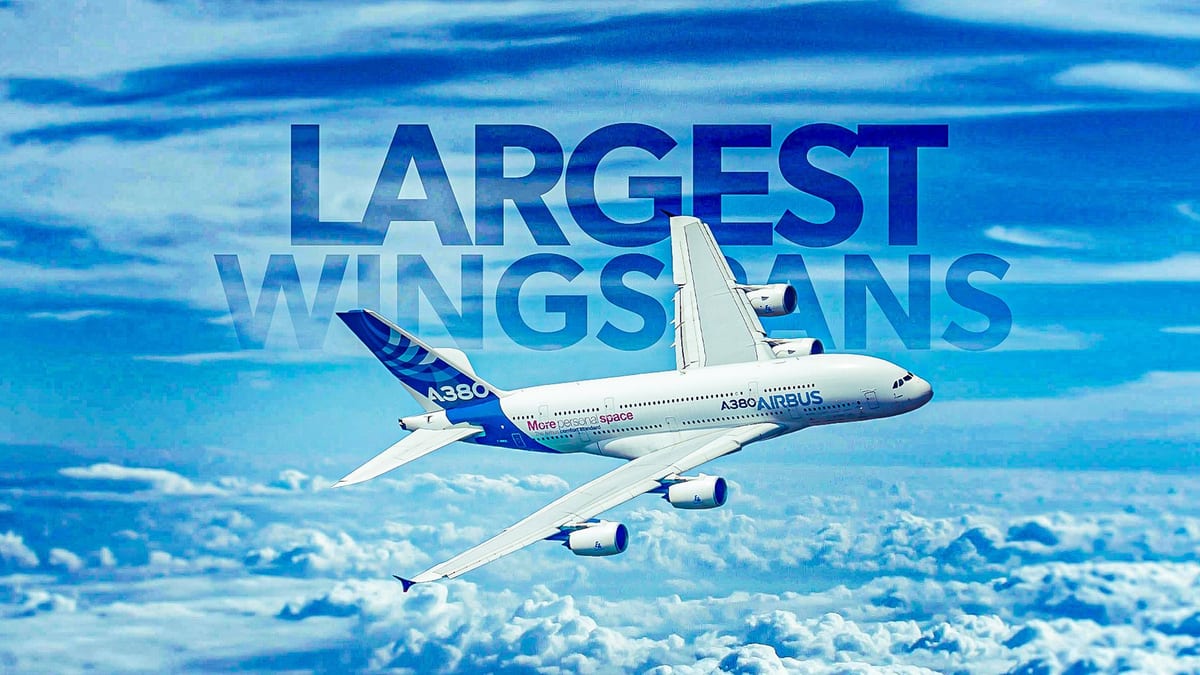
Image by Simple Flying
Airbus A380: The Benchmark Giant
The Airbus A380 remains the undisputed giant of passenger aviation, with a wingspan of about 79.8 meters and a place in the most demanding airport size category. Publicly available specifications show the double deck flagship was designed right up to the so called 80 meter box limit used in airport planning, a figure that still places it at the top of commercial wingspan rankings.
The A380’s immense wing was optimized to lift up to 853 passengers in a single class layout on ultra long haul routes, while delivering the range and climb performance expected of a modern widebody. Its size led airports to widen taxiways, reinforce runways and introduce special stand types to handle the aircraft’s footprint.
Although Airbus ended production in 2021, the type’s wingspan continues to shape network decisions. Carriers such as Emirates, Qatar Airways and Singapore Airlines are extending the life of their fleets, betting that slot constrained hubs and strong premium demand will continue to justify the A380’s outsized wing and capacity well into the next decade.
With renewed interest in high density long haul travel, industry analysts note that the A380’s wing remains a reference point for future large aircraft designs, even as manufacturers focus on smaller, more efficient twins.
Boeing 777X: Record Span With Folding Wingtips
Boeing’s 777X family is set to claim the title of largest wingspan among twin engine airliners, and one of the largest in commercial service overall. The 777 9, the launch variant now undergoing an extended certification program, has an extended wingspan of roughly 71.8 meters, enabled by long composite wings with raked tips.
To keep airport compatibility in check, the 777X introduces folding wingtips that bring the span down to just over 64 meters when raised on the ground. Industry and regulatory documents classify the jet in the same top airport reference group as the A380 when the tips are deployed, reflecting the challenge of accommodating such a broad wing while maintaining access to existing infrastructure.
Program updates from late 2025 and early 2026 indicate that first customer deliveries have been delayed to around 2027, but test aircraft are already a familiar sight at Boeing’s facilities and on long range certification flights. The extended wing is central to the program’s promise of lower fuel burn compared with current generation 777s, leveraging higher aspect ratio aerodynamics and new General Electric GEnx derived engines.
Once in service, the 777X is expected to become the de facto replacement for many aging 747 and 777 fleets, bringing one of the largest wingspans in commercial aviation to more airports and passengers than any other aircraft in its size class.
Boeing 747 8: The Last Queen of the Skies
The Boeing 747 8, the final and largest evolution of the iconic four engine jumbo, features a wingspan of about 68.5 meters, placing it just behind the A380 and 777X in today’s commercial rankings. The redesigned wing, with raked tips instead of the classic winglets of earlier 747 variants, delivers improved fuel efficiency and range compared with the 747 400.
Passenger versions of the 747 8 are now limited to a handful of operators, but the freighter variant continues to be a mainstay of global cargo networks. Its wingspan, combined with a distinctive hump backed profile, remains a defining feature at major cargo hubs and select long haul passenger routes.
Airport planning data categorizes the 747 8 alongside the largest commercial types, requiring wide taxiway separations and specialized parking stands. For many aviation observers, the type represents a bridge between the era of four engine flagships and the new generation of high span twins such as the 777X and Airbus A350.
As production has ended and the fleet gradually shrinks, the 747 8’s wing design is often cited as a stepping stone toward even higher aspect ratio concepts now being studied in research programs on both sides of the Atlantic.
Airbus A350 Family: Long Reach, High Aspect Ratio
Airbus’s A350 family brings one of the largest wingspans in active twin engine service, with the A350 900 and A350 1000 sharing a span of about 64.8 meters. The carbon fiber wing, with its distinctive curved sharklet tips, was developed to balance long range performance with compatibility at airports originally designed for earlier widebodies such as the A330 and Boeing 777.
The A350’s wingspan, while smaller than the A380 and 747 8, still pushes many airports toward higher reference codes and upgraded clearances on key taxiways. Industry reports highlight the type’s role in enabling very long haul point to point routes, including nonstop services linking Europe, Asia and Oceania that would previously have relied on larger four engine aircraft.
Airlines continue to order the A350 as a replacement for aging 777 200 and A340 fleets, often citing the combination of large wing area, advanced aerodynamics and modern Rolls Royce engines as central to fuel burn reductions. The design demonstrates how manufacturers are stretching spans close to practical limits even on twin engine platforms.
With proposals circulating for an ultra long range A350 variant and potential freighter derivatives, the aircraft’s wing is expected to remain a core element of Airbus’s long haul strategy well into the 2030s.
Boeing 777 300ER and Airbus A340 600: Legacy Long Span Twins and Quads
Among current generation widebodies, the Boeing 777 300ER stands out with a wingspan of approximately 64.8 meters, matching the A350 in span and remaining one of the largest in regular passenger service. Airport design manuals frequently reference the type when defining standards for long range twins, reflecting its extensive global deployment since the mid 2000s.
The 777 300ER’s wing, with its raked tip extensions and high structural efficiency, helped make the aircraft a favorite for airlines operating dense long haul routes where range and payload are critical. Even as the 777X approaches entry into service, a sizable 777 300ER fleet continues to operate across Europe, Asia, the Middle East and North America.
Close behind in span is the Airbus A340 600, a four engine widebody whose wingspan is often cited at around 63.5 meters. While production ended more than a decade ago and the active fleet has declined, the type still appears on select long haul routes and in charter or special mission roles, keeping its long wing present at major international airports.
Together, the 777 300ER and A340 600 illustrate how manufacturers pushed near the upper limits of Category E airport wingspan envelopes before the arrival of Category F giants such as the A380 and 777X, establishing a baseline for today’s high capacity twins.
Airport Infrastructure and the Future of Large Wings
The concentration of very large wingspans among a small group of aircraft has significant implications for airports. Facilities that wish to host the A380, 747 8 or future 777X services must invest in wider taxiways, larger parking stands and in some cases reinforced pavement, all of which carry substantial cost.
At the same time, advances in materials and aerodynamic design are driving manufacturers toward even higher aspect ratio wings, which can reduce fuel burn and emissions but require careful integration with existing infrastructure. Solutions such as the 777X’s folding wingtips indicate how the industry is trying to capture aerodynamic gains without forcing every airport to rebuild around wider spans.
Research programs in Europe, North America and Asia are now exploring truss braced wings and other concepts that could push wingspans far beyond today’s limits for future generations of airliners. For now, however, the six aircraft highlighted here define the practical ceiling for wingspan in commercial service, and their presence continues to influence how airlines schedule flights and how airports invest in the next wave of long haul growth.