

More news on this day
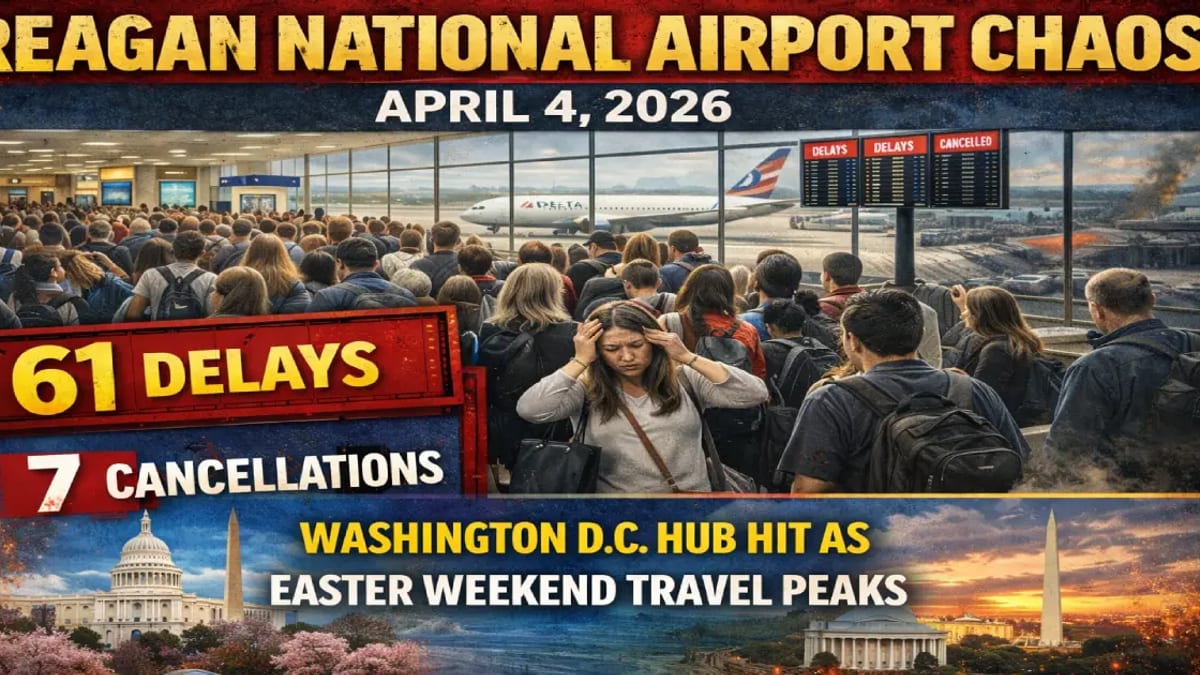
Reagan National Airport faced a new wave of travel disruption on April 4 as 68 delayed and canceled flights crowded departure boards, straining operations at American Airlines’ key Washington hub and adding to a broader pattern of spring travel turbulence across the United States.
Get the latest news straight to your inbox!
American’s Washington Hub Feels the Strain
Publicly available flight-tracking data for April 4 indicate that roughly 68 flights at Ronald Reagan Washington National Airport were either significantly delayed or canceled, placing the compact airport among a group of U.S. facilities experiencing elevated disruption levels in early April. While the absolute numbers are lower than those seen at giant hubs such as Chicago O’Hare or Atlanta, the impact at Reagan National is magnified by the airport’s tight runway capacity and its outsized role in the nation’s capital region.
American Airlines, the dominant carrier at Reagan National, appeared to shoulder a substantial share of the day’s operational stress. Aggregated tracking figures and recent analyses of airline performance show American contending with recurring bottlenecks across its network this spring, with knock-on effects traveling quickly through core hubs including Washington, Dallas, Chicago and New York. At Reagan National, that concentration of service meant that delayed aircraft and crews on a handful of routes could ripple through the schedule, leaving passengers facing rolling departure time changes and missed connections.
The latest difficulties arrived on the heels of other recent disruption events in the Washington region. Reports in late March described a temporary ground stop affecting Reagan National and neighboring airports after an issue at an air-traffic facility triggered a wave of delays. Those earlier interruptions highlight how sensitive the airport is to any constraint on airspace or runway throughput and provide important context for understanding why a tally of 68 disrupted flights on a busy spring Friday quickly translated into visible crowding in terminals and long customer-service queues.
Although weather conditions in the mid-Atlantic were not as severe as during major winter storms earlier in the year, operational data and recent coverage of national flight trends suggest that even modest constraints on staffing, airspace management or aircraft availability can now push Reagan National toward its limits. In that environment, American’s hub strategy at the airport, which relies on turning aircraft and crews quickly through limited gates, can become particularly vulnerable when any part of the system falters.
Part of a Wider Web of Spring Travel Disruptions
The strain at Reagan National on April 4 formed part of a wider web of spring travel disruptions covering multiple regions of the United States. Recent analysis by transportation reporters and aviation data providers shows that airports such as Boston Logan, Chicago Midway, Philadelphia, Nashville, Atlanta and San Francisco have all reported clusters of delays and cancellations in late March and early April, with some days seeing hundreds of late departures and dozens of grounded flights.
Coverage of national statistics suggests that early April has brought elevated delay counts across the U.S. network, with total daily disruptions topping several thousand flights on some days. In this broader context, Reagan National’s 68 affected services represent one node in a system where aircraft, crews and passengers are tightly interconnected. A delay on a morning departure from Washington can strand an aircraft needed later in the day in another city, while a cancellation at a distant hub can leave a Reagan-bound flight without a crew or inbound plane.
Travel industry reporting has underlined that the present disruption pattern is not limited to a single carrier. While American, United, Delta, Southwest and other major airlines have each recorded days with heavy disruption at their primary hubs, the cumulative effect for travelers is experienced as a generalized sense of unpredictability, regardless of the logo on the tail. Reagan National’s role as a connector between Washington and dozens of business and political centers means that schedule instability there can reach into government, corporate and leisure travel plans alike.
Analysts point to several contributing factors, including lingering staffing constraints across parts of the air-traffic control system, tight airline schedules that leave little slack, and seasonal weather that may not rise to the level of a crippling storm but still requires slower operations. In such an environment, even a localized ground delay program or minor equipment issue can quickly swell the tally of delayed departures at an airport like Reagan National.
Runway Limits, Perimeter Rules and Structural Bottlenecks
Reagan National’s unique operating environment amplifies the impact of any disruption. The airport is hemmed in by the Potomac River, bridges and dense urban development, with just a handful of runways and stringent noise and approach procedures. Federal perimeter rules, which limit most nonstop flights to destinations within 1,250 miles, were designed in part to manage congestion and protect nearby airports, yet they also concentrate a high volume of short-haul and shuttle traffic into tightly scheduled waves.
Official planning documents and regulatory notices in recent years have highlighted how runway closures and construction phases can further narrow the airport’s margin for error. Staggered maintenance work and infrastructure upgrades scheduled through the mid-2020s have occasionally required temporary capacity reductions, with advisories noting the potential for higher congestion, delays and cancellations during certain phases. When such constraints intersect with a busy travel period, the number of flights affected can climb quickly, even if total operations remain lower than at larger hubs.
American’s hub strategy at Reagan National depends heavily on rapid aircraft turns, with many flights spending less than an hour on the ground before departing again. Industry observers note that this kind of operation can be efficient under ideal conditions but leaves little room to absorb shocks such as weather reroutes, late-arriving crews or airspace flow restrictions near Washington. As a result, a relatively modest schedule disruption translating into 68 affected flights can nevertheless put visible strain on gate availability, baggage handling and customer service desks.
Past incidents at the airport, including aircraft ground contacts and airspace safety concerns in the Washington area, have also drawn attention to the complexity of operating in the capital’s tightly controlled skies. While those events are distinct from the April 4 disruption and stem from different causes, they contribute to an overall picture of an airport where operational resilience remains an ongoing challenge despite continued investment in infrastructure and procedures.
Impact on Passengers and Knock-On Effects Beyond Washington
For travelers passing through Reagan National on April 4, the figure of 68 disrupted flights translated into crowded gates, longer security and boarding lines, and, in some cases, missed meetings or vacations. Passenger accounts shared on social platforms in recent disruption events at other airports describe long waits to rebook, scarce same-day alternatives and difficulties reaching human agents during peak periods, patterns that likely resonated with many affected Washington-area flyers.
Because American uses Reagan National as a connecting point for routes across the East Coast and into the Southeast and Midwest, disruptions at the airport can quickly propagate to other cities. A cancellation on a Washington to Raleigh or Charlotte service can, for instance, remove an aircraft from later rotations, while late departures to hubs like Chicago or Dallas may cause onward misconnects for travelers heading to smaller regional destinations.
Observers of recent national disruption events have also emphasized the increasingly digital nature of the passenger experience. During busy days, airline mobile apps and websites often struggle under surging demand, with some travelers reporting error messages or long refresh times when many people attempt to change itineraries simultaneously. At Reagan National, where same-day seat inventory on key business routes can be limited, the race to secure an alternate flight during a disruption may hinge on how quickly passengers can access those digital tools.
Hotel occupancy near the airport and in downtown Washington can rise modestly on days with heavier disruption, as some passengers opt to stay overnight rather than accept lengthy multi-stop rebookings. Travel advisers generally recommend that passengers traveling through constraint-prone airports such as Reagan National build extra time into connections, book earlier flights where possible and monitor weather and national delay maps in the days leading up to departure to anticipate potential trouble spots.
What Today’s Figures Suggest About the Months Ahead
The cluster of 68 disruptions at Reagan National on April 4 adds another data point to a spring travel season already marked by instability. While the scale of the problems in Washington falls short of the worst episodes seen at larger hubs, the airport’s strategic importance and limited capacity mean that even moderate disruption carries outsized consequences for the broader network.
Recent analyses of delay statistics across major U.S. airports indicate that facilities like Reagan National contribute a significant share of national delay minutes in a typical year, reflecting both structural bottlenecks and the intensity of daily demand. The early April pattern, in which multiple hubs have reported overlapping issues, suggests that airlines and infrastructure planners may face continued pressure to improve schedule resilience before the peak summer travel season arrives.
For American Airlines in particular, sustained operational stress at Reagan National could complicate efforts to market reliability gains and premium services in the Washington region. Aviation analysts note that frequent travelers often weigh on-time performance heavily when choosing between carriers and airports, especially on high-frequency shuttle routes to New York, Boston and other political and financial centers.
Looking ahead, incremental improvements in air-traffic staffing, airport infrastructure and airline scheduling strategies may help reduce the frequency and severity of disruption clusters like the one recorded at Reagan National on April 4. However, as the latest figures show, the combination of tight capacity, hub concentration and strong demand means that Washington-area travelers are likely to continue facing occasional days when even a relatively small number of schedule shocks can leave an outsized mark on departure boards.