

Most visitors arrive in Alaska chasing glaciers, wildlife and bucket-list road trips. They come in summer, follow familiar cruise itineraries and rarely step far beyond a handful of marquee events. Yet scattered across this vast state is a quieter calendar of festivals that locals anticipate all year and most travelers never even hear about. These gatherings are smaller, more rooted in community and often shaped by traditions far older than Alaska’s statehood. Plan a trip around one of them and you will see a very different Alaska: one of village potlatches, forest clearings turned music grounds, winter carnivals lit by aurora and sports that grew out of Arctic survival.
Nalukataq: Arctic Whaling Festival in Utqiagvik
Far above the Arctic Circle, along the windswept Chukchi Sea coast, the Iñupiat community of Utqiagvik marks the end of the spring bowhead whale hunt with Nalukataq, a whaling festival that blends gratitude, sharing and joy. The celebration usually unfolds in June, after successful whaling crews have brought home massive bowheads that feed the community throughout the year. While it is renowned in Alaska’s North Slope villages, many visitors to the state have never heard of it, let alone considered timing a trip around it.
At its heart, Nalukataq is about distribution and community responsibility. Portions of each whale are carefully saved throughout the season so they can be shared during the festival, alongside other traditional foods. Long plywood tables fill with caribou, waterfowl soups, muktuk and doughnuts, and whaling captains’ families work with volunteers and teenagers to serve everyone who comes. It is understood that the doors are open to all, and elders emphasize that no one should leave hungry.
The most visually famous tradition is the blanket toss. Crews stretch a walrus-hide blanket tight while individuals take turns stepping into the center and launching into the air, sometimes flipping, sometimes tossing handfuls of candy toward watching children. For outsiders, it can look like a performance; for locals, it is intertwined with hunting history, when being lifted above the ice could help spot distant game or leads in the sea ice.
Travelers who are respectfully invited to attend need to remember that Nalukataq is a living cultural ceremony, not a tourist attraction. Photography is usually welcomed, but deference to local guidance is essential. Dress for raw Arctic summer conditions that can feel wintry to most visitors, and understand that there are no grandstands or VIP tickets here. You stand on gravel and tundra next to residents, sharing food and wind, and catch a fleeting glimpse of how subsistence life shapes the rhythm of the year.
World Eskimo Indian Olympics in Fairbanks
Every July, Fairbanks hosts one of the most distinctive athletic events in North America: the World Eskimo Indian Olympics, widely known as WEIO. Founded in 1961, the gathering was created to celebrate and preserve traditional skills that were once essential to survival in the Arctic. Today, it remains an important cultural touchstone for Inuit, Iñupiat, Yupik and other Indigenous athletes from across Alaska and beyond, yet it rarely appears on mainstream visitor itineraries.
The competition events are like nothing at a typical sports meet. The high kick, knuckle hop, one‑foot and two‑foot kicks, and ear pull all have practical roots in hunting, signaling across ice and enduring extreme cold. Spectators watch athletes explode upward to touch a suspended target, or grit their way across the floor on their knuckles, bodies taut with concentration. Many of these games demand a blend of strength, balance, pain tolerance and technique that is hard to appreciate until you see them up close.
WEIO is as much cultural festival as sporting event. Dance groups perform from coastal and river communities, storytellers explain the background of events, and vendors sell handmade crafts and beadwork in the concourse. The Miss WEIO cultural pageant focuses not on evening gowns but on fluency in language, knowledge of tradition and the ability to share that heritage with younger generations. It is a powerful antidote to stereotypes that reduce Alaska Native culture to static museum displays.
For travelers, attending WEIO is a chance to time a visit to Fairbanks during the height of midnight sun and connect with living traditions. Plan several days, as the schedule stretches over four intense evenings. Tickets are affordable, seating is informal and the atmosphere is welcoming, but visitors should approach with humility. Pause to read program notes, listen to emcees explain the history of each event and, when possible, choose locally owned hotels or guesthouses whose staff can help you better understand the stories behind what you are seeing.
Girdwood Forest Fair: A Hippie Haven in the Spruce Trees
Thirty-odd miles south of Anchorage, the ski town of Girdwood transforms each early July into a freewheeling arts and music gathering known as the Girdwood Forest Fair. What began as a small community happening has grown into a beloved summer ritual featuring local bands, craft booths and food stalls tucked into a wooded valley. Despite its popularity with Anchorage residents, many out‑of‑state visitors pass right by en route to the Kenai Peninsula without realizing they are missing one of Alaska’s most relaxed festivals.
The fair’s unofficial motto could be read on its playful signs: no dogs, no politics, no religious orders. That ethos shapes the event’s easygoing spirit. Old‑growth spruce trees shade gravel paths between tie‑dye vendors, jewelers working with moose antler and caribou bone, and food trucks serving everything from salmon gyros to reindeer sausage. A small parade winds through town, bands plug into low‑slung stages, and families spread picnic blankets on the mossy ground while kids dart in and out of the trees.
Unlike some big-ticket festivals, the Forest Fair remains organized by volunteers as a nonprofit. There is no entrance fee, and proceeds beyond operating costs are donated back into local organizations, from youth programs to fire and rescue services. For visitors who worry about overt commercialization, it feels refreshingly handmade and grounded in place. That said, its success brings crowds, and the town’s limited parking and lodging can quickly fill, especially when the fair coincides with holiday weekends.
To fold the Forest Fair into a broader trip, consider basing in Anchorage and using the scenic Seward Highway to make day trips for one or two festival days. Carpooling and shuttles are strongly encouraged, and overnight camping is only allowed in designated areas, which are strictly enforced. Bring cash for vendors, a rain jacket for quick mountain showers, and a willingness to wander without much of a plan. You are here less for a headliner act and more for the cumulative texture of music, cottonwood fluff, mountain light and the sense that everyone has briefly escaped city life together.
Fur Rendezvous: Anchorage’s Wild Winter Carnival
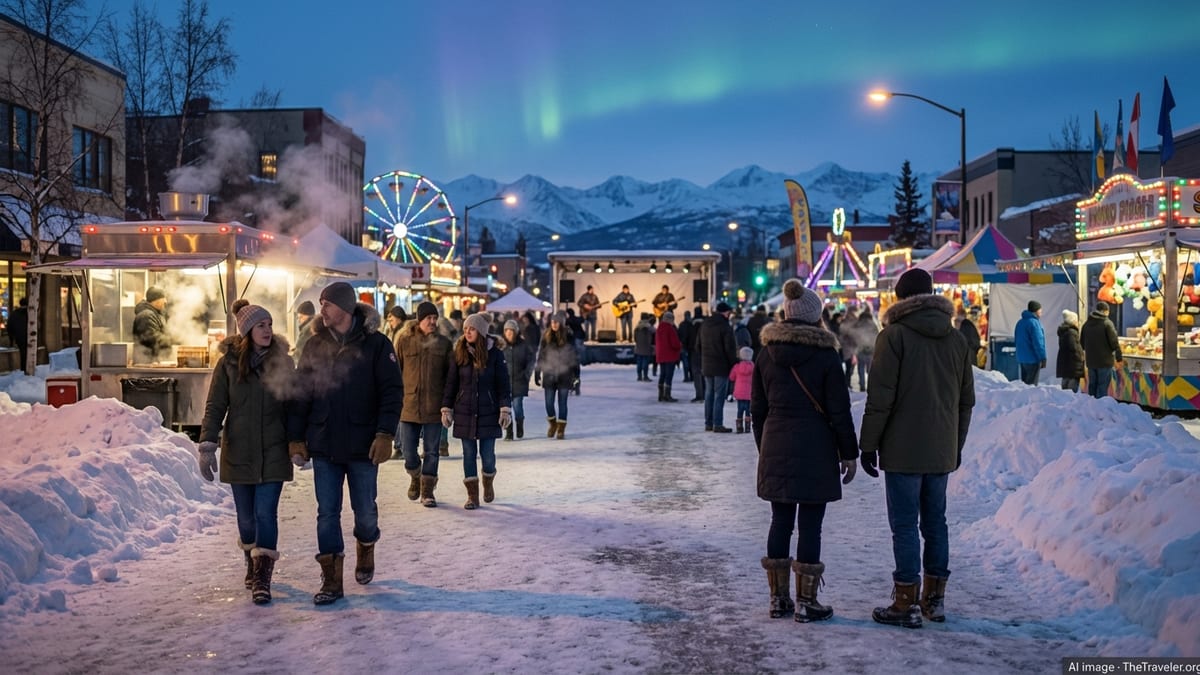
Anchorage in late February is still deep winter, with snow banks piled high and daylight just beginning to stretch out again. It is exactly then that the city erupts into Fur Rendezvous, or “Fur Rondy,” a multi‑day winter carnival that locals embrace as the symbolic turning point toward spring. While it has a strong reputation within Alaska, many visitors focus on summer trips and never experience how joyfully the city leans into cold-season fun.
Fur Rondy traces its roots to the 1930s, when trappers would converge on Anchorage to trade furs and socialize. That trading heritage lingers in the name, but the modern festival has expanded into a wide slate of events: snow sculptures, a carnival midway, sled dog races, fireworks, outhouse races down icy streets and a raucous Miners and Trappers Ball. The city center fills with parka-clad families, teenagers in snow pants and visitors blinking at how Alaskans redefine the phrase “outdoor entertainment” at subfreezing temperatures.
Among the most colorful traditions is the Mr. Fur Face beard contest, where contestants compete in elaborate categories that celebrate the serious facial hair culture that thrives in cold climates. Equally memorable are the open sprint dog races that weave through downtown, giving spectators a close look at athletic sled dogs and their mushers. For a few days, everyday errands share space with costumed racers and marching bands as the line between participant and onlooker blurs.
Travelers willing to visit in winter should pack for true cold, with layered clothing, traction for icy sidewalks and a flexible schedule that can adapt to shifting weather. The reward is a very different Alaska from the postcard of summer cruise ships: one where locals treat minus temperatures as an invitation to play, and where you might cap a day of carnival events with a glimpse of northern lights over the Chugach Mountains. Fur Rondy also dovetails with the start of the Iditarod Trail Sled Dog Race in many years, offering a chance to experience two iconic winter events in a single trip.
Sitka Jazz Festival: Coastal Notes Between Mountains and Sea
On the forested outer coast of Southeast Alaska, the island town of Sitka hosts an annual jazz festival that combines performance with education. The Sitka Jazz Festival typically runs for three days in winter, gathering visiting artists, student ensembles and local audiences in a compact waterfront community framed by volcanic peaks. For travelers who think of Alaska purely in terms of wild landscapes, it is a reminder that culture and creativity thrive even in small, remote towns.
The festival grew out of Sitka High School’s longstanding “jazz nights” and retains a strong educational mission. Visiting musicians not only perform in evening concerts but also lead clinics and workshops for students from across Alaska. Young players rehearse in classrooms and gymnasiums by day, then crowd into venues at night to watch mentors improvise under stage lights. The All‑Alaska Jazz Band, an audition‑based honor ensemble of high school musicians, often features prominently, reflecting the festival’s commitment to nurturing homegrown talent.
For visitors, Sitka Jazz offers a chance to experience Alaska in its shoulder season, when cruise crowds are absent and Pacific storms roll across the horizon. Between sets, you can walk from performance halls to the harbor in minutes, watching bald eagles cruise above fishing boats and rain clouds snag on spruce-covered hillsides. Local cafes and bars sometimes host informal jams, and it is not unusual to see sax players carrying instrument cases down rainy streets beneath the glow of streetlamps.
Because this is a community-scale event rather than a mega‑festival, information on specific dates and lineups often emerges a few months ahead. Travelers interested in timing a trip around it should be comfortable with a bit of uncertainty and willing to book flexible travel. In return, you gain access to a festival where it is easy to meet performers, ask questions in workshops and feel less like a distant spectator and more like a guest welcomed into a close-knit artistic community.
Anchorage International Film Festival: Films Worth Freezing For
Each December, as winter tightens its grip on Southcentral Alaska, the Anchorage International Film Festival lights up local theaters with independent cinema from around the world. Branded with the tagline “Films Worth Freezing For,” the festival is the largest of its kind in the state, typically screening around a hundred films across categories that include features, documentaries, shorts, animation and a special Made in Alaska section. Despite its scale, it remains largely off the radar for most out‑of‑state visitors.
For Alaskans, the festival provides a welcome antidote to long nights, drawing audiences into warm auditoriums for ten days of premieres, filmmaker Q&A sessions and receptions. The Bear Tooth Theatre, a beloved Anchorage venue that combines second‑run cinema with pub food, often serves as a central hub, hosting opening night and popular screenings. Additional venues across the city participate, so it is easy to build your own mini‑itinerary of films, conversations and meals between showings.
What distinguishes the Anchorage festival from many larger urban events is its approachable scale. Industry insiders do attend, but the mood leans more communal than competitive. Locals show up in fleece and parkas, filmmakers mingle casually with audiences in lobbies, and after‑screening discussions can feel more like extended living‑room debates than formal panels. For travelers, this translates into an unusually direct way to engage with directors and producers whose work might otherwise feel distant.
Planning a trip around the festival requires embracing winter as part of the experience. Expect icy roads, limited daylight and the possibility of major snowfalls that can rearrange schedules. With the right clothing and a willingness to walk between downtown venues in the cold, you will discover an Anchorage that few summer visitors see: a creative city that uses film as both escape and reflection during its darkest season, surrounded by mountains and, on clear nights, the green arc of aurora across the sky.
Talkeetna Winterfest: Small-Town Celebration Under Northern Lights
North of Anchorage, the quirky village of Talkeetna sits at the confluence of three rivers with views, on clear days, of Denali’s towering massif. In December, when the last of the autumn visitors have gone, the town turns inward for Winterfest, a month‑long celebration that stitches together local parades, markets, contests and parties. It is a decidedly small‑scale affair, yet for those willing to travel in deep winter it can be one of the most memorable ways to encounter everyday life in rural Alaska.
Winterfest events vary from year to year but often include a Parade of Lights, where decorated vehicles and floats roll through snowy streets after dark, turning the town’s few blocks into a moving light show. Local businesses host tastings and open houses, and community halls fill with live music, potlucks and craft fairs. There is a sense of improvisation: schedules are posted on handbills and chalkboards, and residents talk about what is happening next as they run into one another at the coffee shop or general store.
For travelers, the appeal lies in both the intimacy and the setting. Talkeetna’s central streets are walkable, with log cabins converted into bakeries, galleries and pubs. Snow often blankets the rooftops, and it is common to see people arriving at events on foot, by truck or even by snowmachine. On especially clear, cold nights, the aurora can ripple over the Susitna River or above the outline of Denali far to the north, adding a cinematic backdrop to what are otherwise humble, homegrown festivities.
Those considering Winterfest as a trip anchor should be comfortable with short daylight hours and flexible logistics. Road conditions on the Parks Highway can shift quickly, and some lodging and dining options operate on reduced winter schedules. Yet that very seasonality is what makes the experience special. You are not another face in the summer tour crowd; you are a guest among locals who are finding ways to make the darkest month feel bright.
The Takeaway
Alaska’s best‑known festivals tend to be those most easily grafted onto conventional summer itineraries: big music weekends, state fairs, cruise‑friendly events along major ports. The eight gatherings highlighted here operate on a different scale and rhythm. They are rooted in subsistence calendars, school years, volunteer committees and the realities of living with extreme latitude and weather. Many outsiders do not plan around them simply because they do not know they exist.
Building a trip around one of these festivals means accepting a bit more unpredictability. Dates can shift year to year, storm systems can cancel flights, and detailed schedules may not be finalized until relatively late. In return, you gain a chance to move beyond postcard views and meet Alaska on its own terms. You might share whale stew at a windswept Arctic campsite, watch a teenager execute a perfect two‑foot high kick in a Fairbanks gym, or dance in the rain to a local band beneath hemlock branches in Girdwood.
Most importantly, you will see that Alaska is not just a backdrop of glaciers and mountains, but a network of communities actively shaping their own traditions. Whether you choose the quiet intensity of WEIO, the happy chaos of Fur Rondy or the intimate notes of Sitka Jazz, you will be stepping into gatherings that exist first for the people who live there. Plan carefully, travel respectfully, and you may discover that the true highlight of your journey is not the scenery, but the way Alaskans celebrate within it.
FAQ
Q1. Are visitors welcome at Alaska’s smaller community festivals?
Yes, most of these festivals welcome respectful visitors, but they are planned first for locals, so expect limited services and few formal tourist amenities.
Q2. How far in advance should I plan a trip around one of these festivals?
Begin planning at least six to nine months ahead, as lodging in small towns can be limited and exact festival dates may firm up only closer to the event.
Q3. Is it appropriate to take photos at cultural events like Nalukataq and WEIO?
Photography is generally acceptable, but always ask permission when photographing individuals and follow any guidance from organizers about sensitive moments.
Q4. What kind of clothing should I pack for winter festivals in Alaska?
Pack layered, moisture‑wicking clothing, insulated boots, windproof outerwear, warm hats and gloves, and traction devices for walking on ice.
Q5. Are these festivals suitable for children?
Most are family‑friendly, especially Girdwood Forest Fair, Fur Rendezvous and daylight events at WEIO, though late‑night concerts and some parties may be best for adults.
Q6. How do I find the most current dates and schedules for these events?
Check official festival organizers or local visitor centers shortly before booking, as dates can shift from year to year based on weather and community needs.
Q7. Do I need a car to attend these festivals?
A car is very helpful outside major cities, particularly for Girdwood, Talkeetna and Fairbanks events, while some Anchorage venues are accessible by public transit or on foot.
Q8. Can I combine more than one of these festivals in a single trip?
Yes, with careful timing you can pair events, such as Fur Rendezvous with the Anchorage International Film Festival or WEIO with other summer travel in Interior Alaska.
Q9. How can I be a respectful guest at Indigenous cultural events?
Listen more than you speak, follow local instructions, avoid interrupting prayers or ceremonies, and support local businesses and artisans whenever possible.
Q10. Are these lesser‑known festivals safer or riskier than bigger events?
They are generally safe and closely tied to community life, but remote locations, winter travel and limited medical facilities require extra preparation and awareness.