

France rewards curiosity. Beyond its big cities, a network of efficient trains, highways, and regional buses puts a surprising variety of landscapes and historic towns within easy reach. From Paris, Lyon, and Nice, you can trade traffic for vineyards, medieval alleyways, and Mediterranean coves in under two hours. These seven day trips combine practical accessibility with the kind of atmosphere that lingers long after you return to your hotel.
Versailles: Royal Grandeur Within Easy Reach of Paris
Few day trips capture the sweep of French history as vividly as Versailles. Just southwest of Paris, this former royal residence evolved from a modest hunting lodge to the seat of absolute monarchy in the 17th and 18th centuries. Today the palace complex and its gardens form one of the country’s most visited heritage sites, yet with a bit of planning you can still experience moments of quiet amid the opulence.
Most visitors begin with the Château itself, where mirrored galleries, gilded apartments, and ornate chapels offer a close look at pre-Revolution court life. The Hall of Mirrors, lined with chandeliers and reflecting rows of arched windows, still delivers a sense of ceremony that photographs rarely match. Audio guides and multilingual panels sketch the political context, from the centralization of power under Louis XIV to the diplomatic treaties later signed here.
The gardens are equally important to the Versailles experience. Designed in a formal French style, they unfold in symmetrical terraces, reflecting pools, and tree-lined walks that stretch well beyond the palace steps. Fountains play at scheduled times on select days, but even on quieter weekdays you can wander out toward the Grand Canal and the more intimate groves. Renting a bicycle or small rowboat allows you to see how deliberately the estate was engineered to control views of water and sky.
Versailles is reachable by frequent suburban trains from central Paris in about half an hour, making it one of the simplest day trips in the country. Crowds can be intense in high season, so booking a timed palace entry and arriving early is wise, especially if you hope to combine interior visits with an unhurried stroll in the parkland. Even if you have seen pictures of Versailles your whole life, stepping into its scale in person brings a new dimension to France’s royal past.
Giverny: Monet’s Gardens and Impressionist Light
For a very different vision of French heritage, Giverny offers color and quiet instead of gilded ceilings. This small village in Normandy owes its fame to Claude Monet, who lived and worked here for more than four decades. His house and gardens, now a carefully restored attraction, feel immediately familiar to anyone who has stood in front of his paintings of water lilies, Japanese bridges, and flower beds.
The appeal of Giverny lies in how closely the site matches the canvases. Flower borders are planted in generous, often informal swathes, with seasonal changes that keep the views evolving from spring through autumn. In the water garden, the green footbridge arches over a pond where lilies open in late spring and summer, reflecting willows and sky. On bright days the light scatters across the surface in a way that helps explain Monet’s lifelong fascination with this small patch of water.
Monet’s house has also been reconstructed with attention to period detail, from the yellow dining room to the blue kitchen and his collection of Japanese prints. Although the art on the walls is largely reproduction, the domestic setting adds human scale to the grounds and makes it easier to imagine the painter’s daily routine. The village itself has a modest main street, a churchyard where Monet is buried, and several small galleries and cafés that sustain a relaxed pace between trains.
Giverny is typically accessed from Paris by train to Vernon, followed by a short local shuttle or taxi ride. Travel times vary by service but are often around one hour from the capital. Because the gardens are seasonal and popular, checking opening dates and considering a midweek visit outside the busiest summer weeks can significantly improve the experience. For many travelers, Giverny is one of the most memorable day trips in France because it connects iconic artworks directly to the landscape that inspired them.
Loire Valley Châteaux: Storybook Castles Amid Vineyards
The Loire Valley stretches across central France in a ribbon of river scenery, vineyards, and Renaissance architecture. While the region deserves several days, it is also possible to sample some of its highlights on a long day trip from Paris or from regional hubs such as Tours. The area’s celebrated châteaux, each with its own character, are the main draw, supported by a gentle rural backdrop that contrasts with city life.
Three estates often feature on compact itineraries. Chambord is known for its vast scale and striking double-helix staircase, attributed to designs influenced by Leonardo da Vinci. The château rises from a wide hunting park, its roofline bristling with chimneys and towers that echo in the surrounding moat. By contrast, Chenonceau arches gracefully over the River Cher, its galleries bridging the water in a series of stone spans. Built and expanded by powerful women at court, it has an interior that feels more like a lived-in home than a fortress. Amboise, perched above a bend in the Loire, offers sweeping river views and a compact historic center below its walls.
Travelers typically combine one or two major châteaux with time in a nearby town. Tours, Blois, or Amboise provide cafés, markets, and river promenades that balance the architectural sightseeing. The region is also known for white wines such as Sauvignon Blanc and Chenin-based varieties, and many estates or cooperative cellars offer informal tastings. Cycling between smaller villages along signed paths is increasingly popular and can be adapted to different fitness levels.
High-speed trains have shortened journey times from Paris to the Loire. Services to stations such as Saint-Pierre-des-Corps near Tours can take around one hour, followed by regional trains, shuttles, or rental cars to individual châteaux. Because options and schedules change, especially outside peak seasons, checking connections in advance is essential. For visitors who associate France with romantic castles and riverside picnics, the Loire delivers that image better than almost anywhere else in the country.
Pérouges: A Medieval Village Near Lyon
North of Lyon, the fortified village of Pérouges offers one of France’s most atmospheric small-town excursions. Officially listed among the country’s most beautiful villages, it occupies a hilltop above the Ain valley and preserves a compact center of stone houses, narrow lanes, and a central square that often feels more like a film set than a functioning community. Yet behind the photogenic surfaces, Pérouges retains a lived-in character, with workshops, small inns, and local residents who share the streets with day trippers.
The heart of the village is Place du Tilleul, a slightly uneven open space shaded by a large tree and edged by buildings that mix medieval and early modern elements. Cobblestone alleys radiate outward, some curving along the line of the old ramparts, others climbing toward viewpoints over the surrounding countryside. On quiet mornings you may hear only the crunch of footsteps on stones and a few voices from café terraces serving coffee and local specialties.
Pérouges is especially known for its galette, a simple but distinctive sugar tart traditionally eaten warm. Several bakeries and restaurants in the village serve their own versions, and tasting one has become part of the ritual of visiting. Artisans sell textiles, pottery, and regional products in small shops that fit naturally into the historic fabric rather than overwhelming it. Occasional festivals and markets introduce more activity, but even on busy days the walled layout helps absorb crowds.
Access from Lyon is straightforward, which helps make Pérouges such a practical day trip. Trains from Lyon Part-Dieu to Meximieux-Pérouges take around half an hour, followed by a short uphill walk of roughly twenty minutes to the village gate. Regional bus services and private tours may also be available, and those with a rental car can combine Pérouges with nearby countryside drives. Solid walking shoes are strongly recommended, as the original cobbles are beautiful but uneven. For travelers looking to step directly into a medieval streetscape without committing to a multi-day detour, Pérouges is an appealing choice.
Beaujolais: Rolling Vineyards North of Lyon
Just beyond Lyon’s northern suburbs, the Beaujolais region offers a landscape of vine-covered hills, small villages, and cellars where producers explain how local Gamay grapes become light, fragrant wines. It is an accessible countryside escape rather than a remote wine trail, with trains from the city reaching gateway towns such as Villefranche-sur-Saône in well under an hour. Once there, roads and small lanes climb into terrain that feels far removed from urban traffic.
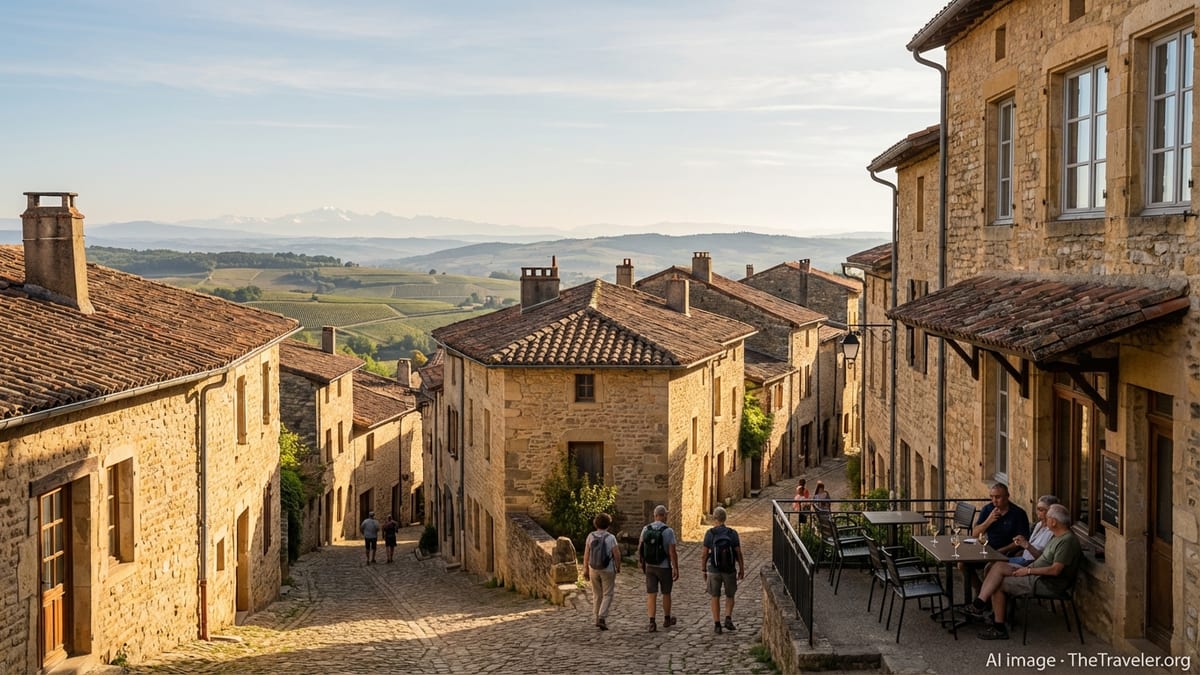
The southern part of Beaujolais is famous for its so-called Golden Stone villages, or Pierres Dorées. Built from warm-toned limestone that glows in late afternoon light, these settlements often share a church, a small square, and houses strung along ridgelines. Oingt, one of the most celebrated examples, has earned recognition among France’s officially designated beautiful villages. Walking its lanes reveals viewpoints across patchwork slopes of vines and pastures dotted with farm buildings.
Wine is the region’s defining product, and many estates have adapted to welcome independent visitors alongside organized groups. Tasting rooms may introduce the differences between fresh, early-drinking Beaujolais wines and more structured bottlings from specific crus further north. Some properties pair glasses with simple plates of charcuterie or local cheese, while larger wine-themed attractions combine exhibitions, landscaped gardens, and family-friendly activities. Reservations are often appreciated, especially in harvest season or on weekends.
Planning a Beaujolais day trip from Lyon involves deciding how much independence you want. Confident drivers can rent a car to explore multiple villages at their own pace, while others may prefer guided minivan tours that handle logistics and appointments. Public transport serves only part of the region, so checking current timetables before relying on it is important. In all cases, remember that country roads can be narrow and winding, and allowing extra time for photo stops will keep the day relaxed. Between the light on the stone, the geometry of the vine rows, and the chance to meet small producers, Beaujolais offers a distinctly local slice of France.
Èze and the French Riviera Hills Above Nice
On the Mediterranean coast, Nice anchors a cluster of day trips that combine sea views with historic villages. One of the most striking is Èze, a hilltop settlement perched between Nice and Monaco. From a distance it appears almost fused with the rock on which it sits, its stone houses rising in tiers toward a ruined castle. At close range, Èze reveals a network of steep passages, archways, and tiny squares that often open suddenly onto sweeping coastal panoramas.
The village is compact but layered, which encourages slow exploration. Visitors wind past galleries and small boutiques set into former dwellings, with occasional chapels and gateways punctuating the climb. At the summit, a landscaped garden planted among the ruins showcases cacti and Mediterranean species, along with sculptures and viewpoints over the Bay of Villefranche and the peninsula of Saint-Jean-Cap-Ferrat. On clear days the horizon stretches far along the Riviera, emphasizing just how dramatically the hills rise from the sea.
Èze is well connected to Nice, yet still feels removed from its bustle. Buses and regional trains link the coast to lower Èze, from which a steep path leads up to the village proper. Many visitors follow sections of this trail, sometimes referred to as the Nietzsche Path, for its combination of workout and scenery. Others arrive by car or bus directly to the upper entrance. The climb, the exposure to sun, and the stone steps all make good footwear, water, and moderate fitness important, especially in the height of summer.
Because the broader Côte d’Azur is dense with attractions, Èze is often combined with coastal stops in a single day: time swimming or strolling promenades in Nice, a harbor visit in Villefranche-sur-Mer, or perhaps an evening meal back at the seaside. Even viewed on its own, though, the village offers a textbook example of a Provençal hilltop community and an easy way to experience the vertical dimension of the Riviera rather than just its beaches.
Arles: Roman Heritage and Provençal Light
Further west along the Mediterranean, Arles offers a day trip steeped in Roman history and artistic associations. Located on the River Rhône, the town became an important regional center in antiquity, a legacy still visible in one of the best-preserved amphitheaters in France, along with a theater, baths, and sections of ancient walls. Walking through the compact historic core, visitors move easily between these monuments and quieter streets lined with townhouses and cafés.
The amphitheater remains Arles’s most emblematic sight. Built with stacked tiers of stone seating, it once held gladiatorial games and civic spectacles. Today it hosts concerts and cultural events, but during daytime visits you can climb its internal staircases and imagine its former scale. Nearby, the Roman theater and the cryptoporticus, a series of underground galleries, add depth to the archaeological picture. Museums in town help interpret the artifacts recovered from the Rhône and surrounding countryside.
Arles is also closely connected to Vincent van Gogh, who spent an intensely productive period here in the late 19th century. While none of his original paintings remain in the town, walking routes trace the locations that inspired some of his most famous works, from riverside quays to café terraces. Interpretation panels show reproductions of the paintings alongside present-day scenes, encouraging visitors to compare the changes and continuities in light, architecture, and vegetation.
Modern Arles balances these layers of history with events and markets that draw visitors from across the region. The city has built an international reputation for photography and contemporary culture, with festivals that transform streets and exhibition spaces at certain times of year. Trains from cities such as Avignon, Nîmes, and Marseille make day visits practical, though schedules can vary by season. For travelers interested in Roman antiquity, art history, or the feel of a mid-sized Provençal town, Arles is a rewarding destination that can comfortably fill a full day.
The Takeaway
France’s appeal extends far beyond the most famous city skylines. Thanks to a well-developed rail network and a dense patchwork of historic towns, gardens, and wine regions, you can transform an ordinary city stay into a sequence of sharply different experiences with minimal travel time. One day you might walk corridors once reserved for kings at Versailles, the next trace the brushstrokes of Monet at Giverny, and later find yourself tasting young Beaujolais in a stone cellar or catching sea breezes high above the Riviera.
These seven day trips represent only a fraction of what is available, but they illustrate how varied the country can feel within modest distances. Whether you favor art, architecture, wine, or landscapes, there is likely a destination a short journey away that speaks directly to your interests. With thoughtful planning around train times, opening hours, and local climate, day trips in France can be as relaxing as they are enriching, adding depth to any itinerary without requiring constant packing and unpacking.
FAQ
Q1. What is the easiest day trip from Paris for first-time visitors?
Versailles is usually the simplest choice, with frequent suburban trains, clear signage, and a straightforward combination of palace visit and garden stroll.
Q2. Can I visit more than one Loire Valley château in a single day?
Yes, but it requires careful timing. Many travelers limit themselves to one major château plus a nearby town to keep the day relaxed.
Q3. Is Giverny suitable for a visit outside the main summer months?
Spring and early autumn often offer pleasant temperatures and good garden displays, with slightly fewer crowds than peak summer weeks.
Q4. Do I need a car to explore Pérouges from Lyon?
No. A regional train from Lyon to Meximieux-Pérouges followed by a short walk is usually enough, though a car adds flexibility for wider countryside touring.
Q5. How much walking should I expect in Beaujolais?
You can keep walking minimal by focusing on tastings near villages, but gentle hikes through vineyards and stone villages are a highlight for many visitors.
Q6. Is Èze appropriate for travelers with limited mobility?
Èze’s steep paths and uneven steps can be challenging. Those with mobility concerns may prefer viewpoints accessible by vehicle or focus on flatter Riviera towns.
Q7. Can Arles be combined with another Provençal city in the same day?
It is possible to pair Arles with nearby cities like Avignon or Nîmes, but doing so can feel rushed. Many visitors dedicate a full day to Arles alone.
Q8. Are guided tours necessary for these day trips?
Guided tours are optional. Major sites have good visitor infrastructure, but tours can simplify logistics and add context, especially in wine regions.
Q9. How far in advance should I book train tickets for popular routes?
Booking several weeks ahead often provides better fares on long-distance services, while regional trains may allow more flexibility closer to departure.
Q10. What is the best way to avoid crowds on these day trips?
Arriving early, choosing midweek dates, and traveling in shoulder seasons such as late spring or early autumn typically results in a calmer experience.