

Spain is made for day tripping. High-speed trains, scenic regional lines and winding country roads put wild gorges, Moorish palaces, surf beaches and cliff-hugging villages within easy reach of the big cities. Whether you base yourself in Madrid, Barcelona, Seville or Málaga, you can step onto a morning train or bus and, within a couple of hours, be hiking through canyons, sailing past sea cliffs or wandering cobbled lanes that feel unchanged for centuries. These seven day trips across Spain combine straightforward logistics with a genuine sense of adventure, turning twenty-four hours into something that feels like a mini expedition.
Montserrat: Sacred Peaks and Cliffside Trails from Barcelona
Just an hour inland from Barcelona, the serrated skyline of Montserrat rises abruptly from the Catalan plains, a jumble of limestone spires and domes that looks almost otherworldly. At its heart sits the Benedictine monastery of Santa Maria de Montserrat, a working religious community that has attracted pilgrims for centuries. Stepping out from the rack railway or cable car station, you immediately feel the shift in atmosphere: cooler mountain air, the sound of bells, raptors circling overhead and sheer cliffs dropping away toward the distant Mediterranean.
Most visitors come for the basilica and its famous Black Madonna, but the real adventure begins once you lace up your hiking boots. Well-marked trails lead out from the monastery complex in all directions, threading through Holm oak forest and across bare rock ridges, past hermitages tucked into caves and ledges. The path to Sant Jeroni, the highest summit in the range, rewards a steady climb with sweeping views over Catalonia on clear days, often as far as the Pyrenees. For a shorter circuit, the route toward the Santa Cova shrine offers dramatic balconies clinging to vertical cliffs and a strong sense of the mountain’s spiritual history.
While Montserrat is accessible year-round, visiting outside the busiest summer weekends helps preserve the tranquil, contemplative feel that makes the area special. Mornings usually bring the clearest skies, and midday light picks out the textures in the pale rock. Pack layers, as temperatures can shift quickly at altitude, and bring water and snacks so that you can linger on a viewpoint rather than rushing back to the cafeteria. With its blend of cultural depth and adventurous walking, Montserrat feels less like a side trip and more like a soul-refreshing escape.
Girona and the Costa Brava: Medieval Walls and Wild Sea Cliffs
North of Barcelona, Girona pairs perfectly with a taste of the Costa Brava for a day that moves from medieval alleyways to wind-scoured headlands. Girona’s old town rises above the Onyar River in a tangle of stone houses and baroque facades, fronted by the city’s photogenic line of pastel riverside buildings. Climbing up to the restored defensive walls, you can stroll along the ramparts as church towers and terracotta roofs tumble away below, with the Pyrenees often snow-dusted in the distance during the cooler months.
Within the city, the Jewish quarter is one of the most atmospheric in Spain, its narrow lanes and hidden courtyards hinting at centuries of layered history. Cathedral steps, Arab baths and tucked-away cafes offer plenty of reasons to dawdle, but the sea is never far away. Buses and local drives connect Girona with the Costa Brava, where rocky coves and pine-fringed cliffs provide an entirely different kind of adventure. Here, sections of the coastal footpath known as the camí de ronda link fishing villages and secluded beaches, often within an easy there-and-back walk.
Choosing a stretch near towns like Calella de Palafrugell, Llafranc or Tossa de Mar lets you combine a couple of hours of clifftop walking with swims in clear water and relaxed seaside lunches. The path can be rugged in places, with stone steps and uneven ground, so proper footwear is essential. Out of the high summer season, the coast feels wilder and more intimate, with softer light on the rocks and fewer people on the trails. By the time you return to Girona for an evening stroll and a final drink on one of its small squares, it feels as if you have squeezed multiple journeys into a single day.
Toledo: River Gorge Walks and Hilltop History from Madrid
Perched on a granite outcrop almost encircled by the Tagus River, Toledo looks like something lifted from an illuminated manuscript. It is one of the classic day trips from Madrid, reached quickly by high-speed trains and frequent buses, yet its compact size and dramatic topography mean you can still find quiet corners and adventurous viewpoints even on busy days. From the moment you glimpse its skyline of spires, synagogues and the hulking Alcázar fortress, the city announces itself as a place where history and landscape are inseparable.
Inside the old walls, Toledo’s cobbled streets weave a tight maze between Gothic churches, former mosques and synagogues, artisan workshops and hidden patios. Exploring on foot becomes a small adventure in navigation, with sudden stairways, dead ends and archways that deliver you into hushed side streets. To change perspective, cross the Puente de San Martín or Puente de Alcántara, medieval bridges that span the river and offer spectacular photo angles back toward the city. Here the Tagus cuts through a modest gorge, and paths trace both banks, providing short but rewarding riverside walks below the cliffs.
One of the most satisfying mini adventures in Toledo is to climb or drive to the viewpoints on the opposite side of the river, where low hills grant panoramic vistas at sunset. The light warms the sandstone into deep gold, and the city seems to float above its own reflection. With some planning, you can combine visits to marquee sights like the cathedral with these quieter circuits along the river and up to the miradores. Comfortable walking shoes are important, as pavements can be uneven and steep. By evening, as many day trippers have left, Toledo’s lanes fall calmer and its lantern-lit alleys feel like a film set you have almost to yourself.
Segovia and Its Surroundings: Roman Engineering and Pine Forest Escapes
Northwest of Madrid, Segovia makes an unforgettable first impression with its monumental Roman aqueduct, a double-tiered arc of granite blocks that strides right into the center of town without mortar. Nearby streets spill out into a honey-colored old quarter crowned by a fairy-tale Alcázar castle perched on cliffs above a valley. It is a day trip with instant wow factor, but beyond the postcard landmarks lies a landscape of oak woods, river valleys and pine forests that invite a more active kind of exploration.
After wandering the historic core and perhaps touring the fortress, it is worth dropping down from the plateau into the Eresma Valley. Within a short walk, the city falls away behind you and the atmosphere shifts to one of birdsong and running water. A network of trails follows the river, passing old mills, ermitas and viewpoints where you can look back at the city framed by trees. The contrast between urbane plazas and this quiet green corridor gives the day an unexpected sense of depth and variety.
If you have access to a car, the nearby Sierra de Guadarrama opens up even more adventurous possibilities for a long day out from Madrid or Segovia itself. Short, well-signposted hikes through mountain passes and pine forest deliver expansive views back toward the Castilian plains, often cooler and fresher than in the cities during summer. Weather in the sierra can change quickly, particularly in spring and autumn, so layers and a basic check of local forecasts are advisable. Combining a morning in Segovia’s historic streets with an afternoon among peaks and pines makes the experience feel much larger than the time invested.
Caminito del Rey and El Chorro: Clifftop Walkway near Málaga
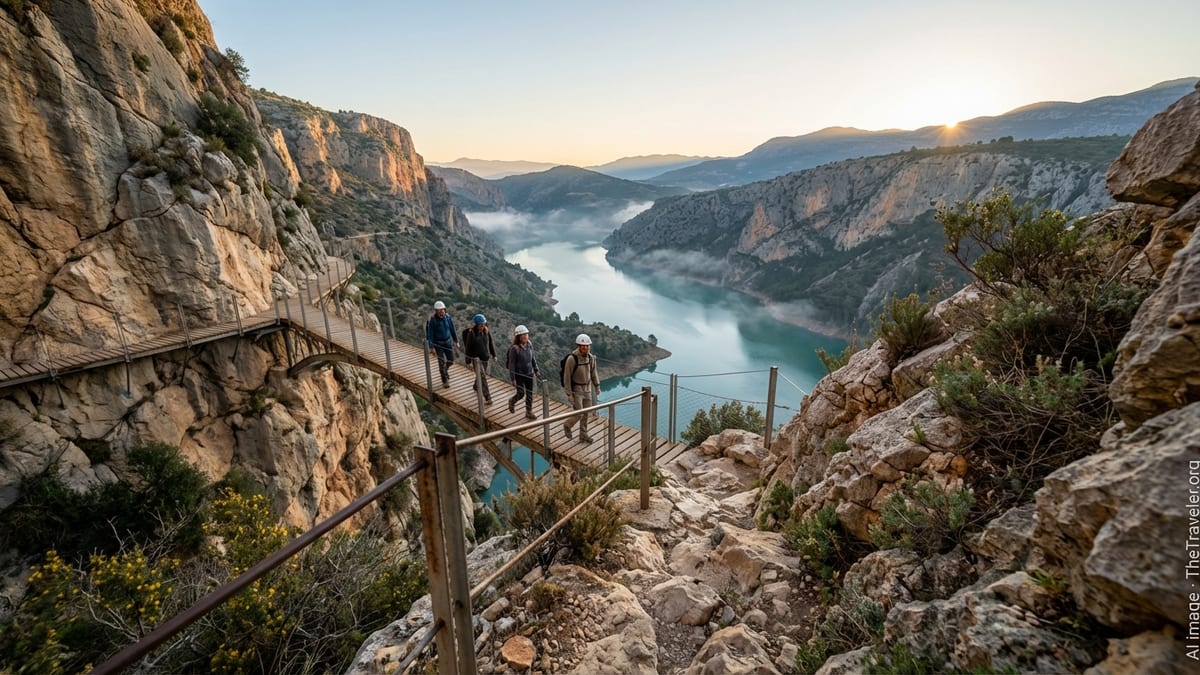
Few day trips in Spain deliver quite as much drama in such a short and controlled package as the Caminito del Rey, the restored walkway pinned high to the walls of the Gaitanes Gorge in inland Málaga province. Once notorious for its crumbling planks and vertiginous drops, the route has been carefully rebuilt as a managed, ticketed experience that still preserves a strong sense of exposure and excitement. Trains and roads from Málaga city bring you to the reservoir and canyon area around El Chorro, where rugged limestone peaks, turquoise water and stands of Aleppo pine create a classic Andalusian mountain scene.
The modern Caminito is a linear walk of several kilometers along boardwalks, tunnels and paths carved into the rock, with a mild net descent that keeps it accessible to reasonably fit walkers. Helmets are provided, and safety barriers line the route, but you still feel suspended between sky and river as you cross narrow bridges and peer down into the gorge. Golden eagles, vultures and other birds of prey often ride the thermals, and in quiet moments the only sounds are wind and water echoing off the cliffs. It is an adventure best tackled unhurriedly, with time to stop at viewpoints and absorb the scale of the landscape.
Because access is regulated by timed tickets and capacity limits, it is wise to secure entry in advance, particularly during peak holiday periods and weekends. Shoulder seasons tend to balance pleasant temperatures with fewer visitors, though even in summer mornings can be relatively cool inside the gorge. Many visitors pair the hike with lunch in nearby villages or a relaxed swim or paddle on the reservoirs to round out the day. Ending with a leisurely train ride or drive back to Málaga as the sun sets over the sierras, you will likely feel that you have spent a whole weekend away rather than just a single day.
Ronda and the White Villages: Bridges, Gorges and Mountain Roads
Set high on a plateau in the Serranía de Ronda, the town of Ronda is defined by its dramatic geography. The deep El Tajo gorge cleaves the settlement in two, spanned by the iconic Puente Nuevo bridge that soars almost 100 meters above the Guadalevín River. From viewpoints just below or beside the bridge, the drop is dizzying, the stone arches monumental and the surrounding mountains layered in shades of blue and green. It is little surprise that Ronda has long attracted writers, artists and travelers in search of striking scenery.
Beyond admiring the bridge from multiple angles, Ronda rewards wandering with hidden gardens, small palaces and traces of its Moorish past. Steep paths drop from the old town down into the gorge, where you can look back up at both the modern and older bridges and fully appreciate their engineering. These descents and reascents can be strenuous, particularly in midday heat, so starting early and carrying water is important. The rewards are the sense of stepping out of the busy streets and into a cooler, wilder world of rock, water and vegetation.
With a car or on organized excursions, Ronda also serves as a gateway to the pueblos blancos, the whitewashed villages that speckle the mountains of Cádiz and Málaga provinces. Winding roads connect hilltop settlements and valley hamlets, many of them offering short signed walking routes into surrounding oak and chestnut forests. It is entirely possible to visit one or two such villages, enjoy a leisurely lunch and a short hike, and still return to a coastal base such as Málaga, Marbella or even Seville by evening. The combination of high viewpoints, twisting roads and deep historical roots makes this region feel like a compact road-trip adventure compressed into a single day.
San Sebastián and the Basque Coast: Surf Swells and Cliff Walks
In Spain’s northwest, San Sebastián offers an invigorating mix of Atlantic air, urban sophistication and easy access to wild coastline. The city itself curls around a shell-shaped bay framed by green headlands, with a sandy beach that draws swimmers and surfers throughout much of the year. Add in a compact old town and some of the country’s most celebrated food culture, and you already have a full and rewarding day. But what elevates a visit into mini-adventure territory is how quickly you can reach rugged stretches of coast and hilly viewpoints just beyond the center.
From San Sebastián, local trains and buses trace the shoreline toward small towns and beaches where the Basque Country shows a more elemental face. Waves crash into cliffs, grassy slopes fall abruptly to rock platforms, and narrow paths wind along the edges. Even simple walks from the edge of town to nearby hills can feel surprisingly wild once you leave the last houses behind. On days with big swells, watching surfers and bodyboarders tackle the break at spots along the coast becomes a spectator sport in itself, underscored by the roar of the sea.
Weather on the Atlantic side of Spain can shift rapidly, so packing a light waterproof layer and expecting a mix of sun, cloud and showers is wise, even in summer. This variability often creates luminous light and dramatic skies, especially in early morning and late afternoon. After a few hours of walking or beach time, returning to San Sebastián’s old town for an evening pintxo crawl feels like re-entering civilization with renewed senses. The contrast between salt-streaked hair and refined bars, between rugged cliff paths and polished plazas, is exactly what makes this kind of day trip linger in the memory.
FAQ
Q1. Are these day trips in Spain realistic without renting a car?
Yes, several of these destinations are served by high-speed or regional trains and reliable buses, especially Montserrat, Girona, Toledo, Segovia, Caminito del Rey and San Sebastián, making them feasible for car-free travelers.
Q2. When is the best time of year to plan adventurous day trips in Spain?
Spring and autumn are generally ideal, with milder temperatures, longer daylight than winter and fewer crowds than the peak summer holiday period in July and August.
Q3. Do I need to buy train tickets in advance for popular routes like Madrid to Toledo or Segovia?
Advance purchase is strongly recommended during weekends, holidays and busy seasons to secure preferred departure times, even though last-minute seats are sometimes available.
Q4. How fit do I need to be for hikes like Montserrat or the Caminito del Rey?
Most routes described require moderate fitness and comfort with sustained walking on uneven ground, but they are not technical mountaineering and are accessible to active travelers.
Q5. Is it safe to hike and explore these areas independently?
In general, these destinations are accustomed to independent visitors, but basic precautions such as staying on marked paths, checking local conditions and carrying water are important.
Q6. Can I visit more than one destination in a single day, such as Segovia and a nearby mountain area?
Combining a historic town with a nearby natural area is possible with careful planning, early starts and realistic expectations about travel times and your own pace.
Q7. What should I pack for a full day trip that includes hiking and city sightseeing?
Comfortable walking shoes, layered clothing, sun protection, a reusable water bottle, light snacks and a small daypack will cover most situations on these outings.
Q8. Are guided tours worth considering for places like Caminito del Rey or Ronda?
Guided tours can simplify logistics, handle ticketing and transport, and provide context, which is particularly useful where daily visitor numbers are controlled or parking is limited.
Q9. How early should I start my day to make the most of these trips?
Leaving on one of the first practical trains or buses gives you cooler conditions for walking, more flexible timing for meals and less pressure to rush between sights.
Q10. Are these mini adventures suitable for families with children?
Families with reasonably active children often enjoy these trips, although very young kids may find longer walks or exposed paths tiring, so choosing shorter routes and built-in breaks helps.