

From the outside, the granite ruins of Great Zimbabwe can look like a silent mystery in the hills of southeastern Zimbabwe. Step closer, though, and the picture transforms.
Between the towering dry stone walls, the intricate passageways and the wealth of artifacts recovered on site, Great Zimbabwe emerges not as a romantic ruin but as hard archaeological proof that a powerful African city once dominated this plateau. From the 11th to the 15th century, it was the heart of a far-reaching state, controlling trade, shaping regional politics and inspiring legends that still echo today.
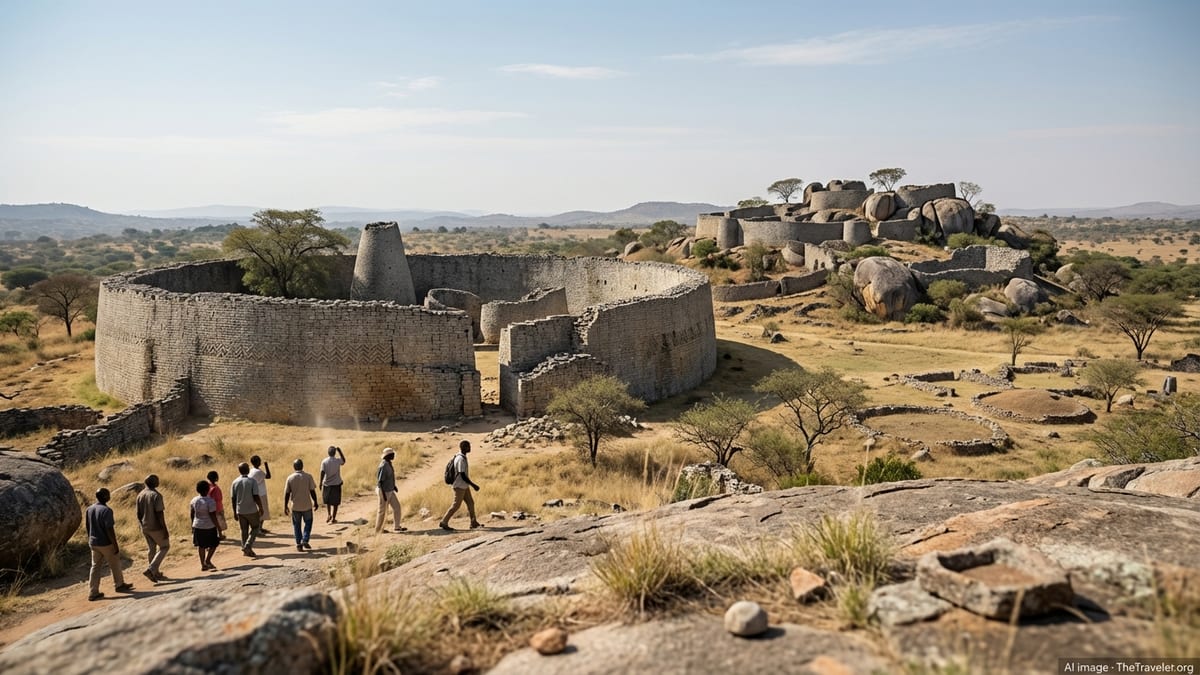
1. Monumental Stone Architecture Without Mortar
If you want to understand how powerful Great Zimbabwe once was, start with the walls. The city’s architecture is not only visually striking, it is a technical achievement that demanded labor, organization and a level of engineering knowledge far beyond what many 19th and early 20th century Europeans were willing to credit to African builders. Today, archaeologists see those same structures as some of the clearest evidence of the city’s political and economic strength.
Precision Building on a Massive Scale
Great Zimbabwe’s best known feature is the Great Enclosure, an elliptical ring of granite walls that at points soar to about 11 meters in height and run for roughly 250 meters in circumference. The complex also includes the Hill Ruins, a granite acropolis, and the Valley Ruins, a sprawling zone of domestic and ritual architecture across the surrounding landscape. Together, these areas extend across up to 7 square kilometers and nearly 800 hectares, making this the largest complex of precolonial stone structures in southern Africa.
What sets these walls apart is the way they were built. Local masons quarried blocks from weathered granite outcrops, then stacked them in careful horizontal courses without using any mortar. The most imposing walls are thick enough to stand freely and incorporate decorative patterns such as chevron and herringbone motifs. To raise such structures required abundant labor, skilled artisans and leaders capable of directing long, multi-generational construction projects, all of which point to a sophisticated state rather than a loose collection of villages.
Architecture Reserved for Elites
The design of the stone complexes also signals hierarchy. The Hill Complex rises about 80 meters above the surrounding country and includes narrow, controlled passageways and walled courtyards that would have limited access. The Great Enclosure, with its imposing outer wall, inner wall and iconic Conical Tower, appears to have housed royal or ritual spaces separate from commoner dwellings.
In contrast, most ordinary residents lived in daga houses, built from clay and granitic sand, in the valley below. These were organized into neighborhood compounds, some of which were ringed by smaller stone walls that offered insulation, privacy and a sense of status, but nothing to match the monumental impact of the elite complexes. That spatial separation between stone-built political and ritual centers and more modest residential zones reflects a stratified society with concentrated authority at the top.
2. A Capital at the Heart of a Regional Empire
Great Zimbabwe was not an isolated mountaintop citadel. For several centuries, it functioned as the political core of a state that controlled a broad swath of the Zimbabwean plateau and influenced neighboring regions. Its power rested on a combination of agricultural wealth, cattle herding and the ability to command people and resources over a wide territory.
A City for Tens of Thousands
Population estimates vary, but many scholars place Great Zimbabwe’s peak population between 10,000 and 20,000 people during the 14th century. For a preindustrial African city without intensive irrigation, this represents a significant urban concentration. Supporting so many people in a landscape of granite hills and savanna required careful management of fields, water sources, and herds.
Archaeological evidence points to a diversified subsistence base. Residents cultivated grains such as sorghum and millet, kept large herds of cattle and smaller stock, and relied on wild resources from the surrounding environment. The city’s rulers controlled not just their immediate hinterland but a much larger region where client communities produced food and livestock that ultimately provisioned the capital.
A State Spanning Tens of Thousands of Square Kilometers
The political reach of Great Zimbabwe extended well beyond its walls. Surveys of smaller “zimbabwes” or stone-built sites across the highveld show a hierarchy of settlements, with Great Zimbabwe at the apex. Archaeologists estimate that at its height, the state dominated an area of roughly 50,000 square kilometers, linking communities through tribute, trade and shared cultural practices.
This regional system was dynamic. As Great Zimbabwe flourished between the 13th and 15th centuries, rival centers, such as Mapungubwe to the south, waned. Later, as population pressure and environmental strain mounted around Great Zimbabwe, political power shifted again toward successor states like Khami and the Torwa and Rozvi polities. Across these transitions, Great Zimbabwe remained a foundational model of what a centralised, powerful African kingdom could look like.
3. Control of Lucrative Gold and Ivory Trade Routes
Behind the stone walls and court rituals lay one of Great Zimbabwe’s greatest sources of power: its grip on long-distance trade. The city rose to prominence at the moment when inland goldfields were increasingly supplying the Indian Ocean commercial world. By mediating that exchange, Great Zimbabwe’s rulers converted local resources into prestige goods and diplomatic leverage.
From Plateau Goldfields to the Indian Ocean
Great Zimbabwe grew into a trading hub after roughly 1300, when it eclipsed Mapungubwe as the main gateway between the gold-rich interior and the Swahili coast. Gold extracted from river gravels and mines on the plateau was brought to the city, where it was stored, worked and prepared for trade. Ivory from elephant hunting in the surrounding region followed the same routes.
From Great Zimbabwe, caravans moved eastward along river corridors such as the Save and Runde. Traders likely used dugout canoes and overland portages to reach coastal ports, notably Sofala, a major Swahili city-state on the Mozambican coast. There, gold and ivory from Great Zimbabwe were exchanged for imported textiles, beads, ceramics and metals that symbolized connection to the wider Indian Ocean world and underpinned elite status at home.
Imported Luxury Goods as Markers of Power
Excavations at Great Zimbabwe have uncovered rich assemblages of imported artifacts. These include glass beads of various colors and sizes, some sourced to India and the Middle East; fragments of Chinese ceramics and Persian-glazed wares; and coins from Indian Ocean trading centers such as Kilwa. None of these objects would have arrived by accident. They point to long-term, structured trade relationships that funneled wealth directly into the hands of Great Zimbabwe’s elite.
Within the city, these imported items were more than curiosities. They became powerful symbols of prestige, incorporated into burials, ritual deposits and the material culture of high-status households. Control over access to such goods helped legitimize the authority of rulers and chiefs, reinforcing the perception that Great Zimbabwe’s leaders were not only wealthy but cosmologically connected to distant powers and forces.
4. A Stratified Society with Complex Governance
Powerful cities derive their influence not just from their size or trade networks, but from the ways they organize people, manage conflict and project authority. At Great Zimbabwe, material evidence suggests a multi-tiered society with clear distinctions between rulers, elites, specialized artisans and commoners, all bound together by shared beliefs and institutions.
Elites, Commoners and Specialized Craftspeople
Archaeological mapping of housing areas shows that Great Zimbabwe’s population was not randomly distributed. Larger compounds with more elaborate stone and daga architecture cluster around the Great Enclosure and other high-status areas, while simpler dwellings stretch across the outer valley. Differences in artifact density and quality, such as higher concentrations of imported ceramics and luxury goods near elite residences, reinforce this pattern of social stratification.
Within this hierarchy, certain groups appear to have held specialized roles. Evidence of metalworking, including iron smelting and gold working, suggests the presence of full-time craftspeople whose skills were vital to the kingdom’s economy and ritual life. Potters, builders and ritual specialists also occupied defined places in the social order. That degree of occupational differentiation is one of the hallmarks of a complex, powerful state.
Royal Authority Embodied in Space and Symbol
The layout of Great Zimbabwe’s core complexes hints at carefully managed royal authority. The Hill Complex, often interpreted as a royal acropolis, includes restricted enclosures that would have separated the ruling family and key ritual spaces from the wider population. The Great Enclosure’s narrow passageways and high walls reinforce the sense of controlled access and staged encounters between ruler and subjects.
Objects like the famous soapstone Zimbabwe Birds, carved from steatite and found mounted on pillars, point to the ritual and symbolic dimension of power. Although their exact meaning is debated, many scholars interpret them as royal emblems or clan totems, possibly associated with the Mwari religious tradition. Their exalted placement within elite enclosures underscores how political and spiritual authority were fused, strengthening the city’s grip on its population.
5. Religious and Ritual Influence Across the Region
Great Zimbabwe’s power was more than economic or military. It was also spiritual. As the seat of a ruling dynasty closely tied to sacred landscapes and ancestral rituals, the city projected religious influence well beyond its hilltop and valley complexes. Many communities in southeastern Zimbabwe still regard the site as a place of prayer, offerings and ancestral communication.
A Sacred Landscape, Not Just a City
The location of Great Zimbabwe was not chosen at random. The city nestles among granite hills that hold caves, springs and boulders associated with ancestral and spiritual forces. Within the site, certain boulders mimic the silhouettes of the Zimbabwe Birds, while others overlook ritual courtyards and enclosures. Archaeologists have identified shrines, altars and areas where offerings appear to have been made over long periods of time.
In this setting, political authority operated in tandem with spiritual power. Rulers presented themselves as custodians of the land’s fertility and the community’s well-being, intermediaries between living subjects and ancestral or divine entities. Ritual specialists likely traveled from surrounding communities to Great Zimbabwe to perform ceremonies during droughts, succession crises and other critical moments, reinforcing the city’s central role in the religious life of the region.
Continuing Spiritual Resonance
Although Great Zimbabwe was largely abandoned as a capital by the late 15th century, its spiritual significance did not disappear. Oral traditions from Shona-speaking communities refer to the site as a place connected to ancestral rulers, rainmaking and communal protection. Even today, local clans with historical ties to the area treat parts of the ruins and surrounding hills as sacred, conducting rituals that echo precolonial practices.
This enduring religious resonance is itself a measure of the city’s former power. In many African societies, political legitimacy is intertwined with the ability to mobilize spiritual authority. Great Zimbabwe’s long-lasting reputation as a sacred center underscores the depth of its influence and the degree to which it shaped identities and beliefs long after its political peak.
6. A City Famous from the Middle Ages to the Modern Nation
Great Zimbabwe’s power was not only felt locally. By the early 16th century, it had also entered the imagination of distant Portuguese traders and chroniclers, who recorded tales of a formidable stone city in the interior. Centuries later, the ruins would become a battleground of ideas, misappropriated, denied and ultimately reclaimed as a symbol of African achievement and national identity.
Medieval Reputation and Early European Accounts
By the 1400s and early 1500s, coastal merchants were already referring to a great inland city associated with gold. In 1531, the Portuguese captain Vicente Pegado described a large stone-built place called Symbaoe, noting its extensive walls and the wealth of its rulers. Though his report was secondhand and colored by rumor, it shows that Great Zimbabwe’s reputation for power and prosperity reached the Indian Ocean world while the city’s influence was still fresh in memory.
Later European visitors in the 19th century encountered the ruins after centuries of abandonment, but local oral traditions and the visible grandeur of the walls led them to connect the site to legendary cities mentioned in the Bible and classical texts. Some speculated, incorrectly, that Great Zimbabwe was the home of the Queen of Sheba or the site of King Solomon’s mines. Even in those distorted accounts, the city appears as a place of immense former power.
From Colonial Denial to National Symbol
As scientific archaeology developed in the late 19th and early 20th century, excavations at Great Zimbabwe revealed a clear picture: the site was built and occupied by ancestors of the Shona people between the 11th and 15th centuries. Early researchers like David Randall-MacIver and Gertrude Caton-Thompson argued forcefully for an African origin based on pottery styles, construction methods and local cultural continuity.
Colonial authorities in Rhodesia, however, resisted this conclusion, preferring theories that credited the architecture to distant civilizations such as the Phoenicians or ancient Egyptians. Official pressure on archaeologists to downplay or deny African authorship persisted well into the mid-20th century. Only later did the scholarly consensus in southern Africa align fully with the evidence: Great Zimbabwe was an African city, built by African hands, and a powerful refutation of racist narratives about the continent’s past.
When Zimbabwe gained independence in 1980, the new state chose its name in direct reference to Great Zimbabwe. The soapstone bird figures from the ruins were adopted as national emblems, appearing on the flag and the coat of arms. The site, inscribed as a UNESCO World Heritage property in 1986, now serves as a touchstone of national pride and a reminder that powerful, complex urban societies flourished in Africa long before colonialism.
7. Engineering and Environmental Challenges of a Mega-City
Powerful states often sow the seeds of their own decline. In the case of Great Zimbabwe, the very success that enabled dense urbanization and regional influence also put intense pressure on the surrounding environment. The city’s eventual abandonment in the 15th century highlights how difficult it was to sustain such a large population in this particular landscape.
Feeding and Fueling a Stone City
At its height, Great Zimbabwe required steady flows of grain, meat, firewood and building materials. Fields in the surrounding plateau produced staple crops, while large herds of cattle grazed in the wider hinterland, moving seasonally to make use of pastures. Firewood was essential not just for cooking and heating but for metal smelting, pottery firing and everyday craft activities.
Over time, this intense demand led to local deforestation and soil depletion. Archaeologists and paleoenvironmental specialists point to pollen records and soil profiles that suggest vegetation change around the city during its peak centuries of occupation. As nearby woodlands thinned, residents would have had to travel farther for fuel, pushing the limits of what was sustainable and increasing the cost of everyday life.
Environmental Strain and Political Realignment
By around 1450, Great Zimbabwe’s population appears to have declined significantly, and political power shifted toward new centers, notably Khami and other capitals further west. Environmental strain is one of several factors that scholars believe contributed to this transition. With nearby fields exhausted and wood sources overused, it became harder to maintain urban densities on the same scale.
At the same time, evolving trade routes and internal political dynamics likely encouraged elites to establish new capitals closer to emerging resources and opportunities. In that sense, Great Zimbabwe’s decline as a city is less a story of collapse than of transformation. The skills, institutions and cultural practices that had made it powerful moved on with its people, shaping successor states that continued to draw on the prestige of their stone-building ancestors.
The Takeaway
Great Zimbabwe’s ruins are not just picturesque remnants of a vanished world. They are hard evidence that a powerful African city once commanded trade networks, organized thousands of people and exerted spiritual and political influence over a vast region. Monumental stone walls, elite enclosures and imported luxuries point to concentrated wealth and authority. Population estimates and environmental studies reveal the challenges of sustaining urban life on this plateau. Oral traditions, national symbols and ongoing rituals show how deep and lasting the city’s imprint has been.
To walk today through the narrow passages of the Great Enclosure or climb the boulder-strewn paths of the Hill Complex is to stand in the footprint of a state that reshaped the map of southern Africa between the 11th and 15th centuries. Great Zimbabwe was not an exception to African history but one of its most compelling expressions: a powerful city whose achievements still challenge old prejudices and invite travelers to see the continent’s past with new eyes.
FAQ
Q1. What is Great Zimbabwe and where is it located?
Great Zimbabwe is an extensive complex of stone-built ruins that once formed the capital of a powerful precolonial African kingdom. It lies in southeastern Zimbabwe, about 30 kilometers from the modern town of Masvingo, on a granite plateau dotted with hills and savanna.
Q2. Who built Great Zimbabwe and when?
Great Zimbabwe was built by ancestors of the Shona people, a Bantu-speaking population that still forms the majority in modern Zimbabwe. Construction of the stone structures began around the 11th century and continued through the 14th and 15th centuries, when the city reached its peak.
Q3. How large was the population of Great Zimbabwe at its height?
Archaeologists estimate that between 10,000 and 20,000 people lived in and around Great Zimbabwe at its height in the 14th century. That made it one of the largest urban centers in precolonial sub-Saharan Africa, with a population density comparable to many historic cities elsewhere in the world.
Q4. Why are the stone walls of Great Zimbabwe considered so impressive?
The stone walls of Great Zimbabwe are impressive because of their scale, precision and construction method. Built from locally quarried granite blocks stacked without mortar, they reach heights of about 11 meters and incorporate decorative patterns. Creating such structures required skilled masons, abundant labor and strong leadership capable of organizing major building campaigns.
Q5. What role did trade play in Great Zimbabwe’s power?
Trade was central to Great Zimbabwe’s power. The city controlled routes that moved gold and ivory from inland mines and hunting grounds to Swahili ports on the Indian Ocean. In exchange, it received imported luxury goods such as glass beads, Chinese and Persian ceramics and metal items, which enhanced the prestige and authority of its rulers.
Q6. Why was Great Zimbabwe eventually abandoned as a capital?
Great Zimbabwe was largely abandoned as a capital around the mid 15th century, likely due to a combination of environmental strain, shifts in trade routes and internal political changes. Deforestation, soil exhaustion and pressure on grazing lands made it harder to sustain a large urban population, while emerging centers like Khami offered new opportunities for elites.
Q7. Is Great Zimbabwe still important to people in Zimbabwe today?
Yes, Great Zimbabwe is deeply important in contemporary Zimbabwe. The country takes its very name from the site, and the soapstone Zimbabwe Bird figures from the ruins serve as national symbols. The ruins are a UNESCO World Heritage site, a focus of national pride and a place where local communities continue to hold rituals and ceremonies.
Q8. Can visitors tour Great Zimbabwe, and what can they see?
Visitors can tour Great Zimbabwe with or without local guides. They can walk through the Great Enclosure’s towering stone walls, explore the Hill Complex with its panoramic views, and wander among the Valley Ruins where ordinary residents once lived. On site, museums and interpretation centers help explain the history, archaeology and living cultural significance of the ruins.
Q9. What evidence proves that Great Zimbabwe was built by Africans?
Evidence for African authorship includes pottery styles that match those of local Iron Age Shona communities, construction techniques that build on regional traditions, and a continuous chain of oral history tying the site to Shona-speaking peoples. Stratigraphic excavations and radiocarbon dating align the occupation of the site with known regional cultural phases, leaving little room for alternative origins.
Q10. Why is Great Zimbabwe considered one of Africa’s most important archaeological sites?
Great Zimbabwe is considered one of Africa’s most important archaeological sites because it demonstrates the existence of a large, complex, urbanized African state long before colonial rule. Its monumental architecture, trade connections, social hierarchy and enduring cultural impact make it a key case study for understanding the depth, diversity and sophistication of African civilizations.