

Set at The Forks in Winnipeg, where the Red and Assiniboine rivers meet, the Canadian Museum for Human Rights is unlike any other museum in Canada. It blends ambitious contemporary architecture with deeply personal stories to explore how human rights have been denied, defended and advanced, in Canada and around the world. Navigating its glowing alabaster ramps and interactive galleries is a journey from darkness toward light, designed to leave visitors thoughtful yet hopeful. These seven highlights capture the museum’s essence and will help you make the most of your visit.
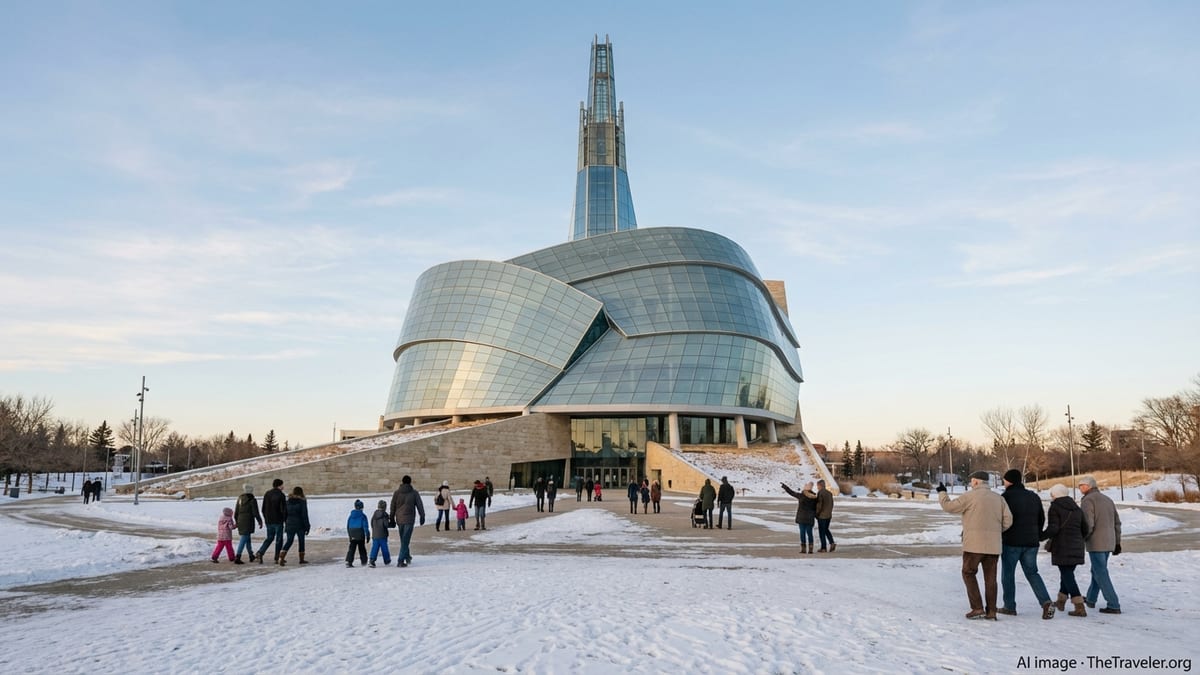
The Building Itself: Architecture with a Message
Before you even step inside, the Canadian Museum for Human Rights announces its ambitions through its striking silhouette on the Winnipeg skyline. Designed by architect Antoine Predock, the structure rises like a stone outcrop wrapped in a glass cloud, topped by a glass spire that reaches roughly 100 metres into the sky. The idea is not simply to impress, but to embody a journey from the earth toward light, mirroring the ongoing struggle from oppression to dignity and justice. Approaching the entrance, you sense that this is more than a conventional museum; it feels like entering a large-scale sculptural narrative about human rights.
At ground level, the museum’s base is clad in Tyndall limestone, a local stone marked by ancient fossils and soft textures that bring a sense of age and memory to the building. Above, faceted glass panels catch Manitoba’s famously changeable light, shifting in tone through the day and with the seasons. The architect wove references to the surrounding prairie landscape into the design, from the rounded forms that suggest glacier-sculpted rock to the expansive views that open up as you ascend inside. The building itself is a reminder that human rights are rooted in specific lands, histories and communities rather than in abstract theory alone.
Inside, the drama continues in a soaring atrium where criss-crossing structural beams spiral overhead and daylight filters down through the glass “cloud.” This space can feel humbling, especially on a bright winter day when reflections dance across the stone surfaces. Even on overcast afternoons, careful lighting and the warm glow from the alabaster ramps give the atrium a gentle radiance. Taken together, these design choices create an atmosphere that feels contemplative rather than monumental, inviting visitors to pay attention, ask questions and stay present with often difficult stories.
Architectural details throughout the building reflect a commitment to accessibility and inclusion. Ramps, elevators and resting places are integrated from the start, not added as afterthoughts, and exhibits are designed with multiple ways to engage. This thoughtful approach reinforces one of the museum’s main messages: that human rights are about the everyday experience of being able to move, participate and belong in shared spaces.
The Alabaster Ramps and Hall of Hope
One of the most memorable experiences at the Canadian Museum for Human Rights is walking the illuminated alabaster ramps that thread through its heart. These pale, glowing pathways link the galleries in a sequence that feels part pilgrimage, part contemplative stroll. Carved from thousands of tiles of translucent alabaster, the ramps emit a soft golden light that contrasts gently with the darker stone walls, guiding you upward level by level. Rather than rushing between exhibits, you are encouraged to slow down, reflect and carry ideas from one gallery into the next.
The Hall of Hope is the emotional centerpiece of this ramp system. Here, the alabaster pathways come together in a space where the light seems to brighten and open, suggesting emergence from shadow into possibility. The museum’s design team has described the entire interior as a metaphorical climb, and it is along these ramps that the metaphor becomes most tangible. After absorbing challenging stories of injustice and struggle, you step back onto the glowing path and literally move toward a brighter, more open space. It is simple, yet remarkably effective at turning architecture into emotional guidance.
The ramps also play a practical role in making the museum one of the more accessible cultural institutions in Canada. Their gentle slopes and generous width allow people with different mobility needs to navigate without feeling segregated or pushed to the margins. Handrails, seating niches and clear sightlines help visitors of all ages feel comfortable as they move between levels. The design signals that participation in the story of human rights must be open to everyone, and that physical access is one of the most basic rights of all.
As you ascend, pause at the edges of the Hall of Hope to look down through the atrium and back toward previous galleries. From this vantage point, the paths you have walked become visible as a network rather than a straight line. It is a subtle reminder that progress in human rights rarely unfolds in a neat, linear way. Instead, it is a web of advances and setbacks, connections and crossings, all illuminated by the choices people make to speak up or stay silent.
The Garden of Contemplation: A Quiet Refuge
Given the emotional intensity of many exhibits, the Garden of Contemplation is one of the most welcome and restorative spaces in the museum. Tucked within the upper levels, this indoor garden is framed by still pools of water edged with dark basalt boulders imported from Mongolia. The combination of gently rippled reflections, cool stone and diffused light creates an atmosphere that feels a world away from the information-rich galleries, even though you are only steps from them.
The garden was envisioned as a place to pause and process difficult stories. After viewing exhibits on genocide, systemic discrimination or the suppression of basic freedoms, many visitors find themselves carrying heavy emotions. Sitting beside the water or resting against the stone, you are given permission to slow down and simply breathe. It is common to see people sitting in quiet thought, couples speaking in hushed tones, or solo travelers jotting reflections in notebooks. The space functions less as an attraction and more as a necessary pause within the larger journey.
Architecturally, the Garden of Contemplation is a study in contrast. Where the atrium is tall and bright, the garden feels lower and more enclosed, with carefully framed glimpses outward. The dark basalt, rough in texture, plays against the museum’s pale limestone and glowing alabaster, evoking the relationship between hardship and resilience. Minimal interpretive text appears here; the focus is on personal interpretation and interior dialogue. In a museum that carefully guides visitors through complex narratives, this is one of the few places deliberately left open to individual meaning.
For travelers, the garden can also be a practical anchor point. If you are visiting with children, it offers a space to regroup away from screens and interactive displays. If you are exploring alone, it can become the place you return to between galleries, marking the transitions in your visit. However you use it, the Garden of Contemplation embodies a key lesson of the museum: that genuine engagement with human rights requires time for quiet reflection as much as time for learning.
“What Are Human Rights?”: Setting the Stage
Early in your visit, you will likely encounter the gallery titled “What Are Human Rights?” which lays the groundwork for everything that follows. Rather than offering a dry legal definition, this introductory space uses multimedia storytelling to explore where ideas about rights come from and how they have evolved across cultures and centuries. Visitors move through an immersive presentation that weaves personal voices, historical moments and visual timelines into an accessible primer on the concept of human rights.
One of the strengths of this gallery is its global scope. The timeline highlights events from many parts of the world, showing that the struggle for dignity and equality is not confined to a single country or tradition. Ancient codes, religious teachings, social movements and international declarations appear side by side, inviting visitors to notice recurring themes: the demand for fair treatment, the push against arbitrary power, the insistence that every person’s life has value. Seen together, these diverse moments suggest that human rights are not a finished product but an ongoing conversation humanity keeps returning to.
The gallery also acknowledges that the term “human rights” can feel abstract or intimidating, especially for younger visitors or those new to the topic. Interactive elements and clear visual design break down complex ideas into graspable pieces without oversimplifying them. Explanations are grounded in everyday experiences: the ability to speak one’s mind, to practice a faith, to learn, to feel safe from violence or discrimination. By linking grand principles to familiar situations, the gallery invites you to see human rights not as something distant negotiated by governments, but as conditions that shape daily life.
Spending time in “What Are Human Rights?” before moving deeper into the museum can pay off later. References to key ideas and documents, from the Universal Declaration of Human Rights to regional charters and national laws, recur throughout other galleries. With this grounding, exhibits on more specific issues become easier to place within a larger framework. For travelers who may only have a few hours at the museum, this gallery serves as a concise yet thoughtful entry point, offering essential context without overwhelming detail.
Indigenous Perspectives: Voices Rooted in the Land
Among the museum’s most powerful spaces is the “Indigenous Perspectives” gallery, which foregrounds First Nations, Métis and Inuit understandings of rights and responsibilities. Set within a dramatic circular theatre surrounded by tall wooden slats, some carved or painted with original artworks, this gallery offers a distinct atmosphere from the more text-heavy areas. Here, the emphasis is on storytelling, relationships and the interconnectedness of all beings rather than purely on laws and charters.
A central feature is the 360-degree film that plays within the circular theatre. Through multiple generations of Indigenous voices, it explores how concepts of rights are inseparable from responsibilities to community, land, water and future generations. Instead of presenting Indigenous perspectives as an afterthought to a dominant narrative, the gallery positions them as foundational ways of understanding human dignity and obligation. Visitors are encouraged to consider how different worldviews might broaden our understanding of what “rights” truly entail.
Outside the theatre, displays highlight historical and contemporary struggles, along with cultural expressions of resilience. Artifacts, images and multimedia installations touch on topics such as treaty relationships, language revitalization, environmental stewardship and the legacy of policies that sought to erase Indigenous cultures. Yet the tone is not solely one of loss. Many exhibits also celebrate resistance, creativity and ongoing movements for self-determination, emphasizing that Indigenous peoples are present-day rights holders and leaders, not only historical subjects.
For travelers, this gallery is a chance to see Canada from perspectives that are often underrepresented in mainstream tourism narratives. It connects the museum directly to its location on Treaty 1 territory and to the long histories embedded in the land around Winnipeg. Spending unhurried time here can change the way you see not only the rest of the museum, but also the city outside its walls, from the rivers that converge at The Forks to the neighborhoods shaped by Indigenous cultures and communities.
Canadian Journeys: Stories of Struggle and Change
“Canadian Journeys” is one of the largest and most absorbing galleries in the museum, weaving dozens of stories into a panoramic view of rights struggles within Canada. Rather than offering a single, sweeping narrative, the gallery is organized into smaller case studies that visitors can explore at their own pace. Each alcove or display focuses on a particular theme, from language rights and voting access to freedom of conscience, disability rights, LGBTQ+ activism and the fight against racially based discrimination.
The design encourages you to think of Canada not as a finished human rights success story, but as a place where progress has often been uneven and hard-won. Exhibits highlight landmark court cases, grassroots campaigns and the everyday actions of people who challenged unfair systems. Some stories are widely known, such as the expansion of women’s political rights or the dismantling of explicitly racist policies, while others may be new even to Canadian visitors. The result is a complex, sometimes uncomfortable portrait of a country frequently praised on the international stage but still wrestling with deep inequalities.
Interactive elements throughout the gallery help transform history into a lived experience. Visitors may encounter multimedia stations where they can listen to oral histories, watch short films or explore digital maps that trace patterns of exclusion and resistance. Some installations invite you to make choices in simulated scenarios, revealing how easy it can be to overlook injustice if it does not affect you directly. Others focus on the emotional dimensions of advocacy, including the courage required to stand up against discrimination and the toll that long-term campaigns can take on individuals and communities.
What makes “Canadian Journeys” a highlight is its insistence on nuance. The gallery does not present heroes and villains in simple terms, nor does it pretend that rights once gained are secure forever. By placing victories, setbacks and unresolved questions side by side, it invites visitors to see human rights as a living, contested field in which ordinary people continue to play active roles. For anyone interested in how Canada’s reputation for fairness has been built, challenged and reshaped over time, this gallery is essential.
Actions for Change and Rights Today: From Learning to Doing
Toward the upper levels of the museum, the focus shifts from history to the present and future in galleries often grouped under themes such as “Rights Today,” “Actions Count” and “Actions for Change.” After traveling through stories of violations, resistance and reform, visitors arrive in spaces designed to answer a pressing question: what now? These galleries highlight contemporary human rights issues, from digital privacy and media representation to the treatment of refugees, ongoing discrimination and emerging challenges posed by new technologies.
Rather than simply cataloguing problems, these areas emphasize agency. Exhibits introduce human rights defenders, community organizers, legal advocates, artists and everyday citizens who have used their voices and skills to push for change. Short films, interactive tables and digital stories illustrate how campaigns take shape, how coalitions form and how small actions can ripple outward. Some stations invite visitors to reflect on their own spheres of influence, whether through their workplaces, social networks, voting choices or daily interactions.
This forward-looking emphasis can be energizing, particularly after the heaviness of galleries dealing with atrocities and systemic abuse. Many visitors report leaving these spaces with a renewed sense of possibility, even if the issues themselves are daunting. The museum avoids quick fixes or simplistic positivity, acknowledging that progress can be slow and uneven. Yet it insists that disengagement is not the only option; there are always ways to participate in building more just communities, however modest.
For travelers, these galleries offer an opportunity to connect what they have learned in Winnipeg to their lives back home. Information panels and interactive tools often encourage visitors to think beyond national borders, recognizing that human rights challenges are interlinked across countries and regions. The clear message is that a museum visit is not the end of the conversation, but one stepping stone in a longer journey toward awareness and action.
The Israel Asper Tower of Hope: A View Toward the Future
Every visit to the Canadian Museum for Human Rights should include time at the Israel Asper Tower of Hope, the glass spire that crowns the building and has quickly become one of Winnipeg’s defining landmarks. Accessible from the upper levels, the tower offers sweeping views over downtown, the rivers and the prairie horizon beyond. On clear days, the city spreads out in all directions, and the big Manitoba sky seems to pour directly into the space through the glass walls. Even on overcast afternoons or winter mornings, filtered light and the geometric framing of the structure create a sense of airy openness.
The tower is meant to serve as both literal and symbolic culmination of the museum’s journey. After moving from darker, more enclosed galleries through glowing ramps and reflective spaces, you emerge into a lookout flooded with natural light. It is a carefully choreographed architectural moment, designed to leave visitors with a feeling of lifted perspective. Many people use the time here to talk through what they have seen, to sit quietly by the windows, or simply to watch the rivers, roads and rail lines that connect Winnipeg to the rest of the continent.
Practical considerations make the tower a highlight as well. The route to the top is clearly marked, and the space is generally accessible to visitors with mobility aids. Railings and benches provide places to rest while taking in the view, and informational panels give context to the landmarks in sight, from historic neighborhoods to recent developments at The Forks. Coming here near the end of your visit can help knit together the museum’s themes with the living city outside, underscoring that human rights are negotiated in real places where people work, live and gather.
Whether you arrive at midday, with bright sunlight casting sharp shadows across the floor, or closer to sunset, when the sky shifts through softer hues, the Tower of Hope is a reminder that perspectives change with time and vantage point. In a museum dedicated to complex, often painful histories, this final space offers a measured optimism: not a promise that all is well, but an invitation to look outward and consider how you might carry what you have learned into the wider world.
The Takeaway
Visiting the Canadian Museum for Human Rights is less about ticking off exhibits and more about undertaking a carefully designed journey. From the first glimpse of its sculptural architecture at The Forks to the last moments in the Tower of Hope, the museum uses space, light and storytelling to guide visitors through the many layers of what human rights mean in practice. The alabaster ramps, Garden of Contemplation, foundational galleries on rights and Indigenous worldviews, detailed Canadian case studies and forward-looking spaces on current issues all work together to create an experience that is intellectually rigorous yet deeply personal.
For travelers, this museum offers a powerful counterpoint to more traditional sights. It asks you not only to observe, but to question your assumptions, to sit with discomfort and to imagine how your own actions might fit into larger narratives of justice and dignity. The highlights described here form a framework, but no two visits are exactly alike; what stands out will depend on your background, interests and the conversations you have along the way. If you make time for reflection, allow the architecture to slow you down and engage fully with at least a few stories in each gallery, you are likely to leave with a new way of seeing both Canada and your place in the wider global community.
FAQ
Q1. How much time should I plan for a visit to the Canadian Museum for Human Rights?
Most visitors find that three to four hours allows enough time to explore key galleries, walk the alabaster ramps, pause in the Garden of Contemplation and visit the Tower of Hope without feeling rushed.
Q2. Is the museum suitable for children and families?
Yes, many exhibits are designed with younger visitors in mind, using interactive elements and clear language, although some galleries address difficult topics that parents or guardians may wish to introduce thoughtfully based on age and sensitivity.
Q3. Are the galleries and ramps accessible for visitors with mobility challenges?
The museum was planned with accessibility as a core priority, offering ramps, elevators, wide pathways and resting areas throughout, so visitors using wheelchairs, strollers or other mobility aids can navigate comfortably.
Q4. Do I need to follow a specific route through the museum?
Staff often recommend beginning with the introductory galleries on human rights and Indigenous perspectives and then moving upward, but visitors are free to explore at their own pace using maps, signage and mobile guides.
Q5. Can I visit the Israel Asper Tower of Hope separately from the exhibits?
Access to the tower is included as part of a regular museum visit, and it is typically reached after exploring the upper galleries, so it is not usually experienced as a stand-alone attraction.
Q6. Is photography allowed inside the museum?
Photography is generally permitted for personal use in many public areas, but some specific exhibits or temporary installations may restrict photos, so it is wise to check signage or ask staff on arrival.
Q7. Are guided tours available, or is it mainly self-guided?
The museum supports both experiences, offering self-guided exploration with interpretive panels and digital tools, as well as scheduled guided tours or programs that provide additional context for selected galleries.
Q8. How emotionally intense is the content, and how can I pace myself?
Because many exhibits address sensitive subjects like genocide and systemic discrimination, visitors are encouraged to take breaks, use quiet spaces such as the Garden of Contemplation and move at a pace that feels manageable.
Q9. Are there places to eat or take a longer rest during my visit?
The main level typically includes amenities such as a café or restaurant area, along with seating and services, allowing visitors to pause for a meal or extended rest between galleries.
Q10. What is the best time of day to experience the museum’s architecture and views?
Daylight hours highlight the glow of the alabaster ramps and the play of light in the atrium, while late afternoon or early evening can offer particularly striking views from the Tower of Hope over the city and rivers.