

Moremi Game Reserve is often described by safari guides as the beating heart of the Okavango Delta. Covering a patchwork of permanent lagoons, seasonal floodplains, acacia woodland, mopane forest and grassy savannah, it delivers an unusually rich mix of wildlife and landscapes in a relatively compact area.
For visitors, that translates into one of Africa’s most varied safari experiences, with traditional game drives complemented by mokoro canoe trips, boating, walking and world-class birding at different times of year. This diversity is precisely why many specialists regard Moremi as Botswana’s most complete and varied safari destination.
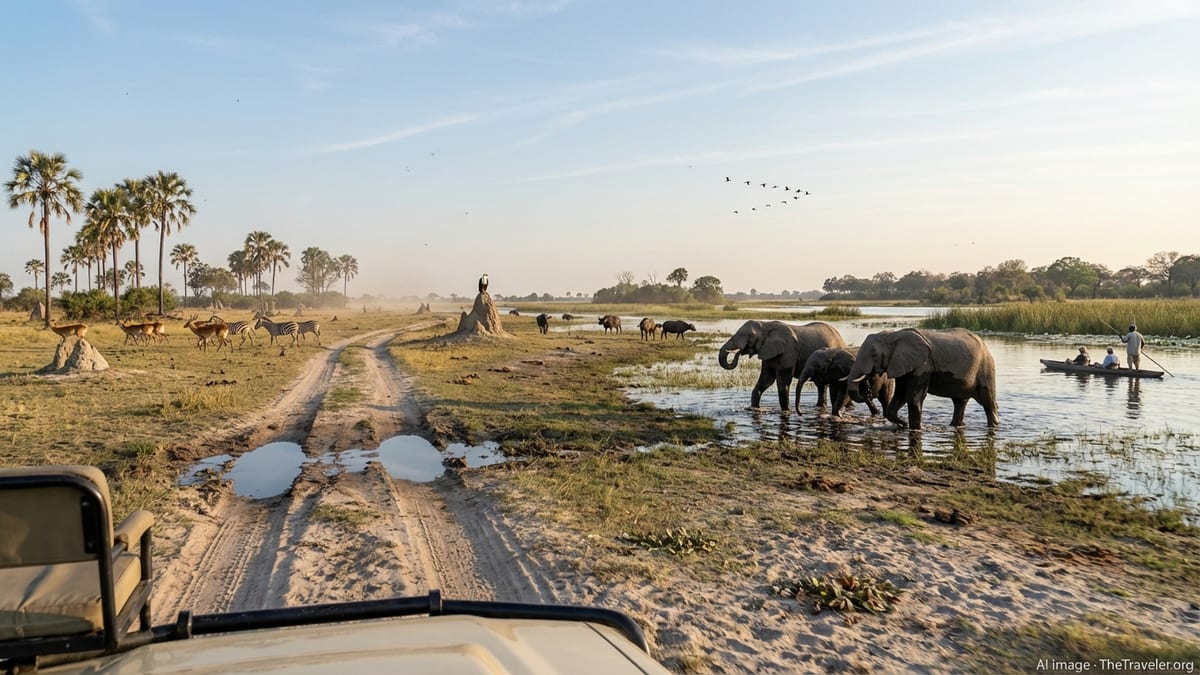
A Mosaic of Habitats in One Reserve
Moremi’s greatest strength is the sheer variety of ecosystems compressed into a single protected area. Established in 1963 on the eastern edge of the Okavango Delta and later expanded to include Chief’s Island, the reserve straddles the transition from dry Kalahari woodland to the watery heart of the Delta. That meeting point creates a remarkably complex environment where wildlife that prefers deep water, marsh, woodland and open savannah all coexist within a day’s game drive.
From Deep Channels to Seasonal Floodplains
In the northern and western reaches of Moremi, visitors encounter classic Okavango scenery: reed-fringed lagoons, papyrus channels and lily-dotted backwaters. These permanent and semi-permanent waterways support hippos, crocodiles, otters and an impressive array of waterbirds, from African skimmers to wattled cranes. During the annual flood, freshwater spills out across surrounding plains, transforming dusty flats into grazing meadows alive with red lechwe, tsessebe, wildebeest and zebra.
As seasonal pans fill, they create stepping-stone habitats that draw species from drier zones into the Delta fringe. When waters later recede, these same animals are forced back towards remaining pools, concentrating game and predator activity. This ebb and flow between wetland and dryland underpins the reserve’s biodiversity and gives Moremi an ever-changing character across the year.
Mopane Forest, Riverine Woodland and Open Savannas
Travel east and south within the reserve and the scenery shifts again into mopane woodland, riparian forests and open grasslands. Mopane belts shelter breeding elephants and buffalo, while riverine woodland along the Khwai and other channels provides leafy corridors for leopards, wild dogs and antelope such as kudu and bushbuck.
Open savannas around Xakanaxa and Third Bridge offer sweeping, big-sky views reminiscent of the Serengeti on a smaller scale. Here, large herds of impala, wildebeest and zebra graze under wide horizons, closely watched by lions and cheetahs. The ability to move in a single morning from closed-canopy forest to wide floodplain, without leaving one reserve, is one of the reasons Moremi feels so varied and rewarding.
Chief’s Island: The Elevated Core of the Delta
Chief’s Island, part of Moremi’s southern section, is a raised sand ridge that remains dry even at peak flood. This higher ground becomes a refuge for wildlife as the waters rise elsewhere in the Delta, concentrating large mammals in an area rich with permanent channels and lush grazing. Long regarded as one of the best game-viewing areas in Africa, Chief’s Island offers everything from elephants and buffalo to lion, leopard and sometimes rhino, all within a scenic, water-wrapped landscape.
Because Chief’s Island combines dry woodland, palm-dotted floodplains and access to navigable channels, it epitomises Moremi’s habitat diversity in microcosm. Many of Botswana’s most famous private concessions lie adjacent to or overlapping this area, reinforcing its status as the core of the Delta’s ecological richness.
Outstanding Mammal Diversity and Big-Game Viewing
Habitat variety in Moremi translates directly into exceptional mammal diversity. The reserve supports healthy populations of Africa’s iconic big game alongside more specialised species that are rarely seen elsewhere. While Botswana is well known for elephants and predators, Moremi stands out for the sheer range of species you can encounter over a few days, particularly during the dry season when wildlife concentrates around dwindling water sources.
High Densities of Elephants, Buffalo and Plains Game
Moremi sits within northern Botswana’s broader elephant range, which holds one of Africa’s largest remaining elephant populations. Herds move through the reserve year-round, using its channels and lagoons for water and mud wallows, especially during the hot months from September to November. Large breeding herds are a common sight on the floodplains, while lone bulls can appear almost anywhere, from forest tracks to lagoon edges.
Away from the elephants, extensive herds of buffalo roam the floodplains and woodlands, drawing lions that specialise in hunting these formidable prey. Zebra and wildebeest mix with tsessebe, lechwe, impala and reedbuck, making for busy scenes at waterholes and crossing points. Because Moremi blends Delta-edge grasslands with richer alluvial soils, its grazing is particularly productive, supporting substantial herbivore numbers and, in turn, sustaining predators.
Big Cats and African Wild Dogs
Moremi has a long-standing reputation for predator action, especially during the dry season between June and October, when vegetation thins out and animals cluster around permanent water. Lions patrol the floodplains, following buffalo and zebra herds on Chief’s Island and around Xakanaxa. Leopards thrive in the riverine woodland, where thick cover and ample prey give them a competitive advantage.
Perhaps most notable is Moremi’s population of African wild dogs, one of Africa’s most endangered large carnivores. Packs are regularly recorded in areas like Khwai and the Mombo concession, using the mixed woodland and open clearings to den, hunt and raise pups. For many visitors, a sighting of painted wolves coursing across a grassland or crossing a shallow channel is a defining moment of their Botswana safari.
Specialist Delta Species and Nocturnal Wildlife
Some of Moremi’s most intriguing mammals are adapted specifically to its wetland setting. Red lechwe, a semi-aquatic antelope, bounds effortlessly through shallow water in pursuit of fresh grass shoots. Sitatunga, far shyer and more secretive, lurks deeper in papyrus beds and is seen less often, but its presence indicates the intact nature of the swamp ecosystem.
At night, spotlight drives in areas adjacent to the reserve boundaries reveal yet another dimension: civets, genets, servals, honey badgers and sometimes aardwolf and pangolin. The overlap of Kalahari and Delta influences means that night drives can turn up species typical of both wetter and drier African regions, underscoring Moremi’s role as a biological crossroads.
Birdlife and Seasonal Spectacles
For birders, Moremi is one of southern Africa’s standout destinations. More than 500 bird species have been recorded in and around the Okavango, and the reserve demonstrates this diversity across its wetlands, riverine forests and woodlands. Crucially, the mix of permanent water and seasonal floodplains, plus the timing of Africa’s migratory cycles, ensures that the avian experience changes markedly through the year.
Waterbirds, Raptors and Okavango Specials
Permanent channels and lagoons host impressive concentrations of herons, storks and waders. Saddle-billed storks, African jacanas and black herons work the shallows, while African fish eagles patrol from high perches, their calls echoing over the floodplains. In places where islands rise abruptly from water, colonies of cormorants and egrets roost together, creating bird-filled silhouettes at dusk.
Moremi is also renowned for scarce species strongly associated with pristine wetlands. These include wattled cranes stalking the marshes, slaty egrets fishing from floating vegetation, and Pel’s fishing owls roosting in large riverine trees. Raptor enthusiasts find plenty to enjoy, from bateleurs and martial eagles to rarer species that hunt along woodland margins.
Green Season Migration and Breeding Displays
When the first rains arrive around November, the reserve transforms. Grasslands flush green, insects emerge in huge numbers and migrant birds arrive from as far afield as Europe and Asia. This green season, running roughly from November to March, is prime time for birding. Swallows, bee-eaters, cuckoos and various warblers join resident species, while weavers and bishops erupt into breeding plumage, turning reedbeds into colonies of bright yellow and scarlet.
Shallow pans scattered across mopane woodland and floodplain edges attract mixed flocks of ducks, geese and waders. For photographers, the combination of dramatic skies, colourful breeding plumage and fewer vehicles on the roads can be particularly rewarding. Although game viewing for larger mammals may be a touch more challenging due to thicker vegetation, birdlife during this period is at its peak.
Year-Round Variety Across Microhabitats
One advantage of Moremi is that even outside peak birding months, there are always interesting species to seek out in different habitats. Woodland birding yields hornbills, barbets, woodpeckers and several owl species. Along the water’s edge, kingfishers, African skimmers and openbill storks are regular highlights. Floodplain grasslands harbour courser, bustard and lark species more typical of semi-arid regions.
Because birdlife responds quickly to changes in water level and vegetation, each visit can feel different. A lagoon that was quiet in October might host flocks of pratincoles or whiskered terns after good local rain in January. This constant flux underscores why guides repeatedly describe Moremi as one of the Delta’s most dynamic and diverse birding arenas.
Land and Water Safaris in a Single Destination
Many African parks are dominated either by vehicle-based game viewing or, in a few cases, by water activities. Moremi is unusual in offering both classic 4x4 safaris and a full range of water-based experiences, often from the same camp, depending on season and water levels. For travellers who want variety without constant transfers between different regions, that combination is a major reason to prioritise Moremi.
Classic Game Drives Across Varied Terrain
Game drives remain the backbone of a Moremi safari. Networked dirt tracks radiate from key areas such as South Gate, Xakanaxa, Third Bridge and Khwai, traversing woodland, grassland and floodplain. In the dry season, when grasses are shorter and wildlife clusters near water, these drives can produce back-to-back sightings of elephants, buffalo, big cats and plains game, sometimes all before breakfast.
The changing terrain keeps drives engaging even on longer outings. One moment you might be negotiating a wooden bridge over a flooded channel, the next you are parked on a termite mound scanning for cheetahs on a sunlit plain. This geographical variety during a single activity distinguishes Moremi from parks where the environment feels comparatively uniform.
Mokoro Excursions and Boat Safaris
When water levels are high, particularly from around May through August in most years, mokoro (dugout canoe) excursions become a signature experience. Punted silently through narrow channels by expert polers, guests glide past reed beds alive with frogs and dragonflies, while sitatunga tracks line the banks. The perspective from water level, coupled with the near-silence of travel, offers a stark contrast to the dust and engine noise of vehicle safaris.
Motorboat cruises on broader channels and lagoons complement mokoro trips. These outings allow access to more distant islands and deep lagoons where hippos wallow and elephants wade chest-deep across flooded plains. As sunset approaches, boats drift in mid-channel, with herons flying to roost and the calls of fish eagles ringing out across mirror-flat water.
Walking Safaris, Birding and Specialist Activities
In selected concessions and at certain times of year, guided walks open another layer of diversity. On foot, smaller details come to the fore: animal tracks in the sand, termite mounds hosting dwarf mongooses, medicinal plants used by local communities. Walking also offers encounters with more elusive antelope species and gives a greater sense of the transitions between woodland, floodplain and pan.
Some operators further enrich itineraries with specialist activities such as catch-and-release fishing when regulations and water levels permit, or scenic helicopter flights over the Delta’s winding channels. Together, these options mean that a multi-day stay in Moremi can easily include several different styles of safari, each revealing another facet of the ecosystem.
Year-Round Appeal and Seasonal Contrast
Unlike many safari destinations that have a very clear “on” and “off” season, Moremi remains productive throughout the year. What changes is not whether there is wildlife to see, but which species are at their best and how you experience them. This strong seasonality, without a true downtime, is a key reason travellers and guides repeatedly return to Moremi and still find something new.
Dry Season: Concentrated Wildlife and Classic Safaris
The dry season, broadly from May to October, is prime time for traditional big-game viewing. As seasonal pans and outlying waterholes dry up, animals gravitate towards permanent channels, rivers and lagoons within or near the reserve. Grasses thin, trees drop leaves and visibility improves dramatically, making it easier to spot predators and prey from a distance.
June through August often provide comfortable daytime temperatures and clear skies, ideal for long game drives and sharp, dust-free photography. By September and October, temperatures rise sharply, but this also ramps up predator activity around shrinking water sources. For visitors focused on lions, leopards, wild dogs and large herds of herbivores, these dry months are outstanding.
Green Season: Lush Landscapes and Birthing Time
From about November to March, the arrival of rain triggers an equally impressive shift. The bush greens almost overnight, newborn antelope totter on wobbly legs and dramatic thunderstorms build over the Delta. This period, often called the green season, trades slightly more challenging big-game viewing for superb birdlife, spectacular skies and quieter reserves.
Young animals bring predators out in force, but taller grasses and thicker foliage make sightings more about patience and tracking than simple roadside encounters. For travellers who value atmosphere, colours and photography as much as ticking off big-five sightings, the green season in Moremi can be irresistible, and lodge rates are often lower.
Flexible Planning Around the Flood
Moremi’s position within the Okavango Delta means it is influenced not only by local rainfall but also by floodwaters arriving from Angola, typically between March and July. These waters peak in mid-winter before gradually receding, reshaping which areas are best explored by vehicle, boat or mokoro at any given moment.
This hydrological rhythm adds an extra layer of diversity. A track that was easily drivable in April may be underwater in June, pushing guides to explore higher ground instead. Conversely, a backwater channel that was bone-dry in October might be navigable by mokoro by May. For visitors, planning with reputable operators who know how to time itineraries around these shifts can unlock the full spectrum of Moremi’s seasonal experiences.
Community, Conservation and Low-Volume Tourism
Moremi’s diversity is not only ecological; it also extends to the way tourism, conservation and local communities interact around the reserve. Botswana’s long-standing policy of high-quality, low-volume tourism has helped limit overdevelopment across the Okavango region, while community-managed areas along Moremi’s borders provide additional habitat and economic benefits for local residents.
A Pioneering Conservation Story
Moremi is often cited as one of the first reserves in Africa to be established through the initiative of local people. In the early 1960s, the Batawana people set aside part of their traditional hunting grounds to protect wildlife and ensure its sustainable use in the face of increasing pressure. That decision laid the foundation for the modern reserve, which has since become central to Botswana’s conservation identity.
Over subsequent decades, Moremi’s boundaries were extended, and anti-poaching and wildlife monitoring efforts intensified. The creation of adjacent private concessions with strict vehicle limits and controlled lodge development has further supported habitat protection, allowing large mammals and predators to move relatively freely across a broad, semi-connected landscape.
Community Areas and Buffer Zones
To the east and north of Moremi, community-managed areas such as the Khwai region function as important buffer zones. These landscapes, while outside the park proper, are used for photographic tourism rather than consumptive hunting, and revenue from lodges and guided activities is channelled towards village development and conservation projects.
For travellers, staying in or passing through such areas offers a deeper understanding of how people and wildlife coexist around the Delta. Cultural visits, village tours and locally guided activities provide insight into traditional knowledge of the flood, the use of wild plants and ongoing efforts to reduce conflict between humans and elephants, predators and livestock.
Low-Density Lodging and Lasting Wilderness Feel
Inside Moremi and in neighbouring concessions, Botswana’s preference for small, low-impact camps means that even at the height of the dry-season rush, visitor numbers remain modest compared with many of Africa’s other marquee parks. Many lodges limit each sighting to a few vehicles and enforce strict off-road and night-driving policies, preserving both the environment and the sense of solitude.
This approach supports the long-term health of the ecosystem while ensuring that the diversity of habitats and wildlife can be enjoyed without overcrowding. In turn, it helps maintain Moremi’s reputation as a true wilderness, not merely a busy safari circuit.
Access, Logistics and Combining Moremi with Other Regions
Another element in Moremi’s appeal is how easily it can be woven into a broader Botswana itinerary. The reserve’s position on the eastern edge of the Okavango makes it accessible both to self-drive adventurers and to travellers flying into remote lodges by light aircraft. This flexibility allows visitors to experience different sides of the Delta as well as other major ecosystems within a single trip.
Self-Drive Exploration and Public Campsites
Moremi is one of the few areas of the central Okavango where experienced self-drivers can explore inside the reserve. Public campsites at locations such as Third Bridge and Xakanaxa offer a more adventurous, close-to-nature experience, with elephants and hippos sometimes wandering through camp and lions calling in the night. For travellers comfortable with deep-sand tracks, water crossings and basic facilities, this independent style of travel adds another dimension to the reserve’s diversity.
Because conditions change with the seasons, self-drivers must plan carefully, paying attention to road reports and water levels. In exchange, they gain access to sunrise and sunset scenes on quiet tracks, far from any lodge or airstrip, and the chance to experience Moremi’s varied habitats at their own pace.
Fly-In Lodges and Multi-Region Safaris
For many visitors, particularly those on tighter schedules, fly-in safaris are the most practical way to experience Moremi. Short charter flights connect the reserve with Maun and with other key wildlife areas such as the private Okavango concessions, the Linyanti and Chobe National Park. This network makes it easy to combine Moremi’s mix of land and water activities with, for example, the elephant-rich riverfront of Chobe or the stark pans of the Makgadikgadi.
Because different regions peak at slightly different times, carefully sequencing stops can maximise variety. A trip might begin with desert and saltpan scenery, move into the lush waterways and mixed habitats of Moremi, and finish with the broad Chobe River, all within 10 to 12 days. In this sense, Moremi frequently serves as the central pivot of a Botswana safari, tying multiple ecosystems together into one coherent journey.
Activities for a Range of Interests and Budgets
Moremi’s accommodation options run from simple public campsites to some of Africa’s most exclusive tented lodges. That spectrum allows travellers with different budgets to experience the same core diversity of landscape and wildlife, whether via self-drive or guided safaris. Families can opt for child-friendly lodges in nearby concessions; honeymooners may choose intimate, water-focused camps; serious photographers might split time between predator-rich plains and bird-filled lagoons.
Because of this flexibility, Moremi appeals to first-time visitors seeking a classic introduction to the Delta as much as to seasoned safari-goers chasing specific species or rare behaviours. The reserve’s diversity of experiences matches the diversity of its habitats, reinforcing its status as Botswana’s most all-round safari area.
The Takeaway
Moremi Game Reserve’s claim to be Botswana’s most diverse safari area rests on multiple pillars that all reinforce one another. A mosaic of habitats, from mopane forest to deep channels and floodplains, supports exceptional mammal and birdlife. Land, water and walking activities reveal these ecosystems from different angles, while pronounced seasonal shifts ensure that no two months, let alone two trips, feel the same.
Layered onto this ecological richness is a pioneering conservation story, meaningful community involvement and a tourism model that favours low-impact, high-quality experiences. Whether you arrive by 4x4 and pitch a tent under the stars or fly into a remote island camp, you encounter the same fundamental qualities: wildness, variety and constant change driven by water and weather.
For travellers weighing where to focus their time in Botswana, these attributes make a compelling case. If you are looking for a single destination that encapsulates the breadth of the Okavango Delta while still offering big-game drama, intimate birding and quiet mokoro channels, Moremi Game Reserve remains the place where all those threads come together.
FAQ
Q1: When is the best time of year to visit Moremi Game Reserve?
For classic big-game viewing with high concentrations of animals and good visibility, the best time is generally from June to October, during the dry season when vegetation is thinner and wildlife gathers around permanent water sources. Travellers interested in birding, lush landscapes and newborn animals may prefer the green season from November to March, accepting slightly more challenging game viewing in exchange for fewer visitors and dramatic photographic conditions.
Q2: How many days should I spend in Moremi?
A stay of at least three to four nights is recommended to experience the main habitats and activities without feeling rushed. If you plan to combine land-based game drives with water activities such as mokoro excursions and boat trips, five or more nights spread across two different areas within or near the reserve will give you a more rounded sense of Moremi’s diversity.
Q3: Can I do both mokoro trips and game drives in a single visit?
Yes, many camps and lodges in and around Moremi offer both land and water activities when water levels permit. During the flood season, typically from around May to August, you can often alternate morning game drives with afternoon mokoro or boat excursions, giving you contrasting perspectives on the same ecosystem over the course of your stay.
Q4: Is Moremi suitable for a first-time safari traveller?
Moremi is an excellent choice for a first safari because it offers a bit of everything: iconic big game, varied landscapes, a mix of activities and a strong chance of seeing predators. Well-run lodges, experienced guides and the option to combine the reserve easily with other parts of Botswana mean that first-time visitors can enjoy a polished yet genuinely wild experience.
Q5: How does Moremi compare with Chobe National Park?
Chobe is famous for its enormous elephant herds and the scenic Chobe River, particularly around the busy riverfront. Moremi, by contrast, typically offers a more intimate, Delta-focused experience with greater habitat variety and a broader mix of activities, including mokoro excursions. Many travellers choose to visit both, using Moremi for its diversity and Chobe for its dramatic river scenes and dense elephant populations.
Q6: Do I need a 4x4 vehicle to visit Moremi on a self-drive safari?
Yes, a high-clearance 4x4 is essential for self-drive safaris in Moremi, as roads are unpaved, often sandy and can feature water crossings, especially during and after the flood. Drivers should have some off-road experience, carry recovery equipment and travel with updated information on road conditions and water levels. Those who prefer not to self-drive can instead join guided lodge-based safaris or organised mobile expeditions.
Q7: What types of accommodation are available in and around Moremi?
Accommodation ranges from simple public campsites inside the reserve, where you bring your own equipment and provisions, to fully serviced tented camps and high-end lodges in private concessions bordering Moremi. Some offer mainly vehicle-based game drives, while others specialise in water activities or walking safaris. This diversity allows travellers with different budgets and interests to tailor their stay to the style of experience they prefer.
Q8: Is Moremi a good destination for families with children?
Moremi can be a rewarding destination for families, particularly if you stay in family-friendly lodges that offer flexible activities, spacious family tents and guides experienced in working with younger guests. Some camps have minimum age limits for certain activities, such as walking or mokoro excursions, so it is important to check policies in advance and choose properties that match your children’s ages and interests.
Q9: What wildlife can I reasonably expect to see in Moremi?
Visitors commonly see elephants, buffalo, hippos, giraffes, zebras, wildebeest and several antelope species, including impala, lechwe and kudu. Predators such as lions, leopards, spotted hyenas and African wild dogs are regularly encountered, especially in well-known areas like Khwai and Chief’s Island. While nothing is guaranteed in the wild, the mix of habitats and healthy populations gives Moremi a strong record for rewarding game viewing over relatively short stays.
Q10: Is Moremi Game Reserve safe to visit?
Moremi is considered safe for visitors who follow park rules and the guidance of experienced operators. Camps and lodges are accustomed to working around large wildlife and provide clear briefings on how to move safely in and around camp. On self-drive trips, travellers should maintain sensible distances from animals, avoid driving at night inside the reserve and stay within designated campsites. As with any remote wilderness, preparation, caution and respect for wildlife are key to a safe and memorable visit.