

On a continent blessed with storied trains and legendary landscapes, Rovos Rail has managed to claim a singular niche. Marketed as the Pride of Africa and often described as the world’s most luxurious train, it pairs slow travel with a cinematic sweep of savannah, desert and vineyards, all viewed from impeccably restored vintage carriages.
With capacity for around 72 passengers and a design that prizes space, service and stillness over speed, this is not simply a way to get from A to B. It is a rolling country house hotel, a private club on wheels and a grand tour of Southern Africa all at once. Here are seven reasons many seasoned travelers consider Rovos Rail the world’s most iconic luxury train.
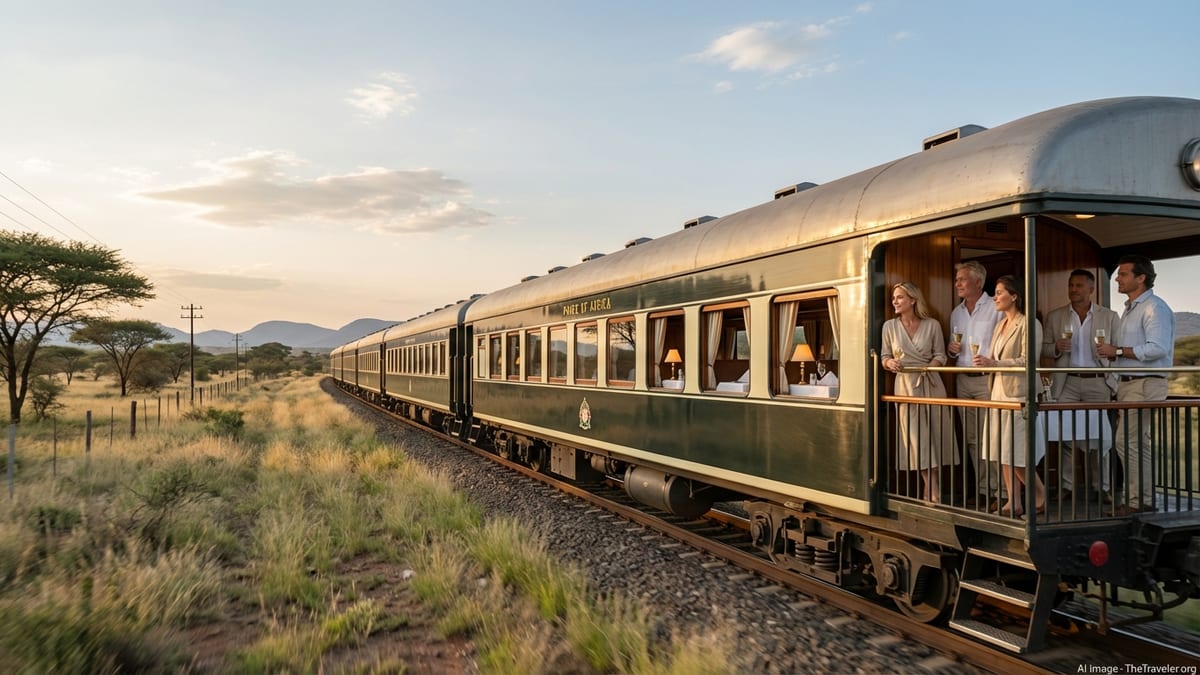
1. A Train Steeped in African Rail Lore
For a train to be truly iconic, it needs more than plush interiors. It needs a story and a sense of place. Rovos Rail delivers both, drawing deeply on the history of African railways and the romance of exploration across the continent’s southern tier. From its private Pretoria station to its evocative itineraries reaching all the way to Dar es Salaam, the line has become a byword for old-world glamour in modern Africa.
A Private Station and Living Rail Museum
Rovos Rail operates out of its own station and locomotive yard in Pretoria, Capital Park, which functions as a working rail yard and atmospheric departure lounge. Guests arrive not at a crowded public concourse but at a quiet, restored station where vintage locomotives, period signage and gleaming teak carriages set the tone long before anyone steps aboard.
The pre-departure ritual here is part of what gives Rovos Rail its mystique. Passengers check in with a glass of South African sparkling wine in hand, wander past lovingly restored rolling stock and listen as staff recount the history of each carriage. Many of these cars were salvaged from scrapyards and painstakingly rebuilt, which gives the train the authenticity of a curated museum combined with the comfort of a five-star hotel.
The Pride of Africa Reputation
Rovos Rail’s flagship train, often referred to as the Pride of Africa, has achieved near-mythical status among rail aficionados. It regularly appears on lists of the world’s most luxurious train journeys and is widely cited as a benchmark for long-distance rail indulgence in Africa and beyond.
This reputation is not a marketing invention but the result of decades of consistent delivery. The line was founded in the late 1980s and has grown from a niche passion project into one of the most recognised luxury travel brands in Southern Africa. Its itineraries span South Africa, Zimbabwe, Zambia and Tanzania, threading together cities, classic safari territory and natural wonders such as Victoria Falls. The breadth of these routes, many of them multi-day or even fortnight-long odysseys, contributes significantly to the train’s iconic status.
An Heir to the Golden Age of Rail
What makes Rovos Rail feel truly iconic is the way it channels the so-called golden age of rail without lapsing into pastiche. The carriages are vintage, the pace is unhurried, and the sense of ceremony is strong, yet this is not a museum piece. It is rail travel as it might have evolved if mass aviation had never eclipsed it.
Passengers are invited to treat the journey as an event in itself. Distances are measured in hours rather than minutes, and route planning celebrates scenic detours over straight lines. In a world defined by speed and distraction, this deliberate, nostalgic approach to movement feels both radical and deeply luxurious.
2. Suites That Rival Boutique Hotel Rooms
If there is a single factor that elevates Rovos Rail to “world’s most luxurious” status, it is the space and comfort of its suites. Where many trains offer compact cabins designed for sleep and storage only, Rovos Rail’s three suite categories feel more like boutique hotel rooms that happen to move. Every suite has an en-suite bathroom, climate control, and thoughtful details that make days on the rails remarkably indulgent.
Royal Suites: Half a Carriage of Private Indulgence
The Royal Suites are the ultimate expression of Rovos Rail luxury. Each one occupies roughly half a carriage, giving passengers around 16 square metres of living space, an extraordinary figure in the rail world. Within this footprint, you’ll find a bedroom area, a small lounge with seating and writing desk, generous wardrobe space and a bathroom that would not feel out of place in a high-end city hotel.
The defining feature of the Royal bathroom is its freestanding Victorian-style bathtub, paired with a separate shower, toilet and basin. Soaking in a full tub while acacia-dotted plains and distant kopjes slide past the window is one of those only-on-Rovos experiences that turn a train journey into a travel story. The fact that this comfort is wrapped in warm wood panelling, brass fittings and period light fixtures only adds to the sense of theatrical luxury.
Deluxe Suites: The Sweet Spot for Space and Value
For many travelers, the Deluxe Suites represent the ideal balance between indulgence and practicality. At around 10 square metres, they are still larger than many cruise cabins and leave enough room for a double or twin bed, a compact lounge area and built-in storage. Every Deluxe Suite includes an en-suite with shower, basin and toilet, along with a cupboard, safe, luggage shelf and a small fridge stocked with drinks of the guests’ choosing.
The feel is that of a cosy yet sophisticated railway stateroom. There is space to dress for dinner, lounge with a book or simply sit by the window as the countryside rolls by. Attention to detail is evident in the quality of linens, the provision of robes and slippers, the availability of both soft and firmer mattresses on request and features like USB charging points seamlessly integrated into classic design.
Pullman and Pullman Gold: Ingenious Use of Space
The smallest suite category, the Pullman (and Pullman Gold on some longer routes), still offers en-suite comfort and air conditioning in roughly 7 square metres. By day, the configuration is a sofa, fold-away desk and storage; at night, staff convert the space into either a double bed or twin berths, depending on guest preference.
Despite their compact footprint, these cabins feel thoughtfully designed rather than cramped. The en-suite bathroom includes a shower, toilet and basin, and there is sufficient storage for luggage, clothing and travel essentials. For solo travelers, couples who prioritize time in the public cars, or guests who want to experience Rovos Rail at a slightly gentler price point, the Pullman suites deliver the same hallmark service and route access in a more efficient package.
Modern Comfort in Vintage Wrapping
Across all suite categories, the guiding philosophy is to hide modern technology behind period aesthetics. Guests enjoy individually controlled air conditioning, reliable hot water, good lighting and practical perks like hairdryers, shaving sockets and in-suite phones, yet the look remains resolutely Edwardian-inspired rather than high-tech.
Daily housekeeping, turndown service, and a dedicated host or hostess assigned to each carriage ensure that suites remain immaculate and well-stocked. The result is a cabin experience that genuinely rivals a well-run five-star hotel, with the added benefit of ever-changing views outside the polished wood-framed windows.
3. Fine Dining and South African Wine Culture Onboard
Luxury rail journeys live or die by their dining car, and Rovos Rail has invested heavily in making meals a highlight rather than a mere necessity. Multi-course menus, a strong emphasis on regional ingredients, an extensive South African wine list and formal dinner service combine to create a culinary program that would comfortably stand on its own in a major city.
Edwardian-Style Dining Cars
Rovos Rail’s dining cars evoke a glamorous past with high-backed chairs, white tablecloths, crystal stemware and soft lighting reflected in polished wood panelling. Candles flicker in the evenings, heavy drapes frame the windows and the occasional jolt of the track adds a reminder that this fine-dining room is in motion.
Tables are set for two or four, allowing couples to dine privately or mingle with fellow passengers. Breakfasts are leisurely affairs with cooked-to-order options; lunches are typically three-course, and dinners stretch to four courses with wine pairings. Dietary requirements are handled with professional ease, and menus change regularly to reflect the regions the train is traversing.
Cuisine That Showcases the Region
The culinary team aboard Rovos Rail takes pride in showcasing African and particularly South African flavours. Expect dishes built around local game meats, Karoo lamb, line-caught fish and Cape-style sauces, alongside international favourites. Fresh fruit from the country’s orchards, artisanal cheeses and decadent desserts round out the offer.
Meals are not rushed. The schedule is designed so that journeys through especially scenic sections often coincide with lunch or dinner, turning each sitting into a movable feast with a constantly shifting backdrop. The steady rhythm of cutlery, conversation and the soft clatter of wheels on track becomes one of the defining sounds of life on board.
A Serious South African Wine Cellar
Wine is a point of pride on Rovos Rail. South Africa’s major wine regions lie within reach of several of the train’s routes, and the onboard list draws heavily from top Cape producers. Passengers can sample crisp Chenin Blancs, structured Cabernets, elegant Pinot Noirs and the country’s signature Pinotage, often paired thoughtfully with individual courses.
Many itineraries attract a high proportion of wine enthusiasts, and informal tastings or discussions with staff about grape varietals and estates are common. Premium spirits, cocktails and local craft beers are also available in the lounge and observation cars, and most journeys include drinks in the fare, further reinforcing the all-inclusive ease of the experience.
Afternoon Tea and All-Day Indulgence
Beyond formal meals, the culinary rhythm of Rovos Rail includes afternoon tea served in the lounge or observation car, often around 16:30. Tiered trays of sandwiches, cakes and pastries appear just as the light softens over the landscape, offering a bridge between daytime excursions and the evening’s formal dinner.
Throughout the day, snacks and room service are available, and the bar remains open from morning until late at night. The cumulative effect is one of gentle, continuous indulgence; guests never feel hurried or constrained by fixed meal times, yet there is a strong sense of tradition and ceremony around each sitting.
4. Immersive Routes Across Southern and Eastern Africa
An iconic train is defined not just by what is inside the carriages but by the terrain it crosses. Rovos Rail’s routes stitch together some of the most celebrated landscapes and cities in Southern and Eastern Africa, transforming each journey into a curated itinerary of national parks, wine country, historic towns and grand natural landmarks.
Cape Town to Pretoria: A Classic African Axis
One of Rovos Rail’s signature journeys runs between Cape Town and Pretoria, typically over three days and two nights. This route captures a cross-section of South Africa’s varied geography: the vineyards and mountains of the Western Cape, the semidesert Karoo, the historic diamond town of Kimberley and the highveld approaching the administrative capital.
Along the way, guests disembark for excursions such as a guided visit to the Big Hole and Kimberley Mine Museum or a stroll through the preserved Victorian village of Matjiesfontein. The itinerary is paced so that the train often passes dramatic scenery in daylight, while longer hauls happen overnight, maximizing both sleep and sightseeing.
Victoria Falls and Beyond
Rovos Rail’s routes northward are among its most sought-after. Journeys from Pretoria to Victoria Falls offer a blend of classic rail romance and safari-country drama, crossing the Limpopo into Zimbabwe and rolling through a mosaic of rural villages, bushland and agricultural zones before reaching the Zambezi River and the falls themselves.
Longer itineraries continue through Zambia and Tanzania, often culminating in Dar es Salaam. These extended voyages, sometimes stretching to fifteen days or more, turn the train into a parallel world in which days are spent watching baobab country and high plateaus pass by, punctuated by off-train adventures to national parks, historic sites and remote towns rarely visited by mainstream tourism.
Specialist and Themed Journeys
In addition to its core itineraries, Rovos Rail operates themed routes that deepen its appeal to specific travelers. There are journeys focused on golf, combining overnight rail segments with tee times at leading courses, as well as itineraries that link the train with safari lodges, private reserves or coastal hotspots.
These journeys transform Rovos Rail from a standalone experience into a central thread within a broader African itinerary. Passengers might fly in for a safari, board the train for a multi-day segment across the interior, then disembark for a stay in Cape Town or a beach resort, all without ever sacrificing the consistency of luxury and service.
Slow Travel as a Conscious Luxury
Rovos Rail typically runs at a more measured pace than modern high-speed rail, often cruising at speeds that allow guests to photograph wildlife and scenery from open balconies. This intentional slowness is part of its charm. Rather than compressing the continent into a series of quick flights, the train stretches time, encouraging passengers to sit, watch and engage with the journey itself.
For many travelers used to short-haul flights and packed itineraries, the experience can be recalibrating. Mornings unfold over coffee and maps in the observation car, afternoons drift by with books and binoculars, and evenings are reserved for unhurried dinners and conversation. In this environment, distance becomes something to savour rather than to conquer.
5. A Digital Detox in a Bygone-Age Setting
In an era of constant connectivity, Rovos Rail’s deliberate retreat from screens and signals has become one of its most distinctive luxuries. There is no Wi-Fi on board, and guests are encouraged to keep phones and laptops within their suites rather than using them in public areas. The result is a kind of analog sanctuary where conversation, reading and simple contemplation reclaim center stage.
Public Cars Designed for Connection
The train’s public spaces are configured with human interaction in mind. Lounge cars feature sofas, armchairs, small tables and often board games or magazines laid out for communal use. The observation car at the rear of the train is a centerpiece, with large windows and an open-air balcony where passengers gather to watch the scenery, share photography tips or simply stand in companionable silence as the wind sweeps past.
A separate smoking lounge caters to cigar and pipe enthusiasts without encroaching on the comfort of non-smoking passengers. Throughout, soft furnishings, club-style décor and low-level lighting create an atmosphere more reminiscent of an old-world members’ club than a modern transport carriage.
The Lost Art of Conversation
Because screens are absent and there are no in-car entertainment systems, evenings naturally gravitate toward conversation. Travelers from around the world swap stories over pre-dinner drinks, compare notes on previous safaris or discuss the day’s excursions. These social encounters often become as memorable as the landscapes outside, and many guests leave with new friendships forged over multiple days and shared experiences.
For solo travelers in particular, this environment can feel welcoming and inclusive. The physical layout of the cars encourages mingling, and the shared novelty of the train journey gives everyone an easy conversation starter.
Room to Disconnect and Reflect
The lack of digital distraction also creates rare space for introspection. Guests often find themselves reading for hours, journaling by the window, or simply watching the play of light across a distant mountain range. The train’s gentle rocking and muffled track noise become a kind of white noise soundtrack, making it easier to slip into a meditative state.
For those who still need to check messages or handle urgent work, mobile reception comes and goes along the route, and it is possible to connect briefly at some stops. But the prevailing culture on board encourages guests to use this sparingly and to view the journey as a deliberate break from their usual online lives.
6. Highly Personalised, Discreet Service
A train can have beautiful carriages and superb routes, but without consistent, intuitive service it will never feel truly world-class. Rovos Rail’s staff are frequently singled out in travel reports for their warmth, professionalism and ability to anticipate needs without intruding.
Dedicated Hosts and 24-Hour Attention
Each carriage or section of the train is served by a dedicated host or hostess who becomes the primary point of contact for guests. These staff members handle everything from making up beds and delivering morning tea to arranging laundry, confirming excursion preferences and restocking in-suite minibars with passengers’ chosen drinks.
Room service is available around the clock, and staff are trained to respond quickly yet unobtrusively. A late-night request for a snack, an extra pillow or assistance with luggage is treated with the same courtesy and efficiency as a formal dining-room service. This creates an atmosphere where guests feel genuinely looked after rather than merely managed.
Consistency Across the Journey
On longer itineraries, the ability of the crew to sustain high standards becomes especially notable. Multi-day or multi-week journeys include numerous border crossings, excursions, schedule adjustments and logistical challenges, yet from the passengers’ point of view the experience remains smooth and unhurried.
Behind the scenes, a sizeable team handles everything from train operations and maintenance to kitchen prep and housekeeping. The fact that guests often remember individual staff members by name after disembarkation speaks to the personal connection forged over days on board.
Unobtrusive Formality
There is an understated formality to service on Rovos Rail that suits its period styling. Staff are smartly uniformed, attentive and well versed in both local knowledge and broader hospitality etiquette. Yet the atmosphere remains friendly rather than stiff. Guests are not overwhelmed with ceremony; instead, they are quietly guided through each stage of the journey, from safety briefings and border formalities to excursion timings and dining-room seating.
This balance of formality and ease is one of the reasons many travelers liken Rovos Rail to a private club: standards are high, expectations are clearly communicated, and everyone is invited to relax within a well-defined framework.
7. A Strong Sense of Occasion, From Dress Code to Details
Finally, what truly cements Rovos Rail’s iconic status is its attention to ritual and atmosphere. From the moment the departure whistle sounds to the last toast in the dining car, the journey is suffused with a sense of occasion that is increasingly rare in contemporary travel.
Evenings That Call for Dressing Up
Rovos Rail maintains a formal or smart dress code for dinner, encouraging men to wear jackets and ties and women to opt for cocktail dresses or similarly elegant attire. This is not an arbitrary rule but a conscious attempt to preserve the sense that evenings on the train are special.
The effect is transformative. After days spent in light linens and safari gear, guests change for dinner and emerge into candlelit dining cars that feel like theatre sets. The ritual of dressing, the muted clink of glassware and the measured call of the dinner gong all combine to create a mood that many passengers describe as akin to stepping onto the set of a classic film.
Design Details That Tell a Story
Throughout the train, design details reinforce the narrative of a bygone age. Carriages are panelled in rich woods with inlaid trim; antique-style light fixtures cast a soft golden glow; brass hardware is polished to a gentle sheen. Curtains, upholstery and carpeting are chosen to echo early twentieth-century tastes while still feeling comfortable and contemporary.
In the suites, small touches such as printed daily weather reports, route maps and thoughtful amenities add layers of care. Public spaces often feature period photographs, maps and memorabilia related to African railway history, giving context to the journey and underlining the sense that guests are part of an ongoing story rather than an isolated trip.
Curated Off-Train Experiences
The sense of occasion extends beyond the carriages. Included excursions are chosen not merely for sightseeing value but for their ability to deepen guests’ understanding of the regions they traverse. Visits might include guided tours of battlefields, walks through colonial-era town centres, wine tastings in Cape vineyards, game drives in private reserves or sunset cruises above Victoria Falls.
Because these outings are fully integrated into the rail schedule and included in the fare on most itineraries, they feel like extensions of the onboard experience rather than bolt-on extras. Guides are carefully selected and briefed, and transport to and from the train is handled seamlessly, ensuring that the mood of unhurried luxury never breaks.
A Journey That Lingers in Memory
Ultimately, the combination of heritage, design, service and landscape results in something greater than the sum of its parts. Rovos Rail is not simply an opulent way to cross Southern Africa; it has become a shorthand among travelers for a particular kind of experience: slow, elegant, immersive and unashamedly romantic.
Long after the last course has been cleared and the final station reached, what many passengers remember are sensory fragments. The smell of polished wood and brewed coffee at dawn. The cool weight of crystal glassware in hand as the sun sinks over distant hills. The moment of stepping onto the open-air balcony and feeling the night air rush past as constellations bloom overhead. These are the details that define an iconic journey and explain why Rovos Rail so often tops lists of the world’s most luxurious trains.
The Takeaway
Rovos Rail has earned its reputation not through gimmicks or fleeting trends but by doubling down on fundamentals: generous space, excellent food and wine, genuinely hospitable service and routes that show Africa at its most compelling. Wrapped in carefully restored vintage carriages and stripped of modern digital distractions, the experience feels timeless rather than retro.
For travelers seeking a once-in-a-lifetime journey that blends the pleasures of a grand hotel with the thrill of overland exploration, the Pride of Africa stands in a class of its own. Whether your itinerary is a three-day sprint between Cape Town and Pretoria or a multi-country odyssey up to East Africa, the train invites you to slow down, dress up and rediscover the art of travel as an event. In a world of rushed connections and anonymous terminals, that alone might be the greatest luxury of all.
FAQ
Q1. What makes Rovos Rail different from other luxury trains?
Rovos Rail distinguishes itself through unusually spacious suites with full en-suite bathrooms, an intimate guest capacity of around 72 passengers, a strong focus on South African cuisine and wine, and immersive routes that cross multiple countries in Southern and Eastern Africa. Its private Pretoria station and deliberate lack of onboard Wi-Fi reinforce a sense of stepping into a slower, more gracious era of travel.
Q2. How many suite categories are there and how do they differ?
There are three main suite categories: Pullman (or Pullman Gold on some routes), Deluxe and Royal. Pullman suites are the most compact and feature a sofa that converts into a bed at night. Deluxe suites are larger, with a fixed double or twin bed and a small lounge area. Royal Suites are the most spacious, each taking up half a carriage and including a Victorian-style bathtub as well as a separate shower and lounge area.
Q3. Is dining on Rovos Rail included and how formal is it?
Meals and most drinks are included in the fare on standard itineraries, and dining is an important highlight of the experience. Breakfast, lunch and a multi-course dinner are served daily in Edwardian-style dining cars. Dinner is typically formal, with a dress code that encourages jackets and ties for men and elegant eveningwear for women, adding to the sense of occasion.
Q4. What kind of routes does Rovos Rail operate?
Rovos Rail operates several core routes, including journeys between Cape Town and Pretoria, itineraries to Victoria Falls, and longer expeditions that run through Zimbabwe and Zambia to Dar es Salaam in Tanzania. There are also specialist journeys, such as golf-focused trips and routes that link the train with safari lodges, wine regions and coastal destinations.
Q5. Are excursions and activities off the train part of the package?
Yes, most itineraries include a curated selection of off-train excursions at no additional cost. Depending on the route, these may involve guided tours of historic towns, visits to natural landmarks such as Victoria Falls, wine tastings, cultural experiences or game drives in reserves. Details vary by journey, so it is important to review the specific itinerary in advance.
Q6. Is there Wi-Fi or mobile coverage on board?
There is no Wi-Fi on Rovos Rail, and guests are encouraged to treat the train as a digital retreat. Mobile coverage varies along the route and is often intermittent, especially in remote areas. Passengers who need to check messages or make calls can usually do so from their suites when signal allows, but public spaces are intended to remain largely screen-free.
Q7. What is the dress code during the day and at night?
By day, the dress code is smart casual and practical, taking into account the warm climate and any planned excursions. In the evenings, particularly at dinner, the train adopts a formal or semi-formal dress code, with men typically wearing jackets and, often, ties, and women opting for dresses or similarly polished attire.
Q8. How suitable is Rovos Rail for first-time visitors to Africa?
Rovos Rail is well suited to first-time visitors because it combines comfort and security with a wide-ranging introduction to the region’s landscapes and cultures. The all-inclusive structure, knowledgeable staff and organized excursions simplify logistics, while the variety of routes allows travelers to pair the journey with time in key destinations such as Cape Town, Victoria Falls or major safari areas.
Q9. Who would most enjoy a Rovos Rail journey?
Rovos Rail appeals to travelers who value slow, scenic travel and a strong sense of tradition. It is ideal for couples, honeymooners, multigenerational families and solo travelers who enjoy social environments. Guests who appreciate fine dining, classic design, wine culture and meaningful conversation will likely find the experience particularly rewarding.
Q10. How far in advance should I book a trip on Rovos Rail?
Because capacity is limited and many journeys operate only on set departure dates, it is advisable to book several months to a year in advance, especially for Royal Suites or peak travel seasons. Longer itineraries and special themed journeys can fill up quickly, so early planning helps secure preferred dates and cabin types.