

More news on this day
More than two decades after entering service, the F-22 Raptor continues to anchor United States air superiority, with analysts and recent budget debates indicating that even newer fighters struggle to match its balanced mix of stealth, speed, agility and combat systems.
Get the latest news straight to your inbox!
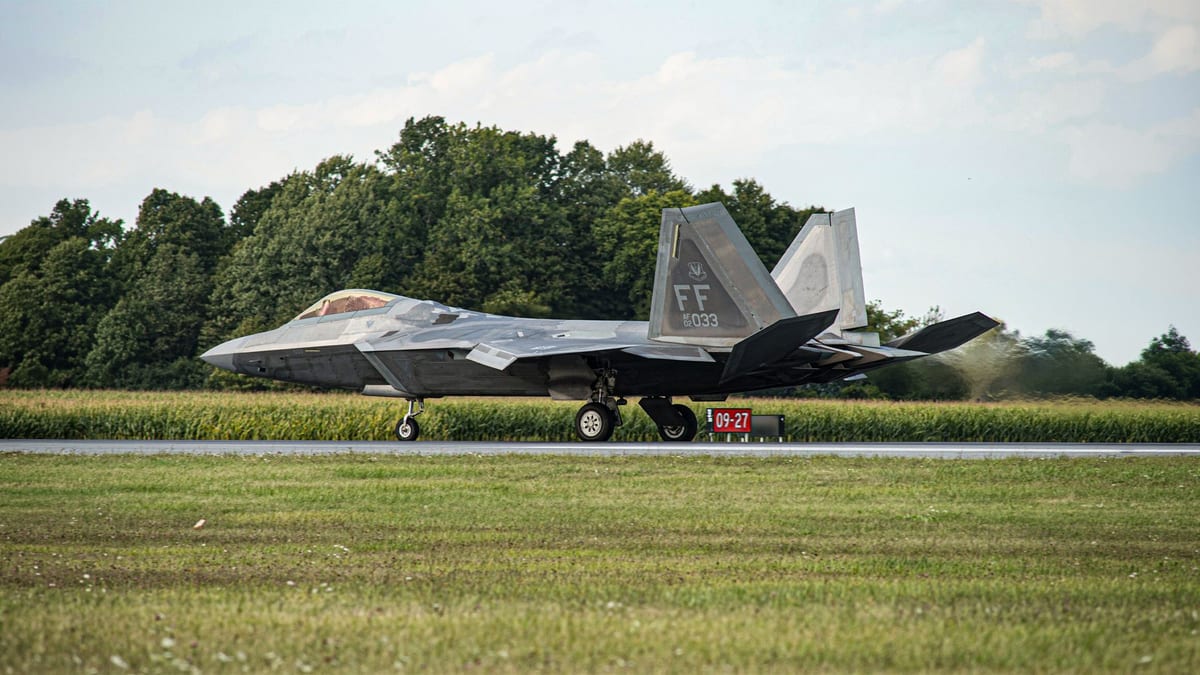
Image by Simple Flying
Stealth Shaping That Still Sets the Standard
Publicly available assessments from defense analysts continue to describe the F-22 as one of the hardest aircraft in the world to detect or track, despite the arrival of newer fifth generation designs from the United States, China and Russia. Its faceted airframe, internal weapons bays and meticulously aligned paneling were engineered from the outset around the air superiority mission, rather than multirole compromise, which remains a key differentiator.
Reports focusing on comparative air power note that the Raptor’s frontal radar cross section remains exceptionally small and is paired with low observability across a wide range of frequencies, making long range detection by ground based radars significantly more difficult. While newer fighters such as the F-35 and China’s J-20 incorporate advanced stealth features, they are generally optimized either for strike or for different operational concepts, whereas the F-22 was purpose built to sweep the skies of enemy aircraft in heavily defended airspace.
Recent coverage of air warfare modernization stresses that keeping the F-22’s stealth edge viable into the 2030s will require continued funding for coatings, materials, electronic warfare upgrades and signature management. Even so, the baseline shaping and internal layout provide a foundation that many analysts still regard as the benchmark that peer competitors are chasing rather than surpassing.
This enduring stealth advantage matters in practical terms for the first shots in any high end conflict. The more difficult the F-22 is to detect early, the more freedom it has to close, launch long range missiles from unanticipated vectors and disengage before adversaries can respond effectively.
Supercruise and Agility Give Kinematic Overmatch
In contrast with many newer jets that rely heavily on afterburners to reach high speeds, the F-22 was designed to supercruise, sustaining supersonic flight without afterburner. Open source technical summaries continue to highlight this capability, which allows the Raptor to cover large distances quickly while preserving fuel and limiting the infrared signature penalties associated with afterburning engines.
Beyond raw speed, the F-22’s thrust to weight ratio, advanced flight control systems and large, carefully blended control surfaces give it exceptional maneuverability. Defense features and aerospace commentators still frequently describe its ability to rapidly change vector and energy state in the vertical as central to its dominance in close in engagements and missile kinematics.
While some emerging designs promise similar or higher top speeds, the combination of sustained supersonic cruise, high altitude performance and agility allows F-22 pilots in training scenarios and simulations to dictate the geometry of a fight more often than not. Newer multirole platforms that carry more external stores or prioritize range and payload may struggle to match that instantaneous performance envelope.
These kinematic advantages have operational implications. Supercruise and agility improve missile effective ranges, reduce reaction time for adversaries and expand the Raptor’s ability to enter and exit contested airspace before enemy fighters can coordinate an intercept.
Sensor Fusion and Situational Awareness Remain Elite
Although the F-22 predates some of the latest cockpit and software architectures fielded on newer fighters, ongoing upgrade programs have focused heavily on sensors, computing power and data links. Aviation publications in late 2025 detailed how current modernization efforts aim to keep the Raptor’s radar, electronic warfare suite and mission computers abreast of evolving threats, while integrating it more tightly into wider air and space sensor networks.
The aircraft’s active electronically scanned array radar, electronic support measures and secure data links already provide a comprehensive picture of the battlespace. Sensor fusion software correlates this information into a coherent display, allowing pilots to track multiple targets at various ranges with reduced workload. Analysts point out that this remains one of the Raptor’s defining strengths, even as sixth generation programs promise to take fusion further.
Recent reporting on air combat simulations indicates that the F-22 continues to act as an information node as much as a shooter, detecting threats at long range and passing targeting data to other friendly aircraft and surface assets. This networked approach is central to current United States and allied air doctrine, and the Raptor’s combination of stealth and sensor reach makes it particularly well suited to the role.
While some newer aircraft feature more modern display systems or sensor suites optimized for strike missions, the F-22’s sensor fusion has been honed for air to air dominance. Its ability to see first, sort complex engagements and assign weapons efficiently remains a central reason analysts still rank it at or near the top of global fighter evaluations.
Combat Proven and Backed by Continuous Upgrades
The F-22’s operational history, once limited by policy restrictions, has expanded in recent years, giving planners more experience with the jet in real world missions. Open reporting describes its use in patrols over sensitive regions, precision strikes and no fly zone enforcement, where its stealth and sensors have provided both deterrence and practical effects.
Budget documents and specialist coverage of United States defense planning highlight that more than one billion dollars per year is being directed toward keeping the Raptor viable through the 2030s. These investments cover avionics refreshes, improved weapons integration, electronic warfare enhancements and structural work to preserve airframe life, all of which allow the jet to adapt to new threat systems and contested electromagnetic environments.
At the same time, debates in Congress about proposals to retire a subset of older training configured F-22s have underlined the platform’s perceived value. Legislative moves to postpone retirements indicate a desire to maintain a credible fleet size until the next generation of air dominance aircraft reaches operational service later in the next decade.
Compared with some newer fighters that are still working through developmental challenges or early operational testing, the F-22 offers something increasingly rare at the cutting edge of combat aviation: a mature, well understood platform that is already integrated into allied tactics, basing infrastructure and logistics chains, yet still has room for meaningful capability growth.
A Strategic Bridge to Sixth Generation Fighters
The United States Air Force has formally designated a sixth generation successor, the Boeing F-47 developed under the Next Generation Air Dominance initiative, with initial operational capability targeted for the early 2030s according to recent program descriptions. Until that aircraft arrives in meaningful numbers, however, the F-22 remains the primary dedicated air superiority asset in the United States inventory.
Analysts writing in late 2025 and early 2026 consistently frame the Raptor as a bridge between fifth and sixth generation concepts. While the future fleet is expected to rely more heavily on collaborative combat aircraft, advanced sensing constructs and expanded range, the F-22 provides the high end manned fighter presence necessary to deter adversaries and underwrite treaty commitments today.
Internationally, other air forces are moving ahead with their own next generation projects, from European collaborations to Asian stealth fighters entering low rate production. Yet few of these programs will field large numbers of operational jets before the 2030s, which means that the F-22’s mix of stealth, speed, sensors and combat experience will likely remain a reference point for another decade.
For planners focused on airspace access in potential flashpoints, the calculus remains straightforward. As long as it continues to receive targeted upgrades, the F-22 offers a combination of survivability, lethality and situational awareness that newer designs have not yet fully displaced, preserving its status as one of the most capable fighter jets in service worldwide.