

For many travelers, the Cowichan Valley is a scenic stretch between Victoria and Nanaimo, a place of forests, farms and winding coastline glimpsed through a car window.
Increasingly, however, visitors are pulling off the Trans Canada Highway for a deeper look, and discovering that Duncan, the self-proclaimed City of Totems at the heart of the valley, can be a highlight of the entire trip.
Compact, walkable and rich in both Indigenous culture and farm-to-table flavor, Duncan rewards anyone who gives it more than a fuel stop.
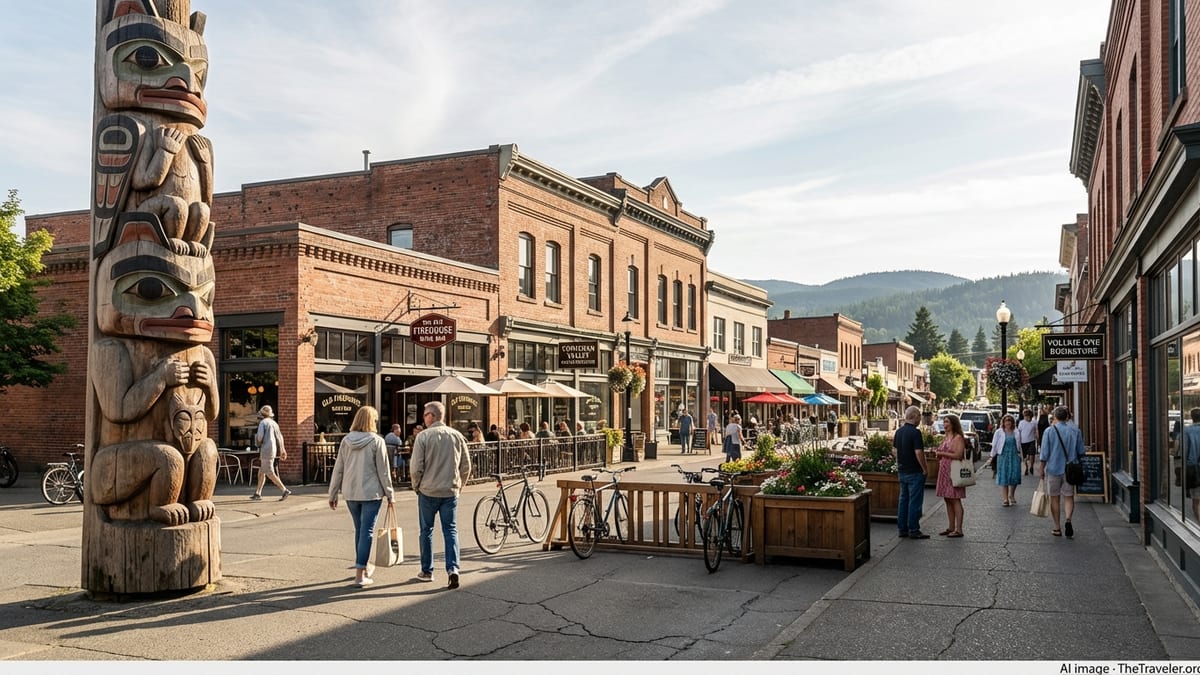
1. Duncan Is the Cultural Heartbeat of the Cowichan Valley
Travelers who come to the Cowichan Valley for landscapes and wine often leave talking about culture, and much of that conversation starts in Duncan. The city sits within the traditional territory of the Cowichan Tribes, the largest First Nation band in British Columbia, and its streets, galleries and gathering spaces reflect that living heritage in visible, everyday ways. For visitors, this means that adding Duncan to a Cowichan itinerary is not just a detour but a way to understand whose land they are traveling through and how that story continues today.
The City of Totems walking experience
Duncan’s most distinctive feature is its remarkable collection of hand-carved totem poles, which have earned it the formal nickname City of Totems. More than 40 poles are clustered through the compact downtown core, and additional carvings line a stretch of the highway and nearby public spaces, creating what feels like an open-air cultural gallery woven into the fabric of the city itself.
Visitors can follow painted footprints on the sidewalks as part of a self-guided walking tour, pausing to read interpretive plaques and learn about the artists, hereditary rights and stories represented by each pole. In summer, the local historical society offers guided totem tours that add nuance around protocol, symbolism and how modern commissions support Indigenous carvers. Even without a guide, spending an hour among these towering cedar figures gives travelers a much richer sense of Coast Salish visual language than a quick museum visit ever could.
Living Cowichan culture and community
Beyond the totems, Duncan offers other accessible entry points into Cowichan culture. Community events, local schools and arts programming increasingly foreground Indigenous perspectives, and exhibitions such as recent totem-focused shows at downtown galleries have helped visitors understand how the poles transition from small maquettes to monumental works. Shops and markets often feature Cowichan-made textiles and art, and travelers who take time to engage with artisans will find that many are eager to explain the techniques, patterns and stories behind their work.
For respectful visitors, this is an opportunity to support local makers, learn correct terminology and protocols, and appreciate that Indigenous culture here is neither static nor staged for tourists. It is a living, evolving presence that shapes the identity of Duncan and the wider valley, and it is one of the strongest reasons to pause here rather than simply pass through.
2. A Walkable Historic Downtown With a Strong Sense of Place
Many Cowichan visitors base themselves on a rural property or at a lakeside cabin and venture into town only for supplies. Duncan rewards those who do the opposite, with a historic downtown that is unexpectedly dense with independent businesses, heritage buildings and public art. For travelers piecing together a flexible valley itinerary, it works beautifully as a half-day hub: park once, wander on foot, and soak up small-city Vancouver Island life.
Compact streets, character buildings and local flavor
Duncan’s core was revitalized in recent years, and the result is a collection of human-scale streets framed by brick and early 20th-century facades that feel more like a European market town than a typical highway community. Cafes spill onto sidewalks in good weather, bookstores and galleries sit next to outdoor outfitters and boutiques, and nearly everything a visitor might want is concentrated within a few blocks.
Because chains are relatively limited in the downtown core, the experience feels distinctly local. Menus lean toward Cowichan-grown ingredients, coffee shops roast or source from Island roasters, and shop windows display the work of potters, textile artists and jewelers who live within a short drive. It is the kind of place where you can pick up a hand-knit Cowichan-style sweater, a new novel by a British Columbia author and a bag of small-batch coffee in under an hour without once stepping into a mall.
Cafes, restaurants and evening ambiance
For many travelers, Duncan becomes the go-to place for meals between winery stops or outdoor adventures. Restaurants emphasize farm-to-table cooking that taps into the valley’s long growing season, while bistros and pubs often feature local wines and craft beers. There is enough variety to keep a multi-day stay interesting, from casual breakfast spots to family-friendly diners and cozy evening rooms for a glass of Pinot Noir and a shared plate.
Evenings are relaxed rather than raucous, more conversation than nightlife. Yet throughout the year, live music and small festivals bring extra energy to the streets, and the city’s central square can feel surprisingly lively on a summer weekend. For visitors who spend their days hiking, paddling or tasting in the valley, a walkable urban core with good food and a mellow, local crowd is an attractive way to end the day.
3. One of Vancouver Island’s Best Farmers’ Markets
The Cowichan Valley’s reputation as “the warm land” shows up vividly at the Duncan Farmers’ Market, a year-round Saturday institution that has become a destination in its own right. Travelers mapping out a Cowichan itinerary increasingly plan their weekend around market hours, knowing they can shop, snack and people-watch here while connecting with the producers who shape the valley’s food scene.
Year-round energy and hyper-local vendors
Held in the central square in the heart of downtown, the market brings together more than a hundred vendors at peak season. Stalls showcase seasonal produce from nearby farms, honey, cheeses, cured meats, preserves, breads, and baked goods, along with locally roasted coffee and ready-to-eat foods. In cooler months the selection shifts to storage crops, greenhouse produce and prepared items, but the market continues even in winter, which is unusual for the region and speaks to the valley’s climate and loyal customer base.
For travelers, this is both a practical and experiential stop. It is easy to assemble a picnic for a day of hiking or wine touring, or to pick up breakfast from food trucks and bakery stands. Shoppers focused on gifts will find soap makers, ceramic artists, woodworkers and jewellers, many of whom are happy to discuss their materials and methods. The atmosphere is relaxed and social, with buskers and scheduled performers adding a soundtrack that ranges from folk to jazz.
A window into Cowichan’s farm and food community
Spending time at the market helps visitors understand just how diverse the valley’s agricultural sector has become. Long known for its orchards and dairy farms, Cowichan has in recent decades added vineyards, craft cideries, distilleries and specialty crop farms ranging from lavender to tea. Many of those producers appear at the Duncan market, offering tastes, bottles and information about visiting their properties later in the trip.
Because the market is walkable from downtown accommodations and close to the highway, it fits easily into almost any itinerary. Travelers can arrive early, beat the mid-day crowds, then head outward to lakes, trails or wineries with a car full of local provisions. For those who enjoy seeing how communities feed themselves, the market alone is a compelling reason to put Duncan firmly on the map.
4. A Gateway to Cowichan Wine, Cider and Culinary Experiences
Wineries and farm-based food experiences are a major reason travelers choose the Cowichan Valley, and Duncan is perfectly positioned as a base for exploring them. The city sits at the center of a designated wine region that has gained official recognition as a distinct grape-growing area, and it is surrounded by rural roads lined with vineyards, orchards and small farms.
Wine country within minutes of downtown
Within a short drive of Duncan, visitors can reach a cluster of wineries that range from small, family-run estates to larger operations with architecturally striking tasting rooms. The valley’s cool-climate, maritime conditions favor grapes like Pinot Noir and aromatic whites, and producers also experiment with hybrid varieties suited to the Island’s particular combination of mild winters and warm, dry summers.
Most tasting rooms welcome drop-in visitors for flights or glasses, and many offer outdoor seating with views of vine-covered slopes and distant hills. The pace is typically slower and more intimate than in bigger wine regions, with chances to chat directly with winemakers or owners about pruning decisions, vintage variation and sustainable practices. For travelers new to Vancouver Island wine, Duncan makes it simple to visit multiple producers in a single afternoon without covering long distances.
Beyond wine: cider, spirits and farm-based flavors
Wine may be the headline, but the culinary landscape around Duncan is broader and more experimental. Craft cideries turn local apples into dry, food-friendly ciders; distilleries produce small-batch gins, fruit liqueurs and other spirits; and farm shops sell everything from pasture-raised meats to specialty cheeses. Some properties offer on-site dining, pairing their products with seasonal menus, while others host occasional long-table dinners and events.
Travelers who enjoy agritourism can easily build a day around these experiences: a morning stop at the farmers’ market, midday winery visits, an afternoon tasting at a cidery, and dinner at a restaurant that sources from many of the same farms. Because distances are short and rural roads are scenic, the journey between stops becomes part of the pleasure.
Food-forward itineraries that pair town and country
One of Duncan’s strengths is how seamlessly visitors can move between town and country. It is entirely realistic to wake up in a downtown guesthouse, walk to a café for coffee and a pastry, browse the market or local shops, then head out on a short drive to a vineyard-lined hillside for lunch. Later, travelers can loop back to Duncan for an evening concert or festival event.
For multi-day Cowichan trips, using Duncan as a culinary anchor adds variety and convenience. It cuts down on repetitive driving, offers reliable restaurant options when rural spots are closed, and allows visitors to taste the valley’s flavors in multiple contexts, from casual market stalls to polished tasting rooms.
5. Easy Access to Trails, Lakes and Coastal Scenery
Travelers often assume they need to choose between staying in a town or staying close to outdoor adventure. Duncan challenges that idea. Within a short radius of the city, hikers, cyclists and paddlers can access forested hills, marshland bird sanctuaries, riverbanks and lakes, then be back at a café table or tasting room before dusk. For an itinerary that balances activity and comfort, this blend of nature and amenity is a strong advantage.
Hiking and biking on nearby mountains and rail trails
Trail networks on surrounding hills provide some of the best viewpoints in the valley. Routes on peaks like Mount Tzouhalem and Maple Mountain offer a mix of forest walking, cliff-edge vistas and intermediate mountain biking, with panoramas across farms, lakes and the Cowichan River corridor. Well-marked trailheads are a short drive from Duncan, and regional parks staff and local bike shops are good sources for up-to-date information on conditions and recommended routes.
For those who prefer gentler grades, multi-use paths follow former railway lines and riverbanks, making it possible to cycle or walk for long stretches without significant climbs. These routes often connect small communities, parks and swimming spots, turning a simple outing into a day of discovery. Because the climate is relatively mild compared with much of Canada, shoulder seasons can be excellent times to explore, with fewer crowds and vibrant fall or spring landscapes.
Wetlands, wildlife and river access
Just north of Duncan, protected marshland offers important habitat for migratory birds and year-round resident species. Boardwalks and viewing platforms make it easy for casual visitors to appreciate the wetlands without specialist gear, while more dedicated birders bring scopes and checklists. The combination of still water, reed beds and distant hills creates a tranquil counterpoint to downtown’s energy, and it is reachable in a matter of minutes.
The nearby Cowichan River is another major draw, known for swimming holes, tubing and fishing in season. Regional parks provide signed access points, picnic areas and basic facilities, and outfitters in the wider valley can help arrange gear or shuttles for longer floating trips. For travelers who want a taste of Vancouver Island’s outdoors without committing to remote backcountry, these easily reached natural areas are a compelling reason to use Duncan as a base.
Lakes and coastal day trips
Lakes and saltwater inlets are close enough to make straightforward day trips from Duncan. Popular swimming lakes and recreation sites are within a short drive, offering beaches, picnic tables and boat launches. To the east, sheltered bays and marinas provide launching points for kayaks and stand-up paddleboards, as well as wildlife-watching opportunities that can include seals and seabirds.
Because these destinations are spread around the valley, staying in Duncan keeps options open. On a hot afternoon, it is easy to pivot from a planned hike to a lakeside swim or a slow drive to a coastal village, then return to the city for dinner. Flexibility is part of what makes Cowichan appealing, and Duncan’s centrality helps travelers fully take advantage of it.
6. Family-Friendly Attractions That Break Up the Highway Drive
For families driving between Victoria and Nanaimo, children often experience the Cowichan Valley as a blur of trees from the back seat. Duncan changes that by offering several attractions clustered close to the highway that are genuinely engaging for a wide age range. Building even a short stop here into a road trip can turn a routine transfer into one of the most memorable parts of the journey.
Hands-on history and forestry heritage
On the outskirts of Duncan, an open-air heritage site devoted to the region’s forestry history gives visitors a tangible sense of how logging shaped Vancouver Island communities. Vintage locomotives, historic buildings and interpretive exhibits are spread over a large property, and many visits include rides on a small train that circles the grounds. Children can clamber near old equipment and watch demonstrations, while adults gain context for the timber operations glimpsed elsewhere in coastal British Columbia.
The combination of outdoor space, mechanical displays and short, repeatable experiences makes this a good fit for families who need to break up a long driving day. It also pairs well with downtown totem viewing, offering two very different perspectives on the region’s past and present in a single day.
Close encounters with birds of prey
A short drive further brings visitors to a facility dedicated to raptors, where hawks, owls, eagles, vultures and falcons take part in daily flying demonstrations and close-up encounters. Skilled handlers explain how each bird hunts and soars, discuss conservation issues, and often invite visitors to watch from remarkably short distances as the animals sweep overhead or land on nearby perches.
The experience tends to resonate with both children and adults, combining spectacle with education. Seeing a bald eagle or a great horned owl only a few meters away, or watching a falcon accelerate across a field, leaves a lasting impression that deepens later wildlife sightings on the coast or in the mountains. For many families, this stop alone justifies routing a road trip through Duncan rather than skirting the city entirely.
Festivals, markets and informal play
In addition to formal attractions, Duncan’s central square, playgrounds and seasonal festivals offer simple outlets for kids to stretch their legs. On market days there is often live music and street performance; during summer events, temporary stages and activity zones transform parts of downtown into car-free spaces where families can move at a child’s pace.
Because everything is so close together, it is easy to improvise. If younger travelers have energy after a structured attraction, parents can reward them with a gelato or bakery treat and a run in a nearby park. If everyone needs a quieter break, a stroll along quieter residential streets lined with trees and gardens can provide it. The flexibility and sheer variety within a compact area are what make Duncan such a strong family stop.
7. Central, Sustainable and Surprisingly Convenient
When travelers design Cowichan itineraries, logistics matter as much as attractions. In this respect, Duncan offers a combination that is hard to beat: a central location in the valley, good road and transit connections to Victoria and Nanaimo, and an urban form that lends itself to lower-impact, car-light travel. For visitors who care about sustainability or simply enjoy leaving the keys behind, those are powerful reasons to stay in town.
A natural hub between Victoria and Nanaimo
Duncan sits almost exactly midway between the provincial capital of Victoria and the ferry-linked city of Nanaimo on Vancouver Island’s main north-south highway. That geography makes it an obvious pause point in either direction, whether travelers are linking ferries to the mainland, flying via Victoria or Nanaimo airports, or continuing north toward other Island destinations.
Because it is a real working city rather than a purpose-built resort, Duncan offers practical services as well as attractions: supermarkets, pharmacies, outdoor gear shops and visitor information. Travelers who use it as a base can reduce the amount of packing and unpacking required, taking day trips outward to lakes, bays and rural communities instead of shifting accommodations each night.
Public transit links and car-light options
While most travelers still arrive by car, transit options connecting Duncan with neighboring regions are improving. Intercity bus routes already link the city with both Nanaimo and Victoria, and regional governments have been advocating for more frequent, affordable service along this corridor. Within the Cowichan Valley, local buses and community shuttles provide access to some outlying neighborhoods and neighboring communities, supplementing taxis and rideshares.
Once in Duncan itself, many visitors find they can walk or cycle to most of what they want to see. The flat downtown core is pedestrian-friendly, with short distances between accommodations, restaurants, galleries and the farmers’ market. For travelers who choose to rent bikes or bring their own, it is straightforward to connect with nearby multi-use paths and quieter country roads, making low-impact exploration part of the experience.
An emerging slow-travel destination
Perhaps the most compelling reason Duncan is appearing more often on Cowichan Valley itineraries is that it fits neatly into a broader movement toward slow travel. Instead of racing from one iconic photo stop to another, visitors here are encouraged to linger: to sit in a café and watch daily life, to talk with artisans at the market, to walk the totem route at an unhurried pace, to return to the same viewpoint at different times of day.
With its blend of Indigenous culture, local food, outdoor access and community events, all wrapped in a compact, human-centered urban fabric, Duncan embodies many of the qualities slow travelers seek. For those exploring the Cowichan Valley, adding a night or two here can transform the trip from a scenic drive into a richer, more grounded experience.
The Takeaway
On paper, Duncan looks like a modest stop on a larger Vancouver Island journey: a small city on the highway between bigger names. In practice, it often becomes the part of a Cowichan itinerary that travelers talk about most afterward. Its totems and Indigenous presence give context to the land; its markets, wineries and restaurants express the valley’s agricultural abundance; its trails, lakes and family-friendly attractions offer easy access to nature; and its central, walkable layout encourages a slower, more sustainable style of travel.
For anyone mapping out time in the Cowichan Valley, the question is no longer whether to pull off at Duncan, but how much time to reserve there. A quick coffee stop and totem stroll will give a taste, but a full day or more allows the city’s layers to unfold. In a region defined by rich landscapes, Duncan stands out as a place where culture, flavor and community come together, and that is exactly why more travelers are adding it to their Cowichan Valley plans.
FAQ
Q1. How much time should I plan to spend in Duncan during a Cowichan Valley trip?
Many travelers visit for a half-day to explore the totems and downtown, but a full day or overnight stay allows time for wineries, markets and nearby trails as well.
Q2. Is Duncan a good base for exploring the wider Cowichan Valley?
Yes. Duncan’s central location, services and dining options make it a convenient base for day trips to lakes, coastal villages, wineries and hiking areas throughout the valley.
Q3. Do I need a car to enjoy Duncan and nearby attractions?
A car provides the most flexibility, especially for rural wineries and trailheads, but the downtown core is very walkable and there are bus links to regional hubs and some nearby communities.
Q4. When is the best time of year to visit Duncan?
Late spring through early fall offers the warmest weather, open winery patios and peak farmers’ market season, but winter visits appeal to travelers who prefer quieter streets and cooler temperatures.
Q5. Are the totem poles in Duncan free to visit?
Yes. The totem poles are located in public spaces throughout downtown and along parts of the highway, and visitors can explore the self-guided walking route at no cost.
Q6. Is Duncan suitable for families with children?
Very much so. Attractions such as the forestry heritage site, raptor center, markets, parks and short walks make Duncan a practical and enjoyable stop for families of all ages.
Q7. Can I combine Duncan with wine tasting without a long day of driving?
Yes. Several wineries and farm-based tasting experiences lie within a short drive of Duncan, making it easy to visit multiple stops while keeping driving distances modest.
Q8. What kind of accommodations are available in and around Duncan?
Visitors can choose from small hotels, motels, bed-and-breakfasts and rural stays in the surrounding valley, giving options that range from simple road-trip overnights to more immersive country experiences.
Q9. Is Duncan a good destination for travelers who enjoy walking and cycling?
Yes. The flat, compact downtown is ideal for walking, and cyclists can access nearby multi-use paths, rail trails and quieter back roads to explore the valley at a slower pace.
Q10. How does Duncan fit into a larger Vancouver Island itinerary?
Duncan works well as a midpoint between Victoria and Nanaimo or as a hub for several days in the Cowichan Valley, pairing easily with coastal villages, inland lakes and other Island destinations.