

Remote, wind‑scoured and fringed with ice for much of the year, Hudson Bay remains one of the world’s last great frontiers. Stretching across northern Manitoba, Ontario, Quebec and Nunavut, its shores are home to polar bears and beluga whales, Cree and Inuit communities, historic fur‑trade posts and raw Arctic landscapes that are changing under the pressures of climate shifts. For travelers willing to venture north, Hudson Bay offers a rare mix of wildlife encounters and cultural experiences that feel genuinely off the beaten path. From Churchill’s polar bears to summer gathering sites near Arviat and Cree‑led experiences on the James Bay coast, here are seven unique things to do around Hudson Bay.
Track Wild Polar Bears on the Western Shore
The shores of western Hudson Bay near Churchill, Manitoba, are among the best places on the planet to see wild polar bears. As sea ice melts in late spring, bears are forced ashore to wait out the ice‑free months on the tundra. In autumn, as new ice begins to form on Hudson Bay, the animals congregate near the coastline, conserving energy until they can return to hunting seals. This seasonal rhythm creates a narrow window, generally from October into November, when specialist tour operators can safely bring visitors into the Churchill Wildlife Management Area and parts of nearby Wapusk National Park to observe bears in their natural environment from custom tundra vehicles or remote lodges.
Most polar bear viewing around Hudson Bay is tightly regulated, both to protect travelers and to safeguard the animals and their fragile habitat. Access to Wapusk National Park, a vast protected area south of Churchill whose name comes from the Cree word for polar bear, is possible only with licensed operators using tundra vehicles, helicopters or small aircraft. These excursions typically spend long days out on the land, scanning frozen ponds and coastal ridges for bears padding across the snow or play‑fighting on the ice. Temperatures can be severe, but heated vehicles and expert guides make the experience accessible to a wide range of travelers willing to dress properly for subzero conditions.
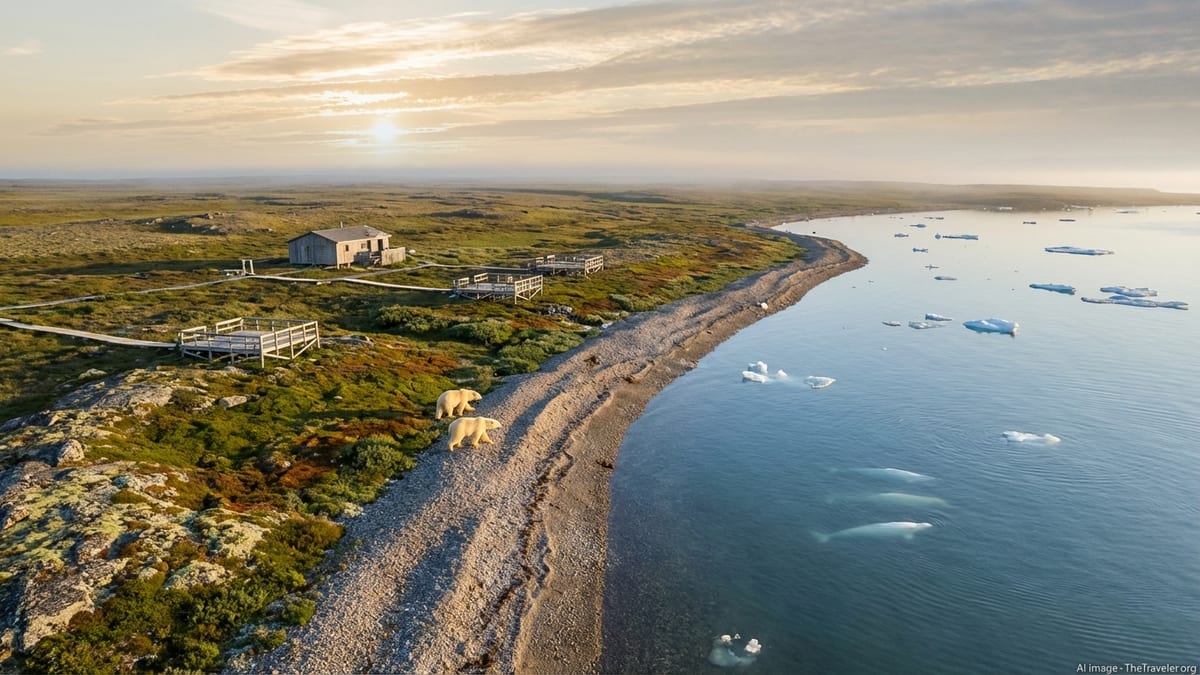
Those looking for more immersive experiences can book stays at isolated eco‑lodges along the Hudson Bay coast east and south of Churchill. In summer, when temperatures are milder and the tundra turns green, bears may be seen dozing in wildflower meadows or wandering the tidal flats, sometimes just beyond lodge fences or from raised viewing platforms. A growing number of operators are designing itineraries that combine guided on‑foot excursions with strict safety protocols, allowing visitors to watch bears at relatively close quarters while minimizing disturbance. Whether you visit in the soft light of late autumn or under the midnight sun, seeing a polar bear in its Arctic home is one of Hudson Bay’s defining experiences.
Whichever format you choose, it is worth remembering that polar bear tourism in the region is evolving as climate patterns shift. Shorter periods of stable sea ice and changing freeze‑up dates are already influencing bear behavior along Hudson Bay’s western shores. Reputable operators continually adjust trip timing, routes and viewing practices to reduce stress on wildlife and to reflect current conditions, so it is essential to rely on up‑to‑date advice when planning a polar bear journey.
Drift Among Thousands of Beluga Whales
Each northern summer, from roughly July to August, thousands of beluga whales arrive in river estuaries that flow into western Hudson Bay. Around Churchill alone, tour operators and Parks Canada estimate that several thousand belugas gather where the Churchill River meets the bay, part of a larger regional population that numbers in the tens of thousands. They are drawn by relatively warm, shallow waters that offer feeding opportunities and protection for calves. For visitors, it is a rare chance to watch and listen to these highly social whales in relatively accessible conditions compared with more remote Arctic regions.
Beluga tours range from boat‑based excursions on the Churchill River to smaller zodiac outings and, in calm weather, kayaking or even carefully supervised snorkeling in drysuits. Many vessels are fitted with hydrophones so that passengers can hear the whales’ chirps and whistles, which earned them the nickname “sea canaries.” On clear days, the nearly white backs of adult belugas are visible at the surface, while gray juveniles weave between them. Encounters are usually relaxed rather than dramatic; the whales often approach boats out of apparent curiosity, rolling to look up at passengers or riding in the wake.
Operators on Hudson Bay increasingly emphasize responsible, beluga‑friendly practices. That can mean using jet drives or modified propellers to reduce the risk of injury, maintaining minimum approach distances, avoiding sudden speed changes and limiting the number of boats interacting with a group of whales at any one time. Travelers should look for companies that highlight safety for both clients and wildlife, and that work with researchers and Indigenous communities to monitor beluga health and migration patterns in the bay.
The beluga season on Hudson Bay also dovetails with other northern experiences. Long sub‑Arctic days mean there is ample time to pair whale watching with tundra hikes, birding, or visits to historic sites such as Prince of Wales Fort and Cape Merry, which overlook the bay and its wide tidal flats. As autumn approaches and the belugas begin moving offshore, many visitors shift focus from the water back to the land, returning for polar bear and northern lights trips later in the year.
Watch the Northern Lights in One of the World’s Best Arenas
Hudson Bay’s western shore sits directly beneath the auroral oval, a band of intense geomagnetic activity that produces some of the world’s most reliable northern lights displays. Around Churchill and other points along the bay, clear winter nights routinely feature ribbons and curtains of green, violet and white light flickering across the sky. While it is sometimes possible to see aurora in autumn, specialist operators typically emphasize February and March, when nights are long, temperatures are cold and skies are often clear, giving visitors better odds of sustained viewing.
Aurora tourism around Hudson Bay has matured over the past decade. Many winter packages combine northern lights viewing with cultural programming and daytime activities. Guests might spend afternoons snowshoeing or dog sledding on the tundra, visiting the Parks Canada visitor center to learn about regional wildlife, and then settle into a purpose‑built aurora lounge or heated dome outside town after dark. These structures are often positioned away from light pollution with north‑facing panoramas and wide‑angle windows, allowing visitors to watch the sky while remaining shielded from the wind.
For photographers, Hudson Bay’s wide horizons and sparse infrastructure offer both challenges and rewards. Foregrounds can be minimal, but the openness creates opportunities for sweeping images of aurora reflected on snow or sea ice. Guided trips often include basic coaching on camera settings suitable for the conditions, with emphasis on working quickly in the cold. Travelers should be prepared for temperatures that can plunge well below freezing and should bring batteries, lenses and tripods that function reliably in harsh winter weather.
Importantly, the northern lights are never guaranteed, even in an auroral hotspot. Cloud cover can move in quickly off Hudson Bay, and intense storms can be followed by days of quieter skies. The most satisfying itineraries treat aurora as one highlight among several rather than the sole focus of a trip. By combining cultural visits, wildlife interpretation and time on the land, travelers can come away with a richer sense of Hudson Bay, regardless of how the sky performs.
Immerse Yourself in Cree and Inuit Cultural Experiences
Around Hudson Bay, Indigenous communities have lived with ice, tides and migrating animals for millennia. Today, Cree and Inuit guides in several regions are developing tourism offerings that invite visitors to engage more deeply with local history, language and land‑based knowledge. On the southwest shore, near James Bay and the communities of Moosonee and Moose Factory in Ontario, Cree‑run outfitters lead canoe trips, trapline visits and cultural walks that reveal the intricate relationships between river, forest and bay. Travelers may ride the Polar Bear Express train north from Cochrane to Moosonee, then take a short boat transfer to Moose Factory Island, where historic Hudson’s Bay Company buildings stand alongside Cree cultural centers and eco‑lodges.
Farther north and west, along the Nunavut coast of Hudson Bay, Inuit communities such as Arviat have been working with Parks Canada and local organizations to interpret cultural landscapes including Arvia’juaq and Qikiqtaarjuk National Historic Site, a traditional summer gathering place for Caribou Inuit. Guided visits in season can include boat trips to island camps, storytelling about seasonal hunting routes and spiritual sites, and demonstrations of traditional skills such as throat singing, drum dancing or preparation of country foods. These experiences are typically small‑scale and tailored to the community’s own priorities, with a strong emphasis on respect for both land and culture.
Wherever you go around Hudson Bay, Indigenous‑led tourism tends to be shaped less around performance and more around relationship building. Rather than set shows, travelers might join a local guide for a walk along the shoreline to look for eider ducks and seal breathing holes, or visit an artists’ cooperative to learn about carving and textile work that draw directly on life with the bay. Conversations may touch on how thawing permafrost and shifting ice conditions are affecting hunting, travel routes and food security. For visitors, these interactions provide context that no wildlife sighting alone can offer, grounding the trip in lived experience and contemporary realities.
Because many programs are seasonal and capacity is limited, it is worth planning cultural components of a Hudson Bay trip well in advance. In some communities, guides balance tourism with full‑time roles in education, resource management or local government, which means flexibility is essential. Approaching these experiences with humility, patience and a willingness to listen can lead to some of the most meaningful moments a traveler will have anywhere around the bay.
Stay at Remote Tundra Lodges on the Edge of the Bay
One of the most distinctive ways to experience Hudson Bay is by staying at a remote tundra lodge reachable only by bush plane, helicopter or specialized overland vehicles. Scattered along the western and southern coasts, these small lodges sit in prime wildlife habitat frequented by polar bears, beluga whales, migratory birds and, occasionally, wolves or caribou. Instead of day‑tripping from a town, guests wake each morning already in the landscape, watching weather roll in from the bay and animals move across the horizon just beyond the windows.
Summer and early autumn itineraries at these lodges often blend marine and terrestrial experiences. Guests might begin the day scanning the tidal flats for polar bears cooling off in the shallows, then head out by zodiac to the mouth of a nearby river, where belugas gather to feed and molt. Afternoon hikes across beach ridges or low tundra reveal a surprising variety of plant life, from hardy lichens to dwarf willow and cloudberries. Migratory shorebirds and geese feed in the wetlands, while Arctic foxes and ground squirrels patrol the margins. After dinner, long golden evenings can be spent on outdoor decks or viewing towers, watching the sky slowly dim over the bay.
In late autumn, some lodges transition to polar bear‑focused programs, with guests observing bears as they pace the shoreline waiting for new sea ice to form on Hudson Bay. Elevated platforms and fenced compounds allow relatively close viewing while maintaining separation and safety. As the season advances and nights lengthen, these remote bases can also provide outstanding opportunities to see the northern lights away from town lights, with aurora sometimes shimmering above the frozen bay.
Remote tundra lodges place a strong focus on environmental stewardship. Because they operate in sensitive ecosystems with minimal infrastructure, most restrict group sizes, manage waste carefully and rely on generators or hybrid systems for power. Staff often include wildlife biologists or local knowledge holders who can interpret animal behavior and changing environmental conditions. Stays at these properties are typically more expensive than town‑based trips, reflecting the logistics of flying in food, fuel and guests, but they offer a level of intimacy with Hudson Bay’s landscapes that is difficult to match elsewhere.
Step Inside the Fur‑Trade Past at Historic Hudson Bay Posts
Long before it became a draw for wildlife watchers, Hudson Bay was a strategic hub in the global fur trade. From the late 17th century onward, the Hudson’s Bay Company and rival traders established a chain of coastal forts and inland posts that served as conduits between European markets and Indigenous trappers across the continent. Today, several of these sites invite visitors to explore that layered history on foot, standing where Cree, Inuit and European traders negotiated alliances, exchanged goods and navigated profound cultural change.
Near Churchill, the stone walls of Prince of Wales Fort still stand on a headland overlooking the mouth of the Churchill River and Hudson Bay. The 18th‑century bastion, now a National Historic Site, was built to protect the Company’s interests in the region and to assert British presence on the bay. Guided summer visits typically involve a short boat ride across the river followed by a walk along the ramparts, where interpretive plaques and staff explain the fort’s role in the fur trade and its relationship with surrounding Indigenous communities. Across the water, the smaller Cape Merry Battery offers sweeping views of the river mouth and the open bay beyond.
On the opposite side of Hudson and James Bay, Moose Factory Island in Ontario preserves another chapter of the story. Here, a cluster of 19th‑century buildings associated with the Hudson’s Bay Company post, along with a historic church and local museum, chronicles the shift from forts and trading posts to permanent settlements and mixed economies. Visitors can learn how Cree families and Company employees shaped one another’s lives, and how the legacy of the fur trade continues to influence land use, language and governance in the region.
Exploring these sites adds depth to a modern Hudson Bay itinerary. Many wildlife and cultural tours already pass near historic forts, batteries or former posts, making it relatively straightforward to include them in a broader journey. When framed with input from local guides and community historians, the experience becomes more than a set of old walls or artifacts; it becomes a way to understand how Hudson Bay’s past underpins its present, from treaty relationships to contemporary debates about resource development and environmental protection.
Explore Arctic Transitions in Wapusk National Park
Covering more than 11,000 square kilometers of largely roadless terrain on the western shore of Hudson Bay, Wapusk National Park is one of Canada’s most remote protected areas. It encompasses a remarkable transition zone from boreal forest to tundra, stitched together by peatlands, lakes and coastal fens. The park is best known internationally for its role as a critical polar bear denning area, particularly around Cape Churchill, where pregnant females dig maternity dens into the peat and raise their cubs through the long Arctic winter. Come early spring, mothers and cubs emerge and eventually make their way toward the sea ice on Hudson Bay.
Public access to Wapusk is intentionally limited to protect this sensitive environment. There are no roads or front‑country campgrounds, and independent travel in the park requires significant planning, permitting and expertise. Most visitors experience Wapusk indirectly, through regulated overflights, guided photography trips by helicopter to Cape Churchill, or excursions into adjacent areas such as the Churchill Wildlife Management Area. From the air, the park’s vastness becomes apparent: patterned ground, thaw lakes and river channels stretching inland from the sweep of Hudson Bay’s coastline.
For those who do venture into or above the park with licensed guides, the reward is a fuller appreciation of how many species rely on the Hudson Bay coast. In addition to polar bears, Wapusk’s wetlands support large numbers of migratory waterfowl and shorebirds, while its inland areas provide habitat for caribou herds, Arctic foxes, wolves and smaller mammals. Researchers and Indigenous knowledge holders work with Parks Canada to monitor changes in permafrost, vegetation and wildlife movement, offering insights into how climate shifts are reshaping one of North America’s key sub‑Arctic ecosystems.
Because Wapusk trips are complex and often expensive, they are not essential for enjoying Hudson Bay, but they do highlight the scale and fragility of the region. Even if you only encounter the park’s story through exhibits at the Parks Canada visitor center in Churchill or through interpretive programs led by local guides, understanding Wapusk’s role adds important context to any journey along Hudson Bay’s western edge.
The Takeaway
From belugas and polar bears to fur‑trade forts and Indigenous homelands, Hudson Bay offers a travel experience that feels far removed from more familiar tourist circuits. Distances are long, weather is unpredictable, and infrastructure outside a handful of communities remains limited. Yet those very challenges help protect the bay’s sense of remoteness and its capacity to surprise visitors who make the journey north.
Approaching Hudson Bay with patience and respect yields the richest rewards. That might mean building extra days into your itinerary to account for weather delays, choosing operators that prioritize wildlife welfare and community partnerships, or seeking out Indigenous‑led experiences that frame the landscape through local knowledge. It also means traveling with an awareness that the Arctic and sub‑Arctic are changing quickly, and that tourism has a role to play in supporting both conservation and cultural resilience around the bay.
Whether you find yourself drifting among curious beluga whales, watching aurora shimmer over the frozen bay, walking the walls of an 18th‑century fort or listening to a Cree or Inuit guide describe generations of life along these shores, Hudson Bay has a way of making the world feel both bigger and more connected. For travelers in search of profound encounters with place, it remains one of North America’s most compelling frontiers.
FAQ
Q1. When is the best time to visit Hudson Bay for polar bear viewing?
The most reliable period for polar bear viewing near Churchill is generally from mid October through November, when bears gather along the coast waiting for sea ice to form on Hudson Bay.
Q2. When can I see beluga whales in Hudson Bay?
Beluga whales are typically present in large numbers in river estuaries along western Hudson Bay from roughly early July through late August, with timing varying slightly by year and location.
Q3. Is it possible to see the northern lights and polar bears on the same trip?
It can happen in late autumn around Churchill, but conditions must cooperate. Many travelers choose separate trips, focusing on polar bears in October or November and aurora viewing in February or March.
Q4. Do I need to join a tour, or can I explore Hudson Bay on my own?
Because of limited roads, harsh weather and wildlife safety considerations, most visitors rely on licensed tour operators or local guides, especially for polar bear, beluga and remote tundra lodge experiences.
Q5. How cold does it get around Hudson Bay in winter?
Winter temperatures around western Hudson Bay frequently fall well below freezing, and windchill can make it feel significantly colder, so high quality cold weather gear is essential.
Q6. Are Indigenous cultural experiences widely available around Hudson Bay?
Opportunities are growing but remain small scale and seasonal. Many Cree and Inuit communities offer guided cultural or land‑based programs with limited capacity that should be booked well in advance.
Q7. How do I reach communities like Churchill or Moose Factory near Hudson Bay?
Churchill is accessible by air from southern Manitoba and by train, while Moose Factory is reached via the Polar Bear Express train to Moosonee followed by a short water crossing.
Q8. Is wildlife viewing around Hudson Bay safe?
With experienced guides and adherence to safety protocols, wildlife viewing is generally safe. Travelers should always follow instructions closely, as polar bears and other animals are powerful and unpredictable.
Q9. How far in advance should I book a Hudson Bay trip?
Popular polar bear, beluga and northern lights departures often fill many months, and sometimes a year or more, in advance, particularly for small remote lodges with limited space.
Q10. What kind of traveler will enjoy a trip to Hudson Bay most?
Hudson Bay is best suited to travelers who appreciate remote destinations, variable weather, simple infrastructure and in‑depth encounters with wildlife, history and northern cultures rather than conventional city sightseeing.