

More news on this day
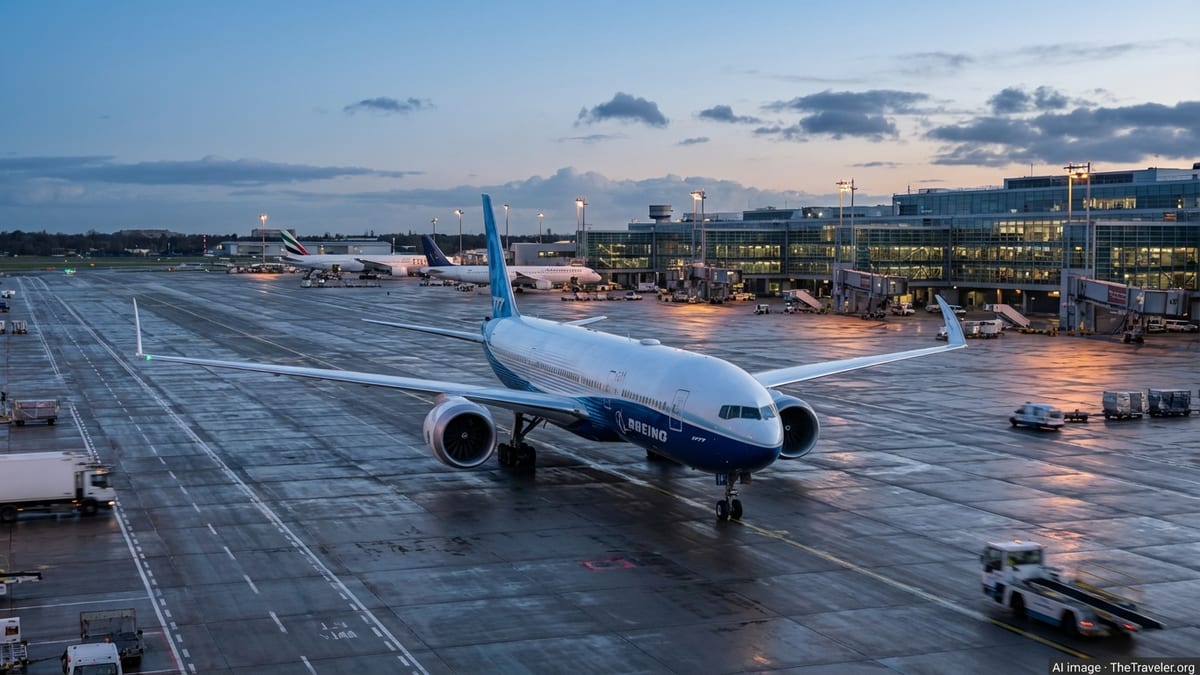
Boeing’s next-generation 777X is edging closer to service with launch work in the United States and Germany shining a spotlight on its most distinctive innovation: a folding wingtip system that allows the world’s largest twin-engine jet to meet strict airport, safety, and certification demands without sacrificing long-haul performance.
A Giant Wing Meets Tight Airports
The 777X family, led by the 777-9, is built around a massive new composite wing that stretches to about 235 feet in span when fully extended. That scale is central to the aircraft’s promise of lower fuel burn and longer range, but it also presents a practical problem: many airport taxiways and gates are not cleared to handle wings that wide. Rather than redesign runways and stands across the world, Boeing opted to reshape the wing itself on the ground.
The solution is a pair of foldable wingtips, roughly 11 feet long on each side, that hinge upward once the jet leaves the runway and taxis toward the terminal. In flight, the tips lock down, giving the aircraft the high-aspect-ratio wing it needs for efficiency and range. On the ground, with the tips folded, the 777X fits into the same airport “Code E” wingspan category as current-generation Boeing 777s and Airbus A330s, reducing the need for infrastructure upgrades.
From a travel perspective, the technology is meant to be almost invisible. Passengers may glimpse the wingtips moving as they sit at the window or as the aircraft lines up for departure, but the design is calibrated so that the motion happens only at low speed and in strictly controlled stages. For airport operators in the United States and Germany, the system is a way to welcome a next-generation widebody without rebuilding terminals or sacrificing gate capacity.
Safety, however, is the defining story behind the folding tips. Both American and European regulators have set out detailed criteria to ensure that the new moving surfaces behave more like a locked structural component than an optional add-on, especially in the moments before takeoff and after landing when flight crews are already managing heavy workloads.
United States Regulators Drive Stringent Design Rules
Because folding wings had never been certified on a commercial airliner, the US Federal Aviation Administration added a dedicated set of special conditions to cover the 777X program. Those rules require that the wingtips be locked down automatically for takeoff and landing, with redundant sensors and independent power supplies designed to prevent inadvertent folding when the jet is traveling at high speed.
The FAA’s safety logic is straightforward: the aircraft must behave like a conventional fixed-wing jet at every critical point in flight. That means multiple interlocks between the wingtip actuators, the flight control computers, and the cockpit warning systems. If, for any reason, the tips are not properly locked when the pilots advance the throttles, the aircraft issues a clear and unmistakable alert, and the takeoff is halted before the jet accelerates to rotation speed.
US engineers have treated the folding mechanism itself as a critical structure, subject to fatigue testing, lightning and electromagnetic checks, and repeated fail-safe evaluations. In practice, this means that even if part of the folding system were to malfunction on the ground, it would fail in a “safe” direction that keeps the wing locked and the jet within its defined operating envelope. The mechanism also has to withstand the same aerodynamic loads as the rest of the wing, proving that the hinge line is not a structural weak point.
The United States has become the primary proving ground for these measures. Boeing’s main 777X test fleet operates from the Pacific Northwest, where the aircraft cycles between airports in Washington, Montana, Oklahoma, and other states for noise, performance, and systems trials. Ground and flight tests overseen by FAA engineers are intended to demonstrate that the wingtip system responds predictably in all conditions, from icy ramp operations to crosswinds and high-altitude turbulence.
Germany and Lufthansa Shape the Launch Profile
Germany’s role centers on Lufthansa, the national carrier that is due to be the 777-9 launch customer. The airline has long positioned the aircraft as the future flagship for its long-haul network, replacing older Boeing 747-400s and 777-300ERs on routes from Frankfurt and Munich to the United States, Asia, and the Middle East. For Lufthansa and German regulators, the folding wingtips are both a capacity enabler and a safety-critical technology that must integrate smoothly into everyday operations.
Airports such as Frankfurt, one of Europe’s busiest hubs, have complex gate layouts and heavy traffic at peak times. The ability of the 777X to tuck its wings into the same footprint as existing widebodies allows airport planners to slot the new jet into current stands serving North American and Asian flights. German authorities, working with the European Union Aviation Safety Agency, have been focused on ground-movement procedures, ensuring that tug drivers, ground handlers, and air traffic controllers understand when and how the wingtips move.
Lufthansa’s flight operations teams have also been deeply involved in writing operating manuals and training programs tailored to the new wings. Standard operating procedures define when the crew commands the fold or unfold sequence, what cockpit indications must appear before taxi or takeoff, and how pilots should respond to any discrepancy between desired and actual wingtip positions. The airline’s simulator programs are being updated to include realistic 777X models, complete with the wingtip logic and associated alerts.
German regulators and Lufthansa have made clear that the new jets will not enter service until those procedures are fully proven. With flight testing now progressing and a first production aircraft for Lufthansa planned to take to the air in 2026, Germany is expected to become the first European country to host regular commercial flights of the 777X and its distinctive folding wings.
Inside the Wingtip Safety Architecture
Behind the smooth motion passengers will see is a dense network of structural components, actuators, locks, and sensors. Each wingtip attaches to the main wing with a robust hinge assembly designed to carry the bending and torsion loads of long-haul flight. Hydraulic or electrically driven actuators rotate the tip up and down on the ground, but cannot drive the motion while the aircraft is in flight beyond tightly controlled, low-speed phases.
Crucially, once the 777X lines up for takeoff and the wingtips are lowered, a series of mechanical locks engage to make the wing effectively continuous. Boeing and its US certification partners have subjected these locks to repeated load cycles, freeze and heat tests, and contamination trials designed to mimic deicing fluid, sand, and other real-world contaminants. Only after passing those tests does the system qualify as meeting the enhanced airworthiness standards introduced after the 737 MAX accidents.
The safety architecture assumes that electronics can fail, so multiple independent sensors monitor the exact position of each tip. These are cross-checked by computers, which in turn feed cockpit indicators. If any disagreement arises between sensors, the system flags it to the pilots, and the aircraft’s logic blocks further configuration changes until the situation is resolved on the ground. Combined with strict speed and weight limits for any folding or unfolding motion, this reduces the risk of a tip moving at the wrong time.
The program’s engineers also worked with airport authorities in the United States and Germany to define clear lines on when and where the tips can be commanded to move. In practice, that means defined “fold zones” on taxiways, reduced taxi speeds when the tips are moving, and strict prohibitions on folding or unfolding on active runways. These rules are designed to protect not only the 777X, but also nearby aircraft and ground vehicles that might be operating close to its large wingspan.
Certification Momentum After Years of Delay
The 777X program has experienced a long and public series of delays. Initially targeted to enter service in 2020, the aircraft has faced redesigns, stricter oversight in the wake of the 737 MAX crisis, and technical setbacks including cracks in engine support hardware discovered in 2024. Flight testing was paused while Boeing reinforced those components and revalidated its analysis with regulators.
In early 2025, certification test flights resumed from Boeing’s US facilities, marking the start of a more intensive phase of work under direct FAA supervision. Since then, the aircraft has added a fifth test airframe dedicated to electromagnetic and systems trials, while others have performed noise and environmental testing at airports across the American West and Midwest. Each stage is designed to build a comprehensive data package on how the wingtip systems, engines, and avionics behave over thousands of hours of operation.
By late 2025, the FAA had authorized Boeing to begin a new phase of Type Inspection Authorization, covering some of the most demanding evaluations of the flight control system and structural behavior. Boeing has acknowledged that the certification environment is more conservative and methodical than when earlier widebodies were cleared to fly, but insists that the extra time is producing a more thoroughly validated product.
The company has now told regulators and customers that it expects first deliveries of the passenger 777-9 to slip into 2027, several years later than originally promised. For airlines in both the United States and Germany, that means longer reliance on aging fleets, but it also signals that safety, including the new wingtip system, is being prioritized over schedule.
Implications for Passengers and Airport Operations
For travelers, the most visible sign of the 777X’s unique wing will likely come at the gate or during taxi. From a terminal window in Frankfurt or an American hub such as Chicago or Newark, observers will be able to watch the wingtips fold down shortly before departure and rise again once the aircraft vacates the runway. Airlines are already planning marketing campaigns around the feature, framing it as a symbol of aviation innovation rather than a curiosity.
Inside the cabin, the benefits of the large composite wing and new engines are more subtle but significant. The 777X’s aerodynamic efficiency should translate into lower fuel burn, which airlines hope will support more nonstop routes between German and US cities and secondary markets. A quieter cabin, lower emissions per seat, and the ability to operate to existing gates in both countries are all part of the story that carriers will present to environmentally conscious travelers.
Airport operations teams are preparing detailed guidance for pushback, taxi, and stand allocation when the 777X begins regular service. Tugs and ground vehicles must respect wider safety margins when the wingtips are extended, while tower controllers will need to account for the aircraft’s changing wingspan as it moves between runway and apron. Training for ramp crews in Germany and the United States is increasingly using virtual and augmented reality tools that show the jet with wingtips in both positions, helping staff judge clearances accurately.
Despite the novelty, aviation authorities emphasize that the folding wings are intended to reduce operational complexity, not add to it. By keeping the extended span within the same code used by existing gates once the tips are folded, the 777X avoids the need for special “super wide” stands that could displace other aircraft. That balancing act between efficiency and infrastructure is one reason regulators have been willing to invest time and resources into certifying the system.
Setting a Template for Future Long-Haul Jets
The regulatory collaboration between the United States and Germany around the 777X is likely to influence how future long-haul aircraft are designed and certified. If the folding wingtips perform as intended over years of service, they may become a reference technology for future widebodies seeking greater aerodynamic efficiency without forcing airports to rebuild.
American and German safety authorities are already documenting lessons from the 777X program, from data-sharing practices to joint simulator evaluations and coordinated oversight of airline training. These experiences could simplify the path for any manufacturer that proposes variable-geometry wings or other unconventional structures on civilian aircraft in the future.
For Boeing, a successful rollout of the 777X wingtip system would mark an important reputational milestone. It would demonstrate that the company can introduce ambitious new technologies while operating under the toughest regulatory expectations in its history. For Lufthansa and its German partners, it offers a chance to showcase a state-of-the-art long-haul fleet that links Europe and North America with improved efficiency and reduced environmental impact.
As the first production 777X destined for Lufthansa prepares for its initial flight from the United States in 2026 and moves toward passenger service later in the decade, all eyes in the aviation world will be on those distinctive wingtips. How they perform in day-to-day operations at airports in Germany, the United States, and beyond will help determine whether this groundbreaking safety system becomes a one-off experiment or a new standard for global air travel.