

Telegraph Cove may be a tiny boardwalk village on northern Vancouver Island, but it offers some of the richest marine wildlife experiences in Canada. Once a humble telegraph station and cannery settlement, today it is a beloved launch point for whale watching, kayaking with orcas, and exploring the wild Johnstone Strait.
Whether you arrive for a dedicated nature trip or a shorter stop on a longer Vancouver Island journey, planning how to spend your time here matters. This guide breaks down the 10 best things to do in and around Telegraph Cove, with practical, up-to-date inspiration for making the most of every tide.
1. Go Whale Watching in Johnstone Strait
If there is one experience that defines Telegraph Cove, it is getting out on the water to look for whales. Johnstone Strait and nearby Blackfish Sound are among the most reliable places in the world to see wild orcas in season, along with humpback whales, porpoises and other marine wildlife. Tours typically run from May into October, with peak orca viewing often in late summer, and they cater to everyone from first-time visitors to serious wildlife enthusiasts.
Join a Dedicated Orca and Humpback Tour
Local wildlife operators in Telegraph Cove run half-day and longer tours focused on orcas and humpbacks, usually aboard stable covered vessels or zippy open-air boats. Naturalist guides provide commentary about the whales’ behavior, local ecology and ongoing research, helping you understand the stories behind each dorsal fin or fluke. Sightings can never be guaranteed, but this stretch of coast is famous for frequent encounters in season, making it one of the strongest reasons people travel all the way to this tiny village.
From the water, you will also gain a sense of how complex this coastal environment is. Tidal currents, upwellings and steep underwater topography create feeding hot spots that draw whales and schooling fish. Many tours practice cautious, regulation-compliant viewing, maintaining respectful distances and letting the whales choose whether to approach. The result is a wildlife experience that feels authentic and low impact rather than intrusive.
Choose the Boat Style That Fits Your Comfort
In Telegraph Cove, whale watching vessels range from semi-covered cruisers with indoor seating to smaller open boats that put you closer to the elements. Semi-covered boats tend to be more comfortable for families, those who prefer a gentler ride and anyone wanting a bit of shelter from coastal weather. Open boats offer a more exposed, exhilarating experience with sweeping views and fewer visual obstructions.
Weather in Johnstone Strait can shift quickly, so bring a warm layer, windproof jacket and a hat even on bright days. Tours generally provide flotation suits or jackets, and many recommend booking ahead for mid-season dates. For photographers, a moderate zoom lens is ideal, as you will be viewing the whales at ethical, legally required distances that protect both them and you.
2. Kayak Among Orcas and Coastal Wilderness
Kayaking has become one of Telegraph Cove’s signature adventures. Sliding quietly along the waterline, you can listen for blows in the distance, paddle across glassy inlets and feel the scale of the rainforest-clad coastline all around you. Guided sea kayak tours here range from relaxed half-day outings to multi-day expeditions that base camp on remote shores and spend days exploring Johnstone Strait, Blackfish Sound and the edges of Robson Bight.
Start with a Half-Day or Day Trip
First-time paddlers and casual visitors can opt for half-day or full-day guided tours departing directly from Telegraph Cove. Outfitters typically provide all the gear, including stable double kayaks that help beginners feel secure, plus detailed safety briefings. Guides know how to read tides, currents and wind, and they can interpret everything from jellyfish species to the behavior of harbor seals that pop up nearby.
While the hope is always to encounter orcas while paddling, the real joy of a shorter trip is seeing the coastline up close. You might paddle past kelp forests, small waterfalls tumbling from the forest, or rocky islets where bald eagles watch from twisted branches. Even without a whale sighting, you are immersed in the soundscape of the coast, from the slap of small waves on the hull to the calls of seabirds overhead.
Join a Multi-Day Kayak Expedition
For those with more time and an adventurous spirit, multi-day kayak expeditions departing from the Telegraph Cove area offer a deeper connection to the region. These trips often combine boat support with self-propelled paddling, allowing you to cover more ground and camp on remote beaches or platform camps tucked above the high-tide line. Evenings are spent around a driftwood fire or watching the twilight linger over dark forested ridges.
Multi-day itineraries commonly explore Johnstone Strait, Blackney Passage and the Broughton Archipelago, a maze of largely undeveloped islands and channels north of Vancouver Island. Here you may encounter orcas, humpbacks, Dall’s and harbor porpoises, seals, sea lions and a wide variety of birdlife. Guides typically prepare meals and manage logistics, leaving you free to focus on paddling, wildlife watching and simply absorbing the calm of the coast.
3. Walk the Historic Telegraph Cove Boardwalk
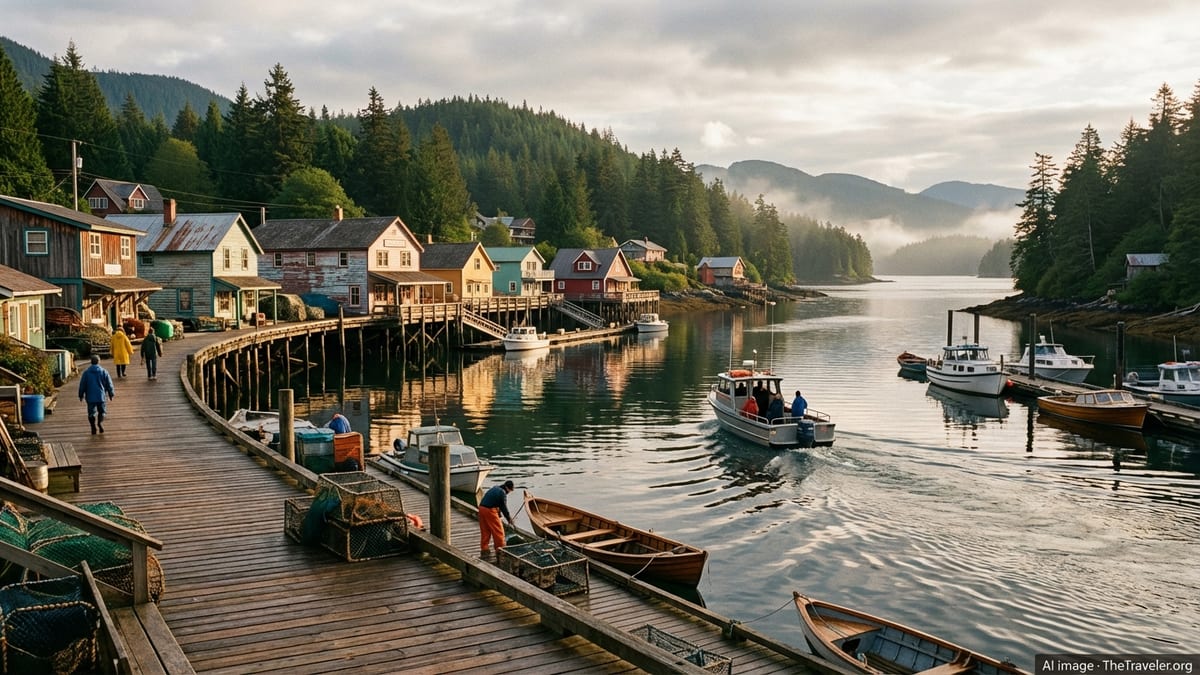
Telegraph Cove is one of the last true boardwalk communities on British Columbia’s coast. A narrow horseshoe of cedar planks curves around a sheltered harbor, with colorful heritage buildings perched on pilings above the water. This compact setting encourages slow wandering: it is the perfect place to stretch your legs between excursions and experience the village’s layered history as a telegraph station, cannery, sawmill and now eco-tourism outpost.
Stroll Through Heritage Buildings and Working Harbour
A walk along the boardwalk lays out Telegraph Cove’s story in a few hundred meters. Restored bunkhouses, former industrial sheds and former family homes have been adapted into guest rooms, small shops and services. Weathered siding and original signage hint at decades of life in a working coastal community, while fishing boats, tour vessels and pleasure craft come and go from the small marinas below.
Interpretive panels, where available, help fill in the past: the arrival of the telegraph line in the early 20th century, the growth of the sawmill and salmon saltery, and the eventual shift toward tourism. At high tide the water laps just beneath the deck boards, and at low tide the pilings are revealed, coated in barnacles and seaweed. The entire place feels surprisingly intimate, especially outside peak hours when the village quiets and you can hear the creaks and knocks of boats against their moorings.
Witness a Community in Rebuild
In late 2024, a serious fire damaged part of Telegraph Cove’s historic waterfront, including several heritage buildings and popular gathering spots. Recovery efforts are ongoing, and visitors in 2025 and beyond will likely see evidence of both loss and renewal along the boardwalk. In many ways, coming here during this period is also an act of support.
Staying overnight, eating in local establishments and booking local tours all contribute to the village’s future. As you walk, you may notice new construction alongside older structures, and you might hear stories from long-time residents and operators about what was lost and what is being rebuilt. For travelers who value living history, witnessing this moment of transition can be as meaningful as the wildlife watching that first drew you here.
4. Explore the Whale Interpretive Experience
Telegraph Cove has long been a hub for whale research and education on Canada’s Pacific coast. For years, its famed Whale Interpretive Centre housed one of the largest collections of whale skeletons in British Columbia and helped visitors understand the complex lives of orcas, humpbacks and other cetaceans. A major fire in 2024 forced a temporary closure and triggered a process of reimagining how this story will be told going forward.
Learn About Coastal Cetaceans and Conservation
Historically, the interpretive center displayed articulated skeletons of local species such as fin and humpback whales, orcas and Steller sea lions, plus exhibits on whale research, acoustics and conservation. Visitors could trace family trees of the Northern Resident orca population, delve into the history of whaling in the region and understand the importance of protected areas like Robson Bight, a critical habitat just south of Telegraph Cove.
As the community recovers, educational efforts are evolving. Pop-up displays, temporary exhibits and partnerships with tour operators and local organizations help keep the story of these animals present in the village, even while a permanent facility is being rebuilt. When planning your trip, check current local information to see what interpretive options are available in the season you visit, and consider setting aside time before or after a whale watching trip to connect the science with what you see on the water.
Connect With Local Researchers and Guides
Many guides and operators working out of Telegraph Cove have deep ties to whale research and conservation projects in the region. Onboard naturalists and kayak guides often share insights drawn from years of field observation, photo-identification work or collaboration with scientists. Asking questions and engaging with their knowledge can turn an already memorable wildlife encounter into a far richer understanding of the ecosystem and the pressures it faces.
This human-to-human exchange is one of the village’s strengths. Rather than a purely commercial tourism hub, Telegraph Cove functions as a community where science, traditional knowledge and visitor curiosity intersect. Even in a rebuilding phase, that culture of learning and stewardship remains one of the best reasons to spend time here.
5. Hike Coastal Trails and Viewpoints
While Telegraph Cove is best known for its marine experiences, there are rewarding hikes nearby that reveal a different side of the landscape. Forested trails lead to viewpoints over Johnstone Strait, and day trips farther afield unlock sweeping beaches and rugged headlands on the north end of Vancouver Island. These walks suit a range of abilities, from short outings to more energetic hikes for experienced walkers.
Tackle the Blinkhorn (Dave Farrant) Trail
The Blinkhorn Trail, also known as the Dave Farrant Trail, is a much-loved local hike near Telegraph Cove. This out-and-back route winds through coastal forest and emerges at viewpoints overlooking Johnstone Strait, where, on a clear day, you may spot whales or dolphins from shore. The trail has some elevation and rooty, uneven sections, so it is best attempted with sturdy footwear and in suitable weather.
Because conditions and signage can change, check the latest local advice on trail access, parking and difficulty before you go. Carry water, be prepared for wet or muddy ground and give yourself enough time to enjoy the views rather than rushing out and back. For visitors who arrive in Telegraph Cove without time for a full-day marine outing, Blinkhorn offers a land-based way to connect with the same waters that draw the whales.
Consider Day Trips to Regional Parks
If Telegraph Cove is your base for several days, you can use it as a springboard to explore other parts of northern Vancouver Island. Scenic coastal parks within driving distance offer atmospheric forest walks, beach rambles and more challenging hikes to elevated viewpoints. Some destinations may require early starts and careful planning around daylight and tides, so they are best suited to travelers comfortable with self-guided exploration.
Before setting off, check regional park information, road conditions and any advisories related to wildlife, closures or weather. Carry the usual essentials for coastal hiking: extra layers, rain protection, water and snacks. Combined with your time on the water, these day hikes round out a Telegraph Cove itinerary and give a broader appreciation for the wild character of this part of the island.
6. Try Your Hand at Fishing and Boating
The waters around Telegraph Cove have long supported fishing, and that tradition continues today in a more recreational form. For many visitors, heading out in search of salmon or bottomfish complements the village’s eco-tourism focus, provided it is done within regulations and with an eye to sustainability. Even if you never pick up a rod, simply being out on the water in a small boat, moving between islands and inlets, can feel like an adventure of its own.
Book a Guided Fishing Charter
Guided fishing charters from Telegraph Cove typically target salmon in season, along with species such as halibut and lingcod where allowed. Skippers bring local knowledge of productive areas, safe routes and current regulations, and they supply the gear you will need. First-timers can learn the basics of trolling or bottom fishing, while experienced anglers benefit from having someone else handle navigation and logistics.
Regulations, seasons and catch limits are subject to change, so it is important to rely on up-to-date information and to follow your guide’s instructions on what can be legally and ethically retained. Many operators emphasize responsible practices and may encourage selective harvesting or catch-and-release for certain species. As with whale watching, dressing for the elements is crucial, since hours on the water can feel cool even in mid-summer.
Launch a Kayak or Small Boat to Explore Nearby Waters
Not every boating experience in Telegraph Cove needs to be structured around fishing or whales. If you have the skills and appropriate equipment, launching a kayak or small boat to explore nearby sheltered waters can be deeply rewarding. Close to shore you might find sea stars, anemones and other intertidal life in clear shallows, or enjoy quiet coves where you hear nothing but your paddle drip and the occasional raven calling from the treeline.
Conditions can change quickly with tides, currents and wind, so self-guided paddlers and boaters should be realistic about their abilities and conservative in their plans. Many visitors opt for guided experiences precisely because local skippers and guides understand how the weather and sea behave here. Whatever you choose, let someone know your route and expected return time, and carry appropriate safety gear such as flotation devices and communication tools.
7. Discover Art, Culture and Small-Village Life
Telegraph Cove’s appeal goes beyond wildlife and scenery. For a community with only a handful of full-time residents, it manages to pack in a surprising amount of character, from working artists to informal gathering spots and seasonal services. Slowing down enough to notice these human details often becomes a highlight of the visit, especially on days when fog or rain softens the horizon.
Visit Local Art and Craft Spaces
At the entrance to the village and along the boardwalk, you may find small galleries and studios showcasing works inspired by the coast. Wood carvings, sculpture, paintings and functional pieces often draw directly from marine themes: orcas, ravens, salmon and the tangled shapes of driftwood. Many items are created on-site, giving you the chance to talk to the artist about how Telegraph Cove and the broader region influence their work.
Because this is a small, seasonal community, opening hours can vary, especially at the shoulders of the May to September visitor season. When you do find a gallery open, take the time to look beyond obvious souvenirs. You may discover thoughtful, handcrafted pieces that carry the feel of this place far more powerfully than mass-produced mementos.
Experience the Rhythm of a Seasonal Coastal Village
Part of Telegraph Cove’s charm is its seasonality. From late spring through early autumn, the village fills with whale watchers, kayakers, anglers and road-trippers making their way up Vancouver Island. Cafes open their doors, the hum of diesel engines and outboard motors echoes around the cove and evenings bring a sociable buzz as people share stories of the day’s sightings.
Outside those months, life slows dramatically, and many facilities close or operate on reduced hours. If you arrive at the very start or end of the season, be prepared for a quieter experience with fewer services available, but also fewer crowds. In any season, simple moments often stick with visitors most: the sight of low clouds snagging on the hills after rain, the sound of a floatplane arriving, or the glow of lights reflecting in the harbor after dark.
8. Use Telegraph Cove as a Launch Pad for the Broughton Archipelago
Beyond the immediate cove lies one of British Columbia’s most intriguing marine landscapes: the Broughton Archipelago. This network of islands, channels and protected bays is known for its quiet anchorages, wildlife and traces of long Indigenous presence along the shores. While most of it is only accessible by water, Telegraph Cove is one of the key jumping-off points for exploring this wilder outer world.
Join Guided Boat or Kayak Excursions into the Archipelago
Several local operators offer day and multi-day trips that venture into the Broughton Archipelago, combining wildlife viewing, paddling and learning about coastal history. Traveling with a guide simplifies the complex logistics of tides, navigation and safe anchoring, especially for those unfamiliar with British Columbia’s coastal waters. Along the way, you may pass ancient clam garden terraces, culturally modified trees and former village sites that speak to centuries of Indigenous knowledge and stewardship.
The archipelago’s channels and islets also serve as a quieter complement to busier wildlife-watching corridors. Here, the focus may shift from chasing specific sightings to settling into stillness: watching mist lift off the forest, listening for wingbeats of seabirds or noticing the subtle movement of kelp forests in the current. It is an environment that rewards patience and respect.
Plan for Remote Conditions and Limited Services
Because there are no roads into the Broughton Archipelago, anyone heading there from Telegraph Cove should treat it as a remote backcountry environment. Even on guided trips, weather delays and route changes are possible, and there are few if any services beyond what your boat or camp carries. Packing appropriate clothing layers, dry bags for personal items and any essential medications is important, as is having realistic expectations about comfort levels.
For self-guided boaters and paddlers, nautical charts, tidal information and a clear understanding of personal limits are crucial. Many travelers choose Telegraph Cove precisely because it offers the contrast of a small but comfortable base with access to such wild surroundings. Returning to the boardwalk after days spent in the archipelago can feel like arriving in a bustling town, even though the community itself remains delightfully small.
The Takeaway
Telegraph Cove rewards those who take the time to look closely. On the surface, it is a postcard-pretty boardwalk village with orcas offshore; in reality, it is a layered place where history, ecology and community resilience intersect. From world-class whale watching and quiet paddles among kelp forests to hikes, art, fishing and forays into the Broughton Archipelago, its experiences are far richer than its small size suggests.
As the village continues to rebuild and adapt after recent challenges, visitor choices matter more than ever. Traveling thoughtfully, supporting local operators and approaching wildlife and landscapes with humility help ensure that Telegraph Cove remains a thriving gateway to one of Canada’s most extraordinary marine environments. Whether you come for a single unforgettable whale encounter or a longer immersion in the rhythms of the coast, this little cove on Vancouver Island has a way of staying with you long after you have left the dock.
FAQ
Q1. When is the best time of year to visit Telegraph Cove for whale watching?
The main whale watching season typically runs from May into October, with orca sightings often strongest in late July through early September. Exact timing can vary year to year based on ocean conditions and salmon runs.
Q2. How many days should I plan to spend in Telegraph Cove?
Many travelers find that two to three nights is enough time for at least one whale watching tour, a kayak outing and unhurried exploration of the boardwalk. If you want to add multi-day kayaking or trips into the Broughton Archipelago, plan four to six nights.
Q3. Do I need prior kayaking experience to paddle in Telegraph Cove?
No. Local outfitters regularly take beginners on half-day and day trips using stable double kayaks and thorough safety briefings. For longer expeditions, operators may ask about your fitness and paddling background to match you with the right trip.
Q4. Is Telegraph Cove suitable for families with children?
Yes, provided you plan carefully. Many whale watching tours and shorter kayak trips welcome children above a minimum age, and the compact boardwalk village is easy to navigate. Families should check age guidelines with individual operators and pack warm, waterproof clothing for everyone.
Q5. What should I pack for a summer visit?
Even in midsummer, conditions on the water can be cool and damp. Pack layered clothing, a waterproof jacket, hat and gloves, along with sturdy footwear for boardwalks and trails. Binoculars, a reusable water bottle and a dry bag for electronics are also helpful.
Q6. Do I need to book tours and accommodation in advance?
Advance booking is strongly recommended during the peak season from roughly late June through early September. Whale watching seats, kayak tours and the limited local accommodation can all fill up, particularly on weekends and holiday periods.
Q7. Can I see whales from shore in Telegraph Cove?
It is occasionally possible to spot whales from shore or nearby viewpoints, especially along trails overlooking Johnstone Strait, but sightings are less predictable than from boats. For the best chance of encounters, a dedicated whale watching tour is advisable.
Q8. What impact did the 2024 fire have on Telegraph Cove?
A serious fire in late 2024 damaged part of the historic waterfront, including some heritage buildings and visitor facilities. Recovery and rebuilding are ongoing, so the village may look different than in older photos, but it remains open and welcoming to visitors.
Q9. Are there services available outside the main May to September season?
Telegraph Cove is highly seasonal. Many accommodations, restaurants and tour operators only run from roughly May to September, with limited or no services available at other times. Always check current opening dates before planning an off-season visit.
Q10. Is Telegraph Cove accessible without a car?
Most visitors arrive by car as public transport options are limited, and having your own vehicle makes it far easier to reach trailheads and regional attractions. Those without a car may be able to arrange transfers or shuttles from nearby communities, but advance planning is essential.