

The Drakensberg Mountains rise in a dark, serrated wall along the border between South Africa and Lesotho, a blend of fortress-like cliffs, high basalt plateaus and valleys laced with rivers and waterfalls. This World Heritage listed range is one of Africa’s great hiking destinations, offering everything from gentle riverside paths to multi day traverses that cross high passes and exposed ridgelines.
Among the countless trails and viewpoints, a handful of routes and scenic spots capture the essence of the Drakensberg, revealing its scale, variety and cultural depth. The following guide focuses on eight defining experiences, grouped by region and style, to help you plan a journey that does justice to this extraordinary landscape.
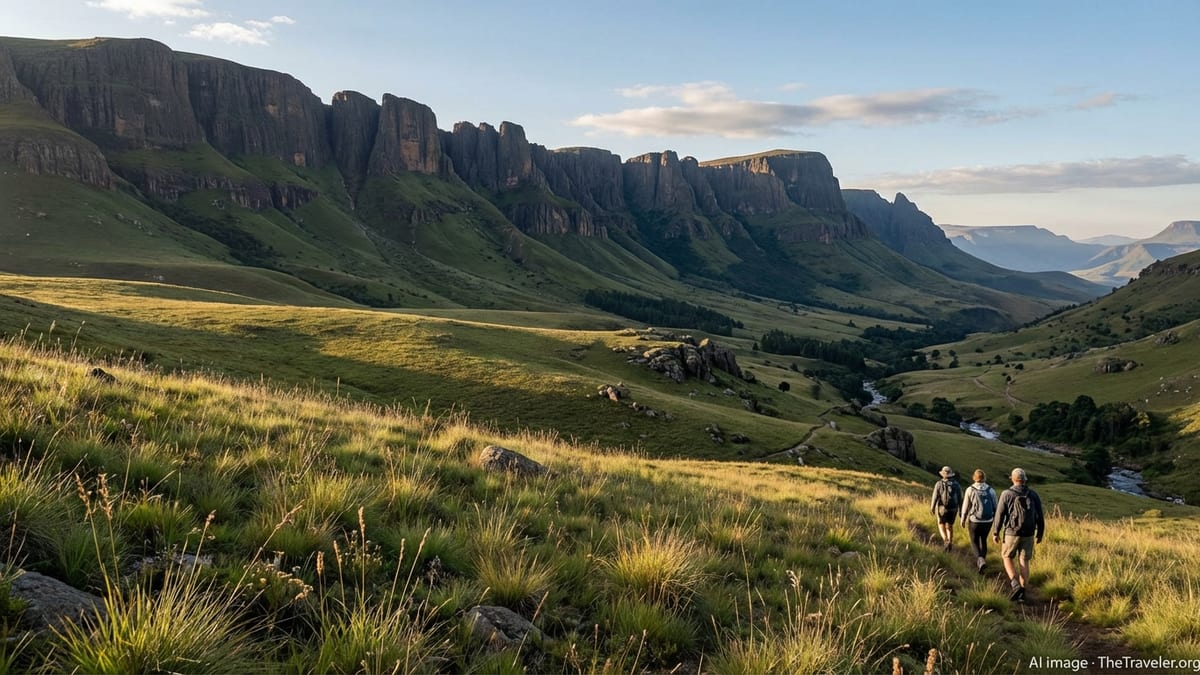
The Northern Drakensberg Icons: Amphitheatre and Tugela Falls
The northern Drakensberg delivers some of the range’s most recognizable scenery, anchored by the Amphitheatre, a sweeping basalt wall more than 5 kilometers long that forms the prow of the escarpment. Here the Tugela River spills almost a vertical kilometer from the plateau, creating one of the tallest waterfalls on Earth. A pair of classic hikes showcase this country from above and below, combining accessible trailheads with truly grand mountain drama.
1. Sentinel Chain Ladders to the Top of Tugela Falls
If there is a single hike that defines the Drakensberg, it is the ascent from Sentinel car park to the Amphitheatre plateau and the brink of Tugela Falls. Starting at around 2,500 meters, a contouring path traverses beneath the Sentinel and neighboring buttresses before climbing steep zigzags toward the escarpment. The trail is clear underfoot, but the altitude and elevation gain give it a solid, full day feel.
The signature moment arrives at the chain ladders, two bolted metal ladders that climb an almost vertical rock face to the rim. Many hikers find the exposure intimidating, but the ladders themselves are sturdy and well maintained, and the ascent is over faster than it looks from below. Those uncomfortable with heights can opt instead for the Kloof Gully, a steep rocky gully that replaces airiness with physical effort, at the cost of extra time and energy.
On top, the mood changes completely. The plateau is surprisingly gentle, a grassy upland plateau where a faint path leads across streams and hollows toward the river’s source at Mont aux Sources and then to the very lip of Tugela Falls. Peering down from the brink into the Royal Natal valley, with ridge after ridge fading into haze, is one of southern Africa’s most memorable viewpoints. On clear days, hikers can trace the line of the escarpment south toward peaks and passes that hint at deeper journeys into the Drakensberg interior.
2. Tugela Gorge Trail beneath the Amphitheatre Wall
Where the Sentinel route explores the Drakensberg from above, the Tugela Gorge trail offers a complementary perspective from the valley floor. Beginning near Thendele Camp in Royal Natal National Park, the path follows the Tugela River upstream as it threads through grasslands and pockets of indigenous forest. The Amphitheatre dominates the skyline ahead, a steadfast wall that gradually fills the horizon as the gorge narrows.
The gradient is steady rather than steep, which makes this one of the most popular day hikes in the region. Families and casual walkers can turn back from any of the river pools and picnic spots along the way, while more determined hikers push on past river crossings and short scrambles into the deeper gorge. In the final section the trail becomes rougher, with boulder hopping and a short ladder or fixed chains to gain a higher vantage point when conditions allow.
In summer, the Tugela often runs full and the rock pools are invitingly clear, perfect for cooling off after the approach through the valley. In the dry season the waterfall sometimes dwindles to a thin veil, but the sculpted rock walls, echoing canyon and uninterrupted face of the Amphitheatre still make the hike worthwhile. Combined with the chain ladder route on another day, it gives a rounded understanding of the Drakensberg’s northern bastion.
Cathedral Peak and the High Escarpment Ridge
South of Royal Natal, the Cathedral Peak region forms another focal point for Drakensberg hiking. Here free standing spires, serrated ridges and deep passes create a compact amphitheater of summits accessible from a single valley system. Well managed trailheads, established paths and a range of route grades make this one of the best places for hikers who want to sample the high escarpment without committing to remote, multi day expeditions.
3. Summit Ascent of Cathedral Peak
Cathedral Peak is perhaps the most famous free standing summit in the Drakensberg, a shark fin of basalt rising above surrounding ridges. The standard hiking route, which departs from the vicinity of the Cathedral Peak Hotel, is a demanding but non technical ascent that rewards competent, fit hikers with a commanding panorama over the escarpment and interior of the range.
The path climbs steadily through montane grassland and protea stands, passing minor viewpoints before steepening on the upper slopes. The final approach includes short rock scrambles, narrow ledges and one or two sections where basic scrambling confidence and a head for exposure are essential. In dry summer conditions, experienced hikers often tackle the route without rope, but this is not a casual walk and should not be underestimated, particularly in wet or misty weather.
From the summit, the Drakensberg unfolds in a near circular view. To the north, hikers can trace the serrated skyline toward the Amphitheatre. To the south, the range marches away in buttresses and basins, with the escarpment edge forming a stark boundary between plateau and lowlands. It is an excellent introduction to the large scale geography of the Drakensberg and a fitting challenge for those ready to step up from valley trails to true mountain days.
4. Organ Pipes Pass and the Bell Traverse
For hikers with a taste for high level journeys, the combination of Organ Pipes Pass and the Bell Traverse ranks among the most scenic multi day routes in the Drakensberg. The Organ Pipes are a striking series of basalt pinnacles that line the escarpment edge above the Cathedral Peak valley. The pass that bears their name climbs from lower grasslands through a narrowing valley to reach the plateau just beyond these rock formations.
Ascending Organ Pipes Pass involves a sustained climb on a clear but steep trail. As the route gains height, views open toward the Little Berg foothills and across to the freestanding summit of Cathedral Peak. Above, the basalt cliffs draw closer, their columns resembling a vast pipe organ cut by erosion. Crossing onto the escarpment, hikers are met by a new world of high altitude grassland, dotted with caves that offer atmospheric overnight shelters.
The Bell Traverse, which is commonly paired with Organ Pipes on a circuit, threads a line across the high slopes beneath a succession of dramatic spires and buttresses, including the Bell, Cathedral Peak itself and the Chessmen. In places the trail narrows to airy ledges and contouring paths across steep mountainsides, demanding surefootedness and stable, dry conditions. In return, it provides continuous, elevated views into both Lesotho and the South African foothills. This route is widely regarded by guides and local hikers as one of the most rewarding in the range for its blend of challenge, exposure and visual drama.
Remote Escarpment Wilds: Mnweni and Mafadi
Beyond the better known hotel bases and national park camps, the central Drakensberg offers more remote sectors that appeal to seasoned hikers seeking solitude and a wilder feel. The Mnweni area, managed in partnership with local communities, and the high ground around Mafadi, the highest point in South Africa, both showcase the Drakensberg at its most unfiltered. Trails are less formal, weather is a critical factor and navigation skills become more important, but the rewards are exceptional.
5. Mnweni Circuit and the Mnweni Pinnacles
The Mnweni region lies between the northern resorts and the Cathedral Peak valley, and it is often described by South African hikers as the most scenic section of the range. Unlike the more developed park areas, Mnweni is accessed via community land, with simple facilities at the Mnweni Cultural Centre and a network of informal paths leading into the headwaters of the Mnweni River and its tributaries.
A classic two or three day circuit typically climbs to the escarpment via Mnweni or Rockeries Pass and returns by an alternate pass, creating a loop that encircles the Mnweni Pinnacles. These tower like formations rise abruptly from hanging valleys near the escarpment edge, their sheer sides and sharp ridges framed by rolling high grassland. Nights are usually spent in caves on or near the escarpment, which combine weather shelter with balconies that look straight out onto the pinnacles.
Hiking here is substantially more committing than on waymarked day routes. Trails can be faint or braided, weather changes quickly and river crossings can be problematic after heavy rain. Local guides are available and widely recommended for visitors unfamiliar with Drakensberg passes. For those prepared and properly equipped, Mnweni offers a combination of cultural encounter, wild landscapes and superb photographic opportunities that captures the Drakensberg spirit in concentrated form.
6. Mafadi and the High Drakensberg Plateau
Mafadi, situated near the border of KwaZulu Natal and Mpumalanga, rises to approximately 3,450 meters and is generally recognized as the highest point within South Africa’s borders. While not as visually dramatic as freestanding peaks like Cathedral Peak, Mafadi occupies a crucial place in Drakensberg lore and provides a compelling objective for strong hikers who want to experience the range from its highest ground.
Popular ascent routes start from trailheads in the Injisuthi or Giant’s Castle sectors and follow long valleys that gradually curve toward the escarpment. Passes such as Judge Pass or Leslies Pass provide access to the plateau, requiring steep climbs on sometimes loose terrain. Once on top, the plateau itself is surprisingly gentle, with subtle rises and hollows leading across to Mafadi’s rounded summit. On clear days, the view takes in a sweep of the escarpment both north and south, as well as far reaching vistas over the foothills.
Most Mafadi ascents are planned as two or three day outings, with overnight stops in high caves or wild camps on the plateau. Water sources can be seasonal and temperatures drop sharply at night, particularly in winter when snow and ice are possible. The combination of distance, altitude and remoteness mean this hike is best attempted by those with previous backpacking experience in mountain terrain. For many, standing on Mafadi is a personal milestone, a literal high point that brings home the scale and continuity of the Drakensberg range.
Central Drakensberg Classics: Giant’s Castle and Rainbow Gorge
The central Drakensberg, stretching from the Champagne Castle area through Giant’s Castle, offers a balanced mix of infrastructure and wildness. Road access and established camps make logistics straightforward, while the escarpment remains impressively close and the valleys retain a sense of space. Two contrasting routes in this section showcase different aspects of the landscape, from high ridgelines to intimate gorges scoured by water.
7. Giant’s Castle Summit and Escarpment Views
Giant’s Castle, a prominent buttress in the central Drakensberg, gives its name to a nature reserve known for both hiking and rock art sites. For those drawn to views and broad scale topography, a full day hike onto the high ground around Giant’s Castle is a defining experience. Routes generally begin from the main camp and follow well maintained paths that climb through grassy slopes, crossing side valleys and contouring around ridges as the escarpment looms closer.
Several variations exist, but the essence of the outing is the steady transition from foothill vegetation into high altitude grassland and rock. As height is gained, the perspective over neighboring buttresses and the curving line of the escarpment continually improves. In good weather, hikers can look north toward Cathedral Peak and south toward the more remote Hodgson’s Peaks, gaining an appreciation of how the Drakensberg functions as a continuous barrier rather than a set of isolated summits.
While the standard routes to the high ridges do not generally require technical skills, the terrain is exposed to wind and sudden mist, and snow is a realistic possibility in the cooler months. Many visitors connect a Giant’s Castle hike with visits to nearby rock art shelters, where interpretive displays explain the legacy of San hunter gatherers who once moved through these valleys. It is a combination that underscores the long human connection to the mountains as much as their scenic drama.
8. Rainbow Gorge and the Intimate Drakensberg
Not all defining Drakensberg hikes are about summits and sprawling vistas. Rainbow Gorge, in the Cathedral Peak region, is a shorter but atmospheric walk that highlights the way water has sculpted the range’s flanks. Starting from the vicinity of the Cathedral Peak Hotel, the path descends through forested slopes into a narrowing sandstone gorge carved by a tributary of the Mlambonja River.
As the walls close in, the character of the hike changes from an open mountain walk to a more exploratory clamber through pools, boulders and rock corridors. Sections of the gorge are shaded and cool even on hot summer days, and after rain the sound of cascading water echoes between the rock faces. The name alludes to the rainbows that form in spray where sunlight penetrates the canyon, particularly in the later morning and early afternoon.
Rainbow Gorge is popular with families and those looking for a more relaxed alternative to the high escarpment routes, yet it still feels distinctly Drakensberg in its geology and vegetation. Combined with an overnight stay in the valley, it offers an accessible way to experience the range’s ambience at close quarters, making it an excellent first walk for visitors who are new to mountain environments or arriving from long journeys at lower altitudes.
Planning Your Drakensberg Hiking Journey
Connecting these eight routes and scenic spots into a coherent trip involves more than simply choosing trail names from a map. The Drakensberg’s weather, altitude, access roads and infrastructure all play a role in shaping what is realistic in the time you have. Understanding how the range is organized and what to expect on the ground will help you string together a sequence of hikes that feels varied but manageable.
Choosing Regions and Bases
One of the first decisions is how many separate regions to include. The northern Drakensberg around Royal Natal and Witsieshoek, the Cathedral Peak and Champagne Castle area, the Giant’s Castle reserve and the more remote Mnweni and Injisuthi valleys are all distinct hubs, separated by driving distances that can easily stretch into several hours on mountain roads.
For a week long trip, many hikers focus on two regions: for example, combining the Amphitheatre and Tugela Falls with Cathedral Peak and Rainbow Gorge, or pairing Cathedral Peak with Giant’s Castle. Those with more time or a particular interest in backpacking might add Mnweni or a Mafadi ascent to the itinerary. Accommodation ranges from hotels and self catering chalets to basic campsites and community run lodges, with many hikers using a comfortable base as a springboard for day hikes.
Season, Weather and Safety
The Drakensberg can be hiked year round, but conditions vary sharply by season. The summer months bring warm temperatures, lush green slopes and impressive afternoon storms that can build rapidly over the escarpment. Lightning, swollen rivers and poor visibility are real hazards in this period, so early starts and flexible itineraries are essential. Winter is generally drier and clearer, with crisp air and long views, but snow, ice and subzero night temperatures are common on the high ground.
In all seasons, hikers should carry proper waterproof layers, warm clothing, sun protection and enough food and water for a full day out. Altitude affects people differently, and routes like the Sentinel chain ladders, Cathedral Peak and Mafadi involve significant time above 3,000 meters. For remote routes, registering your plans with rangers or accommodation providers, carrying a map or GPS and considering the services of a local guide significantly increase safety margins.
Cultural and Environmental Considerations
The Drakensberg is not only a natural landscape; it is also a cultural one. Rock art shelters across the range preserve some of the most important San paintings in southern Africa, while present day communities in foothill areas such as Mnweni maintain long standing relationships with the land. Respecting local regulations, staying on established paths where requested and using registered guides in community managed sectors help ensure that tourism benefits residents and minimizes impact.
The entire uKhahlamba Drakensberg Park, which includes much of the escarpment and adjacent valleys, is recognized as a World Heritage site for both natural and cultural values. Hikers can support conservation by adhering to leave no trace principles, refraining from removing plants or rocks, and avoiding camping in sensitive areas such as close to rock art sites or water sources. Simple actions, such as packing out all litter and avoiding open fires in high grassland, play a tangible role in keeping the Drakensberg’s wild character intact for future visitors.
The Takeaway
The Drakensberg Mountains are not a single trail or summit but an entire world of cliffs, plateaus, rivers and gorges that reward return visits and gradual exploration. The eight routes and viewpoints highlighted here, from the chain ladders above Tugela Falls to the secluded pinnacles of Mnweni and the high shoulder of Mafadi, provide a framework for understanding what makes this range distinctive. They show how the Drakensberg can be experienced from below and above, in short canyon walks and demanding multi day traverses, and how human stories are woven into its valleys.
Whether you are planning your first trip or returning to seek out more remote corners, the key is to balance ambition with respect for the mountains. Choose a mix of hikes that match your fitness and experience, allow for weather changes and local advice, and give yourself time to simply sit and absorb the skyline at dawn or dusk. Do that, and the Drakensberg will reward you not just with photographs, but with a sense of having walked through one of Africa’s great mountain landscapes in a way that feels both intimate and memorable.
FAQ
Q1. What is the best time of year to hike in the Drakensberg?
The most popular months for hiking are generally from April to early June and from late August to October, when the weather is more stable, rainfall is lower and temperatures are moderate. Summer brings lush scenery and dramatic storms, while winter offers clear air and long views but can be very cold on the escarpment.
Q2. Do I need a guide for the main Drakensberg hikes?
Waymarked day routes like the Tugela Gorge trail, some Giant’s Castle walks and shorter Cathedral Peak valley hikes can often be done independently by experienced hikers. For exposed summit routes, high passes, Mnweni circuits or a Mafadi ascent, many visitors choose to hire local guides for navigation, safety and local knowledge, which is strongly recommended if you are unfamiliar with the area.
Q3. How difficult is the chain ladder route to the top of Tugela Falls?
The overall hike is rated moderate to strenuous, with altitude and distance to consider. The chain ladders themselves are physically straightforward but exposed, which can be unsettling if you dislike heights. The ladders are solid and widely used, and there is an alternative gully route for those who prefer to avoid them, although it is steeper and more tiring.
Q4. Can beginners hike in the Drakensberg, or is it only for experienced trekkers?
The Drakensberg offers a full spectrum of routes. Beginners can enjoy shorter, well graded trails such as parts of the Tugela Gorge path, valley walks near Cathedral Peak and selected routes from Giant’s Castle camp. With proper preparation and realistic goals, first time hikers can safely experience the mountains, while tougher passes and summits remain options for when skills and confidence grow.
Q5. Are permits or fees required to access these hiking routes?
Most formal trailheads in uKhahlamba Drakensberg Park and associated reserves require a conservation or entrance fee, and some routes, such as the Sentinel chain ladder hike, have additional hiking permits payable at the access point. In community managed areas like Mnweni, hikers usually pay a modest access fee at local offices. It is sensible to carry cash and check current details with accommodation providers before arrival.
Q6. What kind of gear should I bring for Drakensberg hiking?
At a minimum, sturdy hiking footwear, layered clothing, a waterproof jacket, hat, gloves in cooler months, sun protection, sufficient water, a basic first aid kit and snacks are essential. For longer or higher routes, a detailed map, GPS or navigation app, headlamp and emergency shelter are recommended, and backpackers will also need a suitable tent, sleeping bag and stove rated for cool, changeable mountain conditions.
Q7. Is it safe to drink water from streams and rivers in the Drakensberg?
Many high altitude streams in the Drakensberg appear clear and are used locally, but water quality can vary and animals graze in some catchments. To reduce health risks, visitors are advised to treat water by boiling, filtering or using purification tablets, especially at lower elevations and on more heavily visited routes.
Q8. How long does it take to climb Cathedral Peak or Mafadi?
Most fit parties complete the Cathedral Peak summit as a strenuous day hike, typically in 7 to 9 hours round trip from the usual trailhead. Mafadi is usually tackled as a two or three day backpacking trip, depending on the chosen pass and starting point, with a full day required to reach or descend from the escarpment plateau.
Q9. Are there accommodation options close to the main trailheads?
Yes. The northern Drakensberg around Royal Natal and Witsieshoek has a mix of lodges, chalets and backpacker style accommodations close to the Amphitheatre and Tugela routes. Cathedral Peak, Champagne Castle and Giant’s Castle each have nearby hotels or park camps. In Mnweni and some central valleys, simpler community run lodgings and campgrounds are available, but facilities may be more basic.
Q10. What wildlife might I encounter while hiking in the Drakensberg?
Common sightings include eland and other antelope on the high grasslands, baboons on rocky slopes, and a variety of birds such as bearded vultures and jackal buzzards soaring along the escarpment. Smaller mammals, reptiles and endemic plants are also present. Large predators are rarely seen by hikers, but it is prudent to respect all wildlife, keep a safe distance and avoid feeding any animals.