

Zanzibar City, and especially its historic heart of Stone Town, is one of East Africa’s most atmospheric urban destinations. Crumbling coral-rag mansions, spice-laden markets, Swahili doorways and the constant presence of the Indian Ocean combine to create a city that rewards slow exploration.
Whether you are stopping over between beach days or making Zanzibar City the focus of your trip, there are certain places that define its character. These eight sights capture the history, culture and daily life of the city and should be on every visitor’s itinerary.
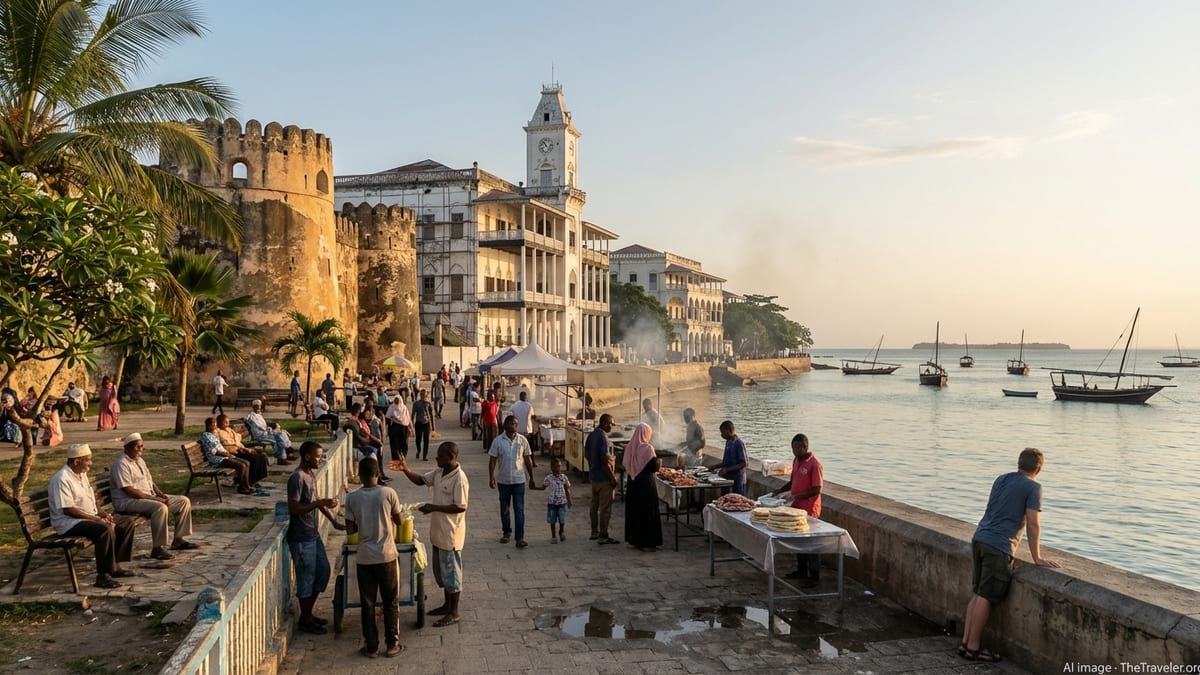
Stone Town’s Historic Waterfront
Zanzibar City’s seafront is where the island’s history, trade and contemporary life converge. Lined with grand palaces, fortifications and shady gardens, it offers a compact introduction to Stone Town’s story, from Omani sultans and British officials to today’s street-food vendors and sunset strollers. Plan to spend at least half a day along the waterfront, ideally staying on as the light softens and the evening market begins.
Old Fort of Zanzibar (Ngome Kongwe)
The Old Fort is Stone Town’s oldest standing structure and an essential first stop for understanding Zanzibar’s layered past. Built by Omani Arabs around the turn of the 18th century on the site of a former Portuguese chapel, its crenellated walls once guarded the harbor against rival powers. Later in its life it served as a prison, railway depot and social club, reflecting Zanzibar’s shifting fortunes.
Today the fort’s interior is a relaxed cultural hub. Within the thick walls you will find an open-air amphitheater, a scattering of small craft stalls, and occasional live music or dance performances, particularly around festival times. It is free to wander, and the cool shade of the courtyard offers a welcome respite from the midday sun. Look for remnants of earlier buildings incorporated into the fort’s fabric and climb sections of the walls where permitted for elevated views across the waterfront.
Forodhani Gardens and Night Food Market
Just outside the Old Fort and facing the sea, Forodhani Gardens form the social heart of Stone Town’s waterfront. By day the park is a leafy place to pause under the trees, watch dhows glide by and observe local life unfolding along the promenade. Families gather on benches, teenagers practice acrobatics by the seawall, and vendors sell sugarcane juice and snacks.
From early evening, usually around sunset, the atmosphere changes as Forodhani transforms into a lively food market. Dozens of stalls set up grills and hotplates, offering skewers of fish, calamari and octopus, Zanzibar-style pizza, urojo soup and fresh-pressed sugarcane juice. It is a convivial setting to sample Swahili street food, though visitors should follow normal precautions with seafood and choose stalls with high turnover.
Bring small notes in Tanzanian shillings or US dollars, and do not be shy to politely confirm prices before ordering. Even if you eat elsewhere, wandering through the illuminated park as the smoke from the grills rises over the harbor is one of the quintessential Zanzibar City experiences.
Palaces and Museums of the Sultans
Much of Zanzibar City’s built heritage dates from the era when the island was ruled by Omani sultans and later administered as a British protectorate. The grand seafront palaces and governmental complexes erected during this period reveal both the wealth generated by the spice and ivory trades and the political intrigues that swirled around the island. Several buildings are currently under restoration, yet their exteriors remain central landmarks and the museums inside offer essential context for the city’s past.
House of Wonders (Beit al Ajaib)
Dominating the Stone Town skyline, the House of Wonders was completed in 1883 for Sultan Barghash as a ceremonial palace and symbol of modernity. It was reportedly the first building in Zanzibar to feature electricity, running water and an elevator. The building’s tall white façade, colonnaded verandas and clock tower are easily recognized from both the harbor and the seafront promenade.
In recent years, the House of Wonders has been undergoing extensive structural restoration after sections of the building were damaged and closed to visitors. Work is ongoing, with a long-term plan to reopen it fully as the Museum of History and Culture of Zanzibar and the Swahili Coast. Even while inaccessible inside for safety reasons, the building is still a vital sight on any walking tour, illustrating the ambition and architectural style of the late 19th-century sultanate.
Check locally for the latest information on access and scaffolding. The square in front of the House of Wonders, especially at golden hour, offers excellent opportunities for photography and for appreciating the continuity between the palace, Old Fort and Forodhani Gardens.
Sultan’s Palace (People’s Palace Museum)
Adjacent to the House of Wonders along Mizingani Road, the Sultan’s Palace was built in the late 19th century on the site of an earlier palace destroyed during the short but consequential Anglo-Zanzibar War of 1896. The imposing three-storey building, with its series of balconies facing the sea, once served as the main residence of the sultan’s family.
After the revolution of 1964, the palace was repurposed as a government office and later converted into the People’s Palace Museum. Exhibits inside focus on the lives of Zanzibar’s last ruling sultans and royal household, displaying furnishings, personal items and photographs that paint a vivid picture of courtly life. Rooms dedicated to Princess Salme (Emily Ruete), who famously fled to Europe and later wrote a memoir, are particularly engaging.
The museum offers one of the clearest windows into the transition from sultanate to modern Tanzanian rule, and it is worth setting aside an hour or two for a guided visit. From the upper floors, views over the harbor and seafront underscore why this stretch of coastline was the epicenter of power.
Markets and Everyday Life
While the palaces and monuments speak to Zanzibar’s high politics and global connections, its markets reveal the rhythms of daily life. Exploring Darajani Market and the surrounding commercial streets brings you into contact with the foods, fabrics and faces that sustain the city today. This is where the island’s famed spices, tropical produce and Indian Ocean catch converge long before they appear on restaurant menus.
Darajani Market (Estella Market)
Darajani Market, sometimes called Estella Market or Marikiti Kuu in Swahili, is Zanzibar City’s principal bazaar and a visit here offers a full sensory immersion. The main covered halls, first constructed in 1904 and later extended, house stalls piled high with spices, grains, fruits, vegetables, meat and freshly landed fish. Outside, side streets brim with household goods, electronics and colorful kangas, the printed fabrics worn by many local women.
Mornings are the most atmospheric time to visit, particularly if you want to witness the frenetic fish auction that often takes place near the market’s far end. Vendors loudly call out bids while porters in rubber boots weave through the crowd balancing trays of tuna, snapper and octopus. In other sections, pyramids of cloves, cinnamon sticks and cardamom pods hint at Zanzibar’s historic role in global spice routes.
Visitors should dress modestly, keep valuables secure and ask before taking close-up photographs. Bargaining is normal for many non-food items, although basic groceries are usually sold at fixed prices. For a first visit, joining a local guide or a small-group food tour can help you navigate the maze of alleys and understand what you are seeing.
Gizenga Street and the Old Dispensary Area
From Darajani Market it is a short walk to the lattice of streets around Gizenga Street, where souvenir shops, small cafés and tailors line the narrow lanes. While some of the merchandise is squarely aimed at visitors, this is still a working part of town where shopkeepers chat in doorways and children thread their way home from school.
At the seafront end of this district stands the Old Dispensary, a late 19th-century former clinic distinguished by its carved balconies and intricate Indian and European decorative details. After a chequered history, the building was restored to its former grandeur and now houses offices and small businesses. Even if you do not go inside, its façade epitomizes the eclectic architectural influences that define Stone Town.
Combining Darajani Market, Gizenga Street and the Old Dispensary into one walking route gives you a balanced impression of contemporary Zanzibar City, linking the commercial heart to the harborfront and older residential quarters.
Religious and Slavery Heritage
Zanzibar’s prosperity was built in no small part on the East African slave trade, and the city bears lasting scars of that history. Visiting the sites connected to both religious practice and the abolition of slavery provides an essential, if at times harrowing, perspective. These places are not simply tourist stops; they are memorials and active spaces of worship that demand sensitivity and reflection.
Christ Church Cathedral and Slave Market Memorial
On the site of Zanzibar’s former slave market stands Christ Church Anglican Cathedral, constructed in the 1880s as a dramatic statement of abolition. The cathedral’s altar is reputedly positioned where the main whipping post once stood, symbolically replacing punishment with prayer. Its interior, with high arches and stained glass, is peaceful yet charged with emotional weight.
Adjacent to the church, a moving monument depicts enslaved people in chains, while the small museum beneath the former mission house documents the mechanics and human toll of the slave trade along the Swahili coast. Photographs, written testimonies and historical artifacts trace the journeys of those who were captured, transported and sold in Zanzibar and beyond.
Visitors can also descend into the preserved underground holding chambers where enslaved men, women and children were confined prior to auction. The low ceilings and stone shelves bring home the brutality of the system in a visceral way. Guided tours, usually led by knowledgeable local staff, are recommended to fully grasp the context and to ensure that time here is spent respectfully.
Historic Mosques and the Call to Prayer
Although many mosques in Stone Town are not open for non-Muslim visitors to enter, their presence is central to the city’s character. Dozens of small and large mosques punctuate the skyline with minarets, from which the call to prayer rings out multiple times each day. Walking through the lanes as the sound echoes between the buildings gives a strong sense of the island’s predominantly Muslim identity.
Architecturally, mosques range from modest neighborhood prayer halls to more substantial complexes with ornate plasterwork and carved details. Out of respect, visitors should avoid photographing worshippers without permission and dress conservatively, especially when passing near mosques during prayer times. Even from the outside, these religious structures remind you that Zanzibar’s history is not only about trade and empire but also faith and community.
Persian Baths and Hidden Alleys
Beyond the headline waterfront sights, some of Zanzibar City’s most intriguing attractions are buried in its warren of backstreets. Among these are the Hamamni Persian Baths, remnants of a once-elaborate public bathing complex that speak to the city’s cosmopolitan influences and elite social life in the late 19th century. Exploring this area also leads you into quieter residential alleys where carved doors and peeling pastel facades reward unhurried wanderers.
Hamamni Persian Baths
The Hamamni Persian Baths were commissioned between about 1870 and 1888 by Sultan Barghash and designed by architects from Shiraz, reflecting connections between Zanzibar and the wider Persian Gulf region. For several decades they functioned as public baths, serving wealthier residents who could pay for the privilege of hot and cold pools, steam rooms and grooming services.
Today the baths no longer operate in their original capacity, but parts of the complex are open to visitors for a modest entry fee. Inside, guides can point out the sequence of rooms from cooler changing areas to the warm and hot chambers, as well as the channels that once carried heated water beneath the floors. The domed ceilings and small skylights create beautiful plays of light, particularly in the late afternoon.
Some sections of the original baths have been incorporated into private homes, so visiting is limited to certain rooms. Even so, this is one of Stone Town’s more atmospheric interiors and an excellent place to imagine the routines of past residents. Pairing a stop here with a guided walking tour through the surrounding lanes gives a richer sense of how the elite of Zanzibar City once lived and socialized.
Carved Doors and Residential Lanes
As you walk to and from the Hamamni Persian Baths, take time to notice the intricate wooden doors that punctuate otherwise plain façades. These doors, with their heavy brass studs and delicate floral or geometric carvings, are famous symbols of Zanzibar and encoded with information about the status, religion and profession of the original householders.
Many of the best examples are tucked away on side streets that see relatively few tourists. Hiring a local guide who knows where to find particularly fine doors and who can interpret their designs adds depth to what might at first seem like purely decorative details. In the process, you will likely traverse quieter quarters of Stone Town where children play football in alleys and neighbors chat from verandas, offering a glimpse of city life far from the seafront.
Islands and Sandbanks off Zanzibar City
Part of the appeal of staying in Zanzibar City is the easy access it provides to the surrounding bay, where tiny islands and shifting sandbanks offer classic Indian Ocean scenery within a short boat ride. Two destinations in particular, Prison Island and Nakupenda Sandbank, are commonly combined into a day trip that balances history with beach time.
Prison Island (Changuu)
Roughly 5 to 6 kilometers off Stone Town, Changuu, widely known as Prison Island, was once used to confine rebellious slaves and later functioned as a quarantine station. The planned prison block was never put fully into use for its intended purpose, but the name stuck, and today the surviving buildings form part of a heritage complex that visitors can explore.
Most tours from Zanzibar City include a guided walk around the historical structures and ample time at the island’s main attraction: a sanctuary for giant Aldabra tortoises, descendants of individuals gifted from the Seychelles in the early 20th century. Many of the tortoises are impressively old and large. While photo opportunities abound, visitors should follow posted guidelines on feeding and handling to avoid stressing the animals.
Small beaches and clear waters around the island invite swimming and snorkeling, although coral conditions and fish life can vary. Basic facilities and a small restaurant are available, but it is wise to bring water, sun protection and reef-safe sunscreen. The boat ride itself offers striking views back toward Stone Town’s minarets and palaces.
Nakupenda Sandbank
Often paired with Prison Island on combined excursions, Nakupenda is a gleaming sandbank that appears and recedes with the tides a short distance off Zanzibar City. Its name means “I love you” in Swahili, and on calm days the low arc of white sand framed by transparent turquoise water looks almost unreal. There are no permanent structures here; at most you will see temporary shade tents and simple picnic setups arranged by tour operators.
Typical half-day or full-day trips from Stone Town time their arrival for low to mid-tide, when there is enough exposed sand to walk, swim and snorkel in the surrounding shallows. Many include a seafood barbecue lunch served on the beach. As Nakupenda is entirely exposed to the elements, sun protection, drinking water and some form of waterproof bag for valuables are essential.
Because its size and shape literally change with the tide and currents, Nakupenda is a fragile environment. Choose an operator that avoids leaving litter, uses reusable serving ware where possible and respects guidelines on anchoring to protect submerged coral patches. Even a few hours here create lifelong memories and offer an iconic perspective on Zanzibar City’s setting in its wide, sheltered bay.
The Takeaway
Zanzibar City is far more than a gateway to the island’s beaches. Within a compact radius you can walk between Omani palaces, Anglican cathedrals, bustling markets and quiet residential lanes, all tied together by the constant presence of the sea. The eight places highlighted here Old Fort and Forodhani Gardens, the House of Wonders and Sultan’s Palace, Darajani Market and surrounding streets, Christ Church Cathedral and the slave memorial, Hamamni Persian Baths, Prison Island and Nakupenda Sandbank form a coherent introduction to the city’s many layers.
Allow at least two full days in Zanzibar City if you can. Spend one day largely on foot inside Stone Town’s maze, perhaps with a licensed guide to unpack the stories behind carved doors and crumbling facades. Dedicate another day to the harbor and surrounding bay, joining a boat trip that reveals how the city has always looked outward to the Indian Ocean.
Most of all, embrace the slower pace. Take breaks in shaded courtyards, linger at the waterfront as dhows return at dusk, and do not hesitate to strike up respectful conversations with residents. Zanzibar City rewards curiosity, and the more attention you give its streets and stories, the more they will stay with you long after you have left its shores.
FAQ
Q1. How many days should I spend in Zanzibar City to see the main sights?
Two full days are usually enough to visit the key attractions in Stone Town, including the waterfront palaces, markets, religious and slavery heritage sites, plus one boat trip to Prison Island and Nakupenda. With a third day you can explore at a more relaxed pace, revisit favorite places and enjoy additional cafés and galleries.
Q2. Is Stone Town in Zanzibar City safe for visitors to walk around?
Stone Town is generally considered safe for visitors, especially by day, provided you take normal city precautions such as keeping valuables discreet and avoiding poorly lit alleys late at night. Petty theft can occur in crowded areas like markets and the night food stalls, so use common sense, stay aware of your surroundings and consider walking with a guide after dark if you are unfamiliar with the area.
Q3. Do I need a guide to visit the eight main places in Zanzibar City?
You can see all eight places independently, but hiring a licensed local guide, even for half a day, greatly enriches the experience. Guides can help you navigate the maze-like alleys, explain complex histories, interpret symbolic details like carved doors and religious architecture, and manage timing for markets and boat trips more efficiently.
Q4. What is the best time of day to visit Darajani Market and Forodhani Gardens?
Darajani Market is most atmospheric in the morning when fresh produce and fish arrive and trading is at its liveliest. Forodhani Gardens are pleasant throughout the day for a seafront stroll, but the famous night food market typically gets going around sunset and stays busy into the evening, making that the ideal time to experience its street-food scene.
Q5. Can visitors enter the House of Wonders and other palaces right now?
Access to the interiors of some historic buildings, particularly the House of Wonders, has been restricted at times due to ongoing restoration and safety work. The exteriors remain major sights, but interior openings and museum access can change. Check locally with your hotel, guide or tourism office shortly before you visit for the latest information on which sections are open.
Q6. How do I arrange a trip to Prison Island and Nakupenda Sandbank?
Boat trips to Prison Island and Nakupenda can be arranged through hotels, reputable tour companies or directly with boatmen along the Stone Town waterfront. Many operators offer combined half-day or full-day excursions that include snorkel gear and a simple lunch. It is wise to compare prices, confirm what is included, check safety equipment and choose providers who follow responsible environmental practices.
Q7. What should I wear when visiting religious and historical sites in Zanzibar City?
Zanzibar is a predominantly Muslim society, so modest dress is appreciated, especially at religious and sensitive historical sites. Shoulders and knees should ideally be covered, and very tight or revealing clothing is best avoided in town. Lightweight, loose-fitting garments are both comfortable in the heat and respectful of local norms; a scarf or shawl can be useful for extra coverage when needed.
Q8. Are there entrance fees for the main attractions in Stone Town?
Some key sites, such as the Old Fort’s courtyard and Forodhani Gardens, are free to enter, while others, including Christ Church Cathedral and the slave memorial, the Sultan’s Palace Museum and Hamamni Persian Baths, usually charge modest entrance fees. Combined tickets and guided tours may be available. Carry small cash in Tanzanian shillings or US dollars, as card payments are not always accepted.
Q9. When is the best season to visit Zanzibar City and Stone Town?
The most popular times to visit Zanzibar City are during the drier months from roughly June to October and again from late December to February, when humidity is lower and walking the city’s narrow lanes is more comfortable. The long rains, typically around March to May, can bring heavy downpours that occasionally flood streets, although the city remains lively and less crowded with visitors.
Q10. Can I use Zanzibar City as a base for exploring the rest of the island?
Yes, Zanzibar City works well as a base for a few days, especially at the start or end of a trip. From here you can easily arrange day excursions to beaches on the island’s north or east coasts, spice farm tours and dolphin or snorkeling trips, returning to the city each evening. Many travelers choose to combine several nights in Stone Town with a separate stay at a beach resort elsewhere on the island.