

The Eola-Amity Hills, just west of Salem in Oregon’s Willamette Valley, reward unhurried travelers with some of the region’s most evocative landscapes. This compact American Viticultural Area feels intimate and rural, with winding backroads, forested ridgelines, and vineyards that climb steep volcanic slopes.
Maritime air spills in through the Van Duzer Corridor, clearing summer skies and sharpening evening light so that even a short walk between vine rows feels cinematic. For visitors, it adds up to a place where the journey between tastings is every bit as memorable as the wines themselves.
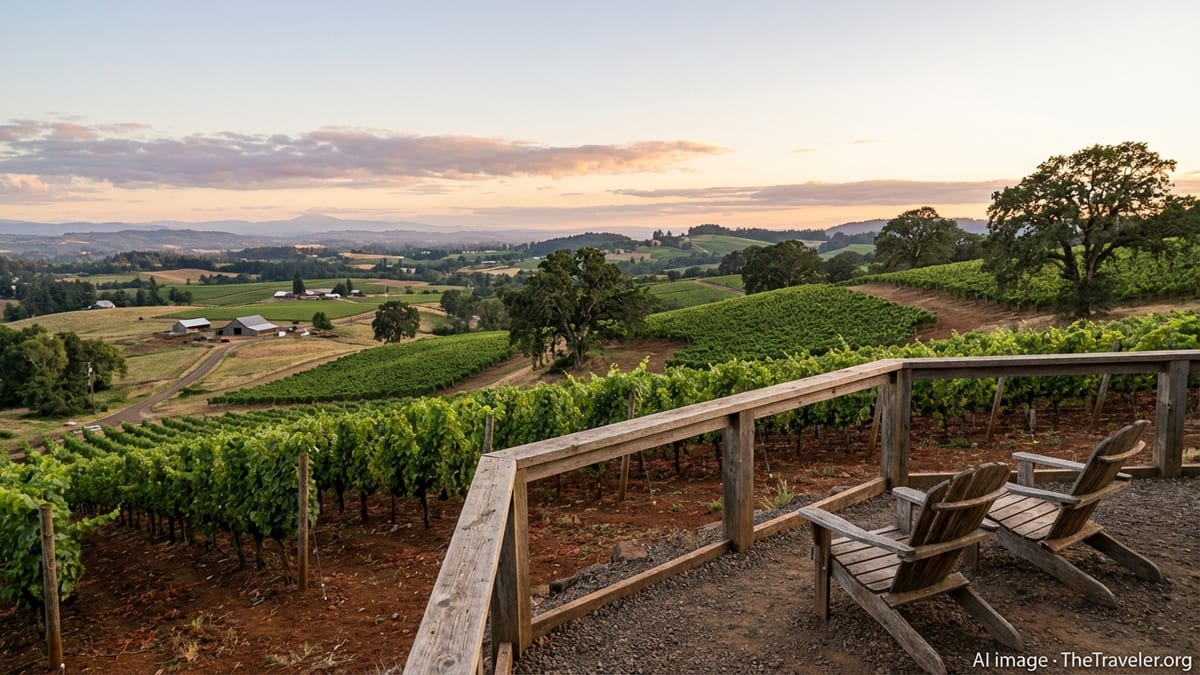
The Landscape of Eola-Amity Hills
To understand why these eight scenic stops feel so special, it helps to picture the broader canvas. The Eola-Amity Hills rise as a chain of low ridges west of Salem, carved from ancient volcanic flows and marine sediments. Vineyards are tucked between oak savannas, small farms, and pockets of conifer forest. Roads weave over crests and along benches, constantly revealing new views of the Willamette Valley floor and distant Cascade peaks. Compared with some more developed wine regions, this AVA remains relatively quiet, especially on weekdays, and that sense of space is part of the appeal.
Most visitors arrive by car from Portland or Salem, using Eola’s country roads as a kind of moving viewpoint. The stops below highlight places where it is worth slowing down, lingering on a deck or trail, and letting the landscape come into focus. Several are wineries with noted views; others are vantage points, backroads, and stays that frame the hills in different light and seasons.
1. Brooks Wine: An Iconic Valley Panorama
Brooks Wine has become one of the signature viewpoints in the Eola-Amity Hills, in part because of its elevated position and open western exposure. The tasting room sits on a slope above estate vineyards, with a wide deck and gardens that invite you to settle in and watch light move across the valley. On clear days, multiple Cascade peaks can appear on the horizon, and in late afternoon the hills often fall into layers of blue and gold.
Why Brooks Belongs on Every Scenic Itinerary
The view from Brooks is not just about a single angle; it is about depth. From the deck you see vine rows stepping down the hill, irregular stands of oak, neighboring vineyards, and distant foothills beyond the valley floor. That complexity gives you a real sense of the AVA’s topography. It also makes Brooks an ideal first or last stop of the day, when low sun emphasizes contours and the sky takes on soft pastels.
Brooks is also known for welcoming hospitality and a full kitchen, which means you can pair the view with thoughtful seasonal plates rather than rushing off for lunch elsewhere. The combination of biodynamically farmed vines, a strong focus on Riesling and Pinot Noir, and an easygoing setting has turned this deck into a kind of unofficial living room for the hills, where locals and visitors linger over flights well into the evening light in summer.
What to Look For While You Sip
When you visit, take a few moments between pours to look closely at how the scene changes. On breezy afternoons, wind racing through the Van Duzer Corridor often shows up as visible movement across the vine canopy, a reminder of the cooling influence that helps shape wines here. As the sun drops, watch for mist collecting in low spots of the valley, especially in spring and fall. Even in winter, the contrast between bare vines, dark soil, and streaked clouds can be striking.
2. Bryn Mawr Vineyards: High-Elevation Vistas
Perched high on the western edge of the Eola-Amity Hills, Bryn Mawr Vineyards is one of the AVA’s most dramatic aerie-style viewpoints. The drive climbs steadily, lifting you above neighboring vineyards until the surrounding hills fall away in multiple directions. The modern tasting room and outdoor terraces are oriented to maximize those long views, making it an ideal stop if you enjoy a sense of height and open sky.
A Ridge-Top Setting Above the Valley
Bryn Mawr’s setting emphasizes verticality. Vineyards spill down from the tasting room across steep slopes, revealing how much work is required to farm these elevations. The reward is perspective: on clear days, you may see the patchwork of the Willamette Valley spreading out below, framed by coastal hills to the west and the distant Cascades to the east. Late afternoon and early evening can be particularly beautiful here, as the sun sets behind the Coast Range and casts the vineyards in warm side light.
Because Bryn Mawr focuses on bold yet finely structured wines, especially Pinot Noir, Chardonnay, and Syrah, tastings naturally invite a slower pace. This is a place to sit outside, let the wind tug at your glass, and listen to the small sounds of a hilltop vineyard: the rustle of leaves, the occasional tractor in the distance, and the quiet murmur of other visitors sharing the same view.
Making the Most of a Visit
Allow extra time here not only for tastings but also for short walks around the terraces and nearby paths, where slightly different vantage points reveal new angles on the same landscape. If you are visiting in spring, look for cover crops blooming between vine rows, adding bands of color to the slopes. In autumn, the vineyard’s changing foliage turns the hillsides into striped patterns of gold, amber, and burgundy that seem to glow against the softer green valley below.
3. Bethel Heights Vineyard and Neighboring Backroads
Bethel Heights Vineyard, one of the early pioneers in the Eola-Amity Hills, occupies a serene bench of vines and old trees with long east-facing views. The tasting room and surrounding grounds feel quietly established, with mature plantings and a sense of continuity that reflects decades of work on these slopes. The vistas are gentler than some higher-elevation ridges, but no less compelling, especially in soft morning light.
An Established Vineyard With a Sense of Place
From the tasting area and nearby paths you can look across a mosaic of estate blocks, neighboring vineyards, and small farms. The vineyard’s position on a bench rather than a sharp crest means the perspective is more enveloping; you feel held by the hills rather than perched on top of them. On days when clouds sit higher in the sky, you may see shifting patches of sun moving across the landscape, illuminating different corners of the valley in turn.
Bethel Heights’ long history in Oregon Pinot Noir also makes it an instructive stop if you are interested in how vines age and how the AVA has evolved over time. That sense of depth in the glass pairs nicely with the view outside: both express layers built over years, not months.
Scenic Driving Routes Around Bethel Heights
The rural roads surrounding Bethel Heights are among the prettiest drives in the AVA. Narrow lanes thread between vineyards, orchards, and old barns, often cresting low rises before dropping into small folds of land. Plan a loop that links Bethel Heights with other nearby estates, and leave time to pull off where it is safe to pause and absorb the scene. Morning can be magical in late summer, when low fog burns off to reveal sunlit vine rows; late afternoon in autumn offers a more saturated, burnished palette.
Because traffic remains relatively light compared with some larger wine regions, much of the pleasure here lies in the quiet. Rolling down the windows, you can hear the steady background hum of wind and birds, broken only occasionally by a passing truck or tractor heading to the next block of vines.
4. Legacy Estate Vineyard: Lakeside Vines and Oak Savanna
Eola Hills Wine Cellars’ Legacy Estate Vineyard offers a different kind of scenic stop, one that combines water, vineyards, and native oak trees in a single sweep. Set on a southwest-facing hillside, the property is laid out around a small lake and clusters of white oaks, giving you multiple textures in a single view. The tasting room embraces this setting with outdoor spaces that look over meandering vine rows, the water’s reflective surface, and distant hills beyond.
A Classic Willamette Valley Wine Country Scene
From the main terrace you can often see the interplay of sun and shadow on vines that roll gently down to the lakeshore. On calm days, the water reflects the sky and slopes like a mirror, doubling the sense of space. The native oaks add structure and shade, their silhouettes grounding the scene and reminding you that this was oak savanna long before grapes arrived. It is a tableau that feels archetypal for the region: vines, trees, water, and a soft horizon of hills.
Legacy Estate’s open lawns and picnic-friendly areas make it one of the most relaxed places in the AVA to spread out a blanket or linger at a table with friends. Families and mixed groups often appreciate the room to roam, and the atmosphere encourages you to slow down between tastings rather than simply move on to the next appointment.
Walking and Exploring the Grounds
If time allows, take a meandering walk around the lake’s edge or along vineyard tracks where permitted. Even a short stroll reveals small details that can vanish from the tasting terrace: the crunch of gravel underfoot, the contrast of red volcanic soil against green canes, the way evening light filters through oak branches. In high summer, look for dragonflies skimming the water’s surface; in autumn, watch for reflections of yellowing leaves turning the lake into a patchwork of color.
5. Seven Springs Vineyard and Evening Land’s Scenic Picnic Setting
Seven Springs Vineyard, farmed by Evening Land Vineyards, occupies a storied slope on the eastern flank of the Eola-Amity Hills. Known among wine enthusiasts for producing some of the AVA’s most distinctive Pinot Noir and Chardonnay, it is also a quietly beautiful place to experience how vineyard orientation shapes a view. The blocks sit mid-slope, with rows angled to catch morning light and shelter grapes from the warmest afternoon sun.
Experiencing the Hillside From a Picnic Area
While formal tastings are by reservation, Evening Land also welcomes visitors to relax in a scenic picnic area with glasses or bottles. From here, you see vine rows stepping up the hillside, framed by trees and glimpses of the valley beyond. The perspective is intimate rather than panoramic, inviting you to study the details of a single site: soil color changes, variations in canopy density, and the way each block turns subtly as the slope curves.
Because Seven Springs is positioned to face east toward Mount Hood, mornings and early afternoons offer some of the most flattering light, especially on clear days when the distant peak emerges on the horizon. In shoulder seasons, cool air often lingers in the lower parts of the slope, so you may find yourself warming your hands on a glass while watching thin mist lift from the vines.
A Stop for Wine Lovers and Landscape Fans Alike
This is an especially rewarding stop if you are deeply interested in how terroir translates from earth to glass. Knowing that some of Oregon’s most discussed wines originate here lends extra resonance to the view. Yet even if you simply want a peaceful, low-key place to sit outside, read a book, or enjoy a picnic in view of carefully tended vines, Seven Springs offers that quieter pleasure too.
6. Spirit Hill and the High Crest of the AVA
Near the crown of the Eola-Amity Hills, high-elevation vineyards such as Spirit Hill capture expansive, wind-brushed views that feel notably wilder. While not all of these sites are regularly open to casual visitors, understanding their setting can inform how you experience the AVA as a whole. Roads that climb toward the crest often pass through forested pockets before emerging into open, exposed blocks of vines that seem to reach toward the sky.
Skyline Views and the Van Duzer Winds
At these upper elevations, views stretch in long arcs, sometimes revealing a sweep of Cascades on clear days, from Mount Hood to peaks farther south. The sense of exposure is immediate. Afternoon winds funneled through the Van Duzer Corridor tend to be strongest up here, whipping through the canopy and leaving vines visibly moving even when lower slopes are relatively calm. That energy contributes to the grapes’ slower ripening and preserved acidity, and it shapes your experience as a visitor too: bring a light layer, even in summer.
Driving along roads that trace the crest, you will notice abrupt transitions between habitats. Dense groves of fir or mixed woodland give way suddenly to neat vine rows marching across open hillsides, only to be followed by grasslands and pockets of scrub. These shifts create a visual rhythm that is very different from the more continuous vineyard blankets of some wine regions; here, the hills still feel mixed-use and ecologically varied.
Scenic Pullouts and Seasonal Contrasts
While formal overlooks are few, you will occasionally find safe pullouts or wide shoulders where it is possible to stop briefly and take in the view. In winter, low clouds can snag on the hills, leaving you alternately in fog and sun as you drive. In late spring, the contrast between bright new vine growth and dark forest corridors is particularly striking. Come autumn, scattered pockets of color from vineyards and native maples punctuate the largely evergreen slopes.
7. Vivid Vineyards Cottage and Hilltop Stays
For many travelers, the most memorable scenic moments in Eola-Amity Hills come not just during tastings but in the quiet intervals before breakfast or after dinner. Hilltop stays such as the Cottage at Vivid Vineyards put you inside the landscape, offering sunrise and sunset views without needing to get in the car. These small accommodations are typically tucked among vines, with private decks or patios that look over rolling hills and the soft lights of distant farmhouses.
Waking Up Inside the Vineyard
At Vivid Vineyards, for instance, the stand-alone cottage sits on a working vineyard planted to Pinot Noir and Chardonnay. Vaulted ceilings and glass doors lead to an outdoor deck from which you can watch first light catch the tops of vine rows and nearby ridgelines. Early mornings here are often quiet enough that you hear only birds and, occasionally, the low rumble of a tractor starting its day. Fog can settle in low pockets, leaving you looking out over an undulating sea of white that gradually thins to reveal the valley below.
Staying overnight amid vines brings subtle details into focus. You may notice how quickly temperatures shift after sunset, or how stars emerge crisply on clear nights, thanks to limited artificial light. In late summer and early fall, you might see signs of harvest preparations: bins stacked near the winery, lights on before dawn, and the distant clink of equipment starting up. All of these small observations deepen your sense of place beyond what a single afternoon tasting can provide.
Choosing a Scenic Base for Exploring
When selecting a place to stay, consider how the accommodation’s orientation and surroundings match your preferences. Some cottages and vineyard guesthouses face east, maximizing sunrise views and softer morning light; others look west toward the Coast Range and are ideal for watching sunsets after a day of tastings. Properties perched higher on slopes will usually offer broader vistas but may be more exposed to wind, while those on benches or lower hills often feel more sheltered and intimate.
8. Quiet Country Lanes and the Wheatland Ferry Approach
Not every scenic stop in Eola-Amity Hills is tied to a single address. In many ways, the region’s greatest beauty reveals itself along its least hurried routes: country lanes that bend between vineyards and the slow approach via the Wheatland Ferry north of Salem. Rather than rushing in on the main highway, consider setting aside time to arrive or depart along these older, more atmospheric corridors.
Country Roads Between Vines and Orchards
Secondary roads that connect Amity, Salem, and the various hilltop wineries pass fields of grain, hazelnut orchards, old barns, and stretches of mixed woodland. Many are lined with ditches and hedgerows that burst into bloom in spring, adding splashy color to the verge. Long, straight segments give way to gentle S-curves as the road follows the land’s natural folds. Driving with the windows down, you move through alternating pockets of warm sun and cool shade, accompanied by the sweet scent of grass after rain or the dustier aromas of late summer.
Because these lanes are working rural roads, you will share them with farm trucks and equipment. That slow pace is part of their charm. Pull over where it is safe if you find an especially compelling view, whether it is a hilltop vineyard glowing at golden hour or a line of oaks marching along a ridge. These unscripted pauses often become the visual memories that stay with you long after the specific wines have blurred together.
Arriving by the Wheatland Ferry
The Wheatland Ferry, operating across a broad, slow stretch of the Willamette River north of Salem, offers one of the most atmospheric approaches to the Eola-Amity Hills. Rather than crossing a high bridge at highway speed, you roll onto a small vessel and watch the water slide by at walking pace. Low bluffs, riparian trees, and distant hills frame the crossing, creating a brief but memorable transition between the valley’s eastern flats and the vine-covered ridges to the west.
The ferry’s schedule can fluctuate with river conditions, so it is wise to check operating status before setting out and to build a little flexibility into your timing. When it is running, though, the crossing adds a sense of arrival that sets the tone for the rest of your trip. Stepping off onto the western bank, you climb gradually toward the hills, with each turn revealing more of the vineyards that await.
The Takeaway
The Eola-Amity Hills reward travelers who value atmosphere as much as itinerary. This is a region defined by contours: low ridges, deep folds, scattered oaks, and vine rows that trace every curve. Scenic stops such as Brooks, Bryn Mawr, Bethel Heights, Legacy Estate, Seven Springs, hilltop stays like Vivid Vineyards, and the quiet approach via country lanes and the Wheatland Ferry all offer different ways of seeing the same landscape. Together, they reveal an AVA that feels both intimate and expansive, shaped by wind, light, and long patient work in the vines.
Whether you come for a single afternoon or a long weekend, try to leave room in your schedule for unstructured time. Linger on a deck as clouds drift over the valley, pause on a backroad to watch shadows lengthen on a distant slope, or wake before dawn to see fog lift between the hills. In Eola-Amity, the most memorable moments often happen in the quiet between appointments, when you have space to look around and realize just how much beauty is gathered into this compact corner of Oregon wine country.
FAQ
Q1. Where exactly is the Eola-Amity Hills AVA located?
The Eola-Amity Hills AVA lies west of Salem in Oregon’s Willamette Valley, roughly an hour’s drive southwest of Portland, centered between the small town of Amity and the Eola Hills near Salem.
Q2. What makes the scenery in Eola-Amity Hills different from other Willamette Valley regions?
The hills here are shaped by volcanic soils and influenced by cool Pacific air funneled through the Van Duzer Corridor, creating steep, wind-brushed vineyards, mixed oak and conifer forests, and frequent long views toward both the Coast Range and Cascade peaks.
Q3. When is the best time of year to visit for scenic views?
Late spring through mid autumn typically offers the clearest vistas, with bright new growth in May and June, lush green canopies in summer, and vivid foliage in September and October. Winter can also be beautiful, with dramatic clouds and mist in the valleys, but conditions are more changeable.
Q4. Do I need reservations at the scenic wineries mentioned?
Many notable wineries in the Eola-Amity Hills, including some of the most scenic estates, strongly recommend or require reservations for tastings, especially on weekends and during harvest. It is wise to check current policies and book ahead, then leave some gaps in your schedule for spontaneous stops.
Q5. Can I enjoy the landscape even if I am not a wine drinker?
Yes. The region’s appeal extends beyond wine, with quiet country drives, small picnic areas, and overnight vineyard stays that let you enjoy sunrise and sunset over the hills. Non-drinkers can focus on photography, short walks where permitted, and the simple pleasure of being surrounded by open countryside.
Q6. Are there good spots for photography in Eola-Amity Hills?
The decks and terraces at hilltop wineries such as Brooks, Bryn Mawr, and Legacy Estate are popular photography spots, as are pullouts along ridge roads and viewpoints near high-elevation vineyards. Early morning and late afternoon generally offer the best light, with long shadows and softer contrast that flatter the rolling terrain.
Q7. Is it possible to visit without a car?
Public transportation into the hills is limited, and most scenic stops are spread across rural roads, so a car or private driver is the most practical option. Some tour operators based in nearby towns and cities offer small-group or private excursions, which can be a good alternative if you prefer not to drive between tastings.
Q8. How long should I plan to explore these eight scenic stops?
A full weekend allows you to experience a relaxed mix of tastings and viewpoints without rushing, especially if you include the Wheatland Ferry approach or an overnight vineyard stay. With only one day, choose two or three anchor wineries with strong views and allow time for a slow drive between them.
Q9. Are there walking or hiking opportunities around the vineyards?
Many vineyards are private working properties, so access is usually limited to designated paths and tasting room surroundings. However, some estates offer short walks, picnic lawns, or informal trails on their grounds. Always follow posted signs and ask staff where it is appropriate to wander.
Q10. What should I bring to make the most of the scenery?
Comfortable layers, as temperatures and wind can shift quickly, along with sunglasses, sunscreen in summer, and a light rain jacket in cooler seasons. A camera or smartphone with plenty of storage, a reusable water bottle, and a flexible attitude toward timing will help you fully enjoy the changing light and views throughout the day.