

On the northeastern edge of Botswana’s Okavango Delta, Khwai Private Reserve has quietly become one of southern Africa’s most coveted safari destinations. Neighboring icons such as Moremi Game Reserve and Chobe National Park may draw more headlines, but Khwai offers a different kind of experience: intensely wild, deeply community rooted and deliberately low on crowds.
For travelers weighing up where to spend precious days on safari, understanding what sets this private reserve apart from Botswana’s national parks is key. The distinctions begin with who controls the land and extend to how you move through it, what you can do after dark, how close you can get to wildlife and how directly your stay supports the people who live here.
1. True Wilderness With Strictly Limited Guest Numbers
National parks in Botswana are designed to provide broad public access to wildlife and landscapes, and they usually achieve that aim very well. Khwai Private Reserve, by contrast, is built around scarcity: limited lodges, limited vehicles and vast tracts of habitat left almost entirely to the animals. This philosophy shapes every aspect of a stay here and is one of the most striking differences visitors notice when they arrive from busier reserves or national parks.
Expansive Private Concession, Tiny Human Footprint
Khwai Private Reserve covers roughly 200,000 hectares on the eastern and northern fringes of the Okavango Delta, a block of land that would swallow many European cities several times over. Yet within this area, only a handful of camps operate, including well known names such as Sable Alley, Tuludi, The Jackal & Hide and Hyena Pan, along with a raised sleep-out called Skybeds. This tight control of bed numbers keeps overall visitor density extremely low compared with national parks, where public campsites, self-drive visitors and mobile safari operators all share the same road network.
The result is a kind of silence and spaciousness that is increasingly rare in popular safari regions. Large areas of the northern reserve are described by operators as effectively devoid of tourist presence, a buffer of true wilderness between the few camp clusters. In practice, that means long periods on game drives without meeting another vehicle, making predator sightings or elephant interactions feel more like private moments than shared spectacles.
Managed Sightings Instead of Crowded Vistas
Most African national parks apply only loose limits on how many vehicles can attend a sighting, and at peak times popular animals can draw a convoy of four-wheel drives. In Khwai Private Reserve, lodge operators coordinate by radio and limit vehicles around key sightings. Guides will often hold back or reroute if another camp’s vehicle is already with a leopard or wild dog pack, allowing each party time without crowding the animals.
This management is not simply about guest comfort. Fewer vehicles around a sighting also reduces stress on wildlife, allowing animals to behave more naturally. Guests are able to sit with a lion pride or watch elephants at a waterhole without engines jockeying for position, which is often cited by repeat visitors as the single biggest qualitative difference between a private reserve like Khwai and time in the public sections of Moremi or Chobe.
2. Flexible Activities Beyond National Park Rules
Botswana’s national parks are governed by strict regulations on when and how visitors can explore. These rules are vital for conservation, but they naturally limit what travelers can do. As a private concession, Khwai operates under a different framework, allowing carefully controlled activities that are simply not possible in most national parks. This flexibility is a fundamental part of the reserve’s appeal and dramatically expands how you can experience the bush.
Night Drives That Reveal a Different Africa
In national parks, vehicles generally must be back at camp by sunset. In Khwai Private Reserve, lodge-guided night drives are a signature experience. After sundowners, guests continue exploring with spotlights, scanning for the reflective eyes and ghostly shapes of nocturnal species. It is often after dark that some of the most unusual animals appear, from aardwolf and serval to porcupine and genets, along with the more familiar nocturnal predators such as leopard and hyena.
These excursions do not simply extend the game-drive day. They reveal a completely different behavioral pattern: lions becoming active and vocal, hippos grazing far from water, owls hunting silently over floodplains. For many, their strongest sensory memories of Khwai are tied to night drives: the hiss of tires on sand, the chill of desert air, the sudden blaze of eyes in the beam and the enveloping soundscape of insects, frogs and distant roars.
Guided Walking Safaris on Footpaths, Not Just Roads
While some national parks permit limited walking with special permits, many visitors never step out of the vehicle. In Khwai Private Reserve, guided bush walks are a core part of the activity menu. Accompanied by an armed professional guide, small groups leave the vehicle behind to follow game paths, examine tracks and approach wildlife at a safe, respectful distance.
On foot, the scale of the ecosystem changes. Tiny details that are invisible from a Land Cruiser come into focus: the scent of wild sage crushed underfoot, the delicate etchings of dung beetle tracks, the structure of a lion paw print compared with that of a leopard. Guides use these walks to interpret not just big game, but the web of plants, insects and small mammals that underpin the larger ecosystem. Legally and logistically, this type of immersive walking is far easier to implement in a private concession than in heavily regulated national parks.
Off Road Access for More Immersive Sightings
National park vehicles are usually required to remain on designated roads, no matter how appealing the tracks of a hunting lion might be disappearing into the bush. In Khwai Private Reserve, guides are permitted to leave established tracks where it is safe and sustainable to do so. This capacity for limited off road driving, used judiciously, has a profound impact on wildlife viewing.
If wild dogs are denning just beyond the treeline or a cheetah is stalking in long grass away from the main route, guides can navigate closer so guests can observe natural behavior without binoculars. Off road driving here is regulated to prevent environmental damage, avoiding sensitive wetlands and fragile soils, but the mere option radically increases the quality and intimacy of many sightings compared with what is usually possible in a park where roads are the final boundary.
3. A Rich Mosaic of Habitats in a Compact Area
On maps, Khwai Private Reserve appears as part of the eastern Okavango Delta complex. On the ground, it unfolds as a surprisingly varied landscape for such a contained area. While national parks often encompass vast, diverse biomes, travelers may need to cover long distances to see them all. In Khwai, multiple habitats lie within day-drive range of one another, giving guests a sense of moving through different ecological worlds over the course of a single safari.
From Mopane Woodlands to Open Floodplains
Much of Khwai is dominated by mopane woodland, a hardy tree that thrives in Botswana’s heat and supports herds of elephant and buffalo. These woodlands are broken by palm-dotted islands, seasonally flooded grasslands and a network of lagoons linked to the Khwai River and Okavango channels. The transition zones between woodland and wetland, in particular, create prime habitat for grazers and predators alike.
This juxtaposition of dry and wet habitats in close proximity is one reason game viewing is so reliable here throughout the year. In the cooler dry season months, animals concentrate around permanent water sources along the Khwai River and remaining pans. When the rains arrive, herds disperse into the mopane, but predators and browsers still utilize the ecotones where woodland meets open grass, keeping sightings productive and varied.
A Critical Wildlife Corridor Between Major Parks
Geographically, Khwai Private Reserve and the neighboring community concession occupy a strategic position between Moremi Game Reserve to the south and Chobe National Park to the northeast. There are no fences separating these areas, which means elephants, buffalo, big cats and wild dogs move freely across a wider landscape that extends well beyond any single protected unit.
This unfenced connectivity gives Khwai a dynamic character. Rather than hosting static resident populations isolated by park boundaries, the reserve receives pulses of animals following ancient migration routes or responding to shifting water levels. For visitors, that translates into a sense that the wildlife is using the area on its own terms, rather than conforming to the closed circuit of a single, bounded park.
4. Exceptionally Productive Predator and Elephant Viewing
Quality wildlife is a prerequisite for any safari, whether in a national park, community concession or private reserve. What distinguishes Khwai is not only the diversity of species, but the regularity and intensity with which travelers can encounter some of Africa’s most sought-after animals. The interplay of water, woodland and open grass draws an impressive concentration of predators and large herbivores, often in close proximity to camp.
Reliable Wild Dog, Lion and Leopard Sightings
Across northern Botswana, the Khwai area has earned a reputation as a stronghold for African wild dog, one of the continent’s most endangered predators. Packs are frequently seen on the move along the reserve’s sandy tracks and floodplain edges. The structure of the concession, with relatively few vehicles, allows guides to follow hunts and denning behavior more intimately than in busier parks where vehicle limits and crowding can cut sightings short.
Lion prides in Khwai hunt both in the mopane woodlands and closer to the river, while leopards are classically encountered in the riverine forests, draped over boughs of jackalberry and leadwood trees. Because guides may drive off road where appropriate, they are often able to maintain visual contact with these elusive cats, particularly at dawn and dusk when they are most active.
Elephant Country in Every Season
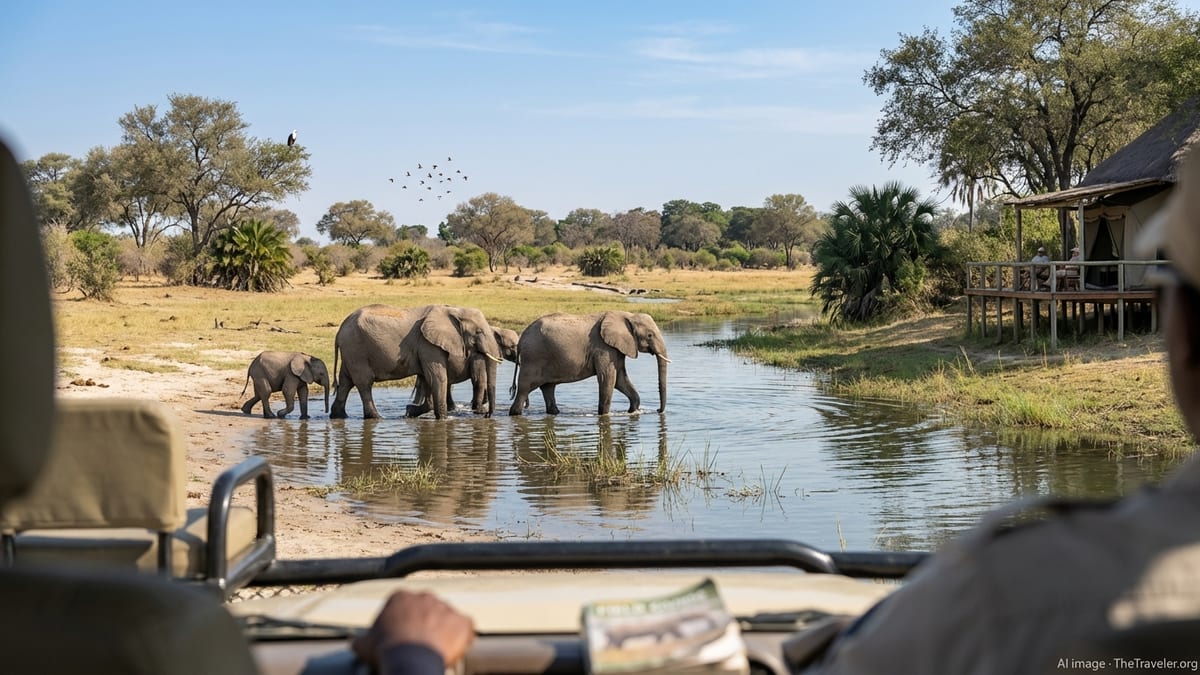
Botswana’s elephant population is the largest in Africa, and Khwai lies in one of its core ranges. Huge breeding herds frequent the reserve, especially during the dry season months when they move toward the reliable waters of the Khwai River and associated channels. Guests commonly see elephants crossing the river in front of camp decks or walking single file through shallow channels, scenes that encapsulate the Delta’s allure.
In the green season after the rains, elephant movements shift as fresh grazing appears in the mopane woodlands to the north, but they remain a near daily presence. National parks in Botswana also deliver excellent elephant viewing, but Khwai’s combination of land and water, plus the ability to linger at sightings without pressure from other vehicles, makes these encounters feel more prolonged and personal.
High Bird Diversity in a Concentrated Range
Northern Botswana supports around 450 bird species, and Khwai shares generously in that richness. River channels harbor African skimmers, kingfishers and African finfoot, while wetlands and floodplains attract wattled cranes and pygmy geese. Woodland and savanna add raptors such as western banded snake eagle and numerous owl species.
Birdwatchers who might spend weeks covering different sectors of a large national park to find such diversity can experience much of it in Khwai over a shorter stay, moving between habitats with ease. The smaller scale of the concession, combined with expert guiding, increases the odds that even casual birders return home with a long and varied trip list.
5. Water-Based Safaris That Complement Game Drives
Water defines the Okavango Delta, yet not every section of every park offers consistently navigable channels. In Khwai Private Reserve, seasonal and permanent watercourses add a vital second dimension to the safari experience. Instead of spending the entire stay in a vehicle, guests can change perspective, exploring by traditional mokoro canoe or motorboat where water levels and regulations permit.
Mokoro Excursions at Eye Level With the Delta
One of Botswana’s quintessential experiences is gliding silently along flooded channels in a mokoro, the local dugout-style canoe. Poling quietly through stands of reed and papyrus, guests in Khwai watch elephants drinking at close range, observe red lechwe moving through the shallows and listen to the sounds of fish eagles calling overhead. The low vantage point makes even familiar animals appear new, with hippos and crocodiles suddenly looming larger than from a vehicle.
These excursions are heavily weather and water dependent and are typically offered in the dry season months when channels are at navigable levels. While some national parks in the Delta region also offer mokoro trips, one advantage in a private reserve like Khwai is the intimacy of the experience: fewer boats, fewer neighboring camps and the ability for guides to choose less-trafficked side channels where the sense of solitude is greatest.
Boat Cruises for Birdlife and Sunset Landscapes
In sections of Khwai where channels broaden into lagoon systems, lodges operate small motorboats to access more distant reaches of the floodplain. These cruises are particularly rewarding for birders, as they allow slow approach to sandbanks, submerged logs and vegetated islands where herons, storks, bee-eaters and skimmers congregate.
Late-afternoon departures often double as sunset outings, returning to camp in pastel light as the sky reflects off the water. While boat cruises also operate in some national parks, the combination of small guest numbers and the freedom to plan flexible timings around wildlife rather than strict gate hours gives Khwai’s water-based activities a noticeably unhurried feel.
6. Community Partnership and Conservation in Action
In many national parks, park fees flow into central government coffers, where they are allocated across a wide portfolio of priorities. The connection between an individual visitor’s stay and local communities can feel abstract. Khwai Private Reserve, by contrast, operates within a matrix of community concessions and joint ventures that make the link between tourism, livelihoods and conservation far more direct and visible.
From Hunting Concession to Community-Backed Sanctuary
The broader Khwai area has undergone a deliberate transformation in recent decades, shifting from a hunting-based land use model to photographic tourism and conservation. The Khwai Development Trust, representing local community interests, plays a central role in managing neighboring community lands and partnering with private operators active in the region, including those in Khwai Private Reserve.
This shift has reoriented economic incentives. Instead of benefiting from short-term fees linked to hunting quotas, the community now derives sustained income from lodge leases, employment, guiding, cultural tourism and seasonal projects such as grass harvesting within the reserve. These multiple revenue streams directly depend on maintaining healthy wildlife populations and intact habitats, aligning community interests with long-term conservation outcomes in a way that can be more focused than the broader remit of many national park agencies.
Visible Local Involvement and Employment
Guests in Khwai are likely to encounter community involvement in very tangible ways: local staff members working in camps, guides who grew up in nearby villages, craft markets within the community concession and cultural visits that introduce guests to the BaBukakhwe and other groups living along the Khwai River. These interactions, when conducted respectfully, provide a window into how people have adapted to and shaped this landscape over generations.
National parks across Africa increasingly emphasize community engagement, but private reserves like Khwai often move faster in piloting new initiatives, from village-based guiding internship programs to structured grass harvesting schemes that supply thatch for houses while managing fire risk. For travelers who want their safari spend to support local people as directly as possible, this joint-management model is an important differentiator.
On-the-Ground Conservation Projects
Because the reserve is relatively compact and intensively managed by a small group of operators, conservation projects in Khwai can be targeted and adaptive. Anti-poaching patrols, research partnerships focused on specific species such as wild dogs or elephants, and habitat management initiatives can be planned and assessed at the scale of the concession rather than across an entire park system.
Some projects are surprisingly practical: organized community grass harvesting inside the reserve generates cash income while reducing the buildup of combustible biomass, helping to moderate the impact of wildfires. Others look longer term, such as monitoring predator dynamics or elephant movement corridors to inform future land-use decisions. Visitors may learn about these efforts through camp presentations or by encountering researchers in the field, gaining insight into the less visible work that underpins their wildlife encounters.
7. Intimate Lodges and Sleep-Out Experiences
Accommodation in national parks runs the gamut from basic public campsites to high-end lodges, but even the most luxurious properties are often part of a larger network of facilities sharing the same park infrastructure. Khwai Private Reserve distinguishes itself through a cluster of small, design-forward camps that are integrated into the landscape, along with a standout sleep-out experience that places guests quite literally in the midst of the wildlife they have come to see.
Low-Impact Camps Blending Comfort and Wildness
Lodges in Khwai are typically constructed with a light footprint, using raised wooden platforms, canvas walls and thatch or tin roofs to minimize environmental impact. Guest numbers per camp are usually capped at levels that maintain a quiet atmosphere, with many properties accommodating fewer than 20 people at full capacity. Rooms often overlook floodplains, waterholes or riverine forest, so that game viewing begins before the first game drive.
While levels of comfort vary between camps, many offer amenities such as plunge pools, private decks and outdoor showers, elements that allow guests to relax fully between activities. Importantly, these comforts are paired with a strong guiding ethos. In a private reserve like Khwai, the camp is not the destination in itself but a platform from which to engage more deeply with the surrounding ecosystem.
Skybeds and the Power of a Night Under the Stars
Among Khwai’s most distinctive offerings is the chance to sleep out in elevated, open-fronted platforms overlooking a busy waterhole. Known as Skybeds, these structures provide proper beds, linen and mosquito nets on raised decks protected by sturdy railings. Guests spend the night listening to the sounds of elephants drinking, lions calling in the distance and owls hunting overhead, with the Milky Way blazing across the sky.
While some national parks offer basic wilderness trails with outdoor camping, Khwai’s sleep-out concept combines the raw immediacy of being out in the open with enough comfort and security to make it accessible to a wider range of travelers. It encapsulates what sets private reserves apart: the ability to innovate within a carefully controlled environment, offering experiences that are difficult to replicate within the more standardized framework of a national park.
8. Tailored Safari Experience With High-Quality Guiding
Ultimately, it is the human element that often determines whether a safari feels generic or transformative. National parks provide the setting, but guiding quality, schedule flexibility and personalized attention can vary widely, especially where self-drive is common. Khwai Private Reserve’s fully guided, fully inclusive model leads to a different style of safari: structured yet adaptable, and calibrated to the interests and pace of a small number of guests.
Expert Guides With Deep Local Knowledge
Guides working in Khwai tend to stay in the area for extended periods, building a granular understanding of animal territories, seasonal movements and subtle cues that predict where action will unfold. Because vehicles are not shared with large numbers of guests from public camps, there is more opportunity for meaningful conversation, detailed interpretation and improvised detours when something interesting appears on the horizon.
For first-time visitors, this means a more accessible learning curve, as guides can explain everything from predator hierarchies to the medicinal uses of a particular shrub without rushing to meet a rigid timetable. For experienced safari-goers, it provides scope to pursue niche interests such as bird photography, tracking a specific wild dog pack over several days or focusing on small nocturnal species that are rarely given attention on standard game drives.
Flexible Daily Rhythm, Not Fixed Gate Hours
In national parks, game drives are usually constrained by gate opening and closing times. In Khwai Private Reserve, the rhythm of each day centers on wildlife and guest preference rather than fixed park regulations. While camps maintain broad patterns of morning and afternoon activities, there is often room to adjust timing: leaving camp earlier to catch predator activity at first light, staying out later with a packed brunch if sightings are particularly good, or returning early for a midday siesta if guests prefer a slower pace.
Combined with access to night drives, walking and water-based excursions, this flexibility allows travelers to build a layered, three-dimensional understanding of the ecosystem. They are not limited to a narrow band of daylight hours spent driving the same roads, but can experience Khwai in multiple moods: cool, golden dawns; shimmering midday heat; the pastel calm of sunset; and the charged mystery of night.
The Takeaway
Khwai Private Reserve offers an experience that feels at once quintessentially Botswana and yet distinctly different from what most national parks provide. Its scale, sparse lodge network and varied habitats create a sense of immersion and solitude that many travelers find increasingly hard to discover in more accessible parks. Flexible activities such as night drives, walking safaris and off road tracking allow for a depth of engagement with wildlife that goes beyond ticking off species from a checklist.
Equally important is the reserve’s integration into a wider socio-ecological landscape. As part of a matrix that includes community concessions and neighboring national parks, Khwai illustrates how private, community and state-managed land can work together to support both biodiversity and local livelihoods. For visitors, choosing Khwai is not a rejection of national parks, but a complement to them: a chance to see how conservation can look when carefully managed exclusivity, community partnership and ecological connectivity are given equal weight.
For travelers planning a Botswana itinerary, the decision is not whether to visit national parks or private reserves, but how to blend the two. Time in Khwai Private Reserve, framed by a night under the stars or a silent mokoro glide at dawn, can provide a counterpoint to the more structured, publicly accessible landscapes of Moremi and Chobe. In that interplay lies one of southern Africa’s most compelling safari stories.
FAQ
Q1. Where exactly is Khwai Private Reserve located in Botswana?
It lies on the northeastern edge of the Okavango Delta, bordering the eastern side of Moremi Game Reserve and to the south of Chobe National Park, within a larger landscape of unfenced wildlife areas.
Q2. How is Khwai Private Reserve different from the Khwai Community Concession?
The private reserve is a large, low-density concession with only a few lodges, used exclusively by their guests, while the neighboring community concession is owned and managed by the local community and sees more varied use, including mobile safaris and some self-drive visitors.
Q3. What activities are available in Khwai that are not usually allowed in national parks?
Guests can typically enjoy guided night drives, walking safaris and limited off road game drives, activities that are often restricted or tightly controlled inside national parks.
Q4. When is the best time of year to visit Khwai Private Reserve?
The dry season from about May to early November is generally regarded as the prime time, when animals concentrate around permanent water and vegetation is thinner, but the green season offers lush scenery, migratory birds and fewer visitors.
Q5. What kinds of wildlife can I expect to see in Khwai?
Common sightings include elephants, buffalo, lion, leopard, spotted hyena, hippo, crocodile, giraffe, zebra and a wide range of antelope, with particularly good chances of seeing African wild dogs and an impressive diversity of birdlife.
Q6. Are mokoro and boat safaris always available in Khwai?
Water-based activities are seasonal and depend on water levels in the channels and lagoons; in most years they are most reliable during the dry season months when the Okavango flood has reached its peak.
Q7. How many lodges are there in Khwai Private Reserve?
Only a small cluster of camps operates in the reserve, including a few permanent lodges and one or two specialized sleep-out sites, which together keep overall visitor numbers low compared with national parks.
Q8. Is Khwai suitable for first-time safari travelers?
Yes, it is very well suited to first-time visitors because guiding standards are high, activities are diverse and the wildlife is abundant, allowing beginners to experience a wide range of sightings in a relatively short stay.
Q9. How does staying in Khwai support local communities?
Tourism revenue from lodges and activities helps fund community trusts, provides jobs in camps and guiding, supports small-scale enterprises and underpins joint conservation projects that depend on healthy wildlife populations.
Q10. Can Khwai Private Reserve be combined with visits to Botswana’s national parks?
Yes, most itineraries pair a stay in Khwai with time in Moremi Game Reserve, Chobe National Park or other parts of the Okavango Delta, allowing travelers to experience both the broad access of public parks and the exclusivity of a private concession.