

High above the St. Lawrence River, where cliffs drop steeply from the plateau of Old Québec, the Citadelle de Québec stands guard. More than a fortress of stone, it is a living stronghold that has shaped Canada’s military story, hosted heads of state, and watched over a city recognized by UNESCO as a World Heritage treasure.
Its ramparts, museums, and ceremonial grounds make the Citadelle one of the country’s most important historic sites, and an essential stop for any traveler who wants to understand Canada’s past and present in a single sweeping panorama.
1. A Strategic Fortress Shaping North American History
The Citadelle de Québec is not just an impressive structure crowning Cap Diamant. It is the final link in a defensive chain that defined Québec City as one of the most heavily fortified urban areas in North America, built to control access to the St. Lawrence River and to guard the gateway to the continent’s interior.
A stronghold born of imperial rivalry
The story of the Citadelle stretches back to the 17th and 18th centuries, when France and Britain were locked in competition for dominance in North America. Québec City, founded in 1608, quickly emerged as a strategic prize, commanding the narrows of the St. Lawrence River and acting as a logistical hub for trade, settlement, and military campaigns.
The fortress travelers see today largely dates from the early 19th century, when British authorities, still wary after the American Revolutionary War and the War of 1812, decided to reinforce Québec’s defenses. Construction of the modern stone walls and bastions began around 1820 and continued for more than a decade. The result was a refuge of last resort, designed to protect the garrison even if the lower town and surrounding heights fell to enemy forces.
Guardian of a World Heritage city
Part of what makes the Citadelle so important is its role within a broader historic landscape. Québec City’s fortified upper town, together with the Citadelle, earned recognition as a UNESCO World Heritage Site in the 1980s for preserving an exceptional example of a fortified colonial city in the Americas.
Unlike many North American cities that dismantled their defensive walls as they expanded, Québec preserved its fortifications. The Citadelle crowns this system, anchoring the city’s skyline and providing tangible evidence of how military engineering shaped colonial urban planning, trade routes, and political power in the St. Lawrence Valley.
2. An Architectural Masterpiece of Star-Shaped Fortification
From the air or from carefully chosen viewpoints along the Plains of Abraham, the Citadelle’s distinctive star-like outline becomes clear. This is one of the most striking examples of bastioned fortification on the continent, blending European military design with the rugged topography of Cap Diamant.
Inspired by Vauban, adapted to Cape Diamond
The fortress follows principles associated with the influential French military engineer Sébastien Le Prestre de Vauban, whose 17th century designs transformed European defensive architecture. At the Citadelle, angled bastions and curtain walls are arranged so that each face can be swept by defensive fire from adjacent positions, minimizing blind spots and making direct assault perilous.
The layout had to respond to the natural advantages and challenges of the site. Sheer cliffs along the southern flank, dropping to the St. Lawrence River, provided a formidable natural defense, while the northern, eastern, and western sides were strengthened with bastions, ditches, and ravelins. Collectively, these elements created a layered defensive envelope around the plateau.
The largest fortress of its kind in North America
Today, the Citadelle is often described as the largest British-built fortress of its type still standing in North America. The complex encloses dozens of buildings, from barracks and magazines to casemates and parade grounds, all protected by thick masonry walls of locally quarried stone.
For visitors, the architecture offers a rare opportunity to walk through an intact 19th century fortification that has not been converted into a ruin or purely decorative monument. The geometry of the walls, the thickness of the ramparts, and the way the fortress dominates the river and surrounding city all demonstrate why military engineers regarded this position as nearly impregnable.
3. A Living Military Base and Home of the Royal 22e Régiment
Many historic forts have long since been decommissioned. The Citadelle, however, remains an active military installation. It is the home base of the Royal 22e Régiment, the Canadian Army’s famous francophone infantry regiment, which gives the site a uniquely dynamic character.
Francophone regiment with global service
The Royal 22e Régiment, commonly known as the Van Doos, was created during the First World War to encourage French-speaking enlistment in the Canadian Expeditionary Force. Since then, its soldiers have served with distinction in major conflicts and peace operations, from the trenches of Europe to modern deployments abroad.
The regiment’s headquarters at the Citadelle reinforces the site’s ongoing military relevance. This is not a stage set arranged for visitors, but a working base where soldiers train, live, and maintain traditions that stretch over a century. Ceremonies, parades, and daily routines all unfold inside the walls, linking the current generation of troops with those who garrisoned the fortress in earlier eras.
Traditions that animate the fortress
Because the Citadelle remains in active use, travelers experience something rare: authentic military life intertwined with historical interpretation. Depending on the season, visitors may see soldiers in distinctive dress uniforms, hear commands called out across the parade ground, or glimpse units moving through the stone-lined passageways between bastions.
This ongoing activity underscores why the Citadelle ranks among Canada’s most important historic sites. It is not simply a relic of colonial warfare, but a place where French-speaking military heritage continues to evolve, reinforcing Québec’s cultural identity within Canada’s armed forces.
4. Official Residence of the Governor General and Canada’s Monarch
Beyond its defensive and regimental roles, the Citadelle also functions as one of Canada’s most significant viceregal residences. On the summit of the fortress, the former officers’ barracks have been adapted as an official residence for the governor general and, by extension, the Canadian monarch.
A seasonal seat of Canadian constitutional life
Since the late 19th century, governors general have spent part of each year in residence at the Citadelle. During these stays, the fortress becomes a working ceremonial and administrative center, hosting meetings, receptions, and official events with domestic and international guests.
Important ceremonies such as the presentation of national honors, investitures, and the accreditation of ambassadors sometimes take place here. In those moments, the Citadelle serves not just as a historic monument, but as a living stage for Canada’s constitutional monarchy, linking the country’s current institutions with its layered colonial and post-Confederation history.
A rare public window into a working residence
Few official residences in the world invite visitors with the same openness as the Citadelle. Guided tours allow the public to view select ceremonial rooms when protocol and security permit, offering insight into how historic architecture can be adapted to modern official functions.
For travelers, this dual role as both fortress and viceregal residence is part of what makes the Citadelle so distinctive. It is at once a symbol of military strength, a working home for Canada’s representative of the Crown, and a venue where heritage, diplomacy, and public engagement intersect.
5. The Royal 22e Régiment Museum and Three Centuries of Military Memory
Embedded within the Citadelle’s walls is one of Canada’s most compelling military museums. The Royal 22e Régiment Museum cares for a vast collection of artifacts, archives, and photographs that illuminate more than 300 years of military and social history.
A collection that spans wars, peace, and daily life
The museum’s holdings include tens of thousands of objects and hundreds of thousands of images, from uniforms, medals, and weapons to personal effects, wartime art, and letters. Together, they trace the evolution of military technology and tactics, but also the everyday lives of soldiers posted to the Citadelle and deployed overseas.
Special exhibitions highlight key chapters in the regiment’s story, including its origins in the First World War, its role in the Second World War, and its later peacekeeping and combat missions abroad. These displays help visitors place the Citadelle in a broader international context, showing how decisions made within these walls reverberated far beyond Québec City.
Historic buildings within a historic fortress
Part of what makes the museum especially evocative is its setting. Exhibitions are housed in historic structures inside the fortress, including former powder magazines and casemates dating back to the 18th and 19th centuries. In some cases, French-era buildings have been adapted for modern museology, creating a powerful dialogue between artifacts and architecture.
Walking through these spaces, travelers move from dim stone chambers to light-filled galleries, encountering stories of conflict and commemoration at each turn. The museum reinforces the Citadelle’s standing as a national site of remembrance, not merely a picturesque fort.
6. Ceremonies, Rituals, and the Changing of the Guard
Military ritual is one of the Citadelle’s most compelling draws for visitors. Ceremonies on the parade ground translate centuries of discipline and tradition into vivid experiences, making the fortress feel alive in a way few historic sites can match.
A Canadian take on a classic ceremony
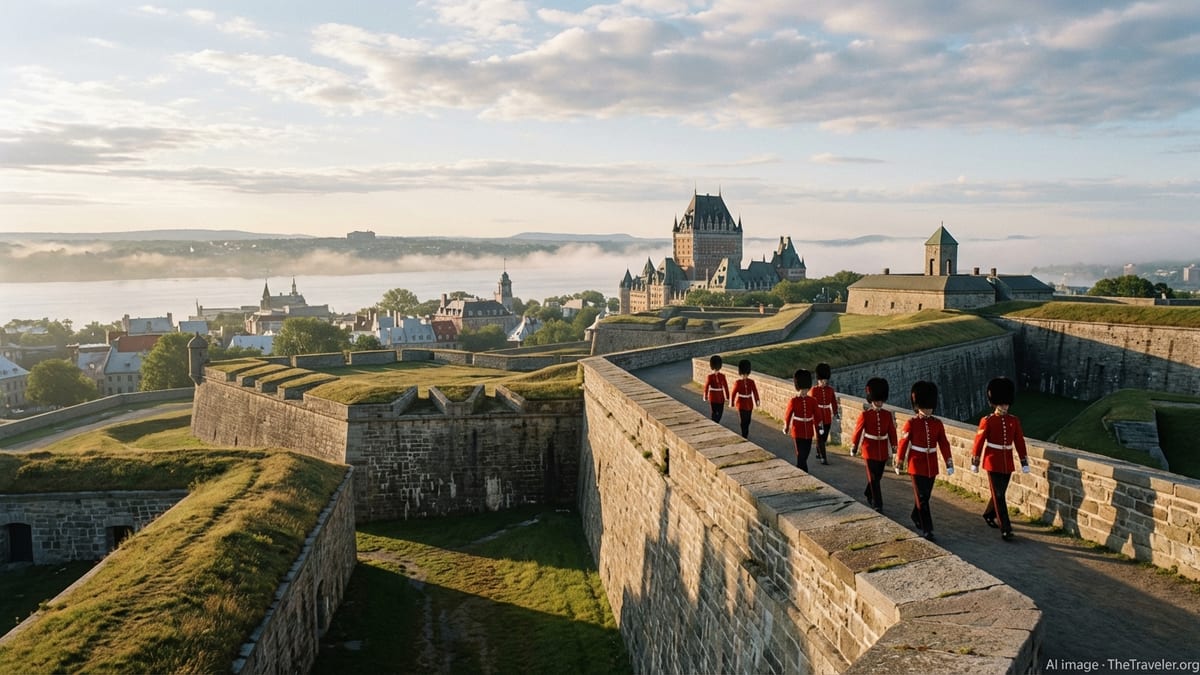
In the warmer months, the Citadelle often stages a formal changing of the guard ceremony that recalls British and Commonwealth traditions while foregrounding Québec’s distinct identity. Soldiers of the Royal 22e Régiment, in scarlet tunics and towering bearskin caps, execute precise drills accompanied by a military band.
For many travelers, watching this ceremony against the backdrop of stone walls and sweeping river views is a highlight of a visit to Québec City. It provides a window into the regiment’s esprit de corps and underscores the continuing relationship between Canadian forces and ceremonial customs inherited from earlier eras.
Daily acts of remembrance
Beyond public spectacles, quieter rituals unfold within the Citadelle every day. A regimental memorial on the grounds holds a Book of Remembrance listing soldiers who have fallen in service since the early 20th century. Each morning, a member of the regiment visits the memorial and reads aloud the names on one page.
This simple act of daily remembrance gives the site a profound emotional weight. It reminds visitors that behind the uniforms, parades, and historic stonework lies a record of sacrifice that continues into the present. In this way, the Citadelle functions as a living shrine as much as a military post.
7. Layers of French, British, and Canadian Heritage in One Site
Few places in Canada concentrate as many overlapping eras of history within such a compact space. The Citadelle embodies the succession of French, British, and Canadian authority in Québec, preserving structures and stories from each period.
Traces of the French regime
Long before the British built the present star-shaped fortress, French authorities recognized the defensive potential of Cap Diamant. Early redoubts and powder magazines from the late 17th and mid 18th centuries still survive within the Citadelle’s walls, their thick masonry a reminder of the city’s earliest attempts at permanent fortification.
These relics of the French period link the site to the origins of New France and to the conflicts that led ultimately to the British conquest of Québec in the 1750s. For travelers interested in colonial history, they provide rare physical continuity with a chapter of North American history often understood only through documents and maps.
British engineering, Canadian identity
The bulk of the Citadelle, however, reflects British military engineering from the early 19th century. The fortress was constructed at a moment when imperial planners believed Québec might again become a battleground, this time with the expanding United States. Although the feared invasion never came, the fort remained a cornerstone of regional defense.
Later, as responsibility for defense passed from London to Ottawa and Canadian forces replaced British garrisons, the Citadelle’s meaning evolved. What began as a symbol of imperial control gradually became a national site, home to a francophone regiment that helped shape modern Canadian identity. This layered history makes the Citadelle a rich case study in how colonial structures can be reinterpreted and reclaimed over time.
8. Panoramic Vistas and the Geography of Power
Part of the Citadelle’s impact comes from its commanding position on Cap Diamant. The fortress occupies one of the most dramatic natural viewpoints in Québec City, and the vistas it offers help explain why powers fought to control this promontory for centuries.
Commanding views of river and battlefield
From the ramparts, visitors can look out over the St. Lawrence River, the Laurentian foothills in the distance, and the rolling grasslands of the Plains of Abraham. These views are not just picturesque scenery. They illustrate how artillery stationed at the Citadelle could dominate approaches by land and water, controlling access to Québec’s harbor and the river corridor beyond.
Standing at the lip of the walls, a traveler begins to grasp how geography shaped political and military decisions. The narrowness of the river at Québec, the height of the cliffs, and the visibility across the surrounding terrain all contributed to the site’s status as a strategic lynchpin in the defense of New France, British North America, and later Canada.
A contemplative space above a modern city
Today, the same vantage points that served defensive purposes now offer moments of reflection for visitors. Looking down on Old Québec’s church spires, slate roofs, and winding streets, it is easy to imagine how the city evolved from a fortified colonial port into a modern capital of French-speaking North America.
These views underline one more reason the Citadelle is so important. It anchors the skyline not only physically, but symbolically, reminding residents and travelers alike that Québec’s built landscape has grown layer upon layer around a historic core that once determined the fate of empires.
9. A National Symbol and Essential Stop for Travelers
Because the Citadelle concentrates so many aspects of Canadian history in one accessible, visually striking site, it has become a national symbol and a cornerstone of cultural tourism in Québec City.
Bringing complex history to life for visitors
Guided tours, interpretive panels, seasonal ceremonies, and museum exhibitions work together to translate complex military and political histories into experiences that resonate with modern travelers. Visitors can walk the ramparts, peer into guard posts, enter historic buildings, and see artifacts that connect the fortress to global conflicts and local lives.
For Canadian visitors, the Citadelle often deepens understanding of how Québec fits into the national story, especially through the lens of francophone military service. For international travelers, it offers a compact introduction to centuries of North American history, spanning Indigenous presence, French and British colonization, and the evolution of an independent Canada.
An enduring emblem of Québec City
Silhouetted against the sky, the Citadelle is as recognizable a landmark as the nearby Château Frontenac or the city’s fortified walls. Its presence signals that Québec is not just a charming old town, but a place where military strategy, political power, and cultural identity converged in ways that shaped an entire country.
In a single visit, travelers can stand on ramparts once manned by imperial troops, watch soldiers of the Royal 22e Régiment on parade, walk through rooms used by Canada’s governor general, and contemplate the names of those who never returned from war. This combination of architecture, ritual, memory, and view is what makes the Citadelle de Québec one of Canada’s most important and evocative historic sites.
The Takeaway
The Citadelle de Québec is more than a dramatic stone fortress perched above a river. It is a living crossroads of French, British, and Canadian history, an active military base, a viceregal residence, and a powerful place of remembrance. Its star-shaped walls, regimental museum, daily rituals, and sweeping views tell a story that stretches from colonial rivalry to contemporary Canada.
For travelers, visiting the Citadelle offers a rare chance to experience a historic site that has never slipped into dormancy. The same grounds that once guarded an empire now welcome visitors from around the world, inviting them to walk the ramparts, witness tradition in motion, and reflect on how this citadel has helped define Québec City and the country that grew around it.
FAQ
Q1. Where is the Citadelle de Québec located within Québec City?
The Citadelle de Québec sits atop Cap Diamant at the southern edge of Old Québec, overlooking the St. Lawrence River and bordering the Plains of Abraham.
Q2. Is the Citadelle still an active military base?
Yes. The Citadelle remains a functioning Canadian Forces installation and serves as the home base and headquarters of the Royal 22e Régiment.
Q3. Can visitors tour the inside of the Citadelle?
Access is generally possible only on guided tours, which take visitors inside the fortress walls to see select buildings, ramparts, and museum areas.
Q4. What is special about the Royal 22e Régiment?
The Royal 22e Régiment is Canada’s best-known francophone infantry regiment, with a distinguished record in major 20th century wars and numerous peace operations abroad.
Q5. Does the Citadelle host a changing of the guard ceremony?
In the summer season, the Citadelle typically stages a formal changing of the guard ceremony featuring soldiers of the Royal 22e Régiment in full dress uniform.
Q6. Is the Citadelle part of Québec City’s UNESCO World Heritage status?
The Citadelle forms a key element of Québec City’s historic fortifications, which helped earn the Old Québec district its UNESCO World Heritage designation.
Q7. What can I see at the Royal 22e Régiment Museum?
The museum displays uniforms, medals, weapons, archival photographs, and personal artifacts that trace more than three centuries of military history at the Citadelle and beyond.
Q8. How long should I plan for a visit to the Citadelle?
Most visitors allow at least two to three hours to join a guided tour, explore the museum, and spend time on the ramparts taking in the views.
Q9. Is the Citadelle open year-round?
The site operates throughout the year, but tour schedules, ceremonies, and opening hours vary seasonally, so it is wise to check current details before visiting.
Q10. Why is the Citadelle considered one of Canada’s most important historic sites?
It combines intact star-shaped fortifications, an active military base, a viceregal residence, and a major museum, all overlooking a UNESCO-listed historic city.