

More news on this day
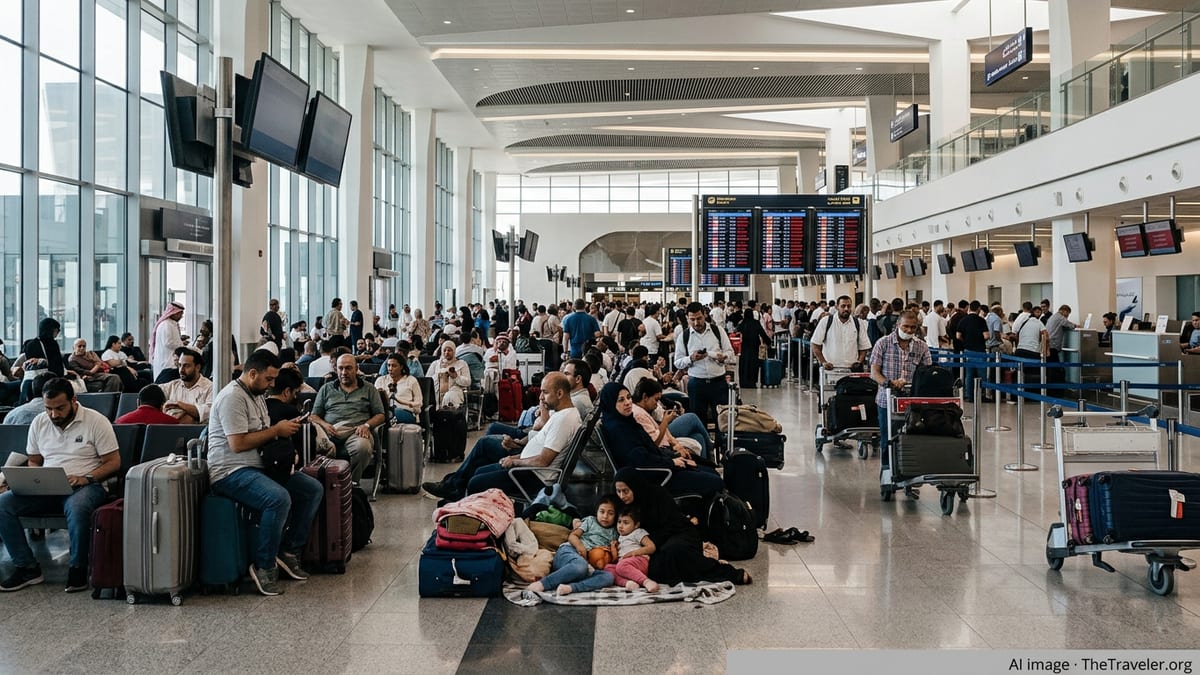
Hundreds of travelers were left sleeping on the floor at Bahrain International Airport on March 7 after a fresh wave of airspace closures triggered 94 flight cancellations, disrupting services by Gulf Air, Qatar Airways, flydubai, Oman Air, IndiGo and other major carriers and snarling connections to key hubs in Dubai, Cairo, Riyadh, Muscat and Kuwait City.
Airspace Closures Push Bahrain to Standstill
Bahrain International Airport confirmed that all regular passenger operations remain temporarily suspended as the kingdom’s airspace stays closed amid the widening regional conflict. Airport authorities said only emergency, military and limited rescue flights are being allowed, leaving most commercial aircraft grounded at stands and passengers trapped in the terminal with no clear timeline for departure.
Aviation data from regional tracking firms shows that Bahrain is among the hardest-hit hubs, with an estimated 94 scheduled passenger flights cancelled or designated as no-fly within a 24-hour window ending on March 7. That level of disruption equates to virtually the entire daily schedule being wiped out, illustrating how abruptly the usually smooth Gulf aviation network has seized up.
Gulf Air, Bahrain’s flag carrier, has halted all departures from its home base and is instead attempting to reposition aircraft that were outside Bahraini airspace when the shutdown began in late February. The airline is operating a patchwork of relief services from airports in Saudi Arabia and Oman, but those options are of little immediate help to passengers stuck inside Bahrain who cannot leave by air.
Qatar Airways is facing a similar bind, with much of its fleet stranded at Doha’s Hamad International Airport while Qatari airspace remains tightly restricted. The carrier has begun limited evacuation and repatriation operations from select cities, yet its normal high-frequency shuttle links through Bahrain and other Gulf points are still largely offline, contributing to cascading delays and missed connections across the region.
Shockwaves Across Regional Hubs
The paralysis in Bahrain is feeding into a broader aviation crisis stretching from the Arabian Gulf to North Africa. Dubai, normally one of the world’s busiest international hubs, has only partially restored operations after several days of severe disruption and intermittent airspace closures tied to the Iran war and subsequent strikes across the Gulf.
While a narrow band of routes is now operating into Dubai International Airport and Al Maktoum International Airport, cancellations remain high. Services linking Dubai with Bahrain, Doha, Kuwait City and Muscat have been particularly affected, as carriers weigh the safety of transiting volatile air corridors and adjust flight paths around closed skies over Iran, Iraq and parts of the Gulf.
In Muscat, Oman Air has taken the unusual step of cancelling entire blocks of regional flights, including services to Bahrain, Dubai, Doha, Dammam and Kuwait, on dates extending into the coming week. The airline says it is prioritizing safety and coordinating with regional aviation authorities on a day-by-day basis while maintaining that Omani airports themselves remain open and capable of handling diverted or special charter traffic.
Beyond the Gulf, the knock-on effects are evident at Cairo, Riyadh and other major Middle East and North African gateways. Carriers report that crews and aircraft are out of position, with aircraft and staff stranded in cities as far apart as Dhaka, Istanbul and European capitals after routings through Bahrain or Doha suddenly became impossible.
Passengers Sleep in Terminals Amid Patchy Rescue Flights
Inside Bahrain International Airport, scenes on March 7 reflected the strain of days of uncertainty. Passengers queued at airline desks under departure boards filled with the word “cancelled,” while families stretched out on cardboard sheets and thin blankets along the concourses. Many reported receiving multiple rolling rebookings before being told that their flights were cancelled without a new date.
Travelers with tickets on Gulf Air, Qatar Airways, flydubai, Oman Air and IndiGo said they were offered a mix of vouchers, fee-free changes and open-ended credits, but very few concrete alternatives to get out of the country quickly. Some foreign visitors said they were weighing costly options, including booking business-class seats on the few flights still operating from neighboring states, then trying to drive or sail across borders to make their connections.
Limited rescue and repatriation operations are under way, but they have not yet caught up with the scale of demand. Qatar Airways and Gulf Air have announced small numbers of outbound flights from Saudi and Omani airports for passengers already abroad, while other Gulf carriers are operating one-off services to Europe and Asia where airspace permits. Priority is often being given to citizens, medical cases and travelers whose visas are about to expire.
In the absence of normal schedules, information has become as valuable as a boarding pass. Airlines and airport authorities are urging passengers not to go to the airport without a confirmed rebooking, but many stranded visitors say they feel they have little choice but to remain on site, fearing that scarce rescue seats will be offered at short notice to those already at the terminal.
Global Airlines Reroute as Disruption Spreads
The shutdown in Bahrain and surrounding Gulf states is rippling far beyond the Middle East. International airlines that normally use the region as a key stopover for Europe–Asia and Europe–Australia traffic have scrambled to reroute flights, in some cases adding hours to journey times and forcing emergency fuel stops at alternate airports such as Singapore or southern European cities.
Several Asian and European carriers have temporarily suspended all services to Bahrain, Doha and Dubai, citing the overlapping challenges of closed airspace, insurance restrictions and the risk of missile or drone activity near major hubs. Others have opted to keep a skeletal presence in the region by operating indirect routings that avoid the most sensitive air corridors, often at the cost of significant additional fuel and crew expenses.
Low-cost Gulf carriers such as flydubai, which rely heavily on dense networks of short regional hops, have been particularly exposed. With their core markets in Bahrain, Kuwait, Saudi Arabia and Oman disrupted, many of their narrow-body fleets are grounded. The situation has opened limited opportunities for some airlines based outside the conflict zone, which are using longer, circuitous routes over Central Asia, North Africa and the Mediterranean to pick up displaced demand.
Industry analysts note that while overall cancellation rates across the Middle East have eased from their peak, individual airports like Bahrain and Doha are still experiencing near-total shutdowns. That uneven recovery is complicating planning for both airlines and travelers, making it difficult to predict which connections will hold and which will collapse at short notice.
What Stranded Travelers Can Expect in the Coming Days
With no clear end to the conflict or the associated airspace restrictions, aviation experts caution that passengers at Bahrain International Airport and other affected hubs should brace for a protracted period of uncertainty. Airlines are reviewing schedules in rolling 24 to 72 hour windows and may continue announcing batches of cancellations with little lead time.
Carriers including IndiGo, Oman Air and several Gulf-based airlines have expanded fee waivers, allowing passengers to cancel or change tickets without penalties for travel to and from the Middle East through the end of March. While helpful for those who can afford to postpone their journeys, such policies bring limited comfort to travelers already stranded in transit with expired hotel bookings and tight visa conditions.
Travel advisers recommend that passengers stay in constant contact with their airline through official channels, keep receipts for unexpected accommodation and meal expenses, and follow updates from local embassies or consulates, which may coordinate evacuation flights if the crisis deepens. For many stuck in Bahrain and neighboring hubs, however, the focus remains on securing any seat out, regardless of carrier or destination.
For now, Bahrain’s glossy new terminal, designed to highlight the kingdom as a convenient connector between East and West, has instead become a symbol of the region’s aviation turmoil. Until airspace barriers lift and full schedules return, rows of grounded aircraft at the edge of the tarmac and weary travelers in the departure halls will continue to tell the story of a Gulf aviation system brought to an abrupt halt.