

I arrived in Nanaimo with that familiar mix of optimism and low expectations I reserve for mid sized port cities. It was a quick ferry over from the mainland, the kind of trip you make thinking, "If it’s great, I’ve discovered a new favourite. If it’s not, at least I got some sea air."
What followed was a full day that unfolded step by step from the moment I stepped off the ferry to the last light fading over the harbour. It was better than I expected in some ways, more limited in others, and ultimately a place I would recommend with a few important caveats.
Arriving by Ferry: First Impressions of a Working Harbour
I arrived on a morning sailing, stepping off the fast passenger ferry into downtown Nanaimo rather than the more distant vehicle terminal at Departure Bay. That choice shaped the entire day. The dock spills you almost directly into the waterfront, so the city’s face is its harbour. My first impression was not postcard perfect. Yes, there was the broad sweep of water, floatplanes, and glimpses of forested islands, but also a practical, slightly scruffy working edge: parking lots, older low rise buildings, and a waterfront that feels more lived in than curated.
The upside of arriving downtown is immediacy. Within a few minutes I was walking along the Harbourfront Walkway, watching a seaplane taxi in while a small ferry shuttled people toward nearby islands. The air smelled of salt and fuel and coffee in roughly equal measure. It felt local more than touristy, which I appreciated. At the same time, if you are expecting a polished, resort style arrival lined with boutique shops and dramatic architecture, Nanaimo does not deliver that hit of instant glamour.
One annoyance hit before any romance could settle in. Signage from the ferry dock toward the main parts of the waterfront is surprisingly sparse. I found myself hesitating at a couple of junctions, not sure which way the more scenic walkway continued. It is not exactly maze like, but for a city that clearly wants visitors to enjoy the harbour, wayfinding could be much better. I relied mostly on instinct and the simple rule of staying as close to the water as possible.
Harbourfront Walkway: Calm Views, Patchy Atmosphere
Once I found the main stretch of the Harbourfront Walkway, things improved. The path unrolls along the shoreline with views across to Newcastle Island and the steady movement of boats in and out of the harbour. On a clear day it is genuinely beautiful in a quiet, unfussy way. I passed families with strollers, dog walkers, and a few people clearly commuting on foot. It gave me that small but real sense of how locals use the space rather than feeling like a corridor built only for out of town visitors.
The atmosphere along the walkway is mixed. In some sections, particularly near the downtown marina and around the seaplane terminal, the design feels intentional: benches placed for views, public art, and a few places to grab a coffee or something small to eat. Other stretches feel like the city is still catching up with its own potential, with parking lots pressing right up against the path and some industrial edges that are more functional than charming. It is not unsafe, but it is inconsistent. I kept thinking that with a bit more investment and continuity this could be one of the best urban waterfronts on the island.
As a place to start the day, though, the walkway did what I needed it to do. I grabbed a takeaway coffee from a spot just off the water and sat on a bench looking across to the green mass of Newcastle Island. The sounds were gentle: gulls, distant engine noise, the clink of rigging. It was peaceful without being spectacular. If you come in expecting a jaw dropping waterfront like Vancouver or Victoria, you might feel underwhelmed. If you calibrate your expectations to "pleasant small city harbour," it hits that mark comfortably.
Maffeo Sutton Park and Sway a Lana Lagoon: The Social Heart
From the downtown core it is an easy walk to Maffeo Sutton Park, which feels very much like the social heart of the harbour. The park opens onto sweeping views, with the manmade Sway a Lana Lagoon forming a kind of sheltered, family friendly pocket inside the broader waterfront. Walking in, I immediately noticed how many different groups were using the space at once. Parents clustered near the modern inclusive playground, older couples followed the paved paths, and people on their lunch breaks hovered near the water’s edge.
On a bright day the lagoon and surrounding lawns are undeniably appealing. The reflections of trees and apartment buildings in the still water, the arc of the pedestrian bridge, and the curve of the beach all come together in a way that is more photogenic than most of Nanaimo’s other public spaces. I could see why the city chooses this park for festivals and seasonal events, including light installations in winter. There is a clear effort to make it a year round gathering place rather than a summer only lawn.
That said, the park is not flawless. The lagoon water, while warmer and theoretically good for swimming, did not look especially inviting when I visited. It had the slightly murky, closed in feel that many urban lagoons suffer from. I was content to walk around it rather than wade in. Some of the infrastructure also shows its age: railings with peeling paint, patches of pavement repaired but not fully resurfaced, and a few corners that felt more tired than timeless. It did not ruin the experience, but it kept nudging me out of that "wow" reaction and back into "this is nice but not exceptional."
Choosing How to Spend One Day: Trade offs and Missed Chances
With only a single day to work with, I had to accept that I would barely scratch the surface of both the city and its surroundings. Nanaimo’s geography presents an immediate dilemma. Do you stay largely on the waterfront and in the compact downtown, or do you detour inland to parks and neighborhoods that require more transit or driving time? With no car and a self imposed walking focus, I chose the former, knowing that meant skipping some of the more praised natural spots.
Bowen Park, with its riverside trails, waterfall, and larger swathes of greenery, tempted me, but the combination of time pressure and bus schedules made it feel like a risk. Getting there from the harbour is not difficult, but it eats up part of your day that you may never get back if the weather turns or the park is busier than you expected. I also briefly considered hopping the small passenger ferry from Maffeo Sutton to Newcastle Island for a loop hike and beach time. In the end, the limited sailing times and the knowledge that I would be constantly watching the clock convinced me to leave that for another trip.
That is the honest tension of a one day visit to Nanaimo. So much of the area’s appeal lies just off shore or a short drive away. If you try to do everything, you end up nibbling at each experience without really tasting any of them properly. I ultimately accepted that this would be a city centric day and that I would live with the mild frustration of seeing beaches and islands just out of reach across the water.
Downtown Streets and the Old City Quarter: Character in Pockets
Leaving the harbour, I climbed gently up into the downtown grid and over toward the Old City Quarter. This part of Nanaimo often appears in guide descriptions as a slightly bohemian, heritage rich neighborhood. In reality, it is a small cluster of older buildings, cafes, and independent shops spread across a few blocks. There are definite charms. Some of the historic facades are lovely, and I had a decent coffee in a quiet spot where the barista knew half the customers by name. It felt authentic, not arranged for visitor consumption.
Still, I could not shake the sense that the area is in the middle of an identity struggle. A couple of storefronts sat empty, and some corners felt like they were waiting for the next wave of investment that had not yet arrived. If you are used to the density of boutiques and restaurants in Victoria’s downtown or in Vancouver neighborhoods, you might find the Old City Quarter comparatively thin on options. I enjoyed wandering, but it took an intentional mindset to appreciate what was there rather than fixate on what was missing.
Food wise, the selection within easy walking distance of the harbour is fine but not remarkable. I found a couple of spots offering local beer and straightforward pub style food, and one bakery that impressed me with fresh pastries. Prices were roughly in line with other Vancouver Island cities, so not cheap but not shocking. The bigger disappointment was the lack of truly standout, must try places that could define a day trip on their own. I never had a bad meal, just meals I will not be talking about in six months.
Afternoon Fatigue and the Limits of a Compact Centre
By early afternoon the limits of Nanaimo as a purely walkable, central city destination started to show. I had walked the main waterfront stretch, explored the park, and browsed through the downtown and Old City Quarter. Without choosing to either hop a bus or pay for a quick taxi ride out to another area, there was not a lot of fresh ground left to cover on foot. The city is compact, which is a blessing in the morning when everything feels accessible and a mild curse later in the day when you start looping past the same storefronts again.
I considered heading to Petroglyph Provincial Park toward the south end of the city, which protects ancient rock carvings, but again transport logistics gave me pause. It is relatively close by car, but becomes a more complicated trip without one. This is the recurring theme if you approach Nanaimo as a car free day visitor. You can have a perfectly nice time hugging the harbour and nearby streets, but you constantly feel the gravitational pull of the outer parks and trails that are just inconvenient enough to deter you.
There is also the question of weather. On the day I visited, conditions were cooperative: bright with some clouds, breezy but not cold. On a rainy or blustery day, the thinness of indoor attractions near the waterfront would become a bigger issue. There are a few cultural venues within reach, including a performing arts theatre, but daytime programming can be limited. If you happen to arrive on a quiet weekday without a special event, you may find yourself stretching fairly simple activities to fill the hours.
Golden Hour on the Harbour: Nanaimo at Its Best
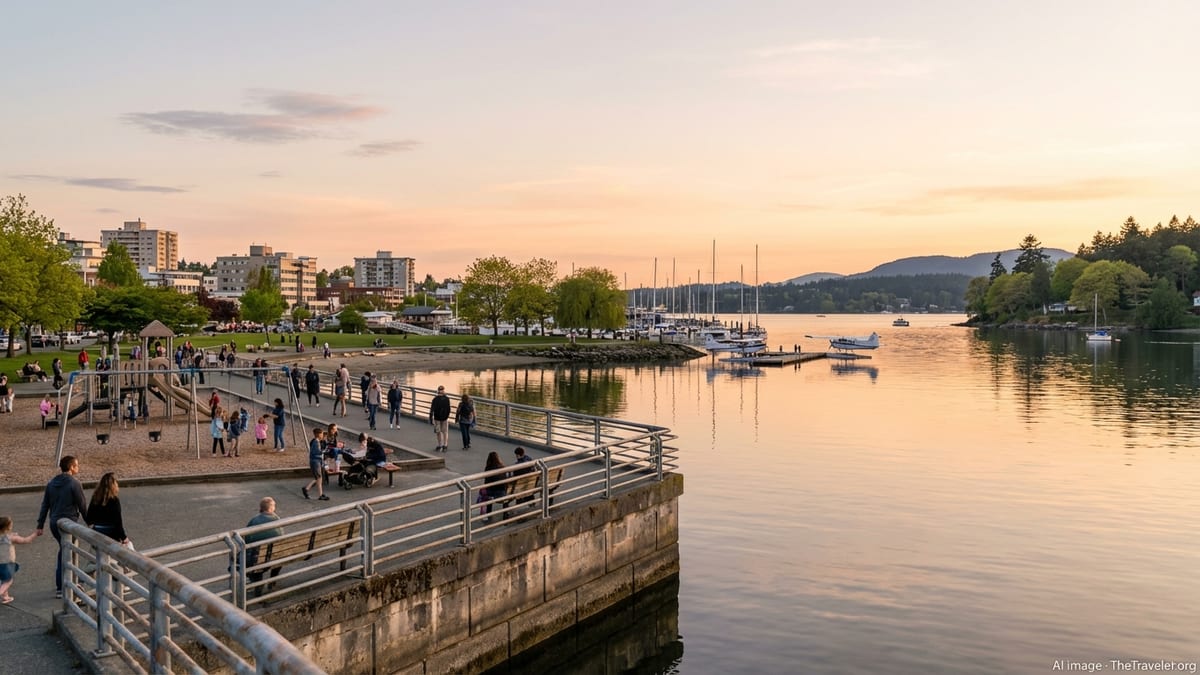
As the afternoon slid into early evening, I gravitated back toward the water. This turned out to be the best decision of the day. Nanaimo is one of those places that benefits disproportionately from good light. During golden hour the modest skyline, marina masts, and distant islands all soften into a surprisingly cinematic scene. I walked again through Maffeo Sutton Park, where the lawns glowed and the lagoon turned from flat grey to pale gold. The same paths that felt ordinary at midday suddenly felt like part of a much more atmospheric coastal city.
I found a spot along the seawall and watched the floatplanes come and go, their engines briefly fracturing the otherwise quiet harbour. Families were still on the playground, but there was a calmer rhythm. A couple of people were fishing off the public dock, chatting casually between casts. This is where Nanaimo really worked for me. It is not a destination of blockbuster sights, but a place where unhurried, low key moments have room to stretch out.
Sunset itself was understated but satisfying. The sun slipped behind the hills, leaving a soft glow over the water and a faint outline of the islands. I will not pretend it was the most spectacular sunset I have ever seen on the Pacific coast. It was not. Yet there was something about the combination of working harbour details and natural calm that felt honest and unforced. It was a scene I could imagine repeating on multiple evenings without it feeling like a production.
Would I Do It Differently Next Time?
Looking back at the day as a whole, I would not repeat it in exactly the same way. I am glad I started and ended on the waterfront, but the middle of the day lacked a strong anchor activity. If I had a do over and the weather cooperated, I would almost certainly build the day around a side trip: either taking the small passenger ferry over to Newcastle Island for hiking and beaches, or making sure I had transport lined up to Bowen Park or another inland green space. Nanaimo’s biggest strengths are its access to nature and island landscapes, and I underused that advantage by staying so tightly bound to the core.
I would also time my visit more carefully around local events. The city clearly invests in festivals, light installations, and community celebrations in and around Maffeo Sutton Park at certain times of year. Landing on a date when something is actually happening on the waterfront would give the day more texture. Arriving on an ordinary weekday meant that while everything was accessible, nothing felt particularly animated. If you are flexible, it is worth checking the local events calendar and trying to coincide your trip with a festival or concert.
In terms of pure logistics, arriving and departing via the downtown passenger ferry worked well. It kept everything walkable and eliminated the hassle of bus transfers from a more distant terminal. The trade off is that you are tied to that operator’s schedule and you do not get the dramatic entry into Departure Bay, which has its own beach and more open coastal feel. If you are traveling with a car or want to bring more gear, the larger vehicle ferries into Departure Bay or Duke Point may still make more sense.
The Takeaway
My day in Nanaimo did not transform my understanding of coastal cities, and it did not need to. What it offered instead was a modest, grounded experience of a place that is still figuring out how to present itself to visitors without losing its working harbour soul. There were moments of real beauty along the waterfront, in the soft evening light over the lagoon, and in the easy pace of locals who clearly see the harbour as their extended front yard. There were also flat spots: a downtown that feels a little in between, a reliance on cars or taxis to access some of the best nearby parks, and a food scene that, at least in the areas I explored, felt competent rather than compelling.
Would I recommend spending a full day in Nanaimo? Yes, with some conditions. It is worth it if you enjoy slow, unscripted wandering more than ticking off marquee attractions, if you are willing to build your day around the rhythms of the harbour rather than a packed must see list, and especially if you pair the city core with at least one foray to an island or nearby park. It is less ideal if you crave dense, highly polished urban charm or if you need non stop indoor activities, particularly on a wet day.
For me, Nanaimo lands in that category of places I may not rush back to, but that I am glad I experienced on its own terms. It is a city that rewards lowered expectations and a willingness to notice small details: a cluster of boats framed by evening light, the way a community uses its central park, the honest grit of a harbour that still works for a living. Under those conditions, from ferry arrival to sunset, it earns its place as a quiet but worthwhile day trip.
FAQ
Q1. Is Nanaimo worth visiting for just one day?
Yes, one day in Nanaimo can be worthwhile if you are content with a relaxed pace focused on the harbourfront, Maffeo Sutton Park, and nearby streets, rather than trying to see every surrounding park and island.
Q2. Do I need a car to enjoy a day in Nanaimo?
No, you do not strictly need a car if you arrive on the downtown passenger ferry and are happy to walk the harbourfront and central areas, but having a car or planning for taxis makes it much easier to reach Bowen Park, Petroglyph Provincial Park, or more distant beaches.
Q3. What is the best time of day to be on the waterfront?
Late afternoon into sunset is when the harbourfront looks its best, as the light softens, views toward the islands become more dramatic, and the park areas feel calmer and more atmospheric.
Q4. Is the Harbourfront Walkway suitable for people with limited mobility?
Much of the Harbourfront Walkway and Maffeo Sutton Park is paved and relatively flat, so it is generally accessible, though some sections further from the core feel more uneven or less well maintained.
Q5. Can I swim in Nanaimo right near downtown?
There is a small lagoon beach at Maffeo Sutton Park where people do swim in warmer weather, but the water can look a bit murky, so expectations should be modest compared with larger open ocean beaches elsewhere on Vancouver Island.
Q6. How does Nanaimo compare to Victoria for a day trip?
Victoria offers a denser, more polished historic core and more obvious tourist landmarks, while Nanaimo feels quieter, more workaday, and better suited to low key waterfront wandering than to intensive sightseeing.
Q7. Is there enough to do indoors if the weather is bad?
Near the waterfront, indoor options are limited, mostly cafes, pubs, and a few cultural venues, so on a very wet or cold day you may find it harder to fill the time without venturing further afield.
Q8. What would make a Nanaimo day trip feel more complete?
Pairing the harbourfront and downtown with a short side trip to Newcastle Island, Bowen Park, or another nearby natural area gives the day more variety and better showcases why people love this part of Vancouver Island.
Q9. Is Nanaimo walkable from the downtown ferry terminal?
Yes, if you arrive on the downtown passenger ferry you can easily walk to the Harbourfront Walkway, Maffeo Sutton Park, and the Old City Quarter without needing transit or a taxi.
Q10. Who is Nanaimo best suited for as a day trip?
Nanaimo is best for travelers who enjoy unhurried harbour views, casual parks, and a local feeling small city atmosphere, rather than those seeking major attractions or a tightly packed sightseeing agenda.