

More news on this day
As Lagos readies itself for the 2026 Fanti Carnival, the city’s historic core is once again poised to become a living canvas of colour, music and memory, tracing a cultural journey that runs from 19th century Brazil to the streets of modern-day Lagos Island.
Get the latest news straight to your inbox!
A Historic Carnival With Afro-Brazilian Roots
The Lagos Fanti Carnival, often associated with the broader Lagos Carnival tradition, has long been recognised as one of West Africa’s most distinctive street festivals, reflecting deep Afro-Brazilian influences that date back to the 1800s. Historical accounts describe how formerly enslaved Africans and their descendants returned from Brazil to Lagos, bringing with them samba-inflected rhythms, elaborate costume traditions and a strong belief in carnival as an act of remembrance and communal pride.
Publicly available historical research traces the roots of the festival to returnee communities such as the Aguda on Lagos Island, where Brazilian-style architecture, Catholic processions and masquerade culture fused with Yoruba spirituality and local customs. Over time, this blend produced a uniquely Lagos expression of carnival, locally known as Fanti or Caretta, which evolved into a highlight of the Lagos Black Heritage Festival and later stand-alone celebrations.
Academic and cultural commentaries note that this Afro-Brazilian connection extends beyond spectacle, reinforcing Lagos’s role in a wider Atlantic story of migration, trade and cultural exchange. The 2026 edition is framed by organisers and commentators as part of an ongoing revival of these historic ties, following renewed attention to the festival’s heritage in recent years.
Reports from previous editions emphasise how the carnival serves as both an artistic showcase and a form of cultural recovery, foregrounding narratives of return, resilience and identity. For many descendants of the Brazilian returnee communities, participation is described as a way of honouring ancestors who carried their traditions back across the ocean and rooted them again in Lagos.
Dates, Venue and What Visitors Can Expect in 2026
According to recent event listings and local media coverage, the 2026 Lagos Fanti Carnival is scheduled for Monday, 6 April 2026, at Tafawa Balewa Square on Lagos Island. Reports indicate that the festivities are expected to run from late morning into the evening, transforming the expansive ceremonial grounds into a hub of parades, performances and food stalls.
Recent announcements highlight Tafawa Balewa Square’s symbolic importance as a civic and cultural space in Lagos. Once a historic racecourse and later a key venue for major national events, the square now frequently hosts large-scale festivals and concerts. Its central location near Lagos Island’s colonial-era streets and Afro-Brazilian quarters makes it a fitting stage for a carnival that looks both backward and forward in time.
Prospective visitors can expect core elements that have defined recent editions of the Fanti Carnival. Published programmes for past years describe a full-scale street parade featuring costumed groups, marching bands, drummers and dancers moving along a designated route through parts of Lagos Island before converging on Tafawa Balewa Square. The procession is typically accompanied by sound systems playing a mix of samba-inspired beats, Afrobeat, fuji and contemporary Nigerian pop, underscoring the festival’s blend of heritage and modern urban culture.
In addition to the parade, previous schedules have referenced supporting activities such as heritage-themed art displays, food showcases curated around Afro-Brazilian and Lagos Island cuisine, and family-friendly entertainment zones. While the precise 2026 programme may still be in flux, publicly available event listings suggest a similar mix of cultural exhibitions, live performances and community-focused experiences.
From Lagos Island Streets to a Global Afro-Atlantic Story
Coverage of the 2025 revival underscored how the Fanti Carnival has become a powerful platform for exploring Lagos’s long-standing relationship with Brazil. Articles and festival commentary highlighted that Brazil is home to one of the largest populations of people of African descent outside Africa, with many tracing cultural, spiritual and historical links back to Nigeria and other parts of West Africa.
In Lagos, the returnee communities established neighbourhoods characterised by distinct architecture, religious institutions and social clubs. Over decades, these spaces became incubators for new cultural forms that blended Brazilian influences with Yoruba language, music and ritual. The Fanti Carnival is often cited as one of the clearest public expressions of this blending, with its processional structure, costuming and drumming echoing Brazilian carnival while retaining unmistakably Lagos aesthetics and sounds.
Analysts of Afro-Atlantic culture have pointed to festivals like the Lagos Fanti Carnival as examples of how heritage is continually reinterpreted rather than simply preserved. In practice, this means that contemporary parade floats might incorporate references to current social issues, while costume designers combine traditional motifs with modern materials and silhouettes. Choreography may include both samba-style steps and contemporary Nigerian dance trends, illustrating how global and local influences interact on the streets.
This layered identity is increasingly visible to international audiences through social media and travel coverage. Drone footage, street photography and short-form video from previous editions have circulated widely, presenting Lagos not only as a megacity of commerce and nightlife but also as a key node in a global network of carnival cultures that stretches from Rio de Janeiro and Salvador to the Caribbean and Europe.
Colour, Costume and the Sensory Experience of the Parade
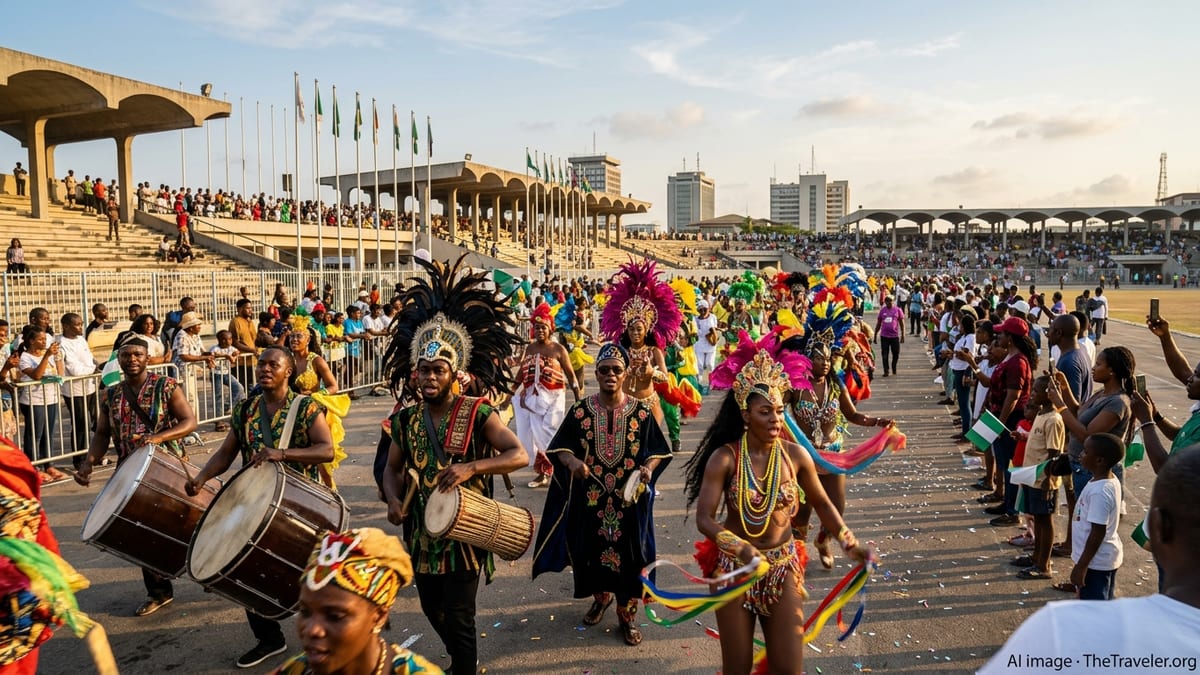
Recent photo essays and on-the-ground reports from the Lagos Fanti Carnival describe an event defined by immersive colour and sound. Parade participants are often seen wearing sequined bodysuits, feathered headdresses, embroidered capes and masks inspired by both Brazilian samba schools and Nigerian masquerade traditions. Bright yellows, greens, reds and blues dominate the visual palette, set off against the pale concrete stands and arches of Tafawa Balewa Square.
The music is typically driven by percussion sections featuring talking drums, djembes, agogos and large bass drums, interlaced with brass bands and mobile sound systems. The result, according to published coverage, is a layered soundscape that shifts from tightly choreographed troupe performances to spontaneous call-and-response moments with the crowd. Spectators lining the route often join in with dancing, singing and the waving of flags and scarves, blurring the line between performer and audience.
Vendors play a familiar role in shaping the sensory environment, offering grilled meats, street snacks, chilled drinks and local desserts. The scent of roasted corn, suya and fresh fritters combines with bursts of coloured confetti and the occasional spray of water or powder from exuberant revellers. For first-time visitors, travel writers note that the experience can feel overwhelming at first, but quickly becomes exhilarating as the rhythm of the parade takes hold.
Nightfall brings a shift in atmosphere rather than an end to activity. Reports from earlier editions indicate that as the sun sets over Lagos Island, stage lighting, illuminated costumes and glowing floats keep the carnival visually striking. Reflections from spotlights and LED elements on the polished brass of instruments and sequins of costumes give the parade a shimmering quality, even as the event retains a street-level, community-driven character.
Practical Notes for Local and International Visitors
While detailed 2026 visitor guidance is still emerging, recent festival coverage and general Lagos travel advice offer several pointers for those planning to attend. Commentators commonly recommend arriving early at Tafawa Balewa Square or along key parts of the parade route to secure good viewing positions, particularly as crowds tend to thicken by mid-afternoon on carnival day.
Publicly available information on past editions suggests that event organisers coordinate with city agencies on traffic management and basic services, with sections of Lagos Island temporarily closed or rerouted around the parade corridor. Visitors are often advised to factor in additional travel time, use designated public transport options where available and follow posted instructions regarding entry points, security checks and restricted areas.
Travel features on Lagos festivals also stress the importance of heat and crowd awareness. Lightweight, breathable clothing, comfortable footwear and regular hydration are widely recommended, especially for those planning to walk alongside parts of the procession. Many experienced attendees suggest carrying only essential valuables and using secure bags, in line with typical big-city festival precautions.
For domestic and international travellers, the 2026 Lagos Fanti Carnival coincides with a broader calendar of cultural and religious events across Nigeria, making it a potential anchor for multi-stop itineraries that include heritage districts, art spaces and coastal getaways. As Lagos continues to promote itself as a cultural capital, the Fanti Carnival is positioned as both a homecoming for local communities and an invitation to global visitors to experience a journey through time, colour and shared Afro-Atlantic history.