

More news on this day
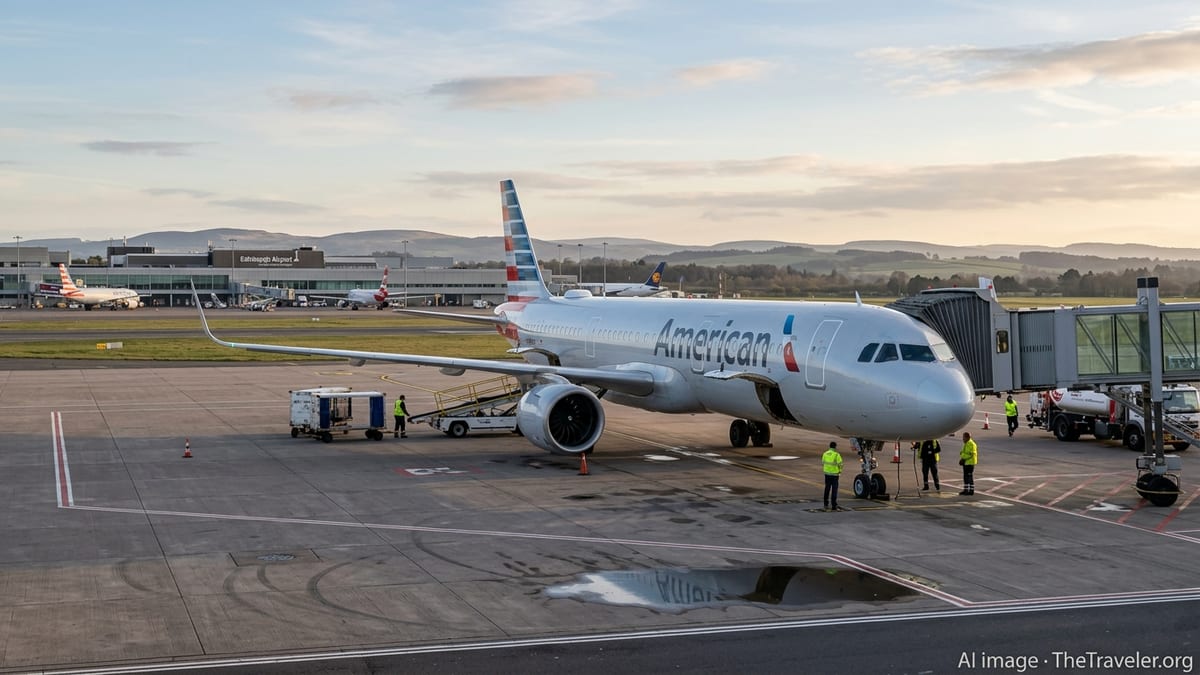
American Airlines has ushered in a new era of long-haul narrowbody flying, deploying the Airbus A321XLR on nonstop New York to Edinburgh service in what industry reports describe as the aircraft’s first scheduled transatlantic route.
Get the latest news straight to your inbox!
A New Chapter for Transatlantic Narrowbody Flights
The introduction of the Airbus A321XLR on American Airlines’ New York John F. Kennedy to Edinburgh route marks a significant shift in how transatlantic services can be operated. Publicly available information shows that Edinburgh has been selected as the first overseas destination for the carrier’s new long-range narrowbody type, positioning the Scottish capital at the forefront of a changing North Atlantic market.
Data from American’s published schedules indicates that the A321XLR is configured with 20 flagship business suites, 12 premium economy seats and 123 seats in the main cabin, for a total of 155 passengers. The aircraft’s extended range and improved fuel efficiency are designed to make thinner long-haul routes viable year after year, while still offering a three-class product that targets both leisure and corporate demand.
The JFK–Edinburgh service builds on American’s existing presence at Edinburgh Airport, where the airline has already been operating seasonal service to Philadelphia using widebody aircraft. Industry coverage notes that the A321XLR deployment from New York is intended to complement, not replace, that widebody link, effectively turning Edinburgh into a two-gateway North American station for the airline.
Aviation analysts point out that this move also reflects a broader trend: carriers are increasingly turning to long-range single-aisle jets to connect secondary cities on both sides of the Atlantic, reducing reliance on traditional mega-hubs and adding point-to-point options that were previously hard to justify with larger aircraft.
Edinburgh’s Growing Transatlantic Profile
The choice of Edinburgh for the A321XLR’s first transatlantic outing underscores how far the airport’s long-haul network has evolved in recent years. According to published traffic and route development updates, American’s presence at Edinburgh has expanded from a single seasonal Philadelphia link to a more diversified portfolio that now includes New York service scheduled across an extended summer season.
Local airport reports indicate that the Philadelphia route has performed strongly since its resumption, with demand sufficient for American to extend operations deeper into the winter period. Adding the A321XLR-operated New York service gives Edinburgh business and leisure travelers additional nonstop access to the United States, while also improving one-stop connectivity across American’s wider network.
On the inbound side, tourism agencies have long promoted Edinburgh’s draw as a gateway to Scotland’s cultural attractions and the Highlands. Travel industry coverage suggests that the combination of a premium-heavy A321XLR cabin and a city known for festivals, heritage and golf could prove particularly attractive to high-yield North American travelers seeking shorter journey times and more tailored schedules than those offered via major European hubs.
For Edinburgh Airport, the A321XLR inauguration adds another differentiator in its competition with other UK and northern European airports. As more carriers take delivery of similar long-range narrowbodies, analysts expect a reshaping of route maps, with airports like Edinburgh vying to secure first-mover advantages on new nonstop links.
Inside American’s A321XLR: Product and Experience
Fleet fact sheets and cabin previews released by the airline show that American’s A321XLR has been positioned as a premium-focused evolution of its existing narrowbody offerings. At the front of the aircraft, 20 individual business suites provide fully flat beds and direct aisle access, aligning the product more closely with what travelers typically expect on widebody transatlantic services.
Behind the business cabin, 12 premium economy seats create a dedicated intermediate option for travelers who prioritize additional space and enhanced service but do not require a full lie-flat product. The 123-seat main cabin, meanwhile, is designed to balance density with competitive amenities such as seatback entertainment and access to high-speed connectivity, according to equipment details shared in fleet documentation.
Publicly available information indicates that all customers on the A321XLR benefit from seatback screens, Bluetooth audio pairing and onboard Wi-Fi, which American has highlighted as key elements in its broader fleet modernization program. Industry observers note that this approach aligns with a push among major transatlantic carriers to standardize a baseline of in-seat entertainment and connectivity even on narrowbody jets.
From an operational perspective, the A321XLR’s extended range and lower fuel burn are expected to help the airline contain costs on routes that might otherwise require larger widebody aircraft with more seats to fill. Reports focusing on fleet strategy argue that this flexibility could allow American to experiment with additional seasonal or shoulder-period services from North America to smaller European markets in the coming years.
Training Flights and Operational Preparation
The A321XLR’s debut on the New York–Edinburgh route follows months of behind-the-scenes preparation. Aviation industry coverage has documented a series of training flights American operated between Philadelphia and Edinburgh using standard A321neo aircraft, flown without commercial passengers. These flights were conducted to familiarize pilots with transatlantic operations on the narrowbody platform and to validate procedures for the forthcoming XLR service.
Reports on these preparations describe a multi-stage process, in which check pilots first gained experience on the route before training line pilots who would eventually operate the A321XLR on the North Atlantic. This methodology is consistent with how carriers typically prepare flight crews for new aircraft types or for operating existing types in new, more demanding environments such as extended overwater segments.
Industry analysts have noted that the choice of Philadelphia–Edinburgh for these training exercises ties directly into American’s network strategy. By using an already established seasonal route, the airline could conduct repetitive long overwater sectors that mirrored the future JFK–Edinburgh profile, while also strengthening its operational familiarity with Edinburgh Airport’s procedures.
The completion of these training flights provided an additional layer of assurance ahead of the A321XLR’s entry into revenue service across the Atlantic. Commentary in aviation trade publications suggests that this level of preparation has been viewed positively by regulators and industry watchers focused on the safe introduction of new long-range narrowbody operations.
What the Debut Means for Future A321XLR Routes
The deployment of the A321XLR on American’s Edinburgh service is widely seen as a blueprint for how the airline may roll out the type on other long-haul routes. Publicly available schedule information already points to plans for the aircraft to appear on key domestic transcontinental markets such as New York–San Francisco and Boston–Los Angeles, creating a mixed portfolio of premium long-haul and high-yield domestic flying.
As additional A321XLRs join the fleet, industry reports anticipate that American will look to connect more secondary U.S. cities to destinations in Europe that historically could not sustain daily widebody service. Analysts highlight potential opportunities from hubs such as Philadelphia and Charlotte, along with select focus cities that offer strong local demand but limited long-haul connectivity.
The Edinburgh launch also takes place amid a broader wave of A321XLR adoption across the Atlantic, with other carriers preparing to bring the type into service in the coming years. Market observers suggest that competition among airlines operating long-range narrowbodies could drive more nonstop options, but may also intensify pressure on yields in certain leisure-heavy markets.
For travelers, the A321XLR’s transatlantic debut on American’s New York–Edinburgh route signals a gradual but notable change in what to expect from narrowbody flying. If early operations prove successful, the aircraft could become a familiar sight on routes that previously required connections, reshaping how passengers move between mid-sized cities on both sides of the Atlantic.