

More news on this day
Drivers across North Wales are facing major disruption after a serious crash forced the closure of a key section of the A5025 on Anglesey, cutting a vital island route and triggering long delays for commuters, freight traffic and visiting tourists.
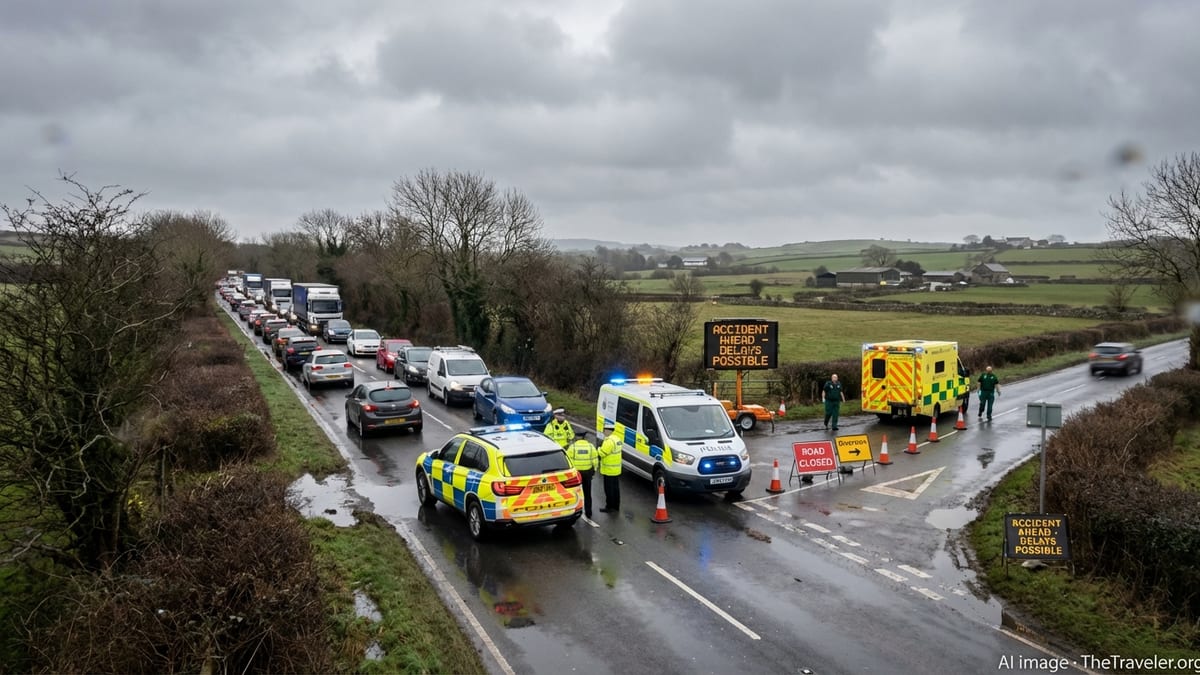
Serious Collision Shuts Key Anglesey Route
A significant road traffic collision on the A5025 near Pentraeth has led to the full closure of a busy stretch of the route, causing widespread travel problems across Anglesey and beyond. Emergency services were called to the scene following reports of a serious crash involving multiple vehicles on this main coastal road, which links communities around the island and connects with routes to the mainland.
North Wales Police and ambulance crews attended as traffic was brought to a standstill in both directions, with officers quickly closing the carriageway to protect responders and those involved. Initial reports indicated serious damage to at least one vehicle, with debris scattered across the carriageway and fears of fuel spillage complicating the recovery operation.
The A5025 is one of Anglesey’s most important roads, forming a spine along the northern and eastern edge of the island between Menai Bridge and Amlwch. Its closure, even for a few hours, has immediate knock-on effects for residents, holidaymakers and freight using Holyhead and the wider North Wales road network.
North Wales Drivers Caught in Gridlock
The impact of the closure was felt within minutes as queues rapidly formed on approaches to the affected stretch near Pentraeth. Local drivers reported slow-moving traffic stretching back through nearby villages, with some motorists stuck for extended periods while emergency services secured the scene and began their investigation.
With the A5025 acting as a primary artery for journeys between coastal communities, the sudden loss of capacity created a ripple effect on connecting roads. Commuters travelling between Anglesey’s northern communities and the employment hubs around Bangor and the A55 corridor faced lengthy delays, adding to mounting frustration on a network already prone to bottlenecks when there is disruption.
Holidaymakers and day-trippers bound for beaches, caravan parks and coastal paths found themselves turning around or attempting to thread through unfamiliar back roads that quickly became saturated. Social media posts from the region described “traffic everywhere you turn” as local lanes and village streets absorbed volumes of traffic they were never designed to handle.
Diversions Strain Rural Roads and Villages
As police and highways teams moved to close the A5025 in both directions, signed diversions were brought in to reroute traffic along smaller local roads across the interior of Anglesey. While essential to keep vehicles moving, these alternatives offered limited capacity and presented new challenges for drivers unaccustomed to narrow, twisting rural lanes.
Residents in nearby communities reported a surge in passing traffic, including larger vehicles and caravans attempting to navigate pinch points, sharp bends and village centres. Concerns were raised about safety in built-up areas where pedestrians share space with vehicles and where pavements are either narrow or non-existent.
For many drivers, confusion over the best alternative route compounded delays. With live traffic information updating as the situation developed, some motorists were diverted more than once as authorities adjusted signage in response to congestion and reports from the ground. Local councillors have long warned that when a strategic road such as the A5025 closes, there are few realistic alternatives that do not place significant pressure on rural communities.
Tourism and Local Businesses Count the Cost
The timing of the closure is particularly sensitive for Anglesey’s visitor economy, which relies heavily on easy road access to its beaches, coastal walks and historic attractions. The A5025 serves as a key lifeline for coastal resorts and small businesses that depend on passing trade, from cafés and pubs to campsites and guesthouses.
With traffic diverted away from the usual route, some hospitality operators reported cancellations or late arrivals, while others saw customer numbers drop sharply as visitors opted to abandon or shorten their trips. For accommodation owners managing weekend changeovers and peak travel days, disruption on the A5025 can quickly translate into lost revenue and operational headaches.
Retailers and service providers in affected villages were left balancing a sudden influx of through-traffic with a fall in leisurely visitors. While some businesses may benefit from stranded motorists seeking refreshments or facilities, many traders fear that repeat disruption on Anglesey’s main roads risks damaging the island’s reputation as an easy, stress-free getaway.
Emergency Response and Ongoing Investigation
Emergency responders spent several hours at the crash scene, working to treat the injured, secure the vehicles and make the area safe. Police collision investigators documented road conditions, vehicle positions and any potential contributing factors such as weather, surface hazards or visibility issues, all of which will feed into a detailed investigation.
Fire crews and recovery teams were tasked with dealing with damaged vehicles and any spilled fuel or fluids, a process that can significantly extend closure times if specialist cleaning is required. Authorities have repeatedly emphasised that, in serious collisions, it is not possible simply to “move cars to the side” and reopen the road, as evidence must be preserved and the environment protected.
North Wales Police have appealed for witnesses, particularly anyone with dashcam footage taken in the minutes leading up to the collision on the A5025 near Pentraeth. Such footage can be critical in determining whether factors such as speed, distraction, overtaking or mechanical failure played a role in the crash, and can help to shape future safety measures on the route.
Fresh Scrutiny on Anglesey’s Vulnerable Road Network
The latest closure has prompted renewed scrutiny of how vulnerable North Wales remains to single incidents on key roads. While much of the national focus falls on major routes such as the A55, incidents on Anglesey’s A-roads can be equally disruptive, especially where there are few viable alternative corridors.
Local representatives and transport campaigners have long argued that Anglesey’s road infrastructure has not kept pace with rising traffic volumes linked to tourism, freight and commuting. When a road such as the A5025 closes unexpectedly, those pressures become starkly visible in the form of gridlocked villages, missed appointments and delayed deliveries.
Recent high-profile incidents on major North Wales routes, including tunnel closures and severe delays linked to collisions and vehicle fires, have underscored the fragility of the wider network. The A5025 crash will add weight to calls for more investment in resilience, from better diversion planning and signage to targeted safety upgrades on known collision hotspots.
Safety Concerns on a Scenic but Demanding Route
The A5025 is known for its changing character, moving from relatively open rural stretches to more constrained sections as it passes through villages and along the coast. Regular users describe a route that demands concentration, with varying speed limits, hidden dips, tight bends and junctions that can catch out unfamiliar drivers, particularly in poor weather.
Past collisions on the road have prompted periodic reviews of signage, speed enforcement and road markings, with some sections benefiting from improved visibility and surface treatments. Despite this, local residents continue to express concerns about driver behaviour, including overtaking on marginal stretches and failing to slow down through village centres.
Road safety experts point out that scenic rural A-roads often combine higher speeds with complex layouts and mixed traffic, from tractors and cyclists to heavy goods vehicles and holiday traffic towing caravans. On Anglesey, where tourism peaks collide with everyday local journeys, the margin for error can be slim when conditions deteriorate or traffic builds suddenly.
Advice for Travellers and What Happens Next
Authorities are urging anyone planning to travel on or around Anglesey to check the latest traffic bulletins and live route information before setting out. With recovery and clean-up operations on the A5025 expected to continue for some time after the initial collision response, drivers are being asked to allow extra time, follow signed diversions and avoid attempting unsanctioned shortcuts through minor lanes.
Public transport users have also been advised to confirm services, as some bus routes may be diverted or subject to delay while the A5025 remains partially or fully closed. Local schools, healthcare providers and businesses are monitoring the situation closely, with some adjusting appointment times and shift patterns to account for staff and visitors struggling to reach sites.
Once the road is fully reopened, engineers are expected to conduct a further assessment of the affected section to determine whether additional safety measures or repairs are required. Any recommendations will feed into ongoing discussions about how to make Anglesey’s road network more resilient in the face of growing traffic demands and the recurring pattern of serious incidents that leave North Wales drivers facing yet another travel nightmare.