

More news on this day
Abu Dhabi’s main international gateway has been thrust into chaos as regional airspace closures, missile and drone strikes, and fast-escalating tensions between Iran, the United States and Israel trigger gridlock across Middle East skies and leave thousands of passengers stranded in the Gulf hub.
Regional Tensions Boil Over Into the Skies
The latest bout of instability was unleashed after coordinated United States and Israeli strikes on Iran, followed by retaliatory missile and drone attacks directed at targets across the Gulf. In response, countries including Iran, Iraq, Israel, Syria, Qatar, Kuwait, Bahrain and the United Arab Emirates moved to close or heavily restrict their airspace, effectively turning one of the world’s busiest aviation corridors into a no-fly zone.
Radar images that usually show dense ribbons of traffic over the Gulf instead revealed vast empty gaps as commercial jets were diverted south over Saudi Arabia or forced to turn back mid-flight. Aviation analysts say the sudden loss of key flight corridors has upended long-haul routes linking Europe, Asia and Australia, with aircraft now flying longer, more fuel-intensive detours to avoid the conflict zone.
For Abu Dhabi, which has spent years positioning itself as a seamless global transit hub, the shift has been immediate and dramatic. Its rebranded Zayed International Airport, opened to fanfare as a next-generation terminal, has instead become an emblem of the shock that geopolitical risk can impose on modern air travel.
Etihad Suspends Operations as Zayed International Backs Up
Etihad Airways, the Abu Dhabi-based national carrier, has temporarily suspended all passenger flights to and from Zayed International Airport through at least early Monday local time. The airline cited regional airspace closures and the need to prioritise passenger and crew safety as reasons for the halt, warning that schedules remain “highly fluid” and subject to rapid change.
Etihad’s decision effectively froze Abu Dhabi’s role as a transfer hub, with ripple effects fanning out across Europe, Asia and Australasia. Travellers whose journeys depended on quick Abu Dhabi connections instead found themselves blocked at their points of origin, diverted to secondary airports, or left sleeping on terminal floors as they awaited new routings.
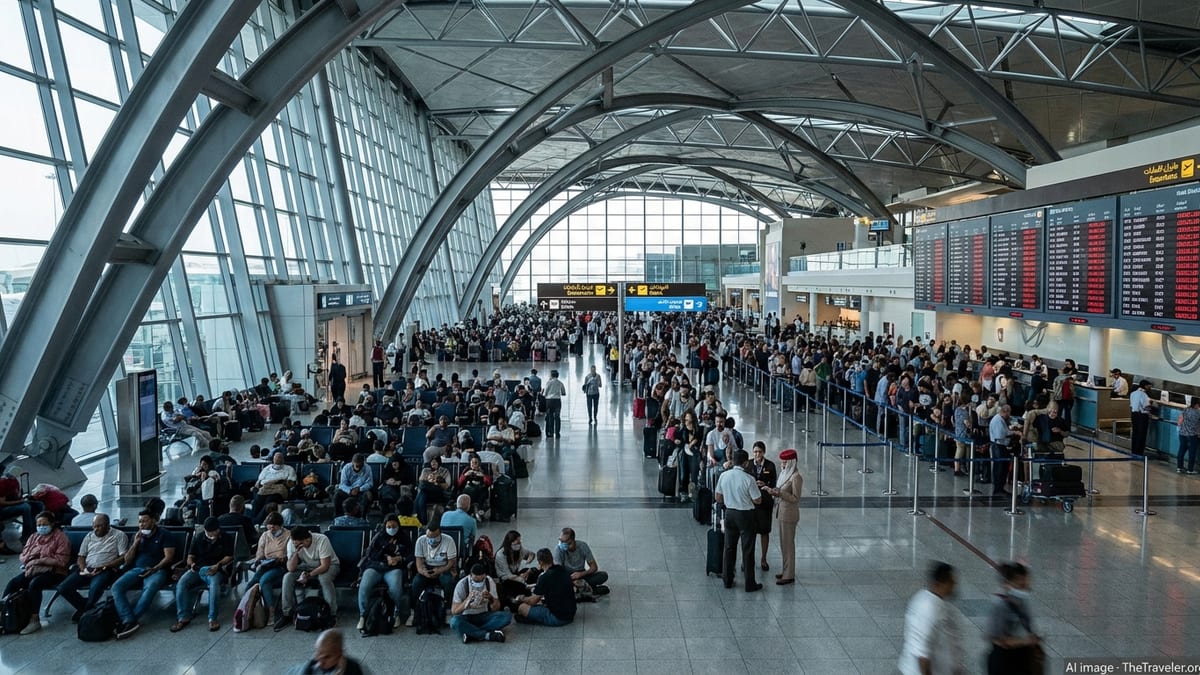
Inside Zayed International, queues have snaked along departure halls as ground staff attempt to rebook or accommodate stranded passengers amid a wave of cancellations. Airport authorities have activated contingency plans to provide food, water and resting areas, but with many inbound aircraft diverted or grounded, the usual churn of arrivals and departures has slowed to a crawl.
Industry observers note that while the impact on Abu Dhabi’s infrastructure appears limited compared with some neighbouring states, even short-lived suspensions can take days to unwind as airlines reposition crews and aircraft and clear extensive backlogs of disrupted itineraries.
Safety Concerns After Strikes Heighten Passenger Anxiety
Adding to operational turmoil is a growing sense of unease among travellers about aviation safety in the region. Iranian retaliatory strikes and drone activity have led to damage at multiple airports, including in the United Arab Emirates, where authorities reported at least one fatality and several injuries in incidents linked to falling debris and drone attacks in recent days.
Although Abu Dhabi’s runways and terminal structures have remained largely intact, heightened security protocols and risk assessments are shaping every operational decision. Carriers are working closely with national aviation authorities and military planners to ensure civil aircraft are kept well clear of active military operations and potential missile trajectories.
For passengers, however, the nuance of airspace management is often overshadowed by images of burning buildings and damaged aircraft stands broadcast from across the Gulf. Social media posts from Zayed International show families clustered around flight information boards filled with red cancellations, while others depict crowded customer service desks where emotions are running high.
Travel agents report a surge in calls from customers seeking to cancel or reroute future trips through Abu Dhabi and neighbouring hubs. Some long-haul travellers are opting to avoid the region entirely, preferring routes that connect via Europe, East Asia or Africa despite longer journeys and higher costs.
Global Airlines Pull Back From UAE Airspace
The disruption in Abu Dhabi has been amplified by decisions from major international airlines to avoid Emirati airspace altogether. European carrier Lufthansa has suspended flights to both Abu Dhabi and Dubai through at least 4 March and instructed its crews to route around the wider UAE airspace, citing security assessments and the evolving military situation.
Other global carriers, including Air France and British Airways, have already cancelled services to key Gulf and Levant destinations such as Dubai, Beirut and Tel Aviv, while low-cost operators have paused flights to Abu Dhabi and nearby regional capitals. This wave of suspensions compounds the capacity crunch facing passengers who would normally rely on a dense mesh of interlinked schedules across Gulf hubs.
Airlines that continue to serve the broader region face their own operational challenges as they lengthen flight paths to avoid closed skies over Iran, Iraq and parts of the eastern Mediterranean. Longer journeys mean increased fuel burn at a time when carriers are still wrestling with higher operating costs globally, raising the prospect of fare pressure once normal schedules resume.
For Abu Dhabi specifically, every international suspension means fewer options to backfill Etihad’s halted services or move stranded travellers onward. Industry experts warn that even if local restrictions begin to ease within days, hesitancy from foreign carriers could prolong reduced connectivity for weeks.
Stranded Travellers Grapple With Uncertainty
For passengers caught in the middle of the crisis at Abu Dhabi’s airport, the primary reality is uncertainty. Many woke on Sunday to find their onward flights cancelled just hours before departure, while others watched aircraft push back from the gate only to return as airspace closures widened during the day.
Airport hotels around the capital are reporting high occupancy as airlines issue meal and lodging vouchers, yet some travellers have struggled to secure rooms as demand outstrips supply. With itineraries in limbo, visitors have turned to social media to share ad-hoc advice on everything from navigating rebooking queues to identifying alternative overland routes to Oman or Saudi Arabia.
Consular staff from multiple countries have been deployed to the terminals to assist citizens in securing updated travel documents, clarifying insurance coverage and exploring limited outbound options. Embassies have echoed the message from UAE authorities, urging citizens to follow official channels, avoid unnecessary journeys to the airport, and be prepared for extended delays.
Despite the tension, scenes of solidarity have also emerged in the departure halls. Travellers have been filmed sharing phone chargers, snacks and floor space, while local volunteers and airport employees distribute water and answer questions where they can. For many, the experience has become a stark illustration of how quickly global mobility can be constrained when geopolitical fault lines shift.
Uncertain Timeline for Relief
With military operations ongoing and regional leaders trading sharp rhetoric, aviation officials are reluctant to predict when normal traffic levels might return to the skies above Abu Dhabi. Analysts point to past conflicts in the region where partial airspace shutdowns persisted for more than a week, with full schedule recovery taking considerably longer.
Airlines and airport operators across the Gulf are now drawing up phased restart scenarios that would initially prioritise repatriation flights, critical cargo and limited transfer traffic. The challenge, executives say, will be synchronising any reopening of UAE skies with parallel decisions in neighbouring countries so that long-haul corridors can function safely and efficiently.
For Abu Dhabi’s Zayed International Airport, the coming days will test the resilience of both its physical infrastructure and its reputation as a secure, reliable gateway linking East and West. How swiftly it can clear the current gridlock, rebuild passenger confidence and coordinate with carriers around the world will shape not only travel patterns in the Gulf, but also broader perceptions of the Middle East as an aviation crossroads in a time of renewed uncertainty.