

More news on this day
Abu Dhabi’s Zayed International Airport has become the latest flashpoint in a spiraling Middle East travel crisis, with more than 200 flights reportedly canceled or severely delayed on Sunday as US-Israel military strikes on Iran triggered sweeping airspace closures and left passengers marooned from Tel Aviv to New York.
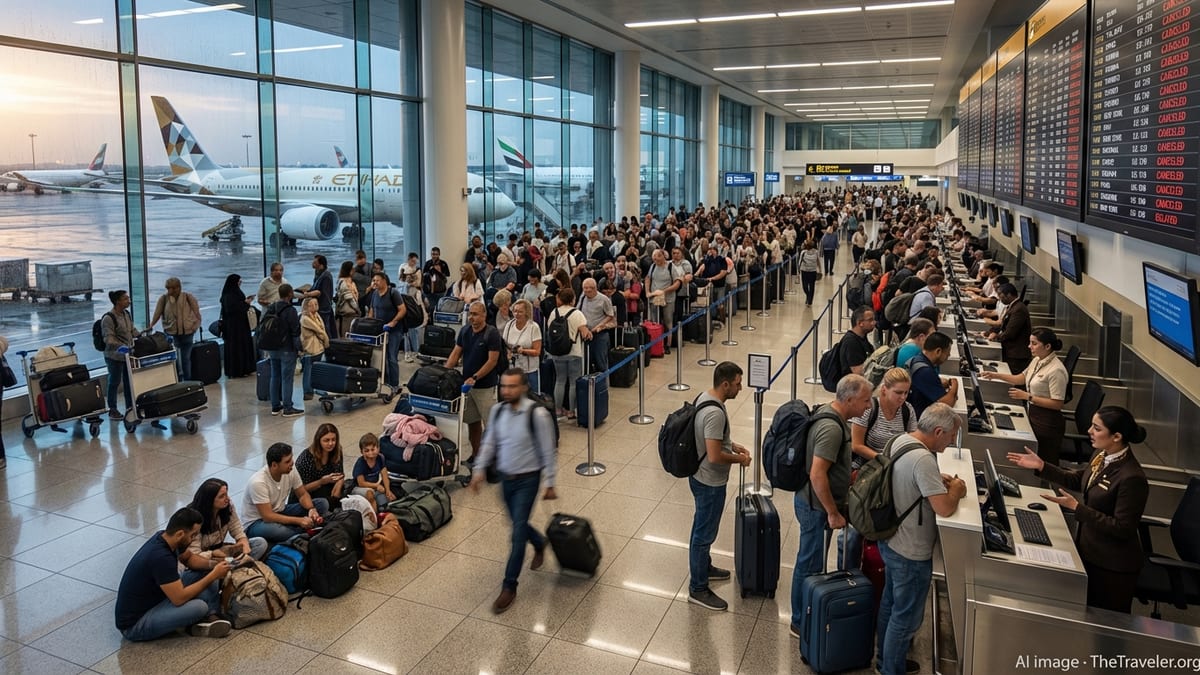
Abu Dhabi Hub Paralyzed as Etihad Freezes Departures
The United Arab Emirates’ capital awoke on March 1 to one of its worst aviation disruptions in years, as Etihad Airways temporarily halted all departures from Zayed International Airport and neighboring states shut chunks of their skies to civilian traffic. Industry data providers and regional media reported more than 200 cancellations and several additional delays linked to Abu Dhabi alone, as schedules were hastily rewritten or wiped out entirely.
Etihad said departures from Abu Dhabi were suspended until at least midafternoon local time on Sunday, later extending that to an overnight pause as military activity and airspace restrictions rippled across the Gulf. Other carriers that rely on Abu Dhabi as a stopover or destination, including Saudia, British Airways and low cost operators such as Wizz Air, also scrubbed or diverted flights as the situation evolved.
The paralysis at Abu Dhabi is particularly disruptive because the airport functions as a major east west transfer point, funneling travelers between Europe, North America, Asia and Africa. With runways open but key air corridors closed or deemed unsafe, airlines faced the choice of long, fuel heavy detours or outright cancellation. Many opted for the latter, leaving packed departure halls and stretches of empty gates where long haul jets would normally cycle in and out around the clock.
While the precise tally was still shifting by Sunday evening, aviation analysts said the combination of cancellations and rolling delays effectively severed Abu Dhabi from much of its usual global network for at least 24 hours, underscoring how quickly geopolitical tensions can neutralize even the most modern hubs.
US Israel Strikes on Iran Trigger Regional Airspace Shutdown
The travel chaos was set in motion after the United States and Israel launched large scale strikes on Iranian targets, prompting Iran to retaliate and leading multiple Middle Eastern governments to close or tightly restrict their airspace. Authorities in Iran, Iraq, Israel, Kuwait, Qatar, Bahrain, the UAE and Syria imposed sweeping bans on civilian overflights, forcing airlines to either reroute far to the south or halt services altogether.
Those closures choked off some of the world’s busiest aviation highways, particularly the corridors that link Europe to Asia via the Gulf. Airports in Dubai, Abu Dhabi and Doha, normally among the most connected on earth, saw hundreds of flights canceled in a matter of hours as airlines scrambled to comply with new military no fly zones and avoid potential missile or drone activity.
Airlines warned that even once some airspace begins to reopen, schedules will remain tangled for days because aircraft and crews are out of position, maintenance checks have been disrupted and alternative routings add hours to flight times. Analysts also cautioned that fuel costs and insurance premiums are likely to rise if carriers are forced to skirt conflict zones for an extended period.
For the UAE, the disruption cuts to the heart of a national strategy that relies heavily on open skies and seamless connectivity. Etihad in Abu Dhabi and Emirates in Dubai normally carry tens of thousands of passengers every day, and even a short shutdown can translate into a significant economic shock for airlines, airports, hotels and tourism operators.
Passengers Stranded from Tel Aviv to New York
Behind the statistics are thousands of disrupted journeys. Among the hardest hit are travelers booked on Abu Dhabi services to and from Tel Aviv, Paris, Vienna, Toronto and New York, routes that rely heavily on tight connections through the Gulf. With onward flights suddenly canceled, many passengers who had already crossed oceans found themselves isolated in transit lounges or stuck in departure cities with no clear path home.
In Tel Aviv, where flights had already been fragile due to months of security concerns, the latest wave of Gulf cancellations wiped out additional connectivity to Asia and North America. Travelers bound for destinations such as Singapore or Sydney via Abu Dhabi or Dubai faced cascading rebookings and, in some cases, the prospect of waiting days for the next available seat on alternative routings.
Major European hubs including Paris and Vienna reported clusters of stranded passengers who had been due to connect onto Etihad and other Gulf carriers. Some were offered hotel vouchers or meal coupons, but capacity on substitute flights via Istanbul, Frankfurt or London quickly filled, leaving others to sleep on airport benches or nearby terminal floors as they waited for news.
In North America, the knock on effects were felt at gateways such as New York, Washington and Toronto, where transatlantic flights that normally continue onward to the Gulf were canceled or converted into turnarounds. Airlines urged customers not to travel to the airport without a confirmed rebooking and warned that call centers and online channels were experiencing heavy backlogs.
Etihad, Saudia, British Airways and Wizz Air Cut Schedules
Etihad Airways, which is headquartered in Abu Dhabi, was at the center of the disruption as it froze departures and announced that its entire network to and from the UAE would be reviewed on a rolling basis. The carrier advised passengers that they could change travel dates without fees or request refunds if their flights had been canceled, but detailed rebooking options remained fluid as conditions changed.
Saudia, the Saudi national airline, trimmed services that routed through or near the affected airspace, while also taking on extra overflight traffic as some airlines attempted to skirt danger zones by flying deeper into Saudi territory. British Airways extended its existing suspension of flights to Tel Aviv and scaled back some services into the Gulf, further reducing options for European travelers trying to reach or transit the region.
Low cost carrier Wizz Air, which has already pared back operations in the Gulf and Eastern Mediterranean amid recurrent security scares, suspended additional flights touching the UAE and Israel, leaving budget conscious travelers with few immediate alternatives. Smaller regional airlines and charter operators followed suit, either canceling outright or shifting to complex, zigzag routes that avoid contested skies.
Industry experts said the disruption highlights how exposed global aviation remains to flashpoint conflicts in the Middle East, where a single corridor closure can strand aircraft and passengers on multiple continents within hours. They added that while airlines have become more adept at crisis rerouting since earlier flare ups, the scale and speed of the latest airspace shutdown have stretched contingency planning to its limits.
Uncertain Timeline for Recovery as Travelers Seek Answers
As Sunday wore on, there was no clear consensus on how long the closures and flight suspensions might last. Military planners were still coordinating use of regional skies, and civil aviation authorities signaled that safety would take precedence over commercial pressures to reopen key corridors. Airlines cautioned that even partial resumptions could be reversed quickly if the security situation deteriorated.
For passengers already caught up in the disruption, the guidance was simple but unsatisfying: monitor flight status closely, remain in touch with airlines through official channels and be prepared for last minute changes. Travel agents reported a surge in calls from customers looking for any available seats on indirect routings that avoid the Gulf entirely, such as longer journeys via Central Asia or southern Africa.
With hundreds of thousands of travelers still displaced across multiple time zones, the Abu Dhabi shutdown has become a potent symbol of how rapidly geopolitical shockwaves can upend the modern travel system. Until airspace gradually reopens and airlines can re thread their global networks, many holidaymakers, business travelers and expatriates will remain involuntary spectators to a crisis unfolding thousands of feet above the usual flight paths.