

More news on this day
Adora Cruises is strengthening its role in China’s rapidly expanding cruise sector through closer collaboration with China Tourism Group and China State Shipbuilding Corporation, using new domestically built vessels and international itineraries to position China as a rising force in global cruise tourism.
Get the latest news straight to your inbox!
Strategic Partnership Anchors a National Cruise Platform
Publicly available information indicates that Adora Cruises sits at the center of a state-backed effort to consolidate and grow China’s cruise industry, with China Tourism Group (CTG) and China State Shipbuilding Corporation (CSSC) emerging as key partners. CTG has led the creation of a unified cruise operation platform to coordinate fleets, marketing and tourism resources across major Chinese ports, while CSSC provides shipbuilding and technical capabilities for a new generation of large cruise vessels. This alignment is designed to give China a vertically integrated presence that spans ship design, construction, operations and travel distribution.
Reports describe CTG as leveraging its nationwide travel agency network, tax-free retail operations and destination management experience to feed passengers into Adora’s ships, while CSSC contributes dedicated cruise design and engineering units. Together, the three parties are described as building an ecosystem in which Adora becomes the flagship consumer brand for China’s cruise ambitions, using a mix of newly built and refurbished ships to accelerate both domestic and international deployment.
Industry analyses of China’s cruise strategy suggest that this partnership model is intended to reduce reliance on foreign shipyards and operators that have historically dominated the sector. By combining CTG’s tourism infrastructure with CSSC’s manufacturing base and Adora’s brand, China is aiming to capture more value from cruise tourism at home while also competing for international passengers and itineraries.
China-Built Flagship Adora Magic City Extends Reach Abroad
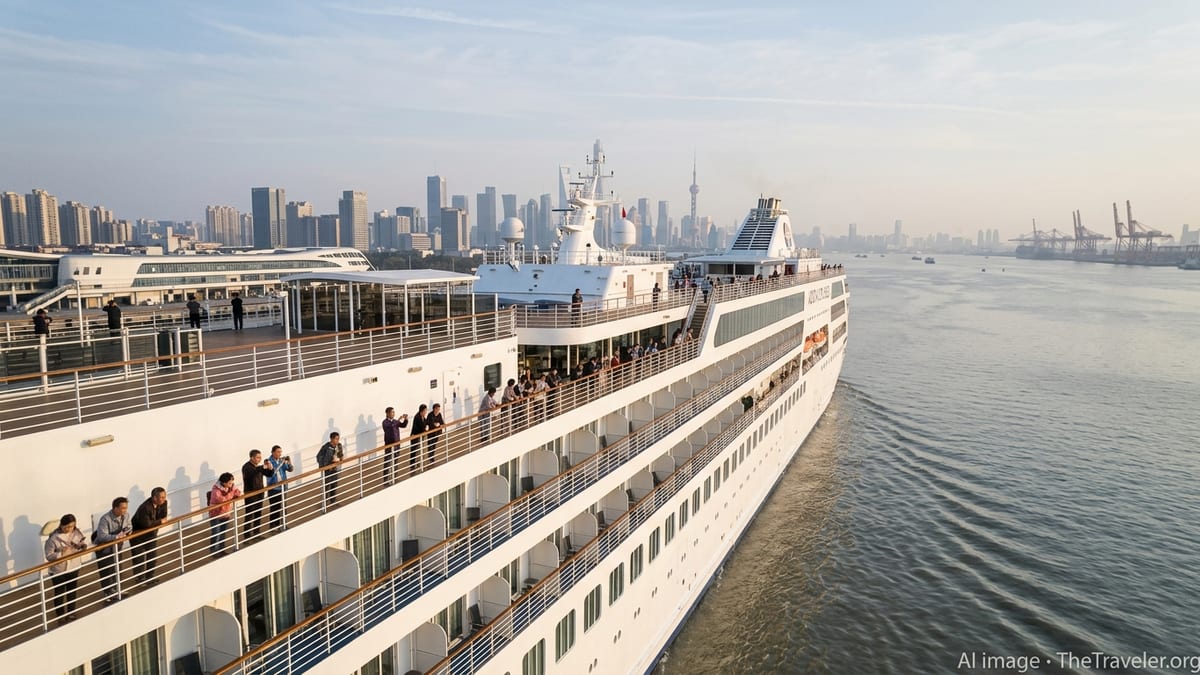
Adora Magic City, the first large cruise ship built in China to international standards, is at the forefront of the partnership’s expansion into overseas waters. The ship was designed by CSSC’s cruise technology arm and constructed at Shanghai Waigaoqiao Shipbuilding, with reports highlighting its capacity for more than 5,000 passengers and a gross tonnage exceeding 135,000. Its successful construction has been widely portrayed as a milestone in China’s ability to deliver complex, high-value cruise hardware.
Operational data for 2024 and early 2025 show Adora Magic City running frequent itineraries from Shanghai and other Chinese ports, including calls at destinations such as South Korea and Japan, as regional cruise markets reopen and expand. Port records from East Asian hubs indicate that the vessel has handled hundreds of thousands of passengers within its first year of commercial service, reflecting strong demand from both domestic and international travelers. Industry coverage also notes that the ship has participated in high-profile events, including major regional business summits, helping to showcase China’s homegrown cruise capabilities to overseas visitors.
Port authorities in China and neighboring countries have promoted new embarkation options linked to Adora Magic City, including semi-homeport operations that allow passengers to board the vessel at foreign ports. These moves are presented as part of a broader strategy to position Chinese-built ships on international routes, support multi-country cruise tourism packages and encourage cross-border spending tied to shopping, dining and shore excursions.
Second Newbuild and Fleet Integration Support Global Growth
Alongside Adora Magic City, CSSC shipyards are advancing construction of a second large cruise ship for Adora Cruises, often referenced in shipbuilding and classification documents as a next-generation unit with an even larger gross tonnage. Public reports state that this vessel is being built to international class standards, with an emphasis on increased capacity, upgraded public spaces and enhanced energy efficiency. Its launch and sea trials, projected for the coming years, are expected to significantly expand the capacity available to Adora for international deployment.
Adora’s growth strategy also includes integrating existing tonnage acquired from established global brands. Adora Mediterranea, originally built for an international cruise line, has been transferred into the Adora fleet and redeployed on itineraries from northern and southern Chinese ports. According to cruise industry databases, the ship operates short and medium-length international routes, complementing the newer China-built flagship and providing flexible deployment across different source markets.
Analysts of the Asia-Pacific cruise market point out that the combination of refitted legacy ships and new domestic builds gives Adora a blended fleet suited to both introductory and more premium cruise products. This structure is seen as important for capturing first-time Chinese cruisers while also appealing to experienced international travelers looking for new routes and culturally distinct onboard experiences.
CTG’s Tourism Network and Duty-Free Expertise Add Commercial Firepower
China Tourism Group’s role in the alliance extends beyond passenger sourcing to onboard and shoreside commercial operations. CTG’s duty-free subsidiary has opened branded retail spaces on Adora vessels, including on ships such as Mediterranea, where official company reports describe dedicated duty-free shops managed under CTG’s established travel retail model. These outlets are positioned to capture high-margin spending from cruise passengers on cosmetics, fashion, liquor and specialty goods.
CTG’s travel agencies and distribution partners are also promoting integrated cruise packages that link Adora sailings with flights, hotels and ground tours in key Chinese gateway cities. Examples highlighted in municipal and corporate announcements include air-sea packages developed with major airlines and online travel platforms, allowing international visitors to seamlessly connect to Adora cruises departing from Shanghai and other ports. This approach is intended to lower barriers to entry for foreign tourists and support higher load factors as Adora moves into longer and more diverse itineraries.
In domestic policy context, the alliance aligns with efforts by Chinese authorities to cultivate cruise tourism as a pillar of coastal economic development and consumer spending. Large-scale cruise festivals, port expansion projects and cruise economy pilot zones are frequently cited as beneficiaries of Adora’s deployment plans, reinforcing the link between the company’s fleet growth and regional tourism strategies coordinated with CTG’s broader portfolio.
Implications for Global Cruise Tourism Competition
The partnership among Adora Cruises, China Tourism Group and CSSC is emerging at a time when global cruise tourism is in a renewed growth phase, with major operators ordering larger ships and adding capacity across the Caribbean, Mediterranean and Asia-Pacific. Industry commentators note that China’s entry as a serious player in cruise ship construction and operation could recalibrate competitive dynamics, especially in Asia, where homegrown brands backed by state resources are now able to deploy large, modern vessels on international routes.
Market observers suggest that the presence of Chinese-built cruise ships in regional and potentially longer-haul itineraries may diversify source markets, attract new passenger segments and encourage ports to upgrade infrastructure to accommodate different ship classes. The integration of CTG’s duty-free and tourism assets is also expected to intensify competition in onboard retail and shore excursion design, areas where global cruise brands have traditionally held a lead.
While some analysts emphasize that China’s cruise sector is still catching up to established Western operators in terms of fleet size and brand recognition, the coordinated strategy around Adora, CTG and CSSC is widely described as a long-term play. As additional ships are delivered and more international sailings are introduced, the partnership is positioned to influence shipbuilding orders, route development and passenger expectations across the wider global cruise tourism market.