

More news on this day
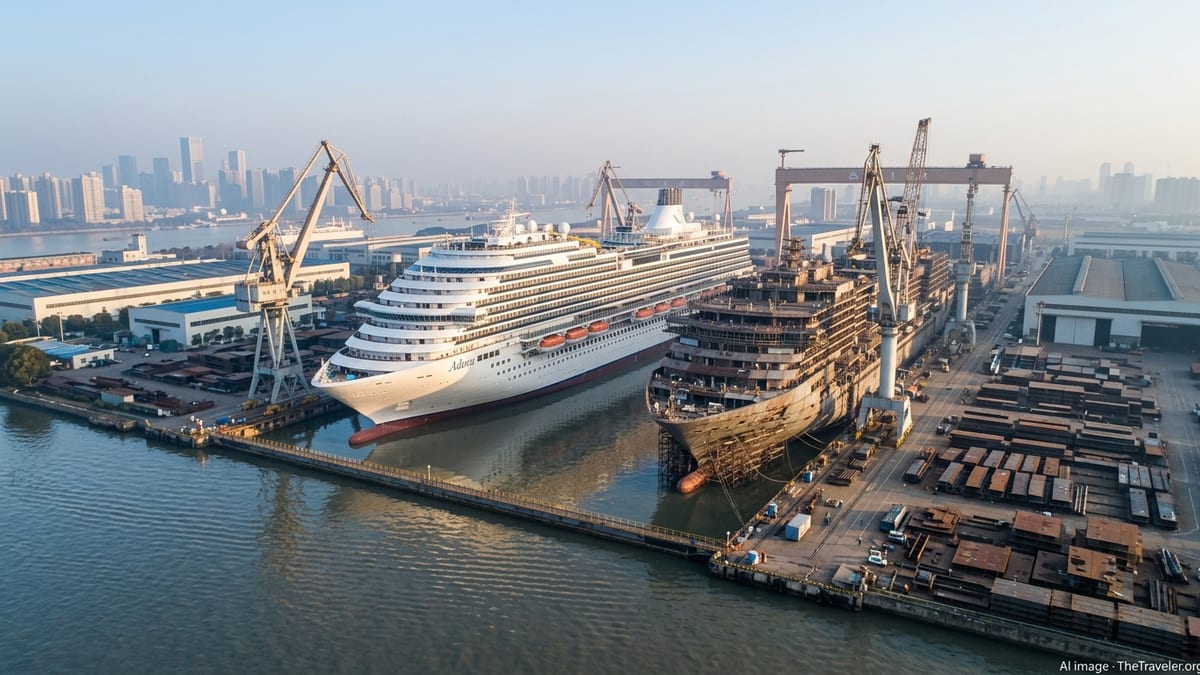
Adora Cruises is doubling down on China’s fast-growing cruise market with two large newbuilds under construction in Shanghai, a move industry observers see as a pivotal step in reshaping both the country’s shipbuilding ambitions and its outbound travel landscape.
Get the latest news straight to your inbox!
China’s First Homegrown Cruise Brand Scales Up
Adora Cruises, the Chinese brand backed by a joint venture involving China State Shipbuilding Corporation, has emerged as a flagship player in the country’s drive to build and operate its own large cruise ships. Publicly available information shows that the line already operates Adora Magic City, China’s first domestically built large cruise ship, alongside the refurbished Adora Mediterranea acquired from the Costa fleet.
The two new mega-ships now on order are being built at Shanghai Waigaoqiao Shipbuilding, the same yard that delivered Adora Magic City. Industry order books and trade coverage indicate that both vessels will be in the 140,000-gross-ton range, placing them in the global “mega-ship” category with capacities of around 4,000 to 5,000 passengers. Their construction signals that China aims not only to serve its domestic holidaymakers at sea, but also to compete in the upper tier of international cruise design and engineering.
Adora Magic City entered full commercial service after a series of sea trials and now sails year-round itineraries from Shanghai and other Chinese ports. Reports from Chinese and international cruise publications note that the ship has already completed dozens of voyages and carried hundreds of thousands of passengers, demonstrating robust demand for cruising among Chinese travelers who had few homegrown options a decade ago.
The decision to move ahead with two additional large ships reflects confidence that this demand will continue to grow, particularly as more Chinese middle-class families seek multi-day leisure travel that bundles accommodation, dining, shopping and entertainment into a single product.
Adora Flora City: A Larger Second Flagship
The first of Adora’s newbuild pair is Adora Flora City, described in shipyard and media reports as China’s second domestically built large cruise ship. Recent updates from the builder indicate that the vessel’s hull blocks have been assembled and floated out, with construction progress now measured at over 90 percent. Delivery is scheduled for late 2026, with entry into commercial service expected in 2027.
At roughly 142,000 gross tons and more than 2,100 cabins, Adora Flora City will be slightly larger than Adora Magic City. Design details released through trade press coverage point to expanded public areas, a larger atrium, more suites and amenities tailored specifically to Chinese tastes. The interiors are reported to emphasize Silk Road motifs and Lingnan cultural elements, reflecting the ship’s planned deployment from Guangzhou, often referred to domestically as the “Flower City.”
Shipyard statements cited in technical publications highlight that lessons learned from constructing the first ship have streamlined work on the second. Despite Adora Flora City’s greater size, total construction hours are expected to be reduced by about one fifth. This efficiency gain is seen within the industry as evidence that China’s cruise shipbuilding ecosystem is maturing rapidly, with implications that reach well beyond a single brand.
Once in service, Adora Flora City is anticipated to operate itineraries from Guangzhou to destinations in South and Southeast Asia, offering Chinese travelers regional cruises that compete directly with established international brands sailing from Hong Kong, Singapore and other hubs.
The Second Newbuild: Expanding Capacity and Reach
In addition to Adora Flora City, Adora Cruises has a second large newbuild on order at Shanghai Waigaoqiao Shipbuilding, giving the brand a total of two mega-ships in the pipeline. Industry orderbook data lists both new vessels as similar in size, hovering just under or around 142,000 gross tons with capacities surpassing 4,000 lower berths, though final configuration details for the third ship in the overall fleet have not yet been widely disclosed.
Together, the two new ships will significantly expand Adora’s capacity beyond its current trio of vessels. Analysts tracking Asia’s cruise sector note that this will position the company to operate a multi-homeport model focused on Shanghai, Guangzhou, Qingdao and potentially additional coastal cities. Such a strategy would mirror the network approach used by North American and European cruise brands, but tuned to the specific travel patterns and holiday calendars of Chinese guests.
While exact deployment plans for the second newbuild have not been made fully public, trade publications suggest that itineraries may range from short coastal sailings to week-long cruises reaching Japan, South Korea and Southeast Asia. This would deepen the integration of China into regional cruise circuits and create new options for foreign travelers interested in embarking in Chinese ports.
For China’s shipbuilding industry, handling two large cruise projects in parallel is viewed as a test of capacity and know-how. Success could pave the way for additional orders, either for Adora itself or for other brands seeking to tap into Chinese yards for future mega-ships.
Transforming China’s Travel and Tourism Landscape
The ramp-up of Adora’s fleet is unfolding against a backdrop of strong recovery in China’s domestic tourism and gradual normalization of outbound travel. Official statistics and industry monitoring show that Chinese holidaymakers are again traveling in large numbers within the country and across Asia, driven by rising incomes and pent-up demand after years of restrictions.
Large cruise ships like those ordered by Adora are designed to function as floating resorts, combining Chinese and international dining, retail, live entertainment and family activities. For many passengers, these vessels become destinations in their own right, framing port calls in Shanghai, Guangzhou or Qingdao as part of a broader onboard experience. As more Chinese travelers gain exposure to cruising, the segment is expected to take a larger share of the country’s leisure spending.
The presence of homegrown ships is also considered important symbolically. Reports in Chinese business media characterize Adora Magic City and its sister ships as milestones in moving the country up the value chain from building bulk carriers and container ships to mastering the far more complex systems of modern cruise vessels. For travelers, this translates into ships tailored more closely to local preferences, from language and payment systems to entertainment lineups.
Regional tourism destinations stand to benefit as well. With Adora Flora City set to operate from Guangzhou and the second newbuild likely to add further capacity from China’s eastern seaboard, ports across Japan, South Korea, Vietnam and other neighboring markets can anticipate more frequent calls from Chinese-operated ships, bringing new waves of visitors and spending.
Global Implications for the Cruise Industry
Adora Cruises’ decision to commission two new mega-ships has drawn attention across the global cruise sector, where orderbooks are once again swelling after a multi-year slowdown. Industry observers note that China is one of the few countries seeking to build large cruise ships domestically rather than relying on established yards in Europe, which have traditionally dominated the segment.
If the Adora program continues on schedule, China will soon count three homebuilt mega-ships in active service, all operating under a local brand and catering primarily to Chinese guests. This development adds a new competitive dimension to the global market, especially in Asia, where Western brands have long supplied most cruise capacity.
The two new Adora ships are also part of a wider pattern in which cruise lines pursue ever-larger vessels to capture economies of scale, add onboard revenue streams and generate marketing impact. While Adora’s ships are smaller than the record-breaking giants ordered by some North American brands, they are firmly in the mega-ship category and will rank among the largest operating in Asian waters.
For travelers, the practical impact will be felt in an expanding menu of itineraries, cabin categories and onboard experiences offered from Chinese ports. As Adora integrates its two newbuilds into the fleet later this decade, the brand is likely to play a central role in defining what cruising from China looks like for both domestic and international passengers.