

More news on this day
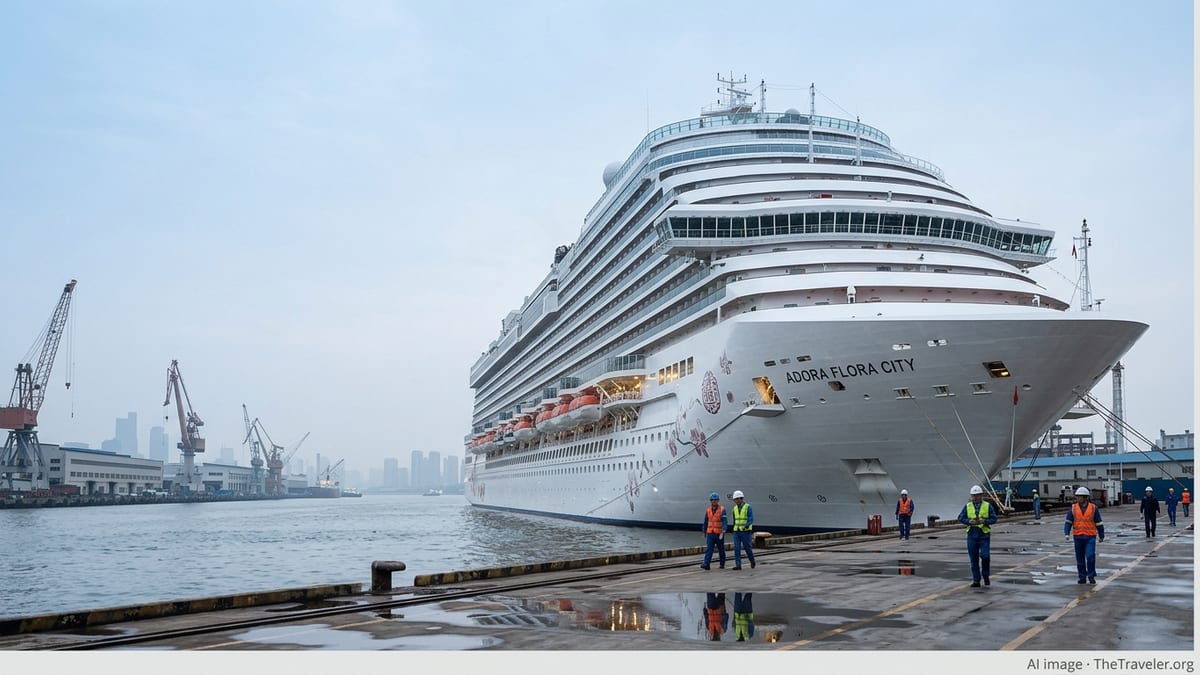
Shanghai is preparing to welcome Adora Flora City, China’s second domestically built large cruise ship, as it nears completion with a concept that fuses Chinese cultural elements and contemporary luxury aimed at both domestic and international travelers.
Get the latest news straight to your inbox!
A New Flagship for China’s Cruise Ambitions
Adora Flora City is emerging as a milestone project for China’s fast-developing cruise industry. Built at Shanghai Waigaoqiao Shipbuilding and designed as a sister vessel to Adora Magic City, it represents the country’s next step in shifting from primarily importing cruise vessels to constructing and operating them domestically. Industry coverage indicates that structural construction and major engineering work are largely complete, with the focus now on interiors, equipment installation and systems testing ahead of its expected delivery in late 2026.
Classed as a Vista-class cruise ship, Adora Flora City is reported to have a gross tonnage of about 142,000 and a length of roughly 341 meters, making it slightly larger than its earlier sister. The expanded dimensions allow for additional cabins and public spaces, with capacity to host more than 5,200 passengers at full load. Observers note that this scale places the ship firmly in the mainstream of global large-ship cruising, while still falling below the size of the very largest mega-ships operated by established Western brands.
The ship is being positioned as a showcase for China’s capabilities in complex shipbuilding, combining local industrial supply chains with design know-how adapted from international cruise standards. Analysts tracking the project suggest that Adora Flora City is intended to demonstrate that Chinese yards can handle repeat-build cruise projects with timelines comparable to long-established European builders, a key factor if China aims to become a significant exporter of cruise vessels in the future.
While its homeport operations are expected to be centered on Guangzhou’s Nansha Cruise Home Port after delivery, Shanghai’s shipyards and cruise terminals are playing a central role in the vessel’s path to market. Sea trials, fitting-out work and promotional activities are reinforcing Shanghai’s position as a strategic hub for the country’s cruise cluster, from engineering and logistics to marketing and itinerary planning.
Design Details: Bigger, Sleeker and Passenger-Focused
Published technical information shows that Adora Flora City builds on the basic platform of Adora Magic City while stretching the hull and reconfiguring internal spaces to boost capacity and enhance passenger flow. The ship will feature a 16-deck superstructure, with additional length allowing designers to refine the layout of cabins, restaurants and entertainment zones. Reports indicate that the number of cabins will reach around 2,144, an increase over its predecessor, and that public areas have been optimized to reduce congestion during peak times such as embarkation and evening events.
From an engineering standpoint, the vessel follows the diesel-electric paradigm common in contemporary cruise design, combining large power output with emphasis on fuel efficiency and reduced emissions relative to older fleets. Although Adora Flora City is not reported to adopt liquefied natural gas propulsion, industry commentary notes that energy-saving hull forms, advanced waste-heat recovery and optimized hotel systems are being incorporated to meet tightening environmental regulations in regional waters.
Passenger-facing design choices also appear closely attuned to China’s maturing cruise market. Cabin categories are expected to skew toward ocean-view and balcony accommodations, reflecting rising demand for private outdoor space among Chinese leisure travelers. Publicly shared renderings and design notes highlight generous atrium spaces, panoramic lounges and large family-friendly recreation areas intended to appeal to multi-generational groups, a key segment in Asia’s cruise demographics.
Connectivity and digital infrastructure are another focal point. Following the model of Adora Magic City, which debuted with extensive 5G coverage on board, Adora Flora City is anticipated to integrate high-bandwidth networks to support mobile payments, app-based services, real-time language support tools and smart-cabin functions. For international travelers, this is likely to translate into robust Wi-Fi, seamless check-in experiences and more personalized digital concierge services.
Celebrating Chinese Culture at Sea
One of the defining themes of Adora Flora City’s concept is its emphasis on Chinese cultural expression in both design and onboard experiences. Drawing on the “Flora City” name, early descriptions suggest that floral motifs associated with southern Chinese cities and Lingnan aesthetics will appear throughout public areas, from lobby artworks and carpets to lighting installations and outdoor landscapes. This approach mirrors broader trends in Chinese hospitality, where hotels and resorts increasingly embed local culture into architecture and interiors rather than relying solely on international design templates.
Food and beverage offerings are expected to be a major cultural touchpoint. Building on the strong response to regional cuisine on Adora Magic City, observers anticipate a curated mix of Cantonese, Sichuan, hotpot and snack-style venues alongside international options. Such a lineup is aligned with the tastes of domestic travelers, for whom dining is often a central component of the travel experience, while also offering international guests a structured introduction to Chinese culinary traditions in a familiar cruise format.
Entertainment programming is likely to lean heavily into Chinese performing arts, festivals and lifestyle activities. Public information on the wider Adora Cruises brand indicates a focus on integrating seasonal themes such as Lunar New Year, Mid-Autumn and maritime festivals into onboard events. For Adora Flora City, this may translate into night-time deck celebrations, lantern-inspired light shows, and stage productions that combine acrobatics, dance and multimedia storytelling about coastal cities along the ship’s itineraries.
Cultural interpretation is also expected to extend to retail and enrichment. Duty-free spaces are anticipated to stock Chinese designer brands and regional specialties alongside familiar global labels, while enrichment programs may feature calligraphy, tea culture and language taster sessions. For international visitors, these elements could position the ship itself as a curated window onto contemporary Chinese culture, complementing shore excursions in Shanghai, Guangzhou and beyond.
Modern Luxury for Domestic and International Travelers
In step with China’s broader shift toward higher-end leisure consumption, Adora Flora City is being framed as a modern luxury product rather than a budget mass-market ship. This is reflected not only in its size and hardware, but also in the layering of premium experiences on board. Industry reports point to expanded suites and club-level areas, concierge services and private restaurants designed to attract affluent travelers who might otherwise choose high-end hotels or international cruise brands.
Wellness and relaxation amenities are set to be central to this positioning. Building on patterns seen across new-build cruise ships worldwide, Adora Flora City is expected to feature a large spa, thermal suites, adult-only quiet zones and panoramic pool decks. These areas are likely to combine Asian and Western wellness concepts, pairing traditional therapies such as Chinese-style massage and herbal treatments with contemporary fitness studios, jogging tracks and rooftop lounges.
Family travel remains a core market, and available information suggests that the ship will devote significant space to children’s clubs, water features and interactive play areas. With demographic data pointing to growing numbers of multi-generational cruise parties in China, the challenge for designers has been to offer enough variety for children and grandparents alike without diluting the upscale ambiance. Observers note that tiered zoning, sound management and careful scheduling of activities are key tools to achieve this balance.
Service design, from multilingual announcements to payment systems, is also expected to reflect the dual ambition of serving a predominantly Chinese clientele while remaining accessible to international guests. Public materials indicate a continued reliance on digital interfaces, including QR-based restaurant reservations, e-menus and app-guided wayfinding. For overseas visitors, an emphasis on English-language signage and staff training could make Adora Flora City an approachable way to experience a Chinese cruise product while still enjoying familiar standards of modern comfort.
Shanghai’s Expanding Role in Asia’s Cruise Market
The emergence of Adora Flora City underscores Shanghai’s importance as a center of gravity for China’s cruise sector, even as the ship is ultimately slated to be based in Guangzhou. The vessel’s construction in Shanghai Waigaoqiao Shipbuilding has drawn attention to the city’s ambitions to build a full industrial chain around cruise tourism, spanning high-value shipbuilding, supply logistics, finance, training and marketing.
Shanghai’s Wusongkou International Cruise Terminal, which has already hosted the maiden voyages and regular departures of Adora Magic City, is widely viewed as a testbed for the operational concepts that will later be applied to Adora Flora City. Process innovations at the terminal, such as streamlined check-in flows, digital customs procedures and multi-ship coordination, are being closely watched by regional ports aiming to raise their own standards for handling large passenger volumes.
For the wider Yangtze River Delta region, Adora Flora City symbolizes a shift toward more domestically controlled cruise value chains. Rather than simply acting as a transit port for foreign-flag ships, Shanghai is positioning itself as a place where ships are designed, built, supplied and, in some cases, homeported under Chinese brands. Market analysts suggest that this could have knock-on effects for local tourism operators, retailers and cultural institutions, which stand to benefit from a more predictable flow of cruise passengers.
As Adora Flora City advances toward sea trials and eventual debut, attention is focusing on how effectively it can marry Chinese cultural storytelling with the comfort and reliability expectations of global cruise travelers. Its performance in the years following delivery is likely to be watched closely by ports, shipyards and tourism authorities across Asia, as they assess the potential for a distinctly Chinese model of modern, culturally rooted cruise luxury.