

More news on this day
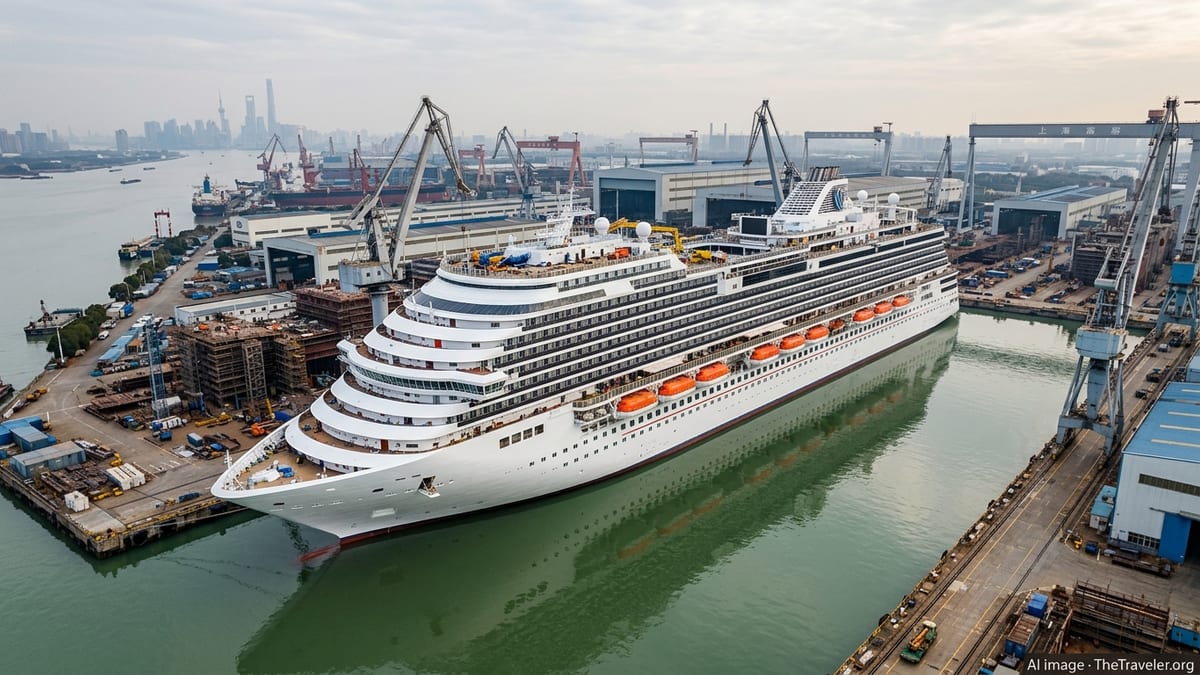
China’s second domestically built large cruise ship, Adora Flora City, has undocked in Shanghai, marking a fresh milestone for the country’s fast‑growing cruise industry and its ambitions in high‑end shipbuilding.
Get the latest news straight to your inbox!
A New Flagship for China’s Homegrown Cruise Ambitions
The undocking of Adora Flora City at Shanghai Waigaoqiao Shipbuilding places China a step closer to fielding a second domestically built large cruise vessel, following the Adora Magic City that entered commercial service in early 2024. Publicly available information shows that Adora Flora City is part of the Vista‑class platform developed with technology input from established European builders, adapted for China’s maturing cruise market.
Reports indicate that Adora Flora City will measure around 341 meters in length with a gross tonnage of approximately 141,800, making it longer and slightly larger than its sister ship. Industry coverage notes that the vessel is designed to carry more than 5,000 passengers, positioning it among the world’s bigger contemporary cruise ships and underlining China’s progress from buyer to builder in this specialized segment.
The undocking signals that hull construction and much of the heavy steelwork have been completed, allowing the ship to move from dry dock into the water for outfitting and systems integration. This transition is widely viewed within the cruise supply chain as a critical threshold, when a project shifts from structural work to the detailed interior and hotel‑style fit‑out that define the onboard experience.
According to coverage of the shipyard’s schedule, Adora Flora City is slated for dockside tests, followed by sea trials beginning in late spring, with delivery targeted by the end of 2026. That timeline, if met, would bring China’s large‑cruise construction cadence close to that of leading European yards.
Shanghai’s Role in Accelerating China’s Cruise Cluster
Shanghai has become a focal point for China’s cruise ambitions, both as a construction hub and a major embarkation port. Waigaoqiao, on the city’s eastern waterfront, hosts the complex assembly of Adora Flora City, while terminals such as Wusongkou have been handling the growing flow of passengers on homeported and visiting ships.
Industry analysis suggests that the undocking of Adora Flora City strengthens Shanghai’s position as a full‑chain cruise center, combining design, building, and operations within a single metropolitan region. Local policy documents in recent years have highlighted cruise tourism as a strategic service sector, linked to wider goals for consumption upgrades and maritime industry development.
Adora Cruises, backed by China State Shipbuilding Corporation with Carnival Corporation as a minority partner, is expected to base vessels at several Chinese ports, with earlier announcements pointing to Guangzhou Nansha as a future homeport for Adora Flora City. The construction and undocking in Shanghai, however, underscore how the city anchors the technical and industrial side of the program.
Observers note that repeated large‑ship projects at Waigaoqiao are helping to consolidate a localized ecosystem of designers, marine engineers, interior contractors, and equipment suppliers. This clustering effect is seen as essential for sustaining China’s move into higher‑value segments of shipbuilding beyond bulk carriers and container vessels.
Shipbuilding Innovation and Supply Chain Upgrading
Coverage from trade media and Chinese outlets emphasizes that Adora Flora City benefits from a more efficient construction process than its predecessor. Reports from the yard indicate that the main structural phase was completed several months faster than Adora Magic City, suggesting a learning‑curve effect that narrows the gap with European builders accustomed to serial cruise‑ship production.
The second Vista‑class vessel incorporates more locally supplied systems, from power generation and hotel services to communications and navigation equipment. Public information from the builder suggests that the proportion of domestically produced components has increased, which aligns with national industrial policy goals to localize key technologies and capture more value within the domestic supply chain.
Technical milestones reported during the build, such as the powering up of the main generator sets and the vessel’s earlier float‑out into the shipyard basin, highlight the complexity of coordinating marine engineering, safety systems, and hotel‑style amenities. The undocking phase adds another layer of testing, as equipment is energized and integrated while the ship is afloat, preparing it for sea trials in open water.
Analysts following the sector suggest that each stage of Adora Flora City’s progress serves as a test bed for standards, project management methods, and design tools that could support additional Chinese‑built cruise ships or large passenger vessels in the future. The experience is viewed as a strategic asset, potentially enabling Chinese yards to compete more effectively for international orders in the longer term.
Implications for China’s Domestic Cruise Market
The arrival of a second big homegrown cruise ship coincides with a rebound in China’s outbound and coastal tourism. After several years of restrictions, cruise itineraries from Chinese ports have been ramping up, with Adora Magic City already operating regional routes and foreign brands gradually returning capacity to the market.
Industry commentary suggests that Adora Flora City will be positioned to capture growing demand from middle‑income travelers seeking short‑haul regional cruises in East Asia, including routes to Japan and Southeast Asia, as well as domestic sailings along China’s coast. The ship’s larger size and updated onboard amenities are expected to target family groups and multi‑generational travelers, a key demographic in the Chinese leisure market.
By adding capacity built in China for a Chinese‑focused brand, Adora Flora City also offers regulators and port authorities more scope to tailor itineraries, onboard services, and digital experiences to local preferences. Public descriptions of the ship highlight expanded entertainment, dining, and retail spaces, as well as upgraded connectivity, aligning with broader trends in the global cruise sector.
Observers note that sustained deployment of modern ships under a domestic flag may also support year‑round utilization of Chinese cruise terminals, smoothing seasonal swings and encouraging ancillary investment in hotels, attractions, and transport links in port cities such as Shanghai and Guangzhou.
Regional and Global Significance
Beyond the national market, the undocking of Adora Flora City carries symbolic weight in the international cruise and shipbuilding arenas. Europe and Japan have historically dominated large‑cruise construction, and China’s emergence with successive, increasingly sophisticated vessels is closely watched by global competitors.
Trade analysts point out that the Adora program demonstrates how knowledge transfer and joint ventures can accelerate capability building, while also raising new questions for international yards about future competition. For now, most assessments suggest Chinese builders will focus on meeting domestic and regional demand, but the experience gained on Adora Flora City could eventually be applied to export projects.
Regionally, the growth of a Chinese‑flag cruise fleet is likely to reinforce East Asia’s role as a crucial theater for the global industry, complementing established hubs in the Mediterranean and Caribbean. Additional deployment of large ships in Asian waters may prompt ports across the region to upgrade infrastructure and services to attract calls from Adora Cruises and other brands.
As Adora Flora City moves through outfitting, mooring trials, and open‑sea testing toward its planned 2026 delivery, industry observers will be watching how reliably China can repeat complex cruise‑ship builds. The smooth undocking in Shanghai suggests that the country’s long‑term bet on cruise tourism and advanced shipbuilding is beginning to show tangible results on the water.