

More news on this day
AEGEAN Airlines is set to launch a new direct service between Casablanca and Athens on October 25, 2026, a strategic move designed to tighten economic ties and expand tourism flows between Morocco and Greece while plugging North Africa’s leading business hub into the Greek carrier’s fast-growing international network.
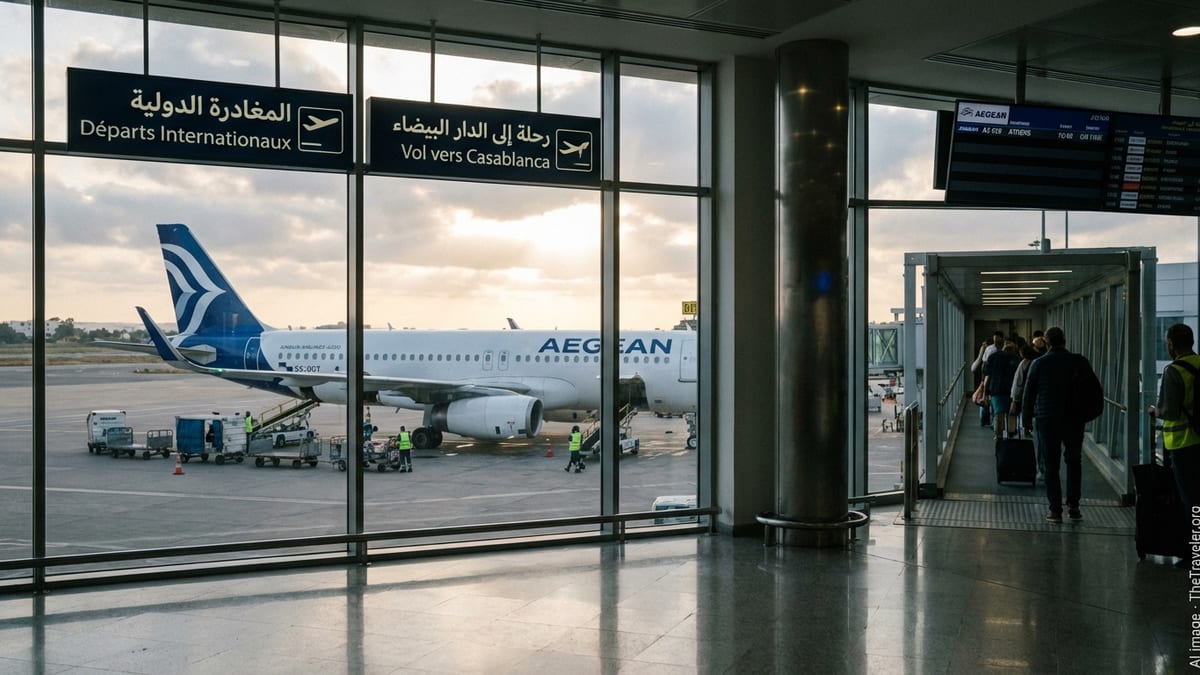
New Route Connects Casablanca to Athens Twice Weekly
The new Casablanca–Athens route will operate twice a week, with flights scheduled on Mondays and Fridays, according to the airline’s recently released schedule details. By opting for these high-demand travel days, AEGEAN is positioning the service to capture both corporate traffic at the start and end of the workweek and leisure travelers seeking long weekend getaways.
Casablanca Mohammed V International Airport, Morocco’s busiest aviation gateway, will be directly linked to Athens International Airport, the primary hub for AEGEAN and a major platform for Southern and Southeastern Europe. The roughly three-and-a-half-hour service is expected to shorten journey times significantly for travelers who previously relied on one-stop connections via major European hubs.
The route also slots neatly into AEGEAN’s broader expansion strategy, which in recent seasons has included new long and medium-haul services to markets in the Middle East and South Asia, alongside added frequencies to key European capitals. The Casablanca launch extends that footprint into an increasingly competitive North African corridor where connectivity has become central to trade and tourism policy.
Strategic Timing Amid Growing Bilateral Cooperation
The timing of the new service coincides with a period of renewed diplomatic and economic engagement between Rabat and Athens. Both governments have highlighted maritime cooperation, renewable energy projects and cultural exchange as priority areas, and better air links are seen as a practical prerequisite for turning memoranda and investment intentions into concrete projects.
Greek officials have repeatedly underlined the importance of diversifying economic partners across the Mediterranean, while Moroccan policymakers are seeking to deepen ties with European Union members beyond their traditional partners in France and Spain. Direct connectivity between Casablanca and Athens is expected to make ministerial visits, business missions and trade delegations more efficient and more frequent.
Industry analysts note that air routes often follow, and then accelerate, political rapprochement. In this case, the service arrives as both countries seek a bigger role in regional logistics chains linking Europe, Africa and the Middle East. For Greece, the route supports its ambition to act as a gateway to the EU for North African trade and investment; for Morocco, it provides a new point of access into Eastern and Southeastern Europe.
Economic Upside for Business and Trade Links
From a business perspective, the Casablanca–Athens route offers new opportunities for companies in sectors ranging from shipping and logistics to agri-food, construction, energy and technology services. Casablanca is a financial and corporate hub for francophone Africa, while Athens has been pushing to reinforce its profile as a regional headquarters location, particularly for maritime and energy-related activities.
Executives and entrepreneurs on both sides are expected to benefit from shorter, more predictable journeys that do not require transiting through traditional northern European gateways. The direct link should help facilitate deal-making, site visits, trade fairs and participation in industry conferences hosted in both countries, especially as the route’s schedule is designed to allow for short business trips of two to three days.
In parallel, the service will make it easier for Moroccan exporters to connect with partners and distributors across Greece and its neighboring markets. By hubbing through Athens, cargo carried in the belly holds of passenger jets can be redistributed across AEGEAN’s European routes, improving the competitiveness of Moroccan exports such as fresh produce, automotive components and textiles. Greek exporters in sectors like pharmaceuticals, chemicals and manufactured goods stand to gain similar efficiencies in serving North African and West African markets accessed via Casablanca.
Tourism Flows Set to Benefit in Both Directions
Tourism stakeholders in both countries see the new link as an important enabler for more diversified itineraries across the Mediterranean. Greek travelers will have easier access to Morocco’s Atlantic and imperial cities, desert experiences and cultural heritage sites, opening the door for twin-center holidays that combine Greek islands or mainland sightseeing with Moroccan city breaks.
For Moroccan travelers, the route offers streamlined access to Athens, a city whose mix of ancient heritage, contemporary culture and expanding culinary scene has propelled it into the ranks of Europe’s most dynamic city-break destinations. From Athens, passengers can connect onto AEGEAN’s extensive domestic network to reach islands such as Crete, Rhodes, Santorini or Corfu, as well as lesser-known destinations that are increasingly marketed to North African visitors.
Tour operators in both markets are expected to design new packages built around the twice-weekly schedule, allowing for four or seven-night stays that align neatly with leisure demand patterns. The service should also support niche segments including conference and incentive travel, religious tourism, cruise extensions and sports-related trips, especially as major events in both countries attract more international attention.
AEGEAN’s Network Strategy and Fleet Expansion
The Casablanca route is part of a wider network strategy that has seen AEGEAN deepen its presence in emerging markets around the Mediterranean while leveraging Athens as a connection point to the rest of Europe. In recent years, the carrier has launched or expanded services to destinations in the Middle East and is preparing for new long-thin routes to South Asia, backed by a modernized fleet.
AEGEAN operates primarily Airbus A320 and A321 family aircraft and has committed to additional A321neo jets with extended range capabilities to reach markets between four and seven and a half hours from Greece. These aircraft, configured with fewer seats and upgraded cabins, are designed to support routes where premium demand, business connectivity and longer stage lengths justify enhanced onboard product and range.
The Casablanca service fits within this framework of selective medium-haul expansion. It reinforces AEGEAN’s role not only as Greece’s flag carrier but as a regional connector linking EU markets with nearby non-EU economies. For Athens International Airport, the new link contributes to its strategy of consolidating hub status by broadening its portfolio of destinations in North Africa and the broader Mediterranean basin.
Gateway to Wider Regional Networks
One of the key advantages of the Casablanca–Athens service is its role as a bridge to wider regional networks on both sides. From Athens, passengers originating in Morocco gain one-stop access to dozens of European, Balkan and Eastern Mediterranean destinations, many of which are not easily served from Casablanca via other hubs.
This expanded reach is particularly valuable for travelers heading to secondary or regional cities, where existing options may involve long transits or complex routings. By flying into Athens and continuing on AEGEAN’s network, passengers can more efficiently reach cities in countries such as Italy, Germany, Cyprus, Serbia or Bulgaria, along with seasonal holiday destinations across the Greek islands.
In the opposite direction, travelers from Greece and neighboring countries gain a new gateway into North and West Africa via Casablanca. Morocco has positioned itself as a regional platform for financial services, aviation, logistics and manufacturing with strong links into sub-Saharan markets. Improved connectivity from Athens into this ecosystem can support new trade corridors, investment flows and corporate partnerships beyond the bilateral relationship alone.
Opportunities for Moroccan and Greek Diaspora Communities
The direct service is also expected to resonate with diaspora communities, students and professionals who maintain ties across the Mediterranean. While Moroccan and Greek communities are more strongly concentrated in Western and Northern Europe, growing numbers of students, seasonal workers and business professionals circulate through both countries and their wider regions.
For Moroccan residents with family or professional links in Greece and neighboring states, the route provides a more straightforward travel option that avoids the need to backtrack through third-country airports. Similarly, Greeks living or working in North and West Africa can use Casablanca as a stepping stone back to Athens and onward to the Greek islands or mainland cities.
Universities, cultural institutes and language schools will likely find the new route useful when organizing exchanges, summer programs and academic collaborations. The easier it becomes for students and researchers to travel between the two countries, the more scope there is for joint research projects, cultural festivals and educational partnerships that reinforce people-to-people ties.
Local Market Impact in Casablanca and Athens
At the local level, both Casablanca and Athens stand to gain from increased passenger volumes, airport activity and ancillary spending generated by the new link. Casablanca’s role as Morocco’s commercial capital and one of Africa’s key financial centers makes it a logical choice for airlines seeking to tap into corporate demand and high-yield traffic segments.
Hotels, conference venues and service providers in Casablanca are likely to benefit from more frequent visits by Greek and European delegations routing via Athens, especially in sectors such as banking, engineering, maritime services and renewable energy. Retailers and hospitality operators at Mohammed V International Airport can also expect higher footfall from transfer and origin–destination passengers on the new route.
In Athens, the service adds another non-EU origin point feeding into the city’s tourism and business ecosystem. Visitors arriving from Morocco will contribute to hotel occupancy in the shoulder and off-peak seasons, aligning with efforts by Greek authorities and industry bodies to promote year-round tourism. Additional traffic also supports retail, dining and cultural institutions in the Greek capital as it continues to reposition itself as a city-break destination in its own right, not only a gateway to the islands.