

More news on this day
Aegean Airlines has broadened its network-wide response to the escalating conflict in the Middle East, adding Israel to a growing list of suspended destinations that already includes Iraq, Lebanon, the United Arab Emirates and Saudi Arabia, with cancellations now affecting recently launched routes through March 13, 2026.
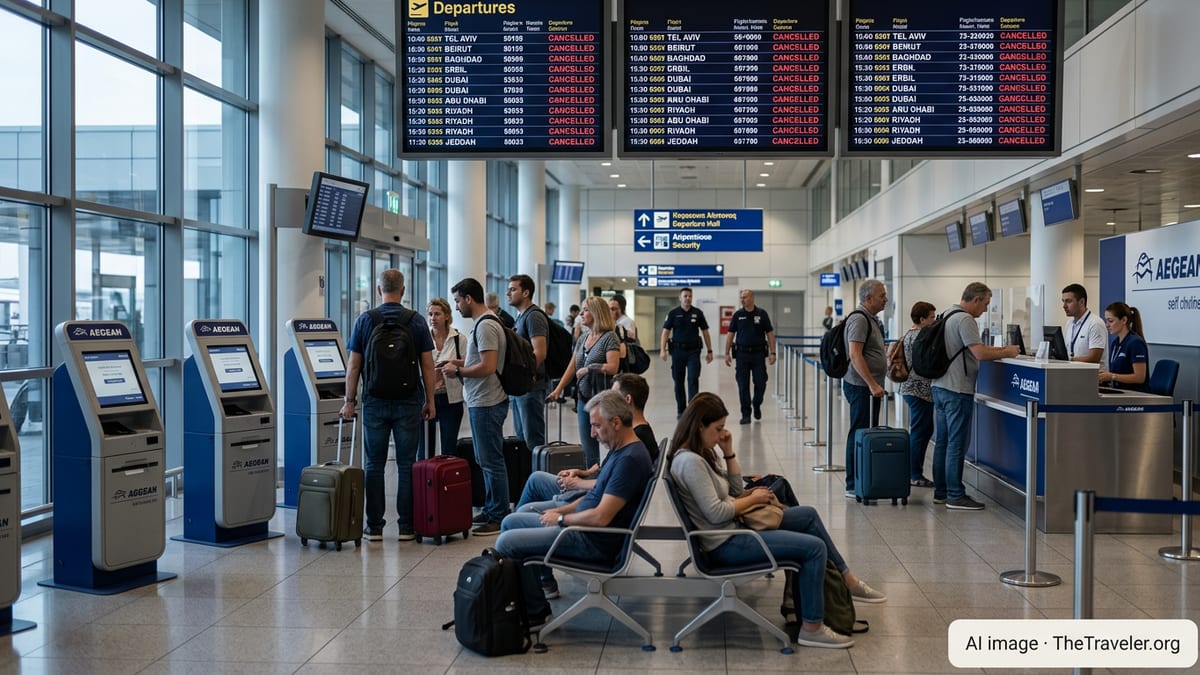
Expanded Cancellations Reach Key Middle East Gateways
The Greek carrier confirmed in updated travel advisories that additional flights to and from Tel Aviv, Beirut, Baghdad, Erbil, Dubai, Abu Dhabi, Riyadh and Jeddah have been removed from the schedule as regional airspace closures and security concerns persist. The move formalizes Israel’s inclusion among routes already disrupted since late February and signals that normal operations in the region remain unlikely in the short term.
By extending suspensions through at least March 13, 2026 on several links, Aegean is effectively freezing much of its Middle East program at the start of the spring travel period. Services connecting Athens and other European gateways with Tel Aviv, Beirut and Iraqi cities had been earmarked as growth markets and were part of a broader strategy to position Athens as a bridge between Europe and the Eastern Mediterranean.
The cancellations come against the backdrop of a wider aviation crisis triggered by the latest flare-up in the Iran war and subsequent military exchanges involving Israel, the United States and armed groups across the region. Temporary airspace closures over Israel, Iraq and parts of the Gulf, combined with heightened risk assessments, have pushed carriers to reroute or ground aircraft, with Aegean joining a long list of airlines forced into rapid operational adjustments.
While some carriers have resumed limited operations into select hubs, Aegean’s latest schedule update indicates a more conservative stance. The airline is prioritizing crew safety and operational predictability over a quick return, even on high-demand routes such as Athens to Tel Aviv and Athens to Dubai.
Impact on New Routes and Athens as a Regional Hub
The timing of the suspensions is particularly sensitive for Aegean because several of the affected flights were newly ramped-up or recently inaugurated routes, designed to capture both leisure and corporate traffic. Connections between Athens and cities such as Erbil and Baghdad in Iraq, as well as expanded frequencies to Tel Aviv and Beirut, were intended to strengthen the airline’s presence in markets with strong diaspora and business ties to Greece and the wider European Union.
Instead, those plans are on hold just as forward bookings were expected to build ahead of Easter and the summer season. Travel agents in Athens and Thessaloniki report a wave of itinerary changes as passengers who had planned onward connections via Athens to Middle East destinations now scramble to rebook through alternative hubs or postpone their plans entirely.
The disruption also weighs on Athens International Airport’s positioning as a growing transfer hub between Europe and the Middle East. With Aegean suspending multiple regional links simultaneously, some of the connectivity gains built up over recent years are temporarily reversed. Competing European carriers that still maintain limited services into the Gulf or to Amman and Cairo may see a short-term uptick in connecting traffic as travelers seek replacement options.
For business travelers, the cancellations are especially challenging on routes where Aegean offered among the few direct links to Greece and southern Europe. Many corporate itineraries between Israel, Iraq or the Gulf and Greece now require longer travel times and multiple connections, increasing costs and uncertainty for companies with operations across the Eastern Mediterranean.
What Affected Passengers Can Expect
Aegean is offering broad flexibility measures to customers whose itineraries fall within the suspension window. Passengers holding tickets on flights to Tel Aviv, Erbil, Baghdad, Beirut, Dubai, Abu Dhabi, Riyadh and Jeddah up to mid to late March are being allowed to change their travel dates without rebooking fees, provided that their new flights are completed by April 30, 2026, subject to seat availability.
For those who prefer not to travel while the security situation remains volatile, the airline is providing the option to cancel and receive a credit voucher for future use. This credit can typically be applied toward any Aegean or Olympic Air operated flight, giving travelers the flexibility to reroute their trips later in the year once the regional outlook becomes clearer.
Customer service channels and call centers have reported high volumes as passengers seek clarification on specific flight numbers and dates, particularly on services scheduled close to the March 13 threshold. Aegean is advising travelers to monitor their booking status through official airline channels and to avoid heading to the airport before receiving confirmation that their flight will operate.
Travel insurers, meanwhile, are scrutinizing policy language as many standard plans contain exclusions related to war and armed conflict. Industry analysts note that passengers impacted by these cancellations are more likely to rely on airline-provided waivers and flexibility than on insurance payouts, underscoring the importance of the measures Aegean has put in place.
Regional Aviation Strains Ripple Beyond Aegean
Aegean’s expanded cancellations illustrate the broader strain on aviation networks across the Middle East as the conflict continues into March. Major Gulf and European carriers have cut or suspended services to Israel, Iraq, Lebanon and parts of the Gulf, and have rerouted flights to avoid sensitive airspace, adding flight time and operational complexity.
In the United Arab Emirates and Saudi Arabia, partial airspace restrictions and heightened security protocols have led to rolling schedule changes. Hub airports in Dubai, Abu Dhabi, Doha and Riyadh, which typically function as key connectors between Europe, Asia and Africa, are seeing fluctuating daily schedules and a patchwork of resumptions and suspensions as airlines reassess risk on an almost hourly basis.
The knock-on effects are being felt far beyond the immediate region. European and Asian travelers bound for destinations in Southeast Asia, India or East Africa via Middle Eastern hubs are encountering missed connections, extended layovers and last-minute rebookings on alternative routings. Aviation data providers estimate that thousands of flights across multiple carriers have been impacted since the latest round of hostilities began.
Industry observers say that Aegean’s decision to lock in cancellations through March 13 on select routes, rather than rolling changes every few days, may offer a degree of clarity for travelers and partners, even if it prolongs the disruption. By setting an explicit timeframe, the airline can better manage aircraft rotations and crew planning, while passengers gain a more concrete basis for rearranging their trips.
Outlook for Travel to the Middle East in the Coming Weeks
With the security situation still fluid and diplomatic efforts ongoing, airlines are preparing for continued volatility in Middle East operations beyond mid March. For Aegean, any decision to reinstate flights to Israel, Iraq, Lebanon, the UAE and Saudi Arabia will depend on the easing of airspace restrictions and an updated assessment of risks on the ground and in regional skies.
Travel industry experts caution that even once formal airspace closures are lifted, a phased restoration of capacity is more likely than a rapid return to full schedules. Priority will initially be given to essential travel and stranded passengers, with leisure and discretionary trips taking longer to normalize.
For travelers considering journeys to or through the region over the coming weeks, the advice from aviation authorities and tour operators is to remain flexible. Booking options that allow changes without heavy penalties, monitoring airline advisories closely and building in extra time for connections can help mitigate the risk of disruption.
Until there is a sustained de escalation of tensions, Aegean’s expanded cancellations, now including Israel alongside Iraq, Lebanon, the UAE and Saudi Arabia, are likely to remain a stark reminder that the Eastern Mediterranean’s role as a global air corridor is inseparable from the region’s geopolitical fault lines.