

More news on this day
Aegean Airlines is consolidating its role as a leading carrier in southeastern Europe, with publicly available 2025 results showing a 5 percent rise in consolidated revenue and a 6 percent increase in passenger numbers as the Greek market continues to surge.
Get the latest news straight to your inbox!
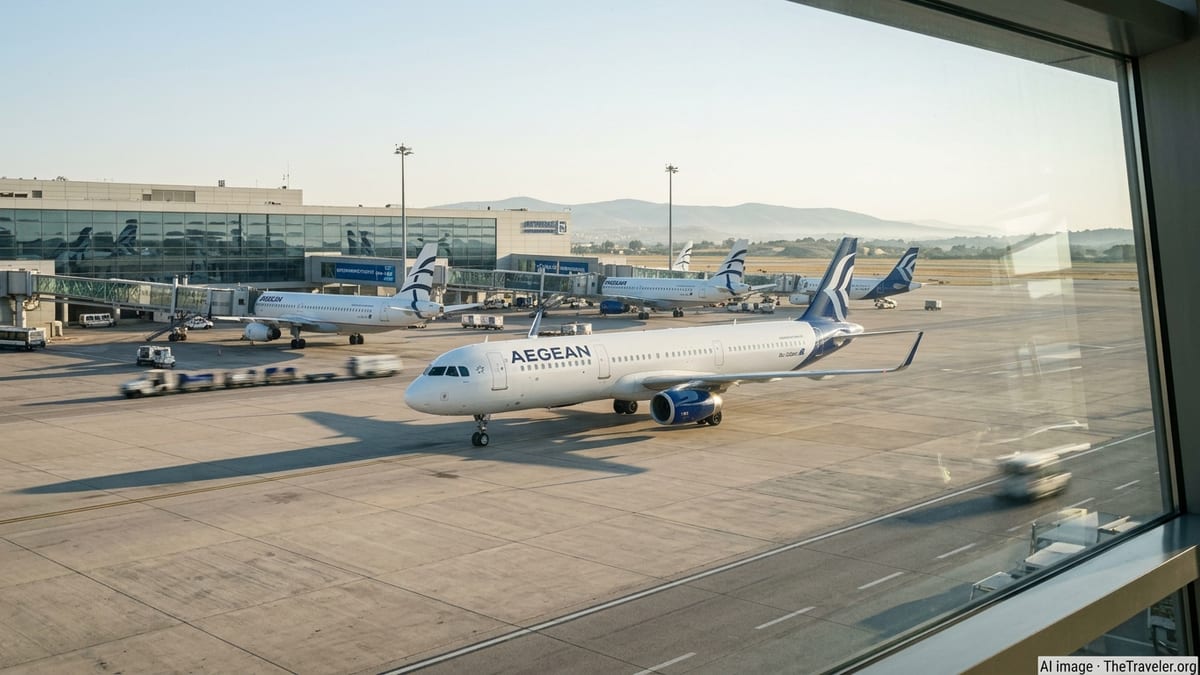
New Highs for Revenue and Passenger Traffic
According to recent financial disclosures and industry coverage, Aegean Airlines closed 2025 with consolidated revenue of about 1.86 billion euros, roughly 5 percent higher than in 2024. Reports indicate that passenger traffic climbed to around 17.3 million travelers for the year, nearly one million more than in 2024 and equivalent to a 6 percent annual increase. These figures extend the record levels first set in 2024, when the airline surpassed 16 million passengers and established a new turnover benchmark.
The latest data highlight a continuation of Aegean’s multi-year recovery and expansion, which has been supported by resilient leisure demand to and from Greece, as well as steadily improving performance in the winter season. The airline’s 2025 earnings also improved, with pre-tax and net profit figures rising at double-digit rates, signaling that growth is being translated into stronger margins rather than relying solely on volume.
Publicly available information on the nine-month period for 2025 had already pointed to this trajectory, with revenue up about 4 percent year on year and traffic indicators at new highs. The full-year results confirm that this momentum carried through the final quarter, despite persistent operational headwinds in the wider European aviation sector, including inflationary pressures and capacity constraints in airport and air traffic systems.
Strength in the Greek Market and Regional Network
Aegean’s latest performance is closely tied to the continued strength of Greece as a tourism destination. Recent statistics show that Greece’s travel receipts again exceeded pre-pandemic levels, with Athens and popular island destinations drawing robust international arrivals through both peak and shoulder seasons. Aegean, as the country’s largest carrier by market share at Athens International Airport, has been a primary beneficiary of this trend.
Industry reporting on Athens International Airport indicates that Aegean holds a market share of more than 40 percent at the capital’s hub, reinforcing its status as the dominant operator in the Greek market. The airline has leveraged this position by expanding frequencies on core European routes, deepening connectivity into secondary cities, and offering a wide range of seasonal services to leisure destinations. Its network in 2025 encompasses roughly 250 routes across 47 countries, covering both scheduled and charter flights.
Domestic connectivity remains another pillar of the group’s strategy. Together with subsidiary Olympic Air, Aegean links Athens, Thessaloniki, and regional airports on the mainland and islands, feeding international services and supporting year-round mobility for local communities. The combination of a strong home market, growing inbound tourism, and an integrated domestic–international network underpins the airline’s ability to maintain a leadership position against European competitors that also serve Greece.
Capacity Growth, Fleet Investment, and Operational Resilience
Reports on Aegean’s fleet strategy show that the airline entered 2025 with around 83 aircraft, including a growing number of Airbus A320neo and A321neo jets. The company has placed additional firm orders for A321neos, aiming to increase seating capacity while improving fuel efficiency and unit operating costs. These next-generation aircraft are central to the carrier’s medium-term plan to boost capacity on key routes and capture further demand from both European and regional markets.
The 2025 results follow a year in which Aegean navigated operational disruption from mandatory inspections of Pratt & Whitney geared turbofan engines, which temporarily grounded part of its neo fleet in 2024. Despite these challenges, publicly available financial information shows that the airline still delivered record revenue and passenger traffic that year, suggesting a degree of resilience in its business model. The subsequent improvement in 2025, with higher profitability and expanded traffic, indicates that the carrier has been gradually restoring and optimizing capacity as aircraft return to service and new deliveries arrive.
The focus on winter capacity growth has also been notable. Aegean has increased flights during traditionally weaker months, particularly on international routes, aiming to smooth seasonality and make better use of its fleet. Quarterly updates during 2025 highlighted double-digit increases in passenger traffic in the first quarter, reflecting this strategic push and contributing to the full-year gains in revenue and passenger numbers.
Competitive Position in Southeastern Europe
The combination of steady financial performance, fleet modernization, and network breadth is reinforcing Aegean’s position as a significant regional carrier in southeastern Europe and the eastern Mediterranean. While it remains smaller than Europe’s largest airline groups by overall scale, Aegean plays an outsized role in connecting Greece to major European hubs, regional capitals, and neighboring countries. Its membership in the Star Alliance further broadens its reach through codeshares and connecting itineraries, increasing its relevance for both business and leisure travelers.
Market analysts note that the airline’s strategy focuses on consolidating its stronghold in Greece while selectively expanding to underserved or growing markets in the wider region. Routes to the Balkans, Eastern Europe, the Middle East, and North Africa complement its dense Western European network, providing alternative one-stop options for passengers traveling via Athens. This positioning supports the airline’s stated emphasis on “extroversion,” or outward-looking growth, as highlighted in previous corporate communications.
With tourism to Greece projected to remain robust and infrastructure improvements under way at key airports, Aegean’s latest results suggest it is well placed to benefit from ongoing travel demand. The 5 percent revenue increase and 6 percent rise in passengers in 2025 underline a pattern of incremental, sustainable growth that strengthens its competitive stance in the region.
Outlook for 2026 and Strategic Priorities
Forward-looking commentary in recent trading updates indicates that Aegean plans to continue increasing capacity in 2026, supported by the arrival of additional Airbus neo-family aircraft and further optimization of its schedule. Network plans point to more frequencies on high-demand routes, deeper seasonal offerings to island destinations, and continued experimentation with new city pairs that can feed its hubs in Athens and Thessaloniki.
At the same time, the airline is contending with industry-wide challenges, including elevated fuel prices, inflationary cost pressures, and environmental regulations that are reshaping fleet and network planning across Europe. Aegean’s investment in more fuel-efficient aircraft, along with efforts to improve operational efficiency and maintain a solid liquidity position, are viewed as key to sustaining its recent performance.
The broader context for 2026 also includes competitive dynamics from low-cost carriers and large network airlines expanding their presence in Greece, particularly during the summer season. Nonetheless, Aegean’s entrenched domestic network, brand recognition among travelers to Greece, and consistent profitability provide a platform from which it seeks to defend and extend its lead. If current trends continue, industry observers suggest that the airline’s 2025 results may serve as a baseline for further incremental gains in both revenue and passenger traffic in the years ahead.