

More news on this day
Aegean Airlines is extending and deepening flight cancellations across the Middle East as the Iran war and regional security fears ripple through airspace, creating fresh uncertainty for Greece’s tourism sector and thousands of travelers heading into the spring shoulder season.
Get the latest news straight to your inbox!
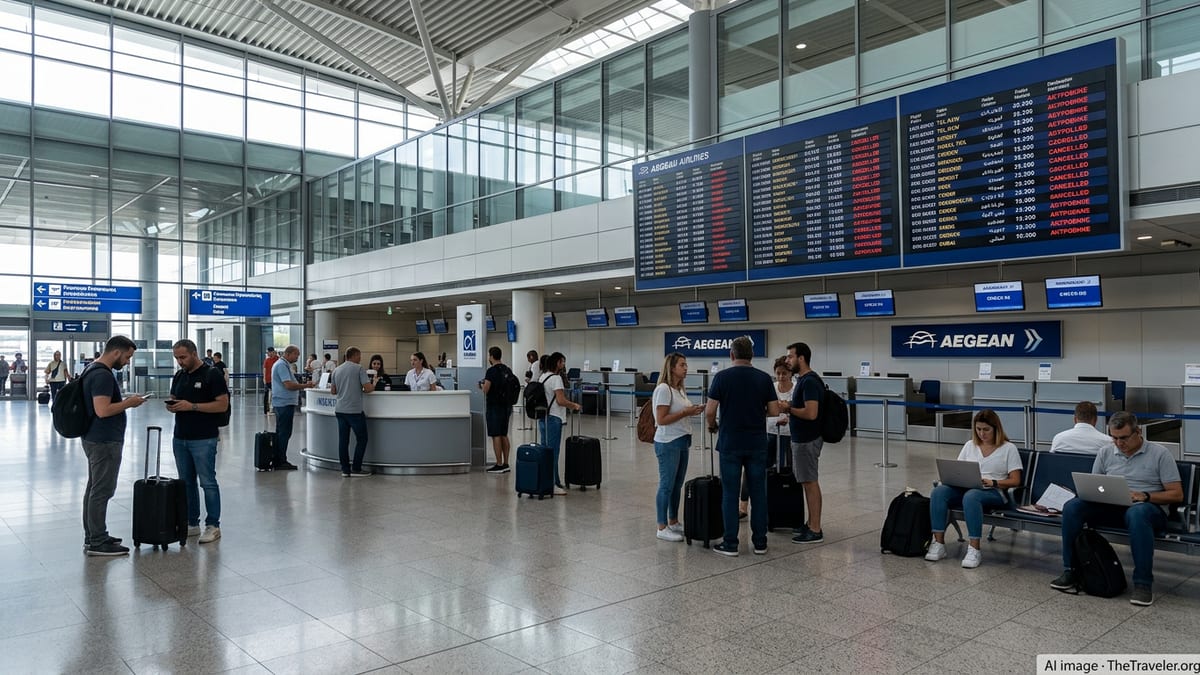
Extended Cancellations Across Key Middle East Routes
Aegean Airlines has announced additional cancellations affecting services to and from Israel, Iraq, Lebanon, the United Arab Emirates and Saudi Arabia, in response to the deteriorating security environment and airspace restrictions across the region. The latest update, issued in early March, confirms that flights to Tel Aviv, Erbil, Baghdad, Beirut, Dubai and Abu Dhabi will remain suspended or severely curtailed through late March and into early April, disrupting both point to point traffic and onward connections via Athens.
According to the carrier’s advisory, passengers holding tickets to and from Riyadh for travel between 14 and 20 March, Tel Aviv and Dubai from 21 March to 1 April, and Erbil, Baghdad and Beirut from 26 March to 1 April are being offered flexibility to rebook or postpone. Travelers can either change their tickets without a rebooking fee for travel up to 30 April 2026 or opt to cancel and receive a credit voucher, reflecting the airline’s expectation that instability could continue to affect operations in the short term.
The move comes on top of earlier cancellations that began in late February as joint United States and Israeli strikes on Iran triggered retaliatory attacks and led several Middle Eastern states to restrict or close portions of their airspace. For Aegean, whose Middle East routes had become an important pillar of its network in recent years, the rolling suspensions represent a significant operational adjustment at the outset of the busy Easter travel period.
Industry analysts note that Aegean is not alone in retrenching from the region, but the timing is particularly sensitive for a carrier so closely tied to Greece’s tourism economy. With demand traditionally rising from late March, the loss of connectivity to high spending markets in Israel and the Gulf threatens to erode some of the gains made during Greece’s post pandemic tourism rebound.
Knock-on Effects for Greek Tourism and Regional Gateways
Greek tourism officials and hoteliers are watching the situation with growing concern as cancellations mount across the wider Middle East. Consultancy data already point to weakening perceptions of security in several regional destinations and a collapse in bookings on key Middle East routes, even as demand shifts toward perceived safe havens such as Greece, Italy and Portugal. For Greek operators, that shift is a mixed blessing: while Greece may benefit from travelers abandoning more volatile destinations, the loss of direct airlift from Israel, the Gulf and Iraq risks trimming overall arrivals and spending.
Resort areas such as Crete and the South Aegean, which have worked in recent years to diversify beyond traditional European markets by courting visitors from Israel and the Gulf, now face a more fragile outlook for the early season. Local tourism associations on Crete have described a wait and see posture, noting that while core European bookings remain solid, uncertainty around regional air links and transit hubs is complicating planning for tour operators and hotels that had banked on growing Middle Eastern demand.
The disruption is also being felt at regional airports that serve as important connectors between the Middle East and Europe. In Beirut, widespread cancellations by multiple carriers in recent days have produced chaotic scenes and stranded passengers, underlining how quickly regional aviation networks can fray when conflict escalates. Aegean’s own suspension of Beirut services removes another link between Lebanon and Europe at a time when travelers are scrambling for alternative routings.
For Athens International Airport, which has been one of Europe’s growth leaders and a key transfer point between the Middle East and Europe, the current wave of cancellations could temporarily dent transit traffic. While overall passenger volumes are still supported by strong European and North American demand, the absence of multiple daily services from Tel Aviv and Gulf cities will likely be visible in spring traffic figures if the crisis drags on.
Travelers Face Rerouting, Longer Journeys and Complex Itineraries
For individual travelers, Aegean’s extended suspensions translate into last minute changes, longer journeys and mounting uncertainty. Many passengers bound for Greece from Israel, Iraq or Lebanon typically rely on direct Aegean flights or one stop connections via Athens. With those options curtailed, they are being forced to piece together itineraries through alternative hubs in Europe or to defer their trips entirely.
Broader regional disruptions are compounding the problem. Airlines across the Middle East and beyond are diverting flights around conflict zones, adding hours of flying time and significantly increasing fuel burn on Europe Asia routes. As airspace restrictions tighten around Iran, Iraq, Jordan and parts of the Gulf, routings that once connected quickly through hubs like Dubai, Doha or Abu Dhabi now face schedule instability, tighter capacity and sharply higher fares during peak periods.
Aegean’s waiver policies provide some cushion, allowing passengers to rebook without change fees or accept vouchers for travel later in the year. Travel agents in Greece say the most common strategy among their clients is to postpone trips originally planned for March and April to later in the summer, when they hope that regional airspace will stabilize and airlines will restore at least a portion of their Middle East schedules.
Still, some itineraries are proving hard to salvage. Business travelers needing to shuttle between Athens and Tel Aviv or Gulf financial centers face particular challenges, as alternative routings often involve multiple stops and overnight layovers. For the high end leisure segment, including yacht charters and luxury island stays that had seen growing demand from Gulf and Israeli clientele, the disruptions are already leading to cancellations and re negotiations of group bookings.
Airlines and Tourism Stakeholders Adjust Strategies
Aegean and other Greek travel stakeholders are now recalibrating plans for the 2026 season. The airline had invested heavily in expanding its international network, leveraging Greece’s tourism momentum and new partnerships in the broader Eastern Mediterranean. With Middle East routes suddenly constrained, capacity is likely to be redeployed to more stable European markets and selective long haul codeshare connections where demand remains robust.
Greek hoteliers and tourism associations are simultaneously intensifying efforts to attract visitors from core European markets and North America, seeking to offset potential losses from Israel and the Gulf. Early booking data suggest that demand from Germany, the United Kingdom and the United States remains strong, offering a buffer if Middle East arrivals lag. However, hoteliers warn that high spending guests from Israel and Gulf states, who often book premium rooms and suites, will be harder to replace one for one.
In parallel, cruise and ferry operators that link Greek ports with the Eastern Mediterranean are reviewing itineraries in light of the Iran war and the closure of critical maritime chokepoints. Several cruise lines have already cancelled or curtailed calls to ports in the Gulf and eastern Mediterranean, while repositioning vessels to the central and western Mediterranean, with Greece vying to capture some of that displaced capacity.
Despite the turbulence, Greek tourism officials continue to emphasize the country’s relative safety and stability compared with other parts of the region. They argue that Greece’s position on the edge of the conflict zone, coupled with strong demand from diversified markets, will allow the sector to weather a temporary downturn in Middle East arrivals. Much, however, will depend on how long Aegean and other airlines feel compelled to keep their Middle East flights on hold.
Outlook: A Delicate Balance Between Risk and Opportunity
The coming weeks will be critical in determining whether Aegean’s Middle East cancellations become a short lived precaution or a more prolonged retrenchment. If hostilities ease and airspace restrictions are gradually lifted, the airline could begin restoring select services to Tel Aviv, Beirut and Gulf destinations in time for the high summer season, salvaging a portion of its planned regional growth.
If the conflict escalates or drags on, however, the impact on tourism flows could deepen. Greek islands that had invested in marketing to Israeli and Gulf visitors might see a softer early season, while urban destinations such as Athens and Thessaloniki could experience a dip in conference and business travel tied to Middle Eastern partners. In that scenario, the resilience of core European and North American markets will be even more crucial in sustaining Greece’s record breaking visitor numbers.
For now, travel industry insiders in Greece are counseling flexibility. Tour operators are revising contracts, hotels are adjusting minimum stay requirements and pricing strategies, and airlines are scrutinizing daily booking trends to decide where to deploy scarce aircraft. Passengers, for their part, are urged to monitor their reservations closely, stay in contact with airlines or agents, and consider alternative travel dates or routings if they are booked on affected Middle East sectors.
As the Iran war keeps regional skies unsettled, Aegean’s cautious approach underscores the delicate balance airlines must strike between maintaining vital connectivity and safeguarding operations and passengers. For Greece, a country whose modern economy is deeply entwined with tourism and aviation, the outcome of that balancing act in the Middle East will help shape the contours of the 2026 travel season.