

More news on this day
Aegean Airlines has reported a 5 percent rise in annual revenue and a 6 percent increase in passenger traffic for 2025, underscoring both the carrier’s resilience and the continued expansion of Greece’s tourism sector in a more competitive European aviation landscape.
Get the latest news straight to your inbox!
Solid 2025 Financial Performance Underpins Growth Story
According to the airline’s latest full-year disclosures, Aegean’s consolidated revenue for 2025 advanced by roughly 5 percent compared with 2024, reaching a new high on the back of robust demand for travel to and from Greece. Publicly available figures indicate that operating profitability also strengthened, with earnings before tax and net profit rising at a faster pace than revenue as costs were managed despite higher regulatory and environmental charges.
The 5 percent top-line gain was closely aligned with the increase in flown passengers, highlighting that growth was driven primarily by higher volumes rather than aggressive fare inflation. Analysts following the carrier note that this balance helps maintain competitiveness against larger European rivals while still supporting investment in fleet renewal, digital services, and network development.
Industry coverage points out that Aegean ended 2025 with a strong liquidity position, including a sizable cash and financial investment buffer. The company has also continued to reduce debt, including the full repayment of a bond issued in 2019, which is seen as improving financial flexibility should market conditions worsen or new strategic opportunities arise.
Passenger Numbers Climb as Greece Extends Tourism Season
For 2025, Aegean carried approximately 17.3 million passengers, up about 6 percent from the previous year, adding nearly one million travelers to its network. The growth came on top of record volumes in 2024, when the airline transported 16.3 million passengers and had already surpassed pre-pandemic levels of activity. The sustained expansion underlines the resilience of demand for Greek destinations even as parts of Europe faced slower economic growth and higher living costs.
Traffic data for the first months of 2025 showed a particularly dynamic start to the year, with passenger numbers in January and February already surpassing the same period a year earlier. This early momentum helped set the tone for another strong high season, supported by increased seat capacity and a broader mix of both leisure and visiting-friends-and-relatives travel.
The passenger growth is closely tied to Greece’s strategy of stretching the tourism season beyond the traditional summer peak. Increasing numbers of visitors are choosing spring and autumn for trips to Athens, the islands, and regional cities, while domestic travelers are making greater use of the airline for business and weekend breaks. This has allowed Aegean to better utilize its fleet throughout the year and reduce the extreme seasonality that has historically challenged Mediterranean carriers.
Network Expansion Strengthens Greece’s Connectivity
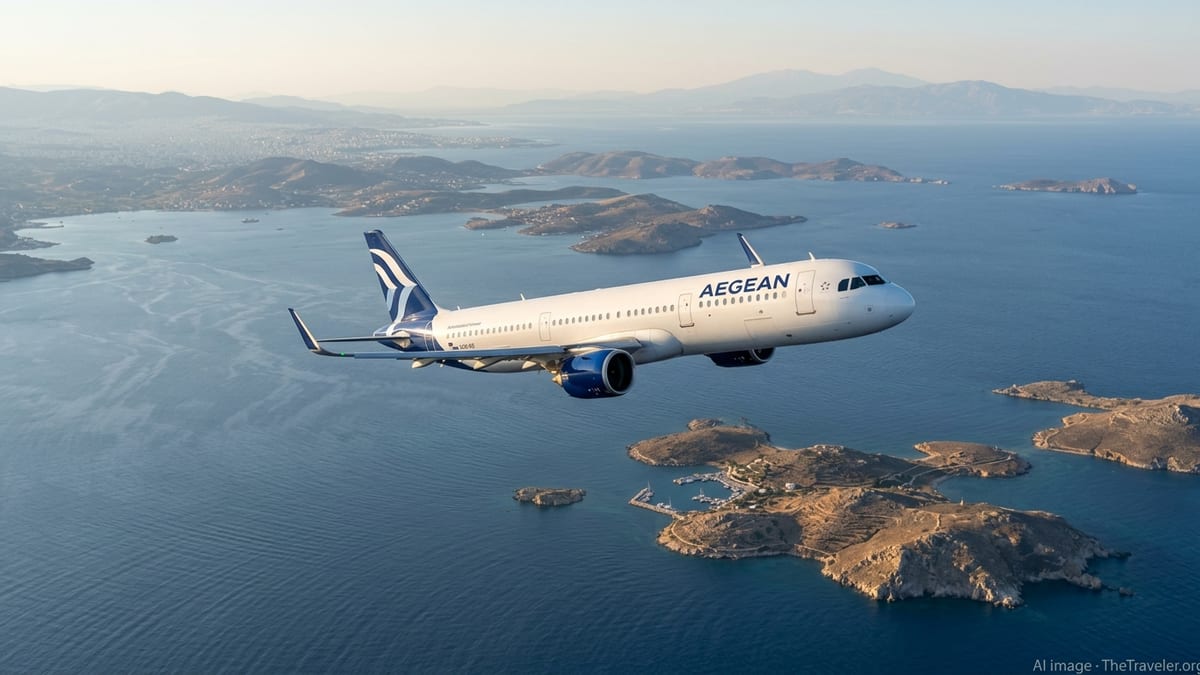
The airline’s 2025 performance was underpinned by continued network expansion, with new routes and increased frequencies to both established and emerging markets. Over the year, Aegean added more Airbus A320 and A321neo aircraft to its fleet, enabling it to offer additional capacity while benefiting from improved fuel efficiency and lower emissions per seat.
Publicly available announcements detail how the company further reinforced Athens as a regional hub, adding more connections from the Greek capital to major European cities and selectively re-entering or upgrading routes in the Middle East and North Africa. Secondary hubs such as Thessaloniki and Heraklion also saw targeted growth, improving direct access to popular islands and regional centers without the need to connect through Athens.
This strategy has helped distribute visitor flows more evenly across the country, easing pressure on the busiest gateways while supporting lesser-known destinations. By aligning capacity with tourism development initiatives, Aegean has positioned itself as a central connector between Greece’s islands, its mainland cities, and key source markets in Europe and beyond.
Tourism Sector Resilience in a Challenging European Market
Aegean’s 2025 results come against a backdrop of mixed conditions for European aviation, with carriers facing higher fuel costs, rising environmental compliance expenses, and ongoing air traffic control disruptions. Despite these pressures, Greece’s tourism sector has continued to outperform many peers, with travel receipts and international arrivals remaining on a positive trajectory.
Reports on the broader market indicate that increased airline capacity into Greece, including from low-cost competitors, has intensified competition on key routes. Even so, Aegean maintained growth in both passengers and revenue, suggesting that its hybrid model of full-service offerings, strong regional connectivity, and embedded loyalty program continues to resonate with travelers.
The airline’s performance also reflects the diversification of Greece’s tourism base. Demand is no longer driven solely by traditional summer holidaymakers from a handful of European countries, but also by city-break visitors, conference and events traffic, and long-haul travelers connecting via major European hubs. This broader mix has helped smooth out fluctuations and supports more stable year-round operations.
Outlook: Continued Investment and Focus on Quality Travel
Looking ahead, Aegean’s published guidance and recent communications point to further selective growth in 2026, with continued deliveries of next-generation aircraft and incremental capacity increases on high-performing routes. The airline is expected to keep fine-tuning its schedule to address persistent delays in European airspace and to make better use of off-peak hours, particularly in congested airports.
At the same time, industry observers anticipate continued investment in the passenger experience, from digital booking and disruption-management tools to upgraded onboard services and partnerships with tourism stakeholders across Greece. The goal is to position air travel not just as a means of transportation, but as an integral part of the country’s tourism value proposition.
With a 5 percent rise in revenue and 6 percent growth in passengers in 2025, Aegean Airlines has reinforced its role as a key driver of Greece’s tourism expansion. As long as demand for authentic, diversified travel experiences in the country remains strong, the carrier appears well placed to translate that interest into sustainable growth while navigating the operational and environmental challenges facing the wider aviation industry.